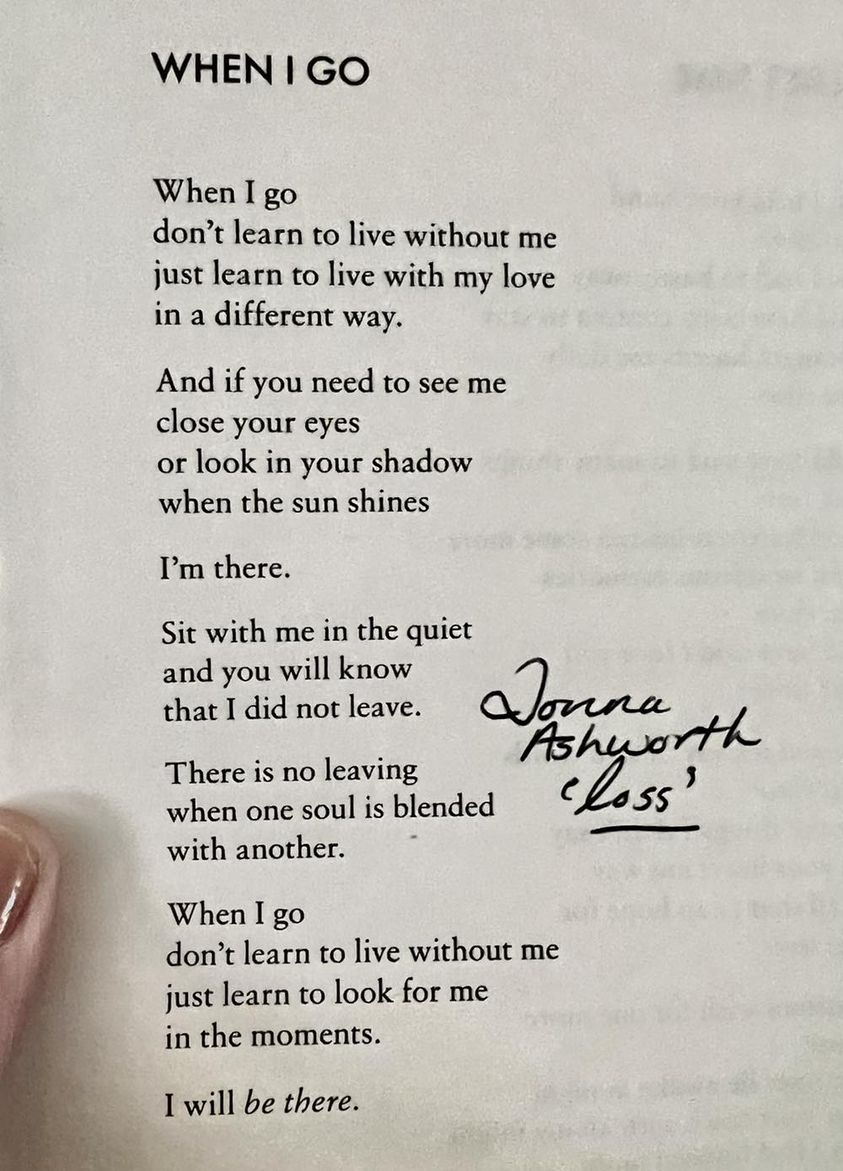
“When I Go”

From _Loss_ by Donna Ashworth

After Friend and I talked about her BEAST lawyer last week, somehow we got to thinking about being at peace with death. I told her I’m okay with it–if it were my time tomorrow, I could accept it. She confirmed that my declaration did not feel delusional or arrogant. I have no intention of dying, and I would not want it or like it, but I would have few regrets, I think. Let me be clear: I would certainly regret any pain and suffering that my death might cause my loved ones. But maybe knowing that I’m at peace with my own mortality would help mitigate their pain? In Being Mortal, Atul Gawande tells us that if the person whose life is ending is at peace (it’s redundant, but there isn’t really another expression for it, is there?) with their own end, then their loved ones are far less likely to experience depression and prolonged grief after their death. This is what I wish for my people. I can go first, literally and figuratively.

A few years ago, another dear friend announced his retirement after nearly 30 years with his company, many of them in leadership roles. His LinkedIn page filled with gushing expressions of gratitude and admiration. I thought about him all day, and wrote him spontaneously in the evening:

…And what will the organization and its people be/feel like without you? 

When my kids were little I used to be afraid to die.  I was afraid they would forget me, and that I would not have a chance to pass down my core values, to have a hand in helping them become excellent people.  But then I realized that as long as I am here, I am the one responsible for that, so nobody else thinks to do it for me.  But if I died, and if I lived well, then people would take what they loved best about me and sustain it for my kids in my place.  If I were successful in building the village around them, then they would not be dependent on me alone to get what I most wanted them to get.  

So now I don’t worry so much about it–partly because they are older and I have had time to instill some things, both by example and by teaching.  But also because I trust that my own circle will enclose them and nurture them if/when they are needed.  That reminds me, maybe I should remind and thank my circle for doing that. 😄

Today I have even more confidence. The kids are three years older, their complex adolescent personality formation accelerating. I see my imprints deepen, for better or worse, and we have reflected together how they see my influence in their attitudes and expressions. We agree to help one another identify and manage our respective deficits. The tribe is still strong and willing, and I have hopefully been more explicit about my gratitude and aspirations. But really I just trust Son and Daughter to keep me with them, alive or dead, near or far, like Ashworth’s poem says.

I wrote my 30 ethical earworms for posterity last year, saved now among 504 total posts on this blog so far. If they read one a week starting if I died today, that’s almost 10 more years of me in their mind’s ear. They will continue to become who they are, and find the places where I fit, to carry me most comfortably and usefully.

On the path of life, we leave pieces of ourselves all along the way, accumulated and spread among our relationships. What do we do when our loved ones die? We honor them by nurturing, strenthening, and cultivating those parts of them that live within us, more intentionally and meaningfully than when we had them physically with us.

So it’s a Peace & Mortality Mindset of living, I suppose. Try to not take any day, any moment, with any person, for granted. Take advantage of any and all opportunities to connect in meaning and love. Act with reckless abandon on any and all impulses of empathy, kindness, generosity, and compassion. None of us knows when the end will meet us or those we love. What can we do today to make any of it just a little less painful?

Let’s get on it, ya?

What Are We Doing?

On this day in 2013, Karl Pierson walked into my high school with a shotgun. When approached by classmate Claire Davis, who asked, “Oh my gosh, Karl, what are you doing?” he shot her. She died 8 days later.

At her memorial on New Year’s Day, 2014, her dad Michael Davis said:

“We can all realize Claire’s last words in our own lives by asking ourselves, in those times when we are less than loving, ‘Gosh, what am I doing?’ … Unchecked anger and rage can lead to hatred, and unchecked hatred can lead to tragedy, blindness and a loss of humanity. The last thing Desiree and I would want is to perpetuate this anger and rage and hatred in connection with Claire. Claire would also not want this.”

Follow the link to read about the light that was Claire, who shone for 17 short years, and how she brightened the lives she touched.

I ran around all day today, forgetting this anniversary. I got to see a friend for coffee and talk leadership, culture, and honest appreciation. I got to run errands, buy things, enjoy an excellent salad while finishing romance audiobook #62, pick up Daughter from school, cook dinner, and now sit at my laptop to reflect and share my thoughts. Claire will never get to do these things, the things I take for granted.

She will never again sit in traffic, hearing people honking loudly in frustrated powerlessness. She will never now witness people actually getting out of their cars to confront each other on the street when one of them makes a wrong turn. She is not here to see first hand the rapid demise of her fellow humans, sliding ever faster and forcefully into grief, rage, violence, and hatred.

Seriously, what are we doing? Is everybody just walking around with a giant can of gasoline, looking to douse random embers and light wildfires, just to watch them burn? What are we feeling that makes us behave like (believe?) everybody we meet is the enemy? I am convinced that people who lash out, even in the most violent ways, are not fundamentally evil. I think we generally treat one another pretty well when we feel good ourselves. For so many, though, whose reasons for feeling pretty terrible are cumulative and compounding right now, I can see how unregulated negative emotions explode at any provocation. I can validate the emotion without condoning destructive behavior, and hold folks accountable to natural consequences. And let’s be clear, all of us do this sometimes, to varying degrees, under stress. Hopefully we can recognize in time to repair, in most cases.

Better to prevent, though–illness, disease, relationship rupture, and social destruction alike.

For myself, I commit to practicing, however imperfectly, one deep breath at a time. Before speaking. Before honking. Before entering a patient room. Before replying to an email or social media post. Before snark. I will go to bed earlier, drink less coffee, eat more plants. I will move my body regularly. I will look for stories of people helping each other and share them generously. I will practice gratitude and presence, humility and curiosity. And I will connect deeply and unabashedly with the people who do the same, so we may hold one another up.

We can ask, and then act, when we answer the question, “What would LOVE do?”

And maybe let some music lift us, too. “Forever Young” by The Tenors helps me tonight.

Whose BEAST Are You?

I feel protective. My friend has embarked on a necessary lawsuit to address wrongs done to her by someone she trusted. Generally I shun litigation as a means of conflict resolution, and I understand that in some cases it is the best path to justice. My friend shares this ethos, and has so chosen a like-minded lawyer. Her opponent has a very different mindset, one of fierce aggression and, sadly, meanness. In talking with Friend, we both feel her vulnerability, the risk of getting steamrolled in her efforts to be fair and equanimatous, even in the face of intense acrimony. She wonders if her lawyer (and she herself, maybe?) can withstand the vitriol flung their way without 1) returning in kind and/or 2) acquiescing simply to get through.

Over breakfast, I tried to articulate what she needed in her lawyer, and wrote it to her later in an email, so she would have it to mull over and expound on. What follows below is a lightly edited version of my message to her, and some reflections of my own after writing it. I love how talking and writing bring me so quickly and effectively to new insights and syntheses of ideas, core values, and resolutions. Onward, my friends!


I get (and validate!) that you sought a lawyer who is “not a fighter”… and you also need an effective advocate. Not adversarial for sure, but assertive and strong.

Like a quiet, confident alpha—tall and straight, with commanding posture–someone who knows they can own the opponent if they want to, but feels secure enough to not need to flaunt it.

So there is a degree of BADASSERY required here too:  You need someone SMART, and SHARP.

Looking for a metaphor here… Not sure why I gravitate toward vehicles—Bullet train? Mack truck? Snowplow? Maybe because the process is necessarily movement, transportation is required, and there is a destination, the path to which presents multiple and formidable barriers?

The BEAST: The US presidential Cadillac—that is your ideal ride to the other side of the lawsuit (over the bridge? Through the morass?)!

Big, black, heavy, SOLID.  GROUNDED and MOBILE at the same time.

Heavily armored–DEFENDED and SAFE, but not weaponized (I think).

Moves with purpose and agenda, no wasted fuel or frivolous trips.

People see it coming and move out of the way with respect.

And if attacked, the cargo–you and your interests–are protected.

Can plow through traffic if absolutely necessary, but only does so as a last resort:

Move or I will move you, make no mistake.

Try me.


Strong back, soft front. Steel spine. Claws and horns only when needed.

Strong and effective, non-adversarial, yet energized advocate. I’m thinking parent, friend, sibling, physician, adult child of aging parent, activist.

BEAST. I can be yours if needed, count on it.