
Strong and Soft: Integrating Our Masculine and Feminine Selves

How do you see and experience your masculine and feminine sides?
Consider your strengths and vulnerabilities–how do you relate them, if at all, to gendered aspects of your personality, behavior, and biases? How would others answer these questions about you?

I’ve thought about this idea sporadically for many years, from writing my residency application essay to interacting with fellow physicians in different specialities, to caring for patients in corporate leadership roles grappling with gender stereotypes and biases. It’s complex and fascinating, intuitive and also worth parsing intellectually. The language can be so charged that having a truly open and curious, non-judgmental and exploratory conversation about it is often challenging. Many thanks to my friends who engage and exchange with me so willingly and generously.

This post will live in the questions more than seek answers. I intend to describe and explore, and invite you to do the same. As I consider what to include here, I feel open, calm, welcoming, warm and giddy with potential connection. I wish for a convening, not just of people–readers of this blog–but of the diverse aspects within any one of us. I hold space for fluid and dynamic integration, for easy flow of energy in an infinite, three-dimensional loop of experience that adapts to context, needs, and goals for individuals and collectives alike.

Does this description feel feminine to you? It does to me, and it aligns with how feminine, or yin 陰 energy is often described. The other night as I discussed non-adversarial advocacy with dear friends, I felt the energy of proactivity, purpose, mission, and leadership–what many would align with masculine, or yang 陽 traits. When I think of me at my best, I strive for ‘Strong Back, Soft Front,” integrating these apparently opposing or dissonant vibrations into something coherent, adaptive, and beneficial for myself, my relationships and my contributions to spaces I inhabit.
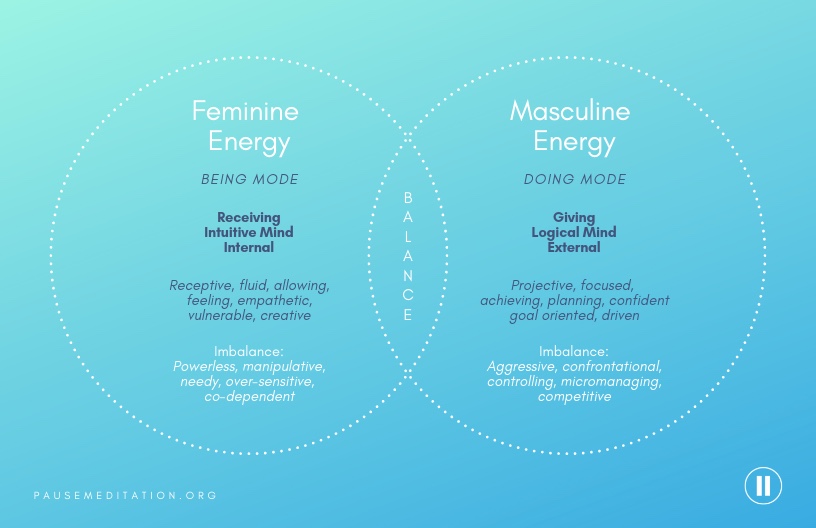
From PauseMeditation.org

If we define masculine and feminine as ‘energies,’ then I think we can agree that all humans, regardless of gender, possess both. They manifest in infinite combinations depending on myriad factors. Both energies serve us, and their healthy integration elevates our relationships and effectiveness exponentially, compared to when they are imbalanced.

In the graphic above, add ‘dominating,’ ‘homophobic,’ and ‘misogynist’, and ‘hyper-‘ to ‘competitive’ on the list of words describing Masculine Imbalance. Consider both men and women who exhibit these traits, yourself included, and the contexts in which they occur. In my residency essay I explicitly stated my awareness of medicine as a male-dominated profession, and that I wanted to avoid exhibiting negative male traits as I navigated my career, while also standing up for my own beliefs and ideas. I also intended not to let my naturally caring and agreeable nature be taken advantage of.
Now look at the descriptors of Feminine Imbalance, and think of when/where in your life you observe these traits in yourself and others. If we are honest, I think we can recognize parts of ourselves in all of these words, in certain contexts and relationships.

These traits and their integration are especially important to me in leadership. The best leaders do the inner work to integrate both receptive and assertive, nurturing and directive, caring and accountable, soft and strong aspects of themselves, so they may manifest all of it in cohesive and holistic presence for the benefit of all. These leaders are both attuned (feminine) and differentiated (masculine): They sense the emotions and needs of those they lead and still maintain focus and direction to move us together from the front. For an excellent discussion of an example from fiction, watch Cinema Therapy’s episode, Aragorn vs. Toxic Masculinity. It’s an excellent twenty minutes to spend.

From Verywell Mind, “How to Harness Yin and Yang for Mental Peace and Clarity“, which I also recommend reading:

“What Are Yin and Yang?

“These forces are complementary and present in all phenomena. In some situations, one force might be more dominant. However, this balance may shift depending on what is needed at the given moment.

  • Yin: Yin is characterized as negative, passive, and feminine. It represents the energy of the Earth and moon. It is often described as receptive, dark, cool, soft, still, and contemplative.  
  • Yang“: Yang is portrayed as positive, active, and masculine. It represents the energy of the sun. It is often described as energetic, expansive, and warm.

“It is important to remember that while the yin and yang (are) opposite of one another, it does not mean they are oppositional or in conflict. Instead, they can be thought of as balancing energies that complement one another.”

Where do our masculine and feminine traits and presence serve us well? Where are they a liability? How is this a function of how we balance (or don’t) the energies we manifest? When I need to stand firm and call BS, I can do it lovingly, from a place of caring–attuned differentiation–balanced masculinity. This is different from and related to differentiated attunement, where I am open and receptive to others while also maintaining my own separate, independent identity–balanced femininity.

Whether we describe these energies, traits, and tendencies as masculine/feminine, yin/yang, or in other terms altogether, my wish is for us all to be more aware of and intentional about the energies we maintain, emit, and absorb from one another. I wish for us to practice Strong Back, Soft Front. May we all Attune and Differentiate. Consider thinking Both AND when presented with any dichotomy. Integrate the polarities, seek the win-win.

I intend to write more about masculine/feminine, male/female dynamic and relationship. It’s so interesting and also fraught; I look forward to the challenge of expressing the nuances and complexities clearly and invitingly. Let’s see how it goes!

Happy Sunday, all.

Own Your Awesomeness, For All Our Sakes

Our deepest fear is not that we are inadequate. Our deepest fear is that we are powerful beyond measure. It is our light, not our darkness that most frightens us. We ask ourselves, ‘Who am I to be brilliant, gorgeous, talented, fabulous?’ Actually, who are you not to be? You are a child of God. Your playing small does not serve the world. There is nothing enlightened about shrinking so that other people won’t feel insecure around you. We are all meant to shine, as children do. We were born to make manifest the glory of God that is within us. It’s not just in some of us; it’s in everyone. And as we let our own light shine, we unconsciously give other people permission to do the same. As we are liberated from our own fear, our presence automatically liberates others.

Marianne Williamson, A Return to Love: Reflections on the Principles of “A Course in Miracles”

My dear darling friends, and you know who you are:

Please receive, accept, internalize and integrate the affirmations, admiration, adulation, and love offered in earnest by others.  Know and trust wholeheartedly in your complete and total worth, just by virtue of your existence, before anything you think, say, or do.  And when we express how wonderful you are for the latter, how you impact and contribute your awesomeness to the world and make all our lives better, take a deep breath, relax a little more into openness, and let it in.  Allow the full truth of your value as a member of humanity to seep in and saturate your being. 

I know it can be uncomfortable—what is that about, anyway?  Social conditioning?  Imposter syndrome?  Whatever the source of this resistance to being loved and lifted, I’m not sure we need to dissect it much.  We can simply practice navigating life and relationships around it, like a shapeshifting, creeping haze that seeks to thwart our full thriving.  Maybe we can even think of it as a game, a clever adversary to be parried with childlike agility and joy, like Peter Pan with Captain Hook.

You have told me you understand in your thinking mind that accepting others’ praise is the ‘right’ thing to do, that dismissing it hurts people’s feelings.  Thus your conflict and ambivalence create a niggling internal distress:  You sense the love, know it’s valid, and want to accept it—to complete that circuit of connection.  But something holds you back from opening fully to the reflection of your own light back onto you, your spirit, your soul.  You may feel guilty for how your denial, earnest and humble as it may be, makes others feel rejected.  Maybe that guilt turns back onto you, as if to say, “See?  You make others feel bad, so of course you’re not worthy of praise.”  How fascinating, this delusional, circular, self-fulfilling prophecy!  How can we break it? 

Alton Brown has described hospitality as what I take to be a reciprocal act of connection.  Receiving another’s offering is not just about making yourself or them feel good.  It’s about strengthening relationships.  Offering and accepting connection weaves and tightens our social fabric, moving the needles of words and actions back and forth, over and under, honoring our bonds in vibrant color and dense texture.  How wonderful.

What if we all owned our awesomeness and power to connect, uplift, and shine, from within ourselves onto, and in reflection of, one another?  What if we all sought first the light in ourselves and others, focused on meeting each other shining that light in front, then refracting in reciprocity out onto the world?  Wow, maybe that’s why we’re afraid—it’s a lot of light, like gazing into the sun.  But that’s what cool shades are for, no?

So, how can we do this?  What practices will make a difference?  My nascent ideas:

  1. Breathe deeply and slowly.
  2. Get still.
  3. Recall self-love and self-compassion—its words, images, tactile and visceral sensations, and the people and environments with whom and in which we have felt them deeply and unassailably.
  4. Connect—to those who matter most and uplift us genuinely, those who can sit with our confessions of discomfort and resistance to praise and patiently, lovingly hold the light for us to step into, one toe at a time.
  5. Lift others: Act bravely and joyfully on impulses to acknowledge, validate, admire, praise, and otherwise amplify their light.  Any small word or act counts, even the awkward and stuttering ones.  People can sense our sincerity and appreciate it.  When you shine your light, then feel it fully accepted and radiated back by another in a smile, taller posture, or simply knowing you made their day better, what happens for you? 
    Soak that up; amplify that.

I know many of you know all this already.  I know many who practice and model the skills of receiving graciously, openly, humbly, and lovingly, leading us all by example.  But we all have moments of self-doubt, or even longer periods of self-disbelief, when we perceive our own light to have dimmed.  Perhaps this is precisely when we need to open ourselves to receive the light we have consistently shone on others reflected back on us.  Hmmm.

Thank you to the people who inspired this post—creators, carers, artists and just straight up wonderful humans I have the pleasure and privilege to connect with and know.  May you all know how much you are loved.  When you need reassurance and validation, may you be still and find it within yourselves, and may you reach out early and often to those of us who stand ready to recharge you.  Plug into that power grid of connection, participate in that alternating current, so we may all carry the spark of love and relationship that saves us. 

We each have a bright and unique light.  There is no ‘too much.’   Shine on, my friends.

Start Where It’s Safe; Make It Safe For Each Other

When and where is it safe for you to disagree strongly and still maintain healthy relationship?

My friend and I had a brief text exchange recently.
Me: “…I wonder when they will start profiling East Asians on the street. My kids and I all live in target cities. It’s less and less safe to be non-white.”
Friend: “You’re citizens; no need to worry.”
Me: “Citizens have been picked up and detained already. Lots to worry about on many fronts. Please do not dismiss people’s concerns, even if you don’t share them. They are not all unfounded.”

Our friendship has developed over a couple of years, accelerating and deepening this year around and through mutually respectful and unreserved political discourse. This thread occurred spontaneously last week. I felt safe to express my fears as well as my reaction to his response. I know he did not mean to dismiss my feelings; he knew that my response was meant to uphold mutual accountability rather than incite shame. Our relationship is now strong and trusting enough for us to be bluntly, caringly honest. We caught up on the phone today and reaffirmed that respect and trust, that bond of platonic love that transends difference even as we embrace and grapple with it. I cannot wait to sit down over lunch and explore each other’s perspectives again soon.

This summer I gave a series of wellness presentations to a global professional firm. Over five Zoom sessions we explored self-awareness and -regulation, open and honest communication, generational differences, variables of diversity, psychological safety, authenticity, leadership, and culture. I did my best to leave an impression and aspiration of empathy, compassion, and accountability in action and relationship, to be cultivated intentionally, both individually and collectively, in the year to come. In all of my conversations with the series organizers before and since, we continue to seek the attitudes, postures, resources, and practices that help a workforce engage and contribute, dissent and challenge, all in the name of elevated collaboration and excellence.

This weekend I traveled to New York City (hence this delayed post) to meet Andy “AJ” Wilson-Taylor and my fellow fans. I only knew two other attendees walking in, and was welcomed and folded into a truly unique throng of uplift and bonding. This community, led by a loving, humble, curious, generous, and kind soul, reflects and amplifies those qualities and values in spades. The brightest love and joy radiated from every person gathered; oxytocin flowed and saturated my whole being. I wondered aloud to more than a few people about the possibilities of capturing the energy of that assembly–the joy, love, shared humanity and connection–concentrating and focusing it, then aiming it to heal the wounds of the world. Members of this group, led by AJ in his unassuming and self-effacing way, have already healed themselves and one another in presence, encouragement, and steadfast mutual support through darkness and disconnection back to light and flourishing kinship.

I pondered this weekend what political discourse would look and feel like in these groups–collegial coworkers practicing interpersonal effectiveness to leverage diversity and elevate creativity and innovation, and a gathering of women brought together by shared love and admiration of a man whose purpose in their space is to ally with and elevate their personal, sexual, and social well-being.

Then yesterday Braver Angels hosted an extemporaneous gathering of leaders from bridging organizations across the country: “Dignity Over Violence: A Unified Civic Response”. I hope to have a link to the recording to share here soon. Claim hope, my friends. This movement of intentional, resilient, and empowering connection across political polarization grows stronger and tighter every year. Love can still win. Over the two hour program, at least twelve leaders both acknowledged what is and pointed to what could be. They cited words and acts of people across the political spectrum, from every demographic, that defy the loudly skewed rhetoric of extremes. In this, yet another mission-driven gathering, I felt an unwavering commitment to mutual understanding and connection, to humility, curiosity, empathy, generosity, and accountability.

“When you hear something triggering, take a deep breath and ask a [good, open and honest] question. Try to understand why that person believes what they believe.” This is the first step to any exchange of true connection.

All systems of human relationship require us all to practice these skills. We cannot just rely on designated leaders to lead by example (especially since so few today do so). Each of us must take up the cause of connection and get to work; more urgently now than ever in my lifetime. But how daunting, to consider reaching across a great political chasm to connect with an adversary, real or perceived?

So after this weekend immersed in gatherings of hope and possibility, I remember that any skill must be developed and cultivated deliberately, consistently, and iteratively. As I prepared to leave the office at 8pm today, I debated briefly about doing my five minutes on the slackboard. Consistency. Commitment. Every session on the slackline, no matter how brief, is another chance to train my nervous system in sensory awareness, feedback integration, and dynamic balance. Over the course of 2.5 songs on my Spotify liked list, I had the best session to date. So too, political discource can be trained in the workplace, in a social gathering, in a family–anywhere and with anybody–by practicing humility, curiosity, empathy, generosity, kindness, and accountability in any relationship system around any topic. We all do it, but I bet we don’t think of it in these terms.

The slackboard, a Braver Angels Zoom call, an AJ’s Angels meet up, my wellness talks, and my conversations with Friend–these are all spaces where I feel safe to express my authentic self. I can challenge staid and conventional social norms, explore the possible. I practice and develop the skills that make me confident to engage in political discourse calmly and with equanimity. Come to think of it, patient encounters train me for this every day, too.

So I ask again: When and where is it safe for you to disagree strongly and still maintain healthy relationship?

Where do you already do this well? When you disagree without getting triggered, how do you show up and conduct yourself? How can you translate this mindset and behavior pattern to the more fraught and emotionally higher risk scenarios? What do you need to feel safe to try/train? Can you identify the ladder of escalating potential triggers to tackle, the way a skier progresses from green to blue to black diamond trails? Can you schedule practice sessions the way an athlete trains for a race, so you can hone the skills, see and feel yourself improving with each encounter?

How can we all make it safe for one another to practice? Like accountability partners at the gym, how can we hold each other up in this effort to save our democracy, to reconnect across polarization and mutual dehumanization, one conversation at a time?

Humility. Curiosity. Empathy. Generosity. Kindness. Accountability. Start where it’s safe and easy. Then look for the next challenge. We grow and strengthen through struggle. Environments and circumstances that feel threatening are not conducive to learning or progress. We can create and cultivate safety for effective disagreement for ourselves and one another. Take a deep breath and ask one good, open, honest question. Start there.