We Can All Relate

Happy Spring, friends!  How are you doing?  The world is still such an intense and often painful place, but somehow the warmer, lengthening days bring hope and solace.

I find myself still immersed in exploration of tribal experiences… Talking, reading, writing, thinking, connecting, reflecting, learning. What’s on my mind tonight:

Comparative Suffering Is Counterproductive

I have known about abusive and violent acts against Asian Americans since the beginning of the pandemic.  I have felt increasingly self-conscious about my Asian-ness for the past five years—more so than at any time since elementary school.  So it was somewhat gratifying to see anti-Asian hate crimes get more press in recent weeks.  But even as I add my own voice to the call for awareness and action, I hesitate.  All violent acts deserve attention and reckoning.  But part of me feels sheepish ‘complaining’ when anti-Black racism feels like such a more endemic, urgent, and severe crisis.  Even as I read more articles on anti-Asian hate this week, the trial of Derek Chauvin progresses in Minnesota, and so many of us hold our breath, knowing that the outrageous possibility of acquittal is real.  But staying quiet about anti-Asian hate helps no one.  I’m part of an out-group, too, and our needs are not less important than anyone else’s.  It is precisely when we start comparing and ranking the value of one group’s suffering against others that we all lose our collective power and potential to drive positive change for all of us.  When I speak up on behalf of the AAPI community, I remember that we are ‘othered’ in different ways and with different consequences from our Black brothers and sisters, but the shared experience of white supremacy binds us together.  I will do better to point out that the empathy, education, connection, and solidarity that I want people to foster in themselves must be applied to all marginalized people, not just Asians.

Leadership Matters

Looking back at summer 2020, I wonder if I did enough to address the concerns and well-being of everyone on my team, but especially my Black coworkers.  Did I foster a psychologically safe environment where people could express their concerns and emotions?  Did I encourage enough self-awareness in thought, speech, and action?  Do I continue to do so?  As the leader, how much should I bring up anti-Asian hate, does that center myself too much?  How do I maintain a balance of attention and integrate our awareness so as to include the concerns of any and all who feel oppressed?  As I face outward to encourage system leaders to speak out, have I done enough on my own team to connect with my AAPI and Black colleagues in support?  How will I know I’m doing enough?  In the end I submit to the assessment of those I lead.  I can solicit feedback and accept it with humility and honesty.  And if I falter, I can ask that people look not only at my impact, but also at my earnest intentions to cultivate connection between us all, and keep doing my best as I learn from mistakes.  I can also continually work with fellow leaders to develop initiatives to improve diversity, equity, and inclusion—to hold us accountable to tangible results, and not just give lip service.

We Can All Relate

How are you “othered”?  I mean based on the tribes in which you claim membership, or certain personal traits, how can you be identified and ostracized by others?  Consider a scenario:  White woman verbally attacks elderly Black man with racist slur.  He retaliates by fat shaming her.  We all have our vulnerable parts, those things we fear being called out and held against us, that we cannot necessarily control.  Even members of the dominant culture have them, though they may or may not be as readily visible as race, gender, or ethnicity.  The fears and anxieties we carry around these soft spots cause varying degrees of personal and collective suffering and social consequence.  When we dig deep and recognize our own vulnerabilities reflected in others, then we can truly relate to all who suffer, and we are moved to act on their behalf—because advocating for one of us is advocating for us all.

I finished watching the PBS series “Asian Americans” (which PBS has apparently made free for streaming since the Atlanta shootings) this weekend, which I highly recommend.  From it I learned how Asians and other marginalized groups have come together in American history to advocate for one another.  Filipino and Mexican farm workers formed the United Farm Workers in 1965.  Asian, Latinx and Black students at San Francisco State University joined together and succeeded in creating America’s first ever ethnic studies program in 1968.  Jesse Jackson spoke out on behalf of Asian Americans after the murder of Vincent Chin in 1982.  And since last summer, I’m happy to see increasing solidarity again between Asian and Black communities.  From a recent article in TIME magazine:  “’We’re not safe until all people of color are safe. Safety doesn’t come in the form of heavier policing calls or of carceral state oppression of poor communities,’ Dao-Yi Chow tells TIME. Chow, who is Chinese American, was one of the organizers of Running to Protest’s ‘Black & Asian Solidarity’ rally. ‘That’s only continuing to align ourselves with white supremacy. And if we continue to do that, those are anti-Black acts that’s only going to continue to drive divisions in between our communities,’ Chow says.”

Call to Action on the Periphery

I’m currently reading Change by Damon Centola.  Hear him discuss the central tenets with Shankar Vedantam on this episode of “Hidden Brain”.  He asserts, with evidence, that social movements and change originate in the periphery of social networks, through strong and overlapping ties.  This means that we each and all have a role to play in making the world more equal for marginalized people and groups.  It all starts with the conversations we have in our daily encounters, and the cascade effects they have on our friends’ friends, etc.  On my work team, if I’m hearing the same message of solidarity from my manager and my medical director, and then my colleague from another practice, and then my fellow committee member, then I’m more likely to accept and adopt it, and then promote it myself.  Whether or not I had a formal training or participated in some system-wide initiative, I’m influenced by those around me whom I respect and care for—and vice versa.  That is why no matter who I am, what I say and do also matters—we all lead by example. 

The journey is long and arduous.  The path winds through caves of uncertainty and adversity.

The only way out is through.  The best way through is together.
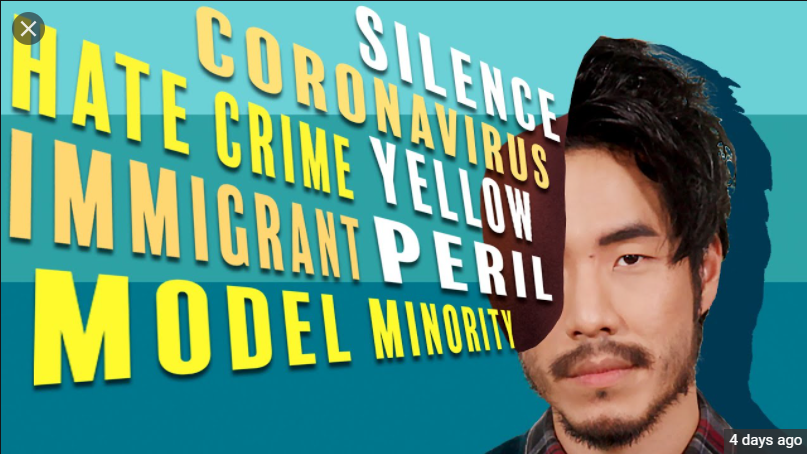
#TalkAsianHate

YouTube: Eugene Lee Yang of the Try Guys

When someone is unfriendly to you, how often do you attribute it to your race? How often does the possibility cross your mind?

Since I was a kid this has always been in the background, and it was worst in elementary school.  Second and third grade stand out:  Kids would pull the sides of their eyes up and down, chanting, “Chinese, Japanese, dirty knees,” or make fun of my name: “Ching-Chong-Cheng.”  In high school one boy in particular referred to me as “Cheng,” and always said it with a sneer.  It could have been innocent—I found him generally sarcastic and antagonistic in the most annoying way.  When I told him how it made me feel uncomfortable his demeanor changed immediately; he apologized and never did it again.  Looking back, he and his friends referred to one another by their last names, and often in that competitive, confrontational, adolescent male way.  So maybe that was actually his way of including me?  I think he harbored no specific malice, but his impact strayed far from any benign (ignorant?) intention, I think based on my own past experience.  I remember the encounter vividly, and to this day appreciate both my own courage to bring it up, and his willingness to accept the feedback and change.

I think my family and I experienced minimal direct racism as I grew up. But I have always felt self-conscious whenever bad news comes from China, like when babies were dying from melamine-tainted formula, and when thousands of dead pigs floated down a river in Shanghai. I hesitate to even mention these stories here, for fear of negative stereotypes they may incite or confirm in readers’ minds about Chinese people. We humans generalize about and denigrate groups we perceive as different from ourselves, often based on minimal information (and these days, more and more disinformation). When these events occurred I asked my friends, and they reassured me that the news was inconsequential.

Not so with coronavirus.  A close family member was verbally assaulted in the mall a year ago, by a white adolescent girl.  She just walked right up to him, two generations her senior, and started yelling, “This is all your fault!”  How entitled, how arrogant, and how brazen—to think you can just attack an elder stranger like that with no fear of consequence.  That is the privilege of membership in the dominant culture.  Hard for me not to feel defensive and alert to threat, not to mention rageful, after that. 

For the past several years, and especially the past year and the last two weeks, acute awareness of what makes me visibly different, and thus a potential target of prejudice and racism, occupies increasing space in the front of my mind.  Our family just road-tripped to Colorado and back.  Driving through the rural Midwest, I found myself thankful that Husband wore his university hospital, orthopaedic surgery logo jacket into the gas station stores.  I spent as little time inside as possible, made sure to be friendly, and felt noticeable relief every time someone smiled and treated me with kindness, or even just common courtesy. 

This hesitation–the vague and disconcerting paranoia I feel–is justified. It’s not debilitating, but I’m frustrated, annoyed, and angry about it.

* * * * *

How important is it to you that all people, including people of color, women, LGBTQ, indigenous and other marginalized groups, feel accepted and welcome, and treated with respect and dignity, everywhere they go?  How can you help?  Below are my suggestions.  I’m tired, friends.  Whatever you can do in your spheres of influence is much appreciated.

Educate yourself.  See links below to multiple articles and a very well-done video (I recommend the video most) to familiarize yourself with current and historical aspects of the Asian-American experience(s).  Talk to your Asian-American friends, if you have that kind of relationship.  But understand that they may not want to rehash their experiences just for your benefit.  Look for published stories to foster your empathy.  Then, if you can muster it, find ways to tell your friends and any other marginalized folks, “I see you.”

Seek diverse perspectives.  Asian-Americans are not a monolith.  Despite some overlapping aspects of culture, Chinese, Korean, Thai, Vietnamese, Indian, and all other groups have divergent histories in and out of the United States, and each individual in any group manifests their own unique experiences.  If you’ve met one of us, you’ve met one of us.  Resist the urge to oversimplify and overgeneralize.

Look at your own biases with self-compassion and accountability.  Biases are human.  We all have them.  It does the oppressed no more good for you to self-flagellate over yours, than if you ignored them altogether.  What matter are your awareness and self-management of your biases, and then your ability to help others do the same. 

Commit to doing the work.  This does not mean expecting perfect words and actions from yourself all the time.  We will all open mouth and insert foot; we will all fall into old habits of thought and assumption.  But we must persist; abandoning the work helps no one.  Every failure teaches us, if we let it, and this helps everybody.

Find a supportive community to hold you up and accountable in the work–friends, tribe members who love you through your struggles to reckon with yourself.  These will most often be people who have committed to doing the same work themselves.  Hold them up in return.  This is a group project; we all depend on one another to succeed.

The One and the Many

How do you change your words or message depending on your audience?

Weeks ago I read an article sharply criticizing public health messaging throughout the pandemic, and took a hard look at my own communication over the past year.  A year ago I wrote a series of posts on COVID, which were generally well received.  I have consistently taken a very conservative approach to mitigation, admonishing people to avoid gatherings and travel, mask up, and be patient.  In my public messaging, I have not directly addressed the mental, emotional, economic, and social costs of all of these measures. 

But what about in my private conversations?  How are they/am I different?

I thought of two groups with whom I interact:  Those whom I know personally, who trust me, and who think similarly to me, and those whom I don’t know, who may not trust me, and who think/believe differently from how I do.  Okay so six groups, not two—and they can overlap—I have patients who trust me and think very differently—but I think my messaging generally takes one of two approaches depending on my audience.  And in the end, I think it comes down to trust.

The One

When speaking to one person whom I know, or someone who agrees with me, two assumptions are at play: 1) they trust me, and 2) I trust that they trust me.  It sounds semantic, but I think it matters.

In this situation, I’m probably much more willing to admit uncertainty, and to ‘negotiate’ my position because I trust that my counterpart understands and respects my concerns.  So I’m willing to show vulnerability in my expertise because I trust that they know I will incorporate new information and update my recommendations.  I also trust them to know that it’s not because I’m stupid or gullible or on some kind of power trip—we’re all just learning and trying to balance everything that matters in a rock vs hard place situation.  When engaging in mutually trusting conversation, even in disagreement, openness, curiosity, and ambivalence can be taken as humility and seeking truth rather than weakness and lack of conviction, and both parties may be more likely to walk away with broader, more nuanced perspectives.  And best of all, the relationship can be strengthened, allowing for continued engagement, learning, and growth.

The Many

Posting to the blog or on Facebook, I think I run a much higher risk of being misunderstood.  I am responsible for providing clear and concise context for any expression or opinion.  My audience is diverse, and depending on any reader’s mood or context themselves, my words may be interpreted very differently one day or one moment to the next—and I have no control over that.  Do they trust me?  Can I trust them to assume my humility and good intentions?  Unclear.

In this space, depending on my mood, perhaps, I may feel defensive, and/or a deep desire to prove myself right.  I may be much less willing to admit to gaps in my knowledge or flaws in my reasoning, for fear that my expertise will be wholly discounted if one aspect of my interpretations or recommendations is imperfect.  If I assume my audience does not trust me, then I’m less likely to trust them to receive my intended message, to take my advice, and achieve my primary goals.  I get preachy, narrowing my perspective and failing to see more than my own point of view.  I ask fewer questions—that is always a red flag.  I make more assumptions, defensiveness increases, and my mind closes further.  It’s an emotional hijack of sorts, resulting in further disconnect and polarization.  Yikes.

Or maybe, just because I don’t know how my message will be perceived, I qualify and hedge, and lob ideas much more passively, inadvertently conveying that I don’t really believe what I’m saying, that I’m actually not trustworthy, just wishy-washy. 

So what should I do?

I think one solution is mindful attunement and differentiation.  As a communicator in relationship of any kind, but especially when I’m the expert, it is my responsibility to manage this dynamic polarity intentionally.  Face to face, I can make sure the other person feels seen and heard, by asking more questions, paraphrasing, reflecting their values and goals back to them.  When writing for an audience I cannot see or hear, I can respectfully acknowledge opposing opinions and their validity, before presenting my own arguments.  Above all, I can hold a larger space for everyone’s values, concerns, and objectives.  I see you.  Please see me.  What do we both care about?  What trade-offs are we willing and not willing to make to achieve our shared goals?

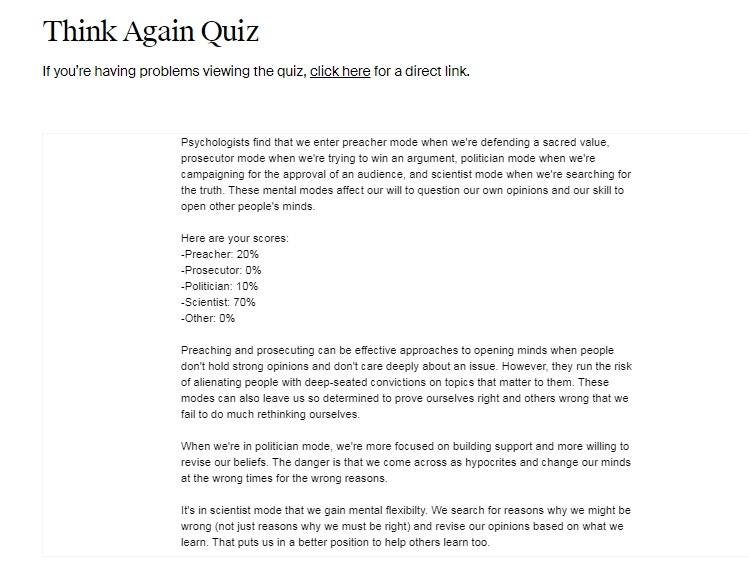
Results from my Think Again quiz, March, 2021

Adam Grant’s new book, Think Again, will be my personal and professional bible for a while, I think.  Its central tenets are intellectual humility and cognitive flexibility.  I may speak and write like a preacher about things that matter deeply to me.  But I will strive to think more like a scientist, seeking truth and connection above winning arguments and/or proving other people wrong.

In the end, as I practice myself, I will observe and apply these principles in other arenas.  Can we keep attunement and differentiation in mind when we hear leaders and politicians speak?  When a constituency is diverse, and an issue complex, can/should we expect a public figure/expression to convey nuance in generalized statements?  I say yes, absolutely.  I think we should hold leaders, as ourselves, to a much higher standard for acknowledging complexity and uncertainty.  Oversimplified sound bites divide and incite, and we should all reject them, strongly.  We can address complexity and uncertainty without inciting mass panic if our statements also clearly convey conviction to core values, and what we are for more than what we are against. 

We can all/each elevate the quality of both private and public discourse if we help one another feel connected throughout.  That means earning trust, and there is no substitute for the work it takes to do this.