Holding the Work

I procrastinate writing this post. I worry how it will be received. I may anger some, offend others, and invite unpleasant backlash. But now that I write it out, as if I said it out loud, that fear abates. How fascinating–naming a fear helps dissipate it. That’s an important practice for the work we hold ahead.

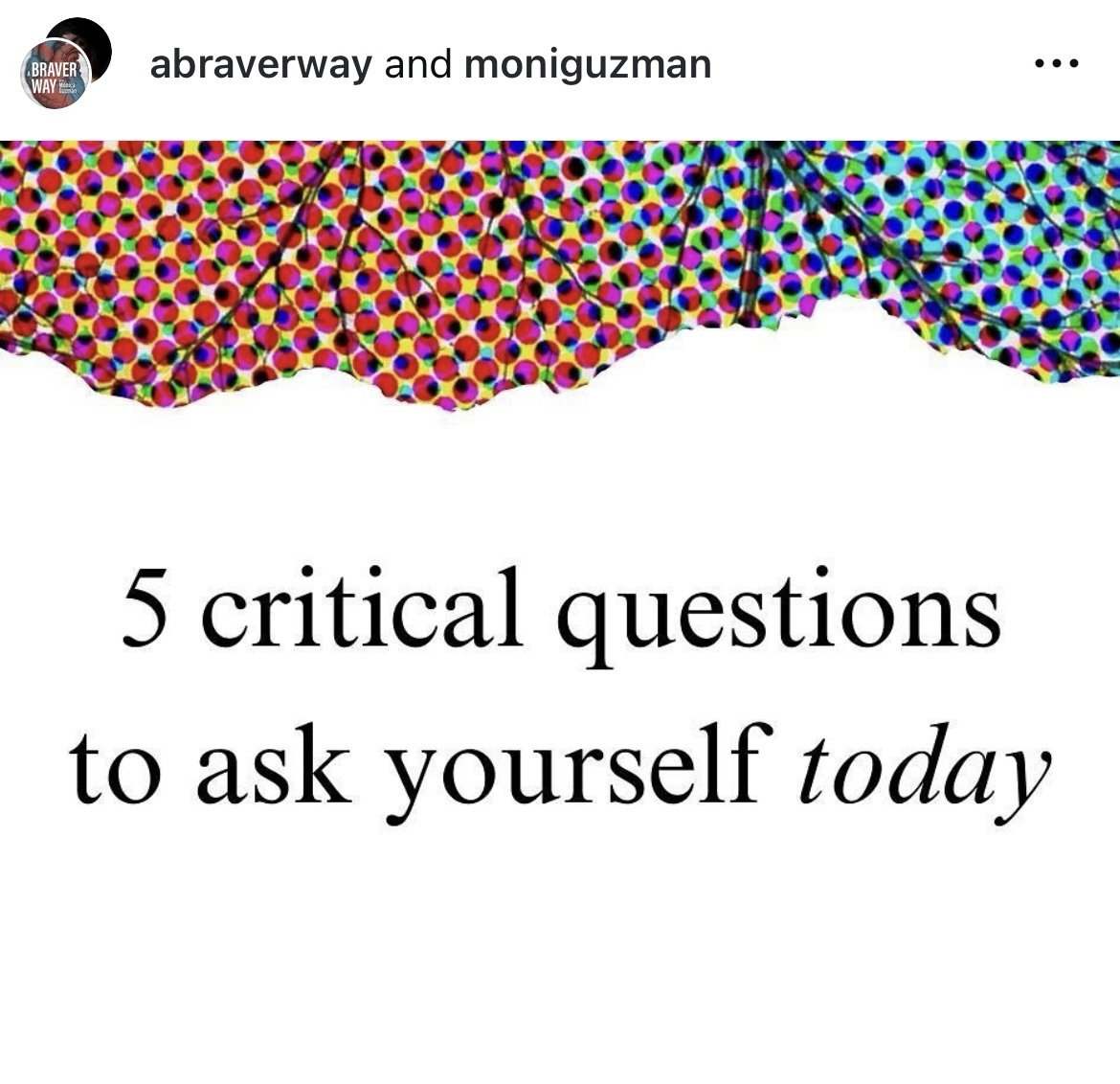
“Question your own fears.” —Monica Guzman, Braver Angels, A Braver Way

Monica Guzman is my hero. Watch the video of her talking about how our fears of what’s in other people’s hearts harms and divides us. Listen and feel her passion, her struggle to stay compassionate to all people, and her distress at how people she cares for now suffer from Trump being elected. Listen to her courage in vulnerability, expressing hope that despite the deep divisions all around, we can still connect across our differences and not destroy ourselves. And know that she has a point of view–she takes a political side. She just doesn’t approach opponents as adversaries.

Monica inspires me to recommit to the work of bridging our political divides, real and perceived. I understand the election was only a few days ago and some people’s pain and distress are still raw. I know some don’t care or want to bridge anything, at least not right now. That’s okay; this post may not be for you. But I’m ready. I hear the call and I’m answering now.

From Instagram

I had a lovely conversation today with a man I’ve known for some years. Our relationship is fun, trusting, and honest. He asked me how I am with the election and I told him I’m very much not okay. He felt great about it. We each described why we feel our own ways, listening for each other’s personal experiences and impressions of the candidates, the parties, and the people around us. I live on the south side of Chicago; he in northwest Indiana. I’m in medicine; he’s in construction. I’m a 51 year-old East Asian woman; he’s a 67 year-old white man. Our life experiences and world views diverge widely. We also have no problems connecting as humans. We both lamented how so few people we know can conduct political discourse calmly and respectfully. We agreed on multiple social issues. Our conversation prompted me to seek data about maternal mortality since Roe v. Wade was overturned. I shared with him and we both learned. It was a meaningful and satisfying conversation, and we agreed to continue. I don’t intend or expect to change his political leanings. I want to understand him, and I want him to understand me. I want us to deepen our relationship, practice healthy political discourse, and bring what we gain from each other back to our own circles. This is how I will make a positive difference in our political culture and landscape.

All people who voted for the other candidate are not evil, or sheep, or whatever name we want to call them. I know how good it feels to say they are (see Brené Brown quote below), and it absolutely does not make anything better. We each get to choose how much contact we want with people who are different from us. Often they cannot be avoided, and then we still get to choose how we interact. We each have power to influence and impact any relationship we touch. Will we be connectors or dividers?

I observe that my fellow progressives are often the ones actively dividing. Cancel culture rages on the left, rife with judgment in minimal interaction, overgeneralization and oversimplification based on assumption and association. I see value in calling out overtly racist and misogynist attitudes and behavior, but public shaming does little to educate, enlighten, or alter anyone’s mind. It just drives their biases underground, only to resurface later. It alienates, inflames, and perpetuates conflict. Judging and throwing away a whole human being based on one fact about them, no matter what that fact is, feels antithetical to a progressive, inclusive ethos to me. And, it is a totally understandable human response to severe moral distress. For those of us committed to bridging, we must learn, practice, and train in self-awareness, self-regulation, and effective communication to mitigate that relationally counterproductive response. We must ground ourselves in openness, curiosity, humility, generosity, empathy, and kindness. These are not mutually exclusive to holding fast to our values, convictions, and causes.

I have many days yet this month to delve into particular skills. For now I can simply sit with a renewed commitment to non-adversarial change agency. This is the Work. I have learned in safe spaces, with people who will not throw me away or belittle me for my beliefs. It’s easy when it’s easy, and it’s how I show up when it’s hard that counts. But I can’t show up competent when it’s hard unless I have practiced–done the drills, entrained the muscle memory, prepared for the harder challenges. So I embrace the test of encounters during the next administration. This is what I have trained for. So I say bring it, I can do this relational stuff better and better, and I can lead by example like Monica Guzman. I still have a lot to learn, and as we say in medicine, see one, do one, teach one–and I’d add–repeat, ad infinitum.

If you’ve read this far and you’re neither offended nor ready, thank you for holding your own space. We can each/all only do what we can, when we can, and how we can.
I Hold the Work for Us to bridge our differences for all our benefit, whatever, whenever, and however we can each make our contribution.

There is hope.
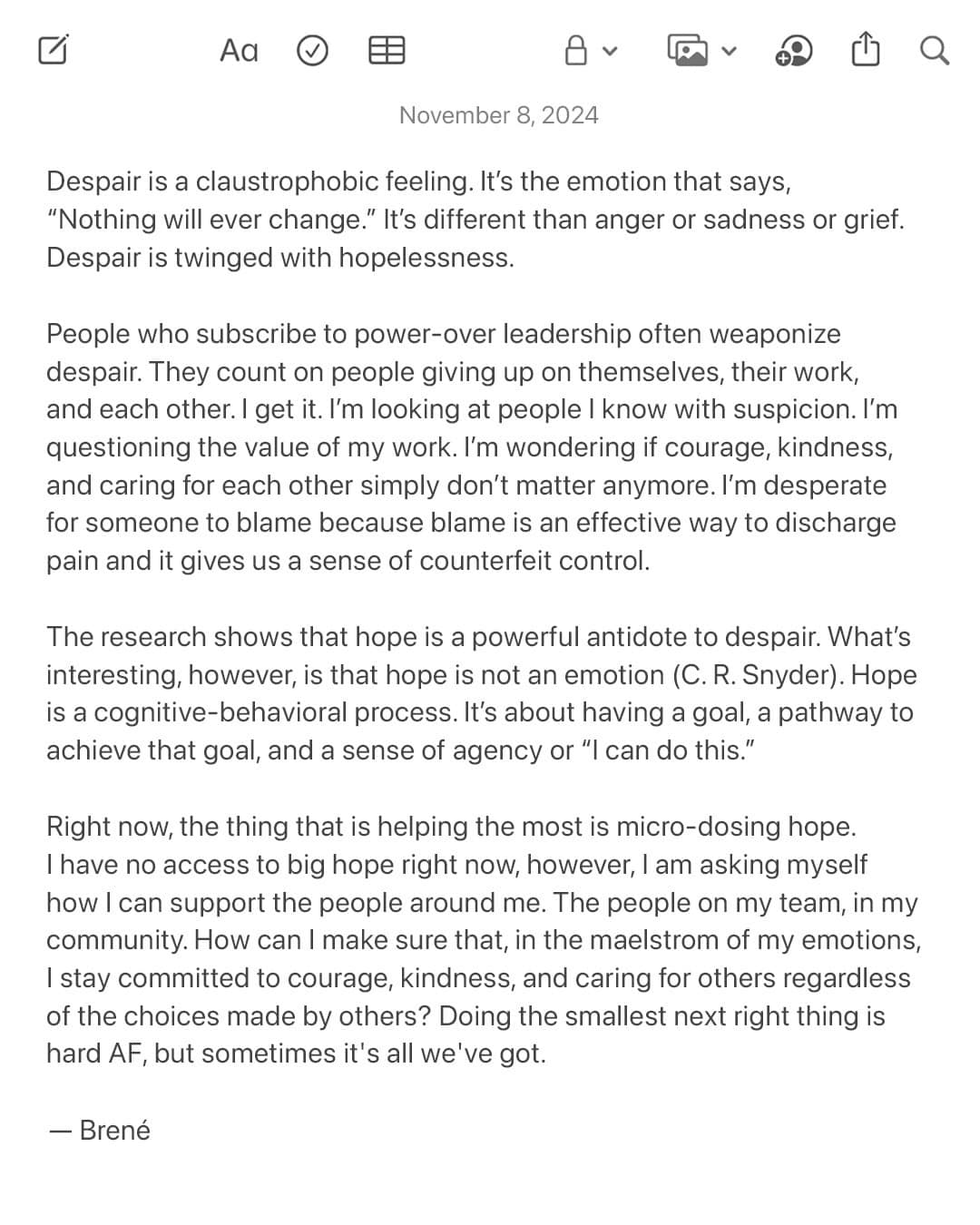
From Facebook

Holding Gentleness

“…A kinder, gentler nation.” –George HW Bush

President Bush the First came to my high school during his campaign for a second term in 1991. I got to speak on behalf of Students Against Driving Drunk (SADD–which I just learned is now Students Against Destructive Decisions) and sit next to him on stage. Decades later my classmate would tell me that the photo of that event which hung in the main office is actually a Getty Image. I’m convinced they put me in that chair so people could get a good view of him–he was at least a foot taller than me. He was also such a decent man. I so admired him, and Barbara, too–I read her memoir in college. I know there are many decent, kind, and gentle people all around. That is what I hold tonight, no matter what anybody says.

Clouds and rain glowered over Chicago today, though temps were still very mild for November. Other than the hour when I PR’d my bench press (6 reps, 80#, all me!) at Ethos this morning, my energy has felt dim and slow. These last couple days I wonder if I’m more anxious about the election than I realized. Huh. Good opportunity to practice some body scan meditation and breath work. As I write this, the usual states have shown their usual colors. I will post this and go to bed, and deal with it all tomorrow.

So how can we all cope with things in the morning and beyond?

Gently is the best word I can muster tonight.

My conservative friend in Alabama went to work the day after the election in 2016 [note: I have corrected this post. The prior version stated he voted for Trump in 2016; he did not]. He did not gloat. His colleague arrived in tears and he held her in a hug. I hope this kind of interaction happens all over the country, tomorrow and onward. Hugs. Gentleness in both triumph and grief. I hope we’ll eventually be able to say both, “See, it’s not as bad as some of us thought it would be,” and also, “Yeah, it’s not the utopia that some of us had assumed.” Because things are rarely all bad or all good like we imagine or expect. What we must do, however, is to admit these things to one another, honestly and humbly. And it’s only safe to do this if we are gentle with ourselves and others, both in person and in rhetoric.

Our threshholds for distress and self-care practices vary. Let us be patient with ourselves and one another. Some will withdraw and cocoon, others will need tighter, brighter connections and out loud processing. Yet more of us will react in new, unfamiliar ways. We will all benefit from one another’s soft words and touch, our respective strengths and generosity in complementary presentation. This is how we save ourselves from political and interpersonal toxicity.

A kinder, gentler world, indeed.
The more we believe it’s possible, the more we will act to make it so.

I Hold Gentleness for Us all, as we approach our shared future. Whatever it is, we will all suffer less if we can be more gentle with ourselves and our fellow humans.

Take a look at the Instagram panels below. Let us consider them for ourselves and in our like-minded groups. How can we set down the adversarial spikes toward others and take up the tools to rebuild our connections? Gently, gently, ever gently.

Screenshot
Screenshot
Screenshot
Screenshot

Holding Wholeness

When was the last time you judged a whole person, dismissed them, or put them on a high pedestal, knowing only one thing about them? They’re a Chinese-American doctor. They’re a black man in jail. They’re a white male CEO. Their body shape is at least as thick as it is wide. They think exactly the way you do about something really important to you. They think the opposite, and loudly.

“Mamala and the Senator”

Most of us probably know Kamala Harris more as the senator, the attorney general, and the district attorney than the maternal figure to her stepchildren, the avid home chef, and the joyful, laughing woman among friends. How do we reconcile these divergent aspects of her humanity? What does this bring up for each of us? What biases does her wholeness as a person trigger?

Some of us want to see women mainly as maternal, domestic figures. We value the feminine as nurturer and caregiver, the personal glue that holds individual family units together. Others of us also cheered when we watched Senator Harris in action, interrogating hearing witnesses with firey eye contact and direct language, not letting them deflect, obfuscate, or gaslight. Some of us cannot reconcile these divergent sides of a woman, cannot imagine their synergistic integration embodied and applied in leadership, especially at the highest level. That’s too bad, because any leader–man, woman, or otherwise–must own all parts of themselves to lead to their full potential. The strong and the soft, the masculine and the feminine, the committed and the flexible, the differentiated and the attuned–these polar and balancing aspects of our nature make us whole humans. People who live in their wholeness lead by example, by inspiration, by resonance with the wholeness of those they lead. They are leaders because we are moved to follow them; we feel their integrity and want it, aspire to it for ourselves.

Democrat, Republican, Libertarian, Independent. Name a professsion. Name a state, a generation, an eye color, and all of its associations in your mind. It’s okay to think of stereotypes. The brain operates on pattern recognition and shortcut heuristics; we could not live effectively without these automatic systems in place. We just need to guard against leaning on them so heavily that we oversimplify and overgeneralize our fellow humans.

What a narrow, uninteresting, and unfulfilling life when we only see people as categories. Red, Blue, old, young, rich, poor, male, female. What happens to our heuristics when we encounter contradictions? Maybe gay people should not be conservative? Asians should not be loud and demanding? How do we react to the unexpected, the new, the unknown? Too often we fear it. It’s perceived as a threat–to our own expectations, identities, and emotional security. Fear can then sublimate to denial, anger, blame, exclusion, and violence.

What happens when we hold space for one another’s incongruous, confounding, enigmatic, vibrant, and distinctive wholeness, ourselves included? Maybe then we can say, “I don’t fully understand us, and I choose to see us–all of us–anyway, and be with the parts I don’t yet get, because the longer I’m with us, either it will get clearer or I’ll just accept what I cannot know and figure out how to live in civility, if not harmony, with the whole of us.”

None of us is defined by only one aspect of our identity. And yet we so easily identify others this way. What a disservice to one another’s full humanity. Even when it’s positive–“You’re a doctor, wow, you must be the smartest person!”–it’s still reductive. And when it’s negative–“All Trump supporters hate women and people of color”–it is destructive, no question, even when we think we protect and defend the good.

Holding wholeness means getting and staying curious. It means being honest with ourselves and holding ourselves accountable to our biases and how they manifest in thought, perception, words, action, and relationship. It means practicing self-compassion for all of this, and extending empathy and compassion to others struggling with their own self-honesty and -delusion.

May we endeavor to see one another’s full humanity in every encounter. May we withhold judgment, even for a moment, a breath. May we move through the world with an attitude of ‘together’, all of me with all of you, inextricable, interdependent, ad infinitum.

I Hold Wholeness for Us.