Better Angels:  Why I Have Committed

IMG_2459

Friends, what is your WHY?  Mine is to cultivate the best relationships between all people, (here comes my spiel [I prefer to call it a mantra—winking emoji]), “because our relationships kill us or save us, and relationships themselves live and die by communication.”

How are you affected by the current political climate?  Are you separated from friends?  Do you feel restricted in your conversations?  Do you self-edit more than before?  Or are you emboldened to speak your mind, finally freed from the social muzzles of more repressed times?  How have politics in the 21st Century affected your relationships?
IMG_2460

I first learned of Better Angels when I read David Blankenhorn’s article, “The 7 Habits of Highly Depolarizing People,” written before the 2016 election.  I was intrigued by the organization but could not figure out how to get involved.  Last year I asked my Facebook friends which charity they thought I should fundraise for—I support so many causes in theory, but could not decide where to focus my efforts.  One insightful friend suggested Better Angels.  I did not end up fundraising for anyone, but I started following Angels on Facebook and signed up for the newsletters.  This May I participated in a skills workshop and wrote about it.  The objective in these workshops is for attendees to learn and practice listening and speaking skills, to facilitate mutual understanding and connection between liberals (Blues) and conservatives (Reds).  The workshops are brilliantly structured to make engagement safe and productive.  I decided I wanted to be part of this solution.

In August I attended my second workshop, “Depolarizing from Within,” aimed at helping us help our own ‘side’ combat the 4 Horsemen of Polarization that we unleash on the other side:  Stereoptyping, Dismissing, Ridiculing, and Contempt.  I took notes on the moderator’s methods this time, as I had committed to training to become a moderator.  Like in teaching, he had to set clear expectations and ground rules.  He had to control the session and politely but firmly interrupt people’s monologues and keep us on task.  This was harder than I expected—many of us wanted to depolarize from the other side rather than our own—self-scrutiny and –regulation is hard.  Going against group think and calling out our peers feels scary and vulnerable.  But we can do it if we have the skills and motivation.  It is essential if we want to reconnect with our loved ones ‘on the other side.’

I read the moderator training materials and watched the videos over the summer.  When I found myself feeling triggered watching a Red/Blue workshop online, I wondered if I’m really up for facilitating such an event.  Moderators, after all, must exude sincere neutrality and make all attendees feel welcome.  We are the leaders in the room; we set the tone.  For the sake of the work, we cannot afford to get emotionally agitated by anything any attendee says.  That means not only in our words, but our body language, facial expressions—people must feel us being professional at all times.  So to test myself, I registered for the next Red/Blue workshop in my area as a participant.

The event was almost cancelled because not enough Reds had registered.  Chicago and Evanston are very Blue cities, and I’m learning how ostracized and unwelcome my Red peers feel among us progressives.  So I’m so grateful for Red folks who came at our organizer’s behest—her friends who did it as a favor to her.  More than once during the morning, we heard how apprehensive some of them felt, not knowing what to expect, and not used to feeling free to express their views.  This makes me so sad, and I feel strongly that we Blues have to own our part in it.  Regardless of how badly we feel our conservative counterparts anywhere behave, it does not excuse our own ad hominem.

About a week before the workshop, we found out Van Jones and his crew would come to film the whole thing and then interview some of us afterward.  With very mixed feelings, I agreed to wear a microphone and appear on camera.  He told us at the beginning that of the 4 hour event, 4 minutes would be aired.  So we could relax.

Not only was I relaxed; I felt positively uplifted and encouraged.  Throughout another set of wisely structured exercises, Red and Blues explored not only our strengths, but our flaws—both ideological and behavioral.  The stage was set for safe self-reflection, and the vulnerability required to practice it.  How often in your conversations, even with people you love, do you feel safe to acknowledge the weaknesses of your ‘side’ and where your group could act better, without someone pouncing on you?  Has it been so long that it doesn’t even occur to you to consider it?  At the end I exchanged contact information with two Reds and another Blue, and I really hope we can continue the conversation.  I will invite them to the skills workshop I will co-moderate next month, my first attempt.

The Better Angels segment aired on the Van Jones Show last night.  It’s about 9 minutes.  I thought the show did an excellent job of highlighting the objective of the organization, and showing perspectives from both sides, as well as an observer, whose notes are worth pausing on and reading, at about 7 minutes.  Please take a look and share your reactions (civilly) in the comments.

IMG_2530

In preparation for Thanksgiving, Better Angels is holding skills workshops across the country in the next weeks.  Find one near you and bring a friend or loved one!  And check out the blog and podcast to read and hear civil, respectful, even friendly Red and Blue perspectives and discourse on issues like gun control and education.

We have so much work to do, my friends.  It feels exhausting and discouraging at times, but not during Better Angels events.  Here the goals and vibe are openness, curiosity, learning, understanding, and above all, connection.  It’s the perfect place for me and my WHY.  So I’m going to stay a while.  I’ got something to contribute here.


The Mark You Make

IMG_2633

Friends, Ozan has written another book!  I know it may seem like it, but he’s not paying me to promote his work, really!  He has offered perks for Inner Circle members, however, like an advance digital copy for preordering, and signed copies when the book is released next April.  In considering what I would ask him to inscribe to my friends in the books I will give them, I realized yet another evocative dimension of my relationships.

If you were to describe your friendships to a third party, or make a meaningful introduction in service of connecting two amazing people, what would you say?  I call it ‘connecting fellow Awesomes,’ and it’s always a pleasure and privilege to serve in this capacity.  I thought to ask Ozan to write to one friend something like, “Cathy thinks the world of you—happy to make such a positive new connection!”  Then I thought, this friend has really made a mark on me.  Then I thought of the mark Ozan has also made, in just 9 months of virtual contact.  And then my mind was blown with the realization of my cosmically marked-up self—the finger, hand, and footprints of all those whom I have contacted.

Years ago I attended the orthopaedic surgery resident graduation dinner with my husband, a happy and fun annual event.  At the end, mingling with faculty and trainees, one of the graduates looked at me and his eyes widened.  “You’re Dr. Cheng!  You were my teaching attending during my third year medicine rotation [7 years prior] at [the hospital where I used to work]!”  I was gratified that his expression was cheerful, rather than distressed or awkward, surprise.  He went on to tell me that I held the team to a high standard of discussion, and that he appreciated my presence and teaching.  I will always remember this encounter with pride and appreciation.

In the past year three patients from my past have resurfaced and told me the positive difference I made it their lives.  I remembered two of them so clearly, both their faces and their names (after 20 years and thousands of patients, I can usually only remember one or other).  Talking to each of them reminded me of all that we had been through together, and I was glad that I had done my job well.

But what about those for whom I have not been a great doctor?  I have had my fair share of patients who left me, for various reasons.  I know I have been seriously disappointing for many.  I wonder how many times I have contributed to patients’ negative overall experience of medicine, and further widened the divide between doctors and patients in our fraught and flawed healthcare system?  Sometimes I look back on my early years of practice and cringe a little—all the writing I do now on empathy, compassion, curiosity, openness, and humility results from years of lessons learned in real time, on real people.  I’m definitely much more adept at it all now than in the beginning.  And I’m still learning—I still get triggered, still fall into old, counterproductive thought and behavior patterns.  Sometimes it feels like I will never be good enough, or enough in general.

IMG_1852

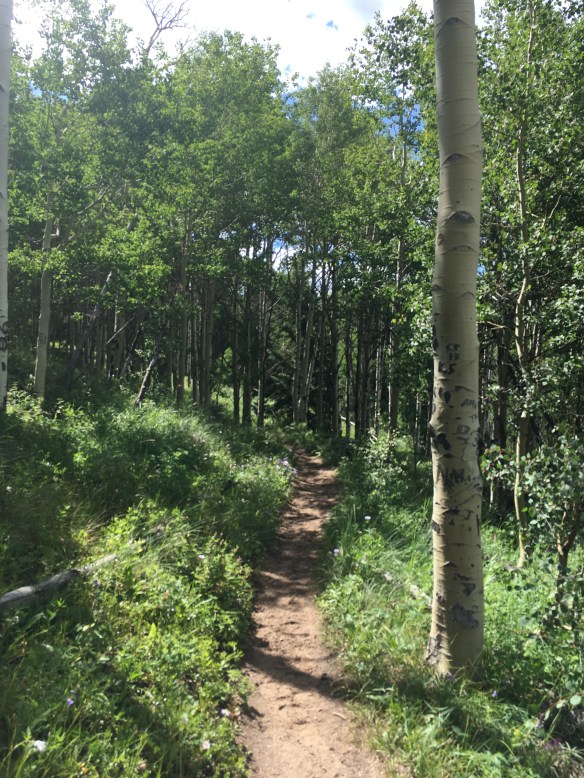
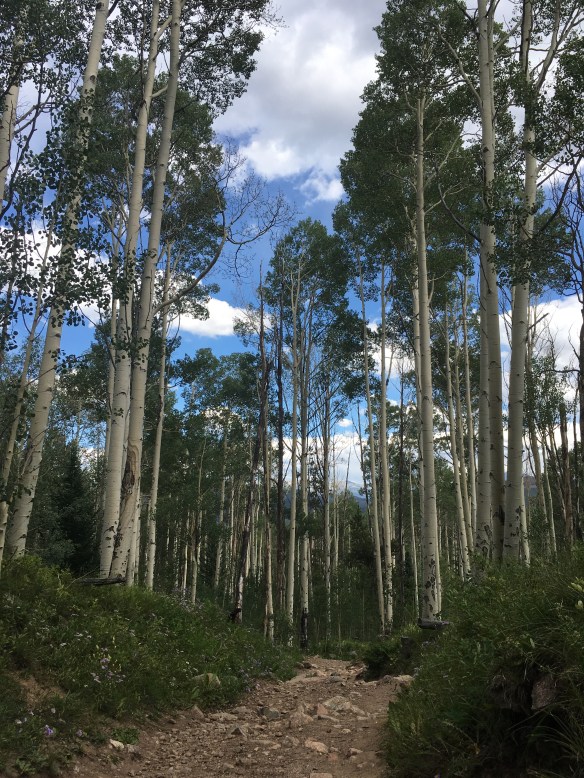
I also think about the people whose marks on me were/are hurtful, dismissive, and otherwise wounding.  It reminds me of carvings I see in the trunks of the beautiful aspens I walked among this weekend.  Did the folks who made them set out to harm the trees?  If they thought the tree might die from their knife marks, would they think twice?  Maybe they were overcome with their profound experience in nature and just wanted to mark it in some way, especially if they shared it with someone they loved (so may initials with plus signs and hearts)?  Sometimes we just want or need to be right, competent, respected, and acknowledged.  So we mark our encounters with stubbornness, aggression, or even violence (in its many forms, overt and cloaked).  Like the strong and flexible aspens, I bear scars from such encounters and still continue to thrive.  Such marks have taught me how to care for myself, and also how not to be toward others.

In the end, how do I reconcile these relationship phenomena?  Sometimes we can see and know the mark we make on others.  Many times we cannot.  Nobody is perfect.  My whole life I will scrape and nick those around me, hopefully never with malicious intent.  I can only hope for their generosity and grace, and forgiveness.

Sister Brené Brown, once again, helps me continue.  In her book Rising Strong, she describes a choice, a mental attitude, that can help us all suffer less.  If you have not read or heard the book, I highly recommend it—it’s my favorite of the 5 of her books I have read.  Assume, she says (with the help of her pediatrician husband), that we are all doing the best we can.  That’s it.  We are all imperfect.  Our circumstances mess with us, our patterns mess with each other, and sometimes it can feel like a strange and inexplicable miracle that we have not all killed one another already.  But choosing to give each other this one, simple, and at times colossally difficult benefit of the doubt, could be what saves us all.

We simply cannot extricate ourselves from each other.  So we can just do your best to take care of one another.  And be prepared to apologize, early and often.

IMG_2498

The Importance of Peer Support

IMG_2151

What a privilege to present again to a group of smart, creative, fun, and engaging designers on Friday.  This time I was asked to address burnout, as so many folks are feeling overwhelmed and stressed.  I did my homework on stress and burnout in the creative fields, and found enough similarities in medicine to feel like a credible speaker.  “It’s not just a job, it’s a way of life,” seemed to capture how we see our respective vocations.

I presented a brief mini-lecture on self-care practices, including habit formation and maintenance in the 5 reciprocal domains of health, and narrative awareness.  The latter is always something we can do when we find ourselves in untenable circumstances:  Ask ourselves what story we tell about the situation, how that story compounds our suffering, and then tell a new story that does nothing to change the objective reality, but can dramatically improve our personal experience of it.  I have learned from work in physician burnout that people don’t just want to be told how to fix themselves.  They want someone to address the problems of the system that oppresses them.  So that’s where I tried to go next.

I started with an Appreciative Inquiry (AI) exercise.  In small groups, I asked participants to share team success stories, and listen for recurring themes around what’s already great about their teams, their work, and their organization.  Words like openness, flexibility, and “we have leaders, not bosses” made the Post-It easel list.  Then, in this headspace, I asked the groups to identify issues they wanted to address.  Instructions were to find important, urgent, and solvable challenges.  Guiding questions included, “Why will the organization be better if it’s addressed?” and “What does better look like?”

Similar to the AI results, common issues arose from multiple groups.  There was general consensus, reviewing the list at the end of 20 minutes, that overall work satisfaction would improve with less digital and more face to face communication, better project clarity, and taking better care of the shared spaces.  I would meet with team leaders and show them the list later in the day.

IMG_1939

When I opened the floor to questions, a self-proclaimed ‘Debbie Downer’ presented a query that I will ponder for many months as I prepare upcoming talks:  “When you ask someone how they’re doing and they say they feel like they’re drinking from a firehose, telling them to adjust their attitude is probably not helpful…  How can we change things that are not in our control?” The Universe had prepared me for this question by sending a new mentor who taught me to ask, “Who owns the things we don’t control?”  Thank you, my loving Cosmos.

I only partially answered Debbie’s question by suggesting she think about how she might influence the owner(s), how she might impact decisions being made in those spaces.  I segued too quickly, I’m afraid, to the question that I wanted to ask the group:  “When someone asks you how you are and you express that you are overwhelmed and drowning, what is a helpful response?”  I thought the discussion that ensued was productive…  It seemed to stimulate people’s intrinsic empathy and compassion.  We recognized the importance of feeling connected, that I’m not the only one feeling this way.  People recognized the relief found in just speaking aloud the list of stressors to a sincere and empathic listener.  We also talked about being prepared to hold space for any potential answer when we ask, “How are you?”  Even if we have no control over the flow out of the fire hose, maybe we can take turns holding the nozzle steady, and at a slightly oblique angle for each drinker, so it doesn’t have to knock us all over when we try to take a gulp.

I had a chance to talk to Debbie a little later (Cosmos offering me a second chance, Thank You Again), and we agreed that stress and burnout, in both medicine and design, are best addressed at both the individual and systems levels.  We can each start with personal accountability for our own experience of the system.  Then we can decide how we show up in the system each day.  We can choose, at any time, to either participate passively in the status quo (which is what we all need to do sometimes), or find a way, however small, to advocate effectively for change.

The latter is much better done with peers, with friends.  Take time to connect (no lunch meetings, let’s just eat together!).  Share stories.  What do we love about this work?  What’s already great?  How could it [realistically] be even better?  How can we help one another, including our leaders, envision and pave the way there?  Who else needs to be enrolled?

My meeting with the team leaders was less structured.  I worried that they left feeling disappointed because I did not offer more concrete advice on personal resilience practices for leaders, and ‘how to lead’ teams in burnout.  But over the hour, I felt no desire or need to lecture.  I queried various aspects of their self- and team awareness, personal resilience practices, and communication.  We briefly reviewed the issues list from the morning workshop, and I left with confidence that they would take it seriously.  It also occurred to me that these designated leaders were already supporting one another in their efforts to lead intentionally, effectively, and compassionately.  Maybe they have also felt overwhelmed sometimes.  Maybe it was also good for them just to talk it out with each other this day.  Maybe we can all do this for one another a little more often.