From Meaning to Mission:  Finding Your Voice and Speaking Up for Change

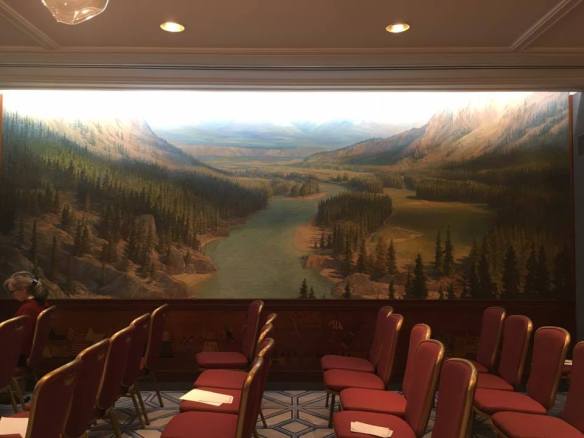
Fairmont workshop room

Have you ever felt like you have no voice in your workplace, your community, or the world at large?  When have you felt you do have a voice?  What made the difference?

Two esteemed colleagues, Liz Lawrence and Eileen Barrett at the University of New Mexico, and I presented the above titled workshop at the International Conference on Physician Health on Friday.  The objective was to give participants an opportunity to recognize and rally their strengths, claim their value and agency, and practice the words to advance an idea or project for improving physician health and well-being.

The idea for the workshop came from a conversation Eileen had with a young physician who felt he had no agency to improve his work situation, due to his junior status.  This prompted her to ask, who has agency, and how do they get it?  She concluded that agency is an active skill, not a passive state of being.  Thus it can be learned/acquired, and everybody has/can have it.  Furthermore, we apply it most effectively when we combine it with our strengths, in service of projects that are personally meaningful.

We presented the reciprocal triad of finding meaning in work, feeling empowered, and inspiration and motivation, as the foundation of agency and action.
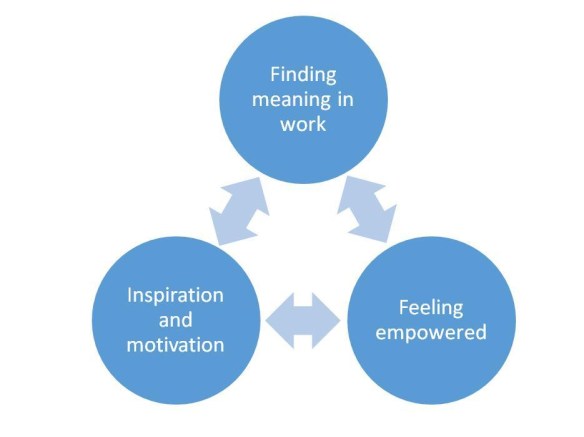
EB triad

Identifying Strengths

The first exercise had participants pair up and describe their strengths to each other.

What are your strengths?  Imagine describing them to someone, out loud, in person.  How does this feel?  Our attendees reported feeling uncomfortable, not used to it.  They also felt confident, connected, and encouraged speaking to someone they knew was listening supportively.

Defining the Project

Second, we asked participants to think for a few minutes about their own projects.  It could be something they had been working on for a while, a new idea they recently came across, or something from a sample list we provided, related to Culture of Wellness or Efficiency of Practice.  We asked:

  • Is your idea “Big Enough to Matter, Small Enough to Win?” quoting Jonathan Kozol.
  • Is it Specific, Measurable, Achievable, Relevant, and Time-bound (SMART)?
  • How will your strengths apply?
  • What else do you need? Who can help?

Partners met again to share and discuss each other’s ideas.

Afterward they reported elevated inspiration, excitement, and mutual support.  Positive energy in the room rose palpably at this point, with lots of gesturing, smiling, and engagement.
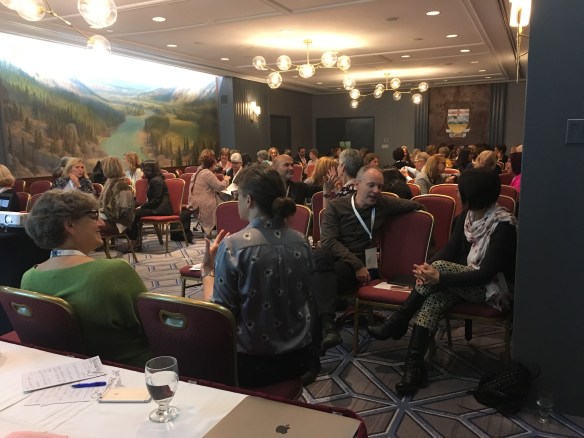
ICPH 2018 workshop

Communication and Relationship

We didn’t call it an elevator pitch, but that’s basically what we asked attendees to attempt.  In 90 seconds, each participant was to distill and express their idea into words that would convey its essence and enroll their partner in its goal.  Having advanced to this segment of the workshop in less than twenty minutes, and now asking them to perform a pitch on the fly, I gave a pep talk (modified here to include some words I wish I had said):

“Now it’s time to PRACTICE.  If we are to make progress in our projects, we must enroll other people.  It’s all about relationships.  Relationships kill us or save us, and they live and die by communication.  A previous presenter said, ‘Language is the vehicle through which all interactions take place—both verbal and nonverbal.’

“You never know when or where you will meet your champion, or who it will be.  The easier and better you can pull your idea out of your back pocket and present it cogently and impromptu, the higher your chances of success.  Know your ask—be as clear as possible.  Know your audience—what about your project is meaningful to them, what will they relate to?  Make them the hero:  Don’t come at them with demands.  Come alongside them with open-ended questions; help them appreciate the power they have to help.

“You will have to be persistent.  Practice will be key.  Our keynote speaker, applying complexity theory to the work of physician well-being, invoked the image of a grain of sand dropping onto a pile.  One grain may stick on impact and nothing happens to the pile.  Another may cause a small section of sand to tumble just a little.  Yet another grain can trigger the avalanche that alters the sand pile landscape entirely—and no one can predict which grain will be which.  I posit that you are not a grain of sand.  You hold an idea—a whole bag of sand—and each time you pitch it, you drop a grain (or a handful) on the pile.  If one grain makes no immediate change, drop another one, and another, and another.  This is the essence of the Growth Mindset—practice.  Practice is Creation.  Practice is Evolution.  Practice is Progress.  Your job now as speaker is to try with abandon.  There is no such thing as a bad try.  Pay attention to how it feels, where you get stuck, and where you shine.  As the listener, your job is to make it safe for your partner to let go of fear and judgment, to lay it all out.  Support, encourage, and critique with love.  What moved you, what did you observe in words and body language that drew you in or put you off?  What did you want more of?

“Make the most of this time.  Dig in the bag and pull out a few grains to drop.  Take advantage of your partner for feedback and support.”

The room was positively buzzing.  And participants’ comments made our day (paraphrased here):

“Sticking with the same partner throughout was helpful; we could really connect each other’s strengths to our respective ideas and help each other develop them.”

“It was fascinating to see the energy change between talking informally about the idea and then having to present it as a pitch.  She was so much smaller and hesitant the second time around.”  (Partner):  “The first time I was just talking to a colleague.  The second time I pictured presenting to my board.”  The experience was enlightening and curiosity-provoking.

“It’s different and easier talking to a supportive stranger, someone with whom you don’t already have relationship baggage.”  How else, then, might we approach our stakeholders—how could we practice awareness of our assumptions and relationship dynamics, and perhaps modify them positively?

“Hearing someone else’s ideas informs my own.  I like how he conveyed something, I saw how I could do the same; it gave me more insight.”  Taking turns both presenting and listening engaged both people in mutual support and encouragement—both roles were helpful.

The Takeaways

Liz, Eileen and I have collaborated on physician wellness since 2015.  We share meaning and mission around inspiring our colleagues to claim their value, recognize and stand both confidently and humbly in their power, and participate in a global movement of positive change.  Our strengths and styles complement one another and the work flows naturally, synergistically.  What a privilege and an honor it was to have this opportunity to present to and commune with our tribe members in physician health.  May the processing and integration of all of our new learnings continue to sustain and connect us for the long road of work ahead.  As Barack Obama says, “Change will not come if we wait for some other person or some other time. We are the ones we’ve been waiting for. We are the change we seek.”

Onward, my friends.

EB LL CC ICPH 2018

Hold One Another Up

IMG_2158

Hello Friends!

How was your week?  I wrote in my last, very brief post that it had been a hard few weeks, but whoa-Nellie, these past 10 days or so have been a bit unbelievable.  But then again, almost nothing is truly unbelievable anymore.

When the news first came out about families getting separated at the border, I felt profound empathy for the parents, and then the kids, imagining their despair, grief, and lasting trauma.  But the administration is now targeting even naturalized citizens, looking for fraud on applications to deport people.  My parents, my husband, and all of his siblings are all naturalized citizens.  My son is currently abroad and it occurred to me to wonder whether he will be held up in customs and immigration on his return.  At this point I cannot know for sure that my own child, a native-born American citizen, won’t be kept from me, and even though it is unlikely, I now feel it fully in the realm of the possible.  I know I’m not the only one.  That is simply unacceptable.

It also occurred to me that any of my Latinx friends and co-workers could be stopped on the street or approached on a bus or train, and commanded to show proof of citizenship, as so many across the country have experienced, illegal and unconstitutional as it may be.  45 actually autographed photos of people who have been killed by illegal immigrants, while denying that native-born citizens commit proportionally more crime than immigrants, legal or illegal.   Right now, June 2018 in the United States, it feels to me that only straight, white, Christian, cisgender males are safe.  It all makes me want to vomit.

In the past year or so, people who know me call me an ‘activist.’  I take immense pride in this perception, and at the same time feel a little unworthy.  What have I done?  In 2017 I wrote a lot of letters to Members of Congress–even had Healing Through Connection stationery printed to do it.  I called.  I donated.  I marched.  2018 has been slower in action.  I’m still reading, keeping up, donating, and engaging on social media.  But I feel like it’s not enough, that I should be doing more.

Today I am more aware than ever that most of my colleagues and institutional leaders are white.  I am East Asian.  We are not the targeted groups.  However empathetic and outraged we may feel, we are likely only indirectly affected by current events.  So many of our support staff, however, are people of color.  They hold positions in the organization with the least autonomy, authority, and voice.

We are all expected come to work every day and do our jobs.  We take care of patients.  We put our personal feelings, stressors, and worries aside and meet our patients where they need us, and nobody knows what we might be dealing with ourselves.  But we do this now during a mind-bending crisis of national conscience.  Now is the time when our emotional and social support networks are called forth and tested.  As a physician, a default leader of the patient care team, how can I not acknowledge this profound disturbance of our collective consciousness?  How can I expect my team to perform optimally in a false vacuum?  The realities of our world are simply inescapable, and they affect us all, like it and accept it or not.

I may not be marching in front of Congress or the DHS.  I may not be writing legislators or calling them every day.  I am not a designated leader of my professional society, publishing op-eds on the long term health and societal consequences of our government’s actions.  But I can absolutely stand up in solidarity with and for the people closest to me.

So this week I expressed to my teams in no uncertain terms that whatever anyone is feeling or going through right now, they should know that their physician leaders support them, and we will be here for them however they need us, just like we are all here for our patients.  I made no overt political commentary.  I simply acknowledged the moral morass I see in our country and tried my best to make it safe for us all to experience it together, out loud and in person, and to help one another through it.

If there were ever a time for physicians to walk the talk as leaders, as caregivers for the caregivers, it is now.  I know now that I don’t have to be the loudest or most visible ‘activist.’  I just have to act in accordance with my core values.  And it starts with holding up the people right next to me every day.

Relationship Revolution


“In my lifetime I want to see the culture of medicine driven more by relationship than by revenue.”

–me


Nice to be back, friends!

This post is a bit different from my usual format and style.  It’s maybe more raw and blunt.

Please bear with me and keep an open mind?

I know posting this may be risky.  It started out as just jotting down ideas for a longer, more detailed future post.  I had to get the ideas and thoughts out so I could focus on work.  And then the ‘jotting’ somehow evolved into what I imagine a poetry slam might look like.  So I decided to post as is.

My long term objective is to stimulate generous thought and respectful discussion between patients and physicians.  I wish to prod us out of our default complaint modes and reorient all of us to the idea that we are all on the same team, but our connections are under siege by outside forces.  The system harms and oppresses us, physicians and patients, the end users, and the ones with the real power.  Together, we are the sleeping (sedated?) giant that must rise up and reclaim the system for ourselves.  This post is an attempt to spark the flame that draws us together, by pointing directly to the spikes that drive us apart.

Disclaimer: What follows is my own expression and does not represent or reflect the opinion or position of any colleague, institution, or professional society with whom I associate or to which I belong.

ice castle spider legs

I hear my colleagues say: Get rid of the patient portal!

It’s too much!

Limiting characters does not work, they just send multiple messages

Charging for messages just makes more work

“They abuse the system”

“We give an inch, they take a mile”

Keep them away!

Us vs. Them mentality.

Antithetical to mission of medicine: To meet patients where they need us, and help them.

WHY?

Because we are too busy.

DOING WHAT?

Every. F*ing. Thing.

Rx prior authorizations

Endless documentation, infinite clicks

Rx refills with no information on follow up or patient status

Filling slots to meet RVU goals

Prescribing more meds to meet “quality” goals

Keeping up with the latest evidence for every disease, test, treatment, guideline, diet fad

Rushing to the next patient so that the patient we’re with does not have time to even think of their questions, must less ask them

Patients walk away from visits with their true needs unmet.

So they use the resources available to them to ask for what they need.

And this ‘adds’ to our work

And we feel busier and more frustrated, exhausted, frayed, irritable

We feel Overwhelmed.


Patients also feel it

They feel unseen, unheard, dismissed, discarded

And they don’t understand or relate to where it comes from

They get angry

So they send more messages: to us, about us; criticizing us, lashing out

Making us feel bad about ourselves

Which manifests as defensiveness first, then even more frustration, exhaustion, irritability

But we don’t disengage.

We remember our calling.

We forge on in smoldering resentment, pride, bitterness, duty, guilt, shame, and occasional fulfillment


And then abstractions to reconcile the cognitive dissonance


Patients suck

All they do is take take take

They don’t understand that I’m Doing My Best to help them

Why don’t they appreciate me

They are so entitled these days

They want everything now now now

They think I’m at their beck and call

Like I’m not working every minute of every day

Like I don’t have a family and a life also

Like I live only to serve them

Patients are the enemy

Really?


Oh and it happens on both sides


Doctors suck

All they do is type away at that blasted computer

They don’t even look up, see me, or hear me

They don’t understand what I need

They just want to see more patients

Make more money

I’m just a number to them

A cog on a conveyor belt

They’re all in the pockets of Big Pharma and Insurance

They withhold the help I need

They hoard it

They don’t care about me

They Don’t Care About Patients

All they care about is making the next buck

Doctors are the enemy

Really?

ice castle doorway

There is no substitute for the Time and Energy

Required to cultivate Healthy, mutually Respectful, mutually Fulfilling, mutually Beneficial relationships

It is always a two-way street

Our relationships kill us or save us.  Always.

snake river keystone

Doctors and patients must find ways to reconnect

Find one another through the thick morass

And Hold Tight

In Solidarity

Learn, Train and Practice Together

Our Communication, Empathy, Compassion, and Collaboration skills

Defend against the forces that drive us apart

Advocate for one another and for our Sacred Contract

So we may once again

Heal Through Connection