The Most Meaningful Fiction of My Life Yet

What stories do you consume repeatedly? What drives this?

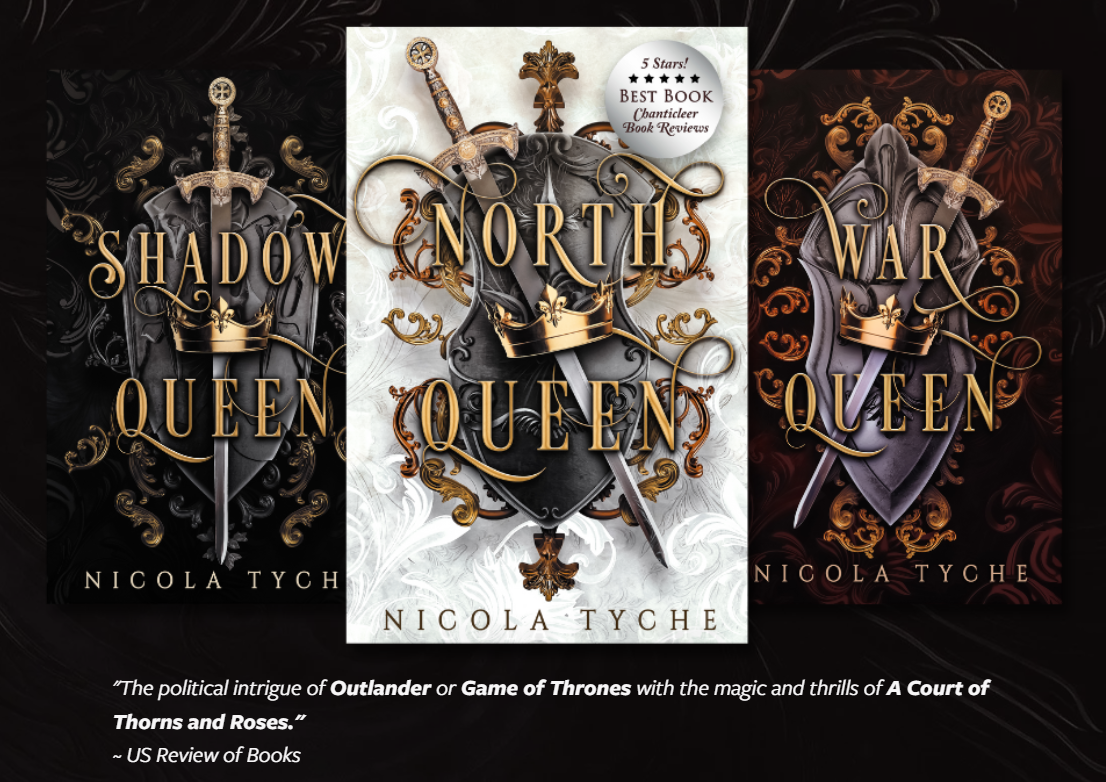
I have alluded to the Crowns Trilogy by Nicola Tyche a few times since I first listened back in November. Tonight I’m five hours away from finishing my fifth binge of the entire series since then. How fascinating!

Regular and long time readers of this blog will recognize other books with this kind of record in my history, such as The Art of Possibility and Start With Why. Recently the novels Beastly Beauty and Never the Roses have left deep impressions on me. The thread tying them all together, of course, is the centrality of relationship and integrity to oneself and one’s core values, and how this then shapes our connections to others. That theme certainly persists in Crowns, but its impact feels deeper, more acute, and I could not fully articulate why until these past weeks. Many thanks to my dear friends who have helped me put it into these early coherent words. I had already identified that it was the utter accuracy and completeness of the story’s depiction of humanity–its tender, messy, violent, complex, and paradoxical nature, that strikes me. But all good fiction does that. What is it about Crowns that hooks me so deeply?

First Sharon asked me, after hearing me gush about the writing, to describe specifically what I love about it. First, active verbs, hallelujah! Then the dialogue, the banter, the clever and subtle humor. Then the performances. Katherine Kennard, Connor Brannigan, and Zach Lazar Hoffman voice all of the characters with both technical precision and emotional depth. I imagine the writing made it easy for them to embody the characters, because the words are evocative. Fear, anger, devotion, anguish, loyalty, conviction, ambivalence, and, of course love–the characters’ conveyence of all these emotions and more spring from each chapter right into my amygdala, sparking it in ways I may have never experienced before from a book.

Phara first introduced this series to me, and I shared widely and immediately. Donna and Anna both loved it and we finally gathered to discuss last Thursday. For two hours we professed our admiration for Norah, the strong back, soft front heroine and our love for Mikhail, the utterly romantic hero we all wished to know better. We gushed over the loyal and tragic Alexander and his fun and lighthearted brother Adrian. But we saved our greatest devotion for Soren, for the depth and complexity of his character and the scope of his arc as the strongest and most lovable (in our opinion) hero of all. I named our group chat Sorenettes. Asked again, so lovingly, why this series affects me so, I was able to get to how the characters all show us how we can change our minds about people, groups, and ideas, and the inherited and established assumptions that we had previously held as immutable truths. This story gives me hope for connection despite serious barriers.

But it was Sean, whom I referenced in another post centered on Crowns back in December, who really cracked it open for me two days ago. Meeting in the Den at Ethos before our strength class, Sean’s face postively lit up when he asked, “Cathy, five times?” Remarkable and outstanding. I was queried again, invited enthusiastically to go deeper yet. And then it emerged: validation. Crowns hits me squarely at my Why, which is connection, especially across difference. Over three long books and over 40 hours of narration, the sweeping epic that spans kingdoms at war, a tragic love triangle, and the full scope of human emotion, the characters persist and finally triumph in the work of connection, despite myriad forces that oppose and threaten it, even mortally. What cosmic fortune that Phara gifted me this trilogy just when the world feels so lost to our ability to connect in general, and especially across any differences.

The insights have continued to roll out over the weekend. There’s too much to write tonight; I’ll have to do it all in chunks! That feels right–I want to savor the continuous processing, unfolding, emergence, and integration of meaning and synthesis that this story evokes. I already have at least three posts in draft, which I look forward to fleshing out: Rupture and Repair, Clinging to Our Beliefs, The Freedom of Being Seen and Known… OH, I could probably right a post a day this November based on quotes and passages!

My current thesis statement of the Crowns impact on me:
It is our face to face, one-on-one, personal connections, forged with continuous and concerted effort, patiently over time, despite both internal and external barriers and resistance, that save us. These connections require openness, curiosity, honesty, empathy, integrity, and humility from us all, and when grounded in love, they can overcome almost any division, I am convinced.

What relationships in your life fit this description?

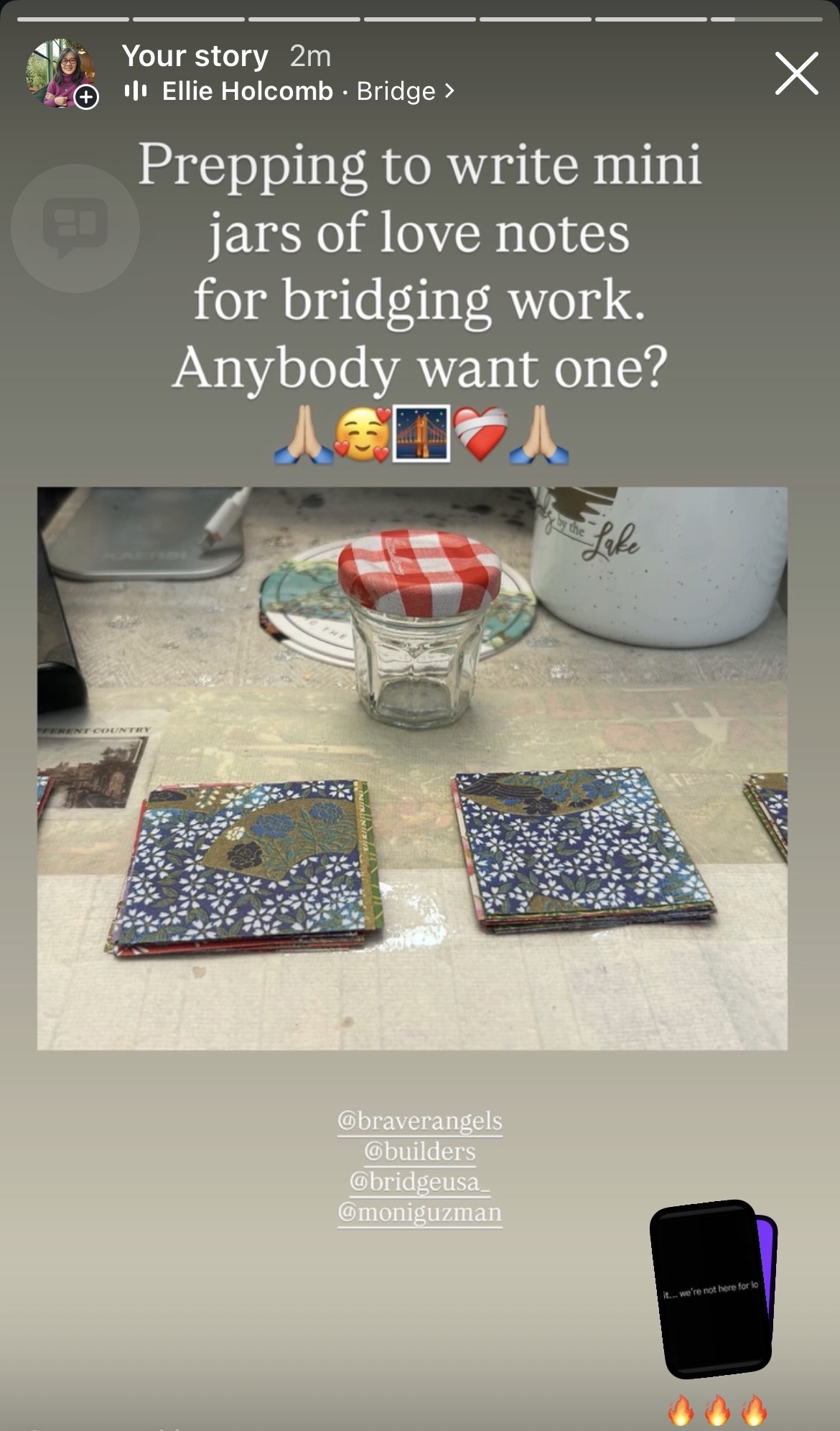
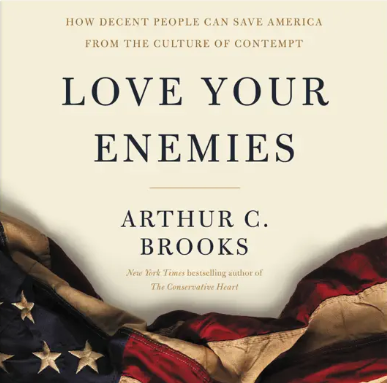
Interestingly, jar smile writing slowed down unexpectedly and disconcertingly these last few weeks. I sat down most nights with the intense desire to write, then found myself uninspired for the usual love notes. Fascinating. I managed to sputter out some decent ones for the Ethos jar before finally hearing the call. Lessons and insights from Love Your Enemies and Crowns swirl together like the sweetest soft serve ice cream in my head and heart, and that’s what I need to put into jars right now. I feel people’s desire for less adversarial, calmer, and more thoughtful discourse. I sense the distress so many feel that it may be a lost cause. It is not! There is hope! And I can literally ‘bottle it’ for us! I posted on Instagram tonight:

“Prepping to write mini jars of love notes for bridging work. Anybody want one?”
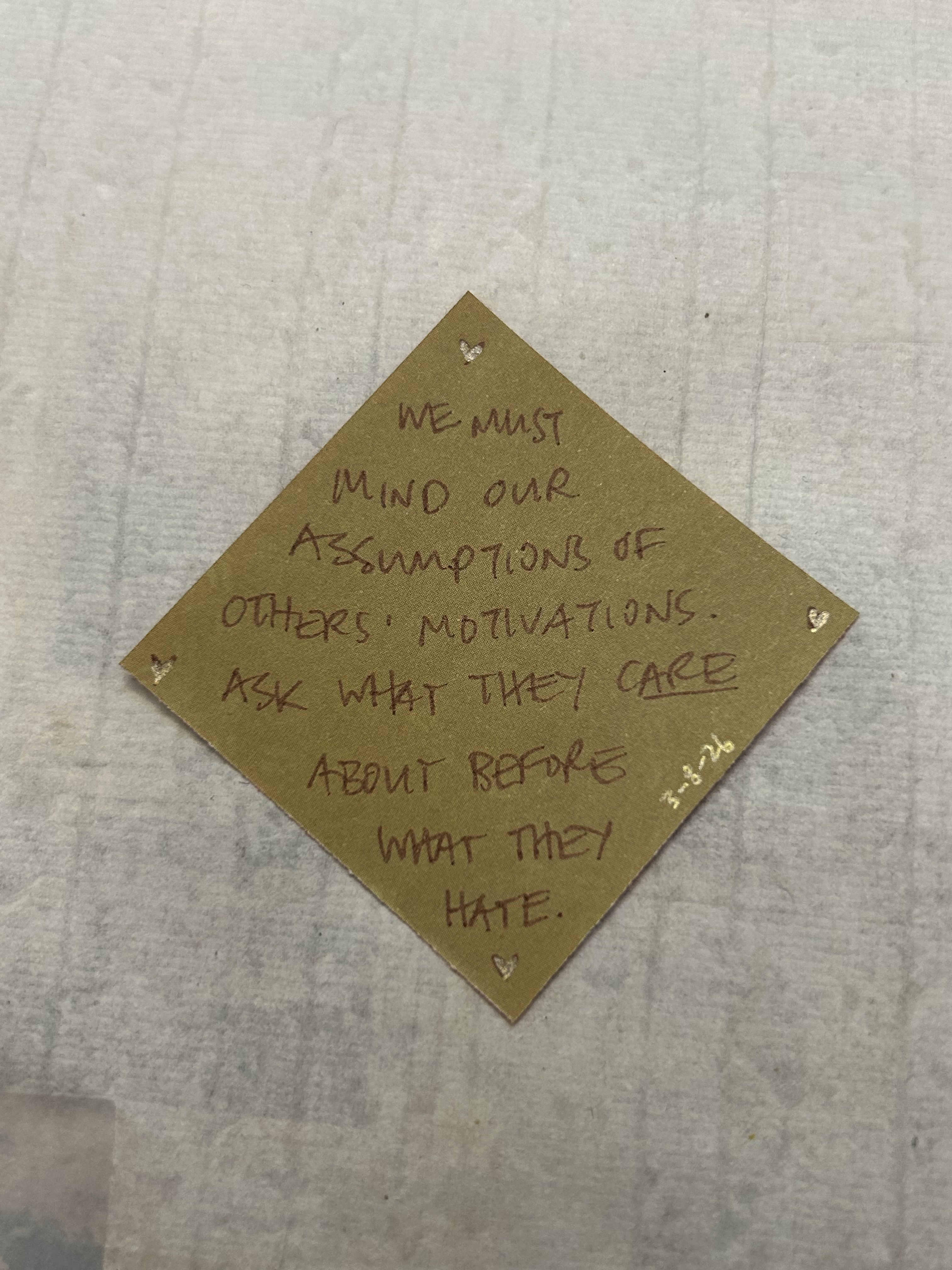
“We must mind our assumptions of others’ motivations. Ask what they *care* about before what they hate.”
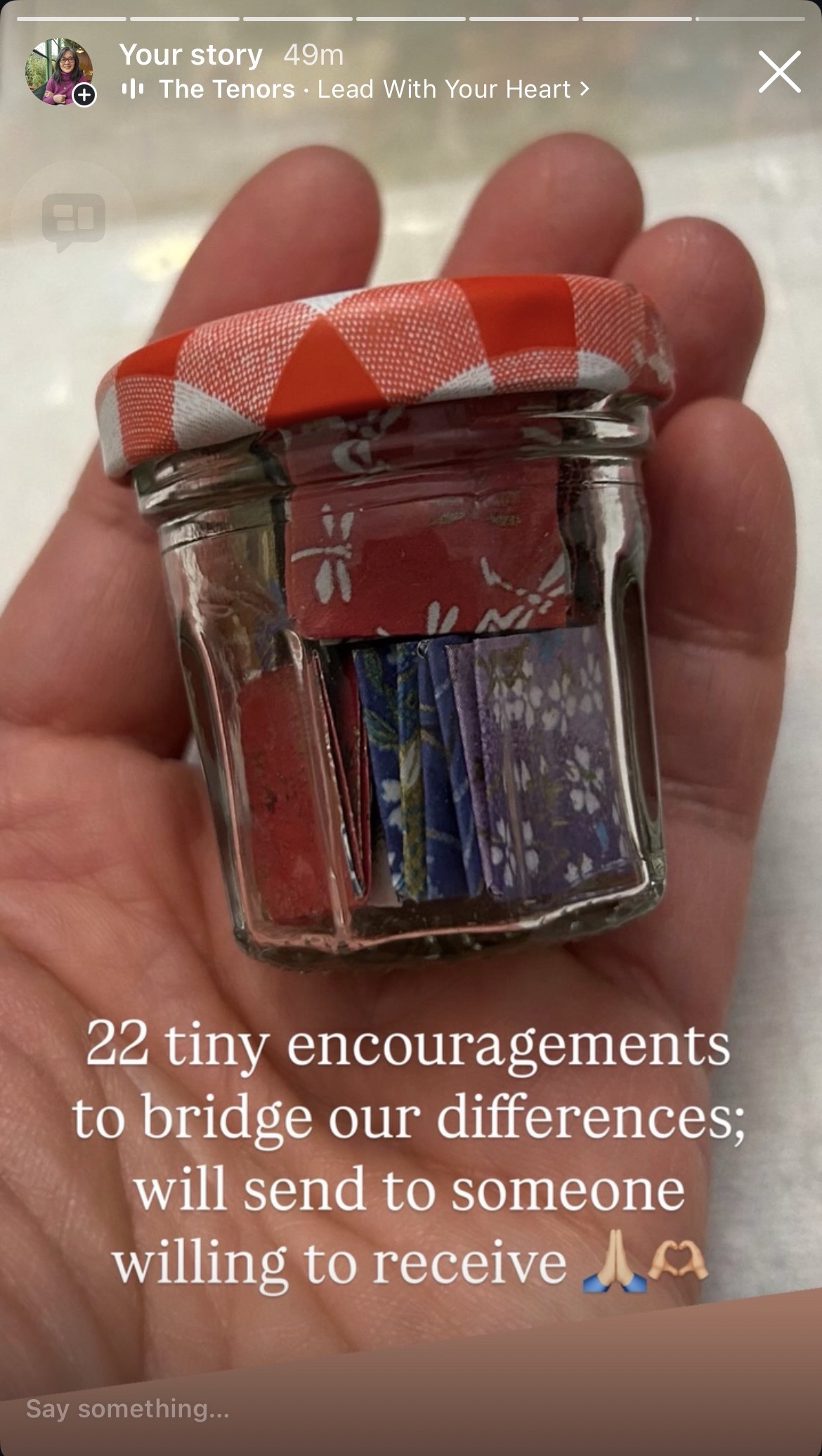
“22 tiny encouragemennts to bridge our differences; will send to someone wililng to receive.”

The first jar is already spoken for, and I feel inspiration rising to continue and persist.

So much good work to do, my friends. And I cannot think of a better way to do it than together. Epic love stories and tiny love notes help, of course.

This Is How We Do It

Thank you, Arthur Brooks, for giving us the manual that could save us.

Last night I traveled to northwest Indiana to cook and talk politics at my Red voting friends’ home. When we made the date I did not realize it would be just after Chinese New Year, though we agreed to make potstickers. My friends had bought a bowl full of Asian fruit to celebrate and we exchanged perspectives and opinions for six hours straight. I felt mildly nervous for days beforehand, but as soon as we got to chopping, wrapping, and talking, all anxiety fell away.

There was a lot of listening, questioning, explaining, and storytelling. It was all loving and connecting. I hope we continue to meet, cook, talk, and commune.

I had listened to Love Your Enemies this week and ordered the paperback to annotate; but I got the large print by accident. So I brought it to my friends’ house and offered it to them, which they enthusiastically accepted. I hope we can talk about its principles together soon, share the book with everybody we know, and maybe even expand our conversations to include others.

My hardcover arrived yesterday and I’m about 65% through reading and marking it up (it goes much faster after having listened). I hope to return here with highlights after today, but in case I don’t, here are four rules toward the end that would make everything better in all relationships and conversations, if we followed them regularly:

  1. Cultivate relationships “based on willing the good of the other and a shared sense of what is virtuous and true.” These are the friendships of honest caring and in which you do not fear disagreement. You each genuinely want to know why the other thinks or feels differently about something, that curiosity is founded in love, and you disagree respectfully.
  2. “Do not attack or insult. Don’t even try to win… The point of disagreement–if disagreement is to make us better and draw us together [which is Brooks’s premise in the book and I agree]–is never winning. It certainly isn’t to attack someone else. It is to enrich the discussion, test out your point of view in a respectful way, and persuade someone you care about.” Shaming, one-upping, jeering, name-calling and the like do no good. Please stop.
  3. “Never assume the motives of another person… To be sure, some people do harbor bad motives… But it is not reasonable to argue that malevolence and hatred are the animating fources behind the beliefs of the vast majority of Americans today. Worse than being just unfair, such a belief is too often based in rank ignorance… The truth is that highly partisan conservatives and liberals are shockingly clueless about the other side–about their motives and everything else. How many times have you heard a conservative pundit say that Democrats want to keep poor people dependent on the government to keep them voting Democratic? Or a liberal pundit say that Republican tax policies are all about helping Republicans’ wealthy friends?” The point is, individuals’ motives are complex and diverse within any given group, and they are often not nearly as nefarious or divergent from ours as the loudest and most extreme among us may scream.
  4. “Use your values as a gift, not as a weapon.” Examples: Someone who is pro-life calling someone who is pro-choice a baby killer, or someone in favor of gun control saying that NRA supporters care more about guns than children. “Values are supposed to be positive. Even if people disagree with them they aren’t supposed to harm others. It’s impossible to maintain the moral content of our values and use them as a weapon at the same time.”

I posted the following to my Instagram and Facebook accounts this week, and I extend the invitation to readers of this blog. We have work to do, my friends. The only way out is through. The best way through is together. I hope you will join me.

“Ok friends.

“I am filled with hope tonight. 🥰🙏🏼🥰
More and more people I know are inspired (or agitated) to do bridging work, and their skills, experiences, and perspectives are all so instructive, regardless of their politics.

“Looking through (Arthur Brooks)’s library in anticipation of his upcoming book, I found Love Your Enemies: How decent people can save America from the culture of contempt. Written in 2019, it is a cogent and humbling dissection of the state of our complex union to that point, and strikes remarkably prescient for our current toxic morass—culture of contempt on steroids!

I’m only about 35% through and it’s already both shifting and deepening my understanding of and approach to connecting across relational differences of *all* kinds. I have already ordered my print copy and I will mark it up with JOYFUL ENTHUSIASM!

“My friends, this is our moment.
“‘What can I do, I’m just one person?’ said seven billion people.”

“I want to share this book and this work with any of you who sense any inkling, any spark or movement of hope that you could participate, even in the smallest way. Because even if only seven of us start, our energy will ripple out. We *can* make a difference!

“So I have an offer/invitation:
I will gift this book, in the format of your choice, to you, my friends.
I have two conditions:
1. I know you in real life (online counts if we have interacted meaningfully and would meet in person if we were in the same city).
2. You agree to engage in one bridging conversation before July 4, with me or someone important in your life, as an earnest attempt at this work.

“My intent is to walk with, support, encourage, and hold you accountable on this important journey as we all learn, practice, and train together. If you commit to talking to someone else, I offer two thirty minute calls, one for coaching in advance, and one to debrief afterward.

“Comment here (I reserve the right to delete ad hominem etc) or DM me. Ask me questions. Share with our mutual friends.
My tank is full right now and my engines rev.
Let’s get to work! 👊🏼💪🏼👏🏼”

On the Eve of Re-Entry

https://www.bbc.com/news/entertainment-arts-59390446

Does the Great British Baking Show make you cry?

Daughter and I watched most of Season 9 (2021) this weekend and I teared up more times than all of 2025 combined. I sat down to write about it, then realized I did that already, back in 2019. So now what? Blog, Cheng. Write what’s on the mind.

Tomorrow I return to work for the first time since New Year’s Eve. 18 days off. I last took this much time away in 2021, a five month leave of absence for family crisis. Wow. I thank my lucky stars for colleagues who so generously cover, so I may leave in total confidence. Here on the eve of re-entry, I feel strongly ambivalent–eager to resume my professional identity and also reluctant to exit the bliss of vacation.

Son and Daughter were home for five and six weeks, respectively, perhaps the longest we have all been together since Son started college in 2022. We took a family trip to London, then Son and I went to Colorado together. I got quality time with both kids, all together and one-on-one. I shake my head at the gift, heart full to bursting. I also see their sibling relationship evolving, which warms me. My momness heart was made for adult children. The bulk of hands-on parenting is complete and now I get to reap the rewards, hallelujah. I did okay; they’re okay!

Son returned to college yesterday; Daughter goes back in two days. I miss them both now more than ever–what is that about? When they were both home for Thanksgiving, twelve weeks after emptying the nest, I realized afresh how anxious I am about their health and well-being when they are here. Out of sight, out of mind is not necessarily a bad thing in parenting, I thought sheepishly. So I knew to expect it this holiday, and managed it a little better, yay! Son has proven himself independent and capable for years now, and Daughter managed herself remarkably maturely her first semester of college. I can safely and confidently loosen my watchful grip and step more fully into advisor mode. Wow.

Everything changes. I should have known that this new life phase would be a longer transition than just those first few months of lone couplehood again after 22 years of 24/7 parenting. It was positively blissful, and these past weeks of whole family togetherness required more psychological adjustment than I had anticipated. I make no assumptions now–how will I feel come Wednesday, when it will be another seven weeks before Kids return? I hold my psyche open to any response. Son will live at home this summer for the first time in four years–three whole months! I cannot wait. If Daughter comes home too, holy cow. We will all re-negotiate new family dynamics–bring it! My conversations and observations with both of them this break make me so proud and grateful–they are my people–curious, creative, sensitive, and mature. I relish the chance to witness their further growth and development.

Bake Off, with its loving and creative connections forged among contestants while they rise to repeated challenges together, this amazing expression of all that is good about people and bringing out our potential for one another, stirs all that I hold dear for myself, my children, my patients, friends, colleagues and the world. Take the risk. Do your best. Support others in doing the same. No wonder it makes me cry.

2026 feels portentious, more so than recent new years. I feel a strong desire to be even more mindful, intentional, alert, and aware of my attention and expenditures. The Opal app continues to mitigate my social media use. I feel less driven now to post and share, and it’s a very good thing. I intend to write a lot more this year. I will do some deeper inner work with Grant Gosch. I will complete at least one, good, unassisted pull up! I will continue to nurture and cultivate the relationships that matter most, and also open myself to any new connections that emerge with that cosmic twinkle I recognize so well. I will trust myself to know when I know, to hold on or let go according to my now well-trained, middle aged intuition.

It’s all good. Maybe I should take a few weeks off at the beginning of every year?