The One and the Many

How do you change your words or message depending on your audience?

Weeks ago I read an article sharply criticizing public health messaging throughout the pandemic, and took a hard look at my own communication over the past year.  A year ago I wrote a series of posts on COVID, which were generally well received.  I have consistently taken a very conservative approach to mitigation, admonishing people to avoid gatherings and travel, mask up, and be patient.  In my public messaging, I have not directly addressed the mental, emotional, economic, and social costs of all of these measures. 

But what about in my private conversations?  How are they/am I different?

I thought of two groups with whom I interact:  Those whom I know personally, who trust me, and who think similarly to me, and those whom I don’t know, who may not trust me, and who think/believe differently from how I do.  Okay so six groups, not two—and they can overlap—I have patients who trust me and think very differently—but I think my messaging generally takes one of two approaches depending on my audience.  And in the end, I think it comes down to trust.

The One

When speaking to one person whom I know, or someone who agrees with me, two assumptions are at play: 1) they trust me, and 2) I trust that they trust me.  It sounds semantic, but I think it matters.

In this situation, I’m probably much more willing to admit uncertainty, and to ‘negotiate’ my position because I trust that my counterpart understands and respects my concerns.  So I’m willing to show vulnerability in my expertise because I trust that they know I will incorporate new information and update my recommendations.  I also trust them to know that it’s not because I’m stupid or gullible or on some kind of power trip—we’re all just learning and trying to balance everything that matters in a rock vs hard place situation.  When engaging in mutually trusting conversation, even in disagreement, openness, curiosity, and ambivalence can be taken as humility and seeking truth rather than weakness and lack of conviction, and both parties may be more likely to walk away with broader, more nuanced perspectives.  And best of all, the relationship can be strengthened, allowing for continued engagement, learning, and growth.

The Many

Posting to the blog or on Facebook, I think I run a much higher risk of being misunderstood.  I am responsible for providing clear and concise context for any expression or opinion.  My audience is diverse, and depending on any reader’s mood or context themselves, my words may be interpreted very differently one day or one moment to the next—and I have no control over that.  Do they trust me?  Can I trust them to assume my humility and good intentions?  Unclear.

In this space, depending on my mood, perhaps, I may feel defensive, and/or a deep desire to prove myself right.  I may be much less willing to admit to gaps in my knowledge or flaws in my reasoning, for fear that my expertise will be wholly discounted if one aspect of my interpretations or recommendations is imperfect.  If I assume my audience does not trust me, then I’m less likely to trust them to receive my intended message, to take my advice, and achieve my primary goals.  I get preachy, narrowing my perspective and failing to see more than my own point of view.  I ask fewer questions—that is always a red flag.  I make more assumptions, defensiveness increases, and my mind closes further.  It’s an emotional hijack of sorts, resulting in further disconnect and polarization.  Yikes.

Or maybe, just because I don’t know how my message will be perceived, I qualify and hedge, and lob ideas much more passively, inadvertently conveying that I don’t really believe what I’m saying, that I’m actually not trustworthy, just wishy-washy. 

So what should I do?

I think one solution is mindful attunement and differentiation.  As a communicator in relationship of any kind, but especially when I’m the expert, it is my responsibility to manage this dynamic polarity intentionally.  Face to face, I can make sure the other person feels seen and heard, by asking more questions, paraphrasing, reflecting their values and goals back to them.  When writing for an audience I cannot see or hear, I can respectfully acknowledge opposing opinions and their validity, before presenting my own arguments.  Above all, I can hold a larger space for everyone’s values, concerns, and objectives.  I see you.  Please see me.  What do we both care about?  What trade-offs are we willing and not willing to make to achieve our shared goals?

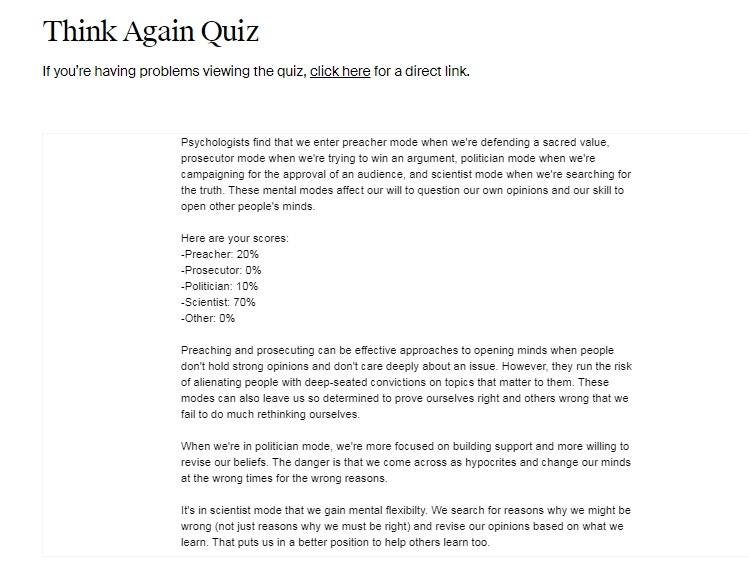
Results from my Think Again quiz, March, 2021

Adam Grant’s new book, Think Again, will be my personal and professional bible for a while, I think.  Its central tenets are intellectual humility and cognitive flexibility.  I may speak and write like a preacher about things that matter deeply to me.  But I will strive to think more like a scientist, seeking truth and connection above winning arguments and/or proving other people wrong.

In the end, as I practice myself, I will observe and apply these principles in other arenas.  Can we keep attunement and differentiation in mind when we hear leaders and politicians speak?  When a constituency is diverse, and an issue complex, can/should we expect a public figure/expression to convey nuance in generalized statements?  I say yes, absolutely.  I think we should hold leaders, as ourselves, to a much higher standard for acknowledging complexity and uncertainty.  Oversimplified sound bites divide and incite, and we should all reject them, strongly.  We can address complexity and uncertainty without inciting mass panic if our statements also clearly convey conviction to core values, and what we are for more than what we are against. 

We can all/each elevate the quality of both private and public discourse if we help one another feel connected throughout.  That means earning trust, and there is no substitute for the work it takes to do this.

The Value of Comradery

I’m having a party!

Well, not really.  I’m inviting colleagues to convene on video in the name of professional community and connection, so it’s almost a party.  It’s also my homework!

These six weeks I get to take Stanford’s inaugural online Physician Well-Being Director Course, along with over a hundred other physician leaders.  What a privilege and pleasure!  I’ve already learned so much, and we’re only one third of the way through.  I may have made a new friend—we bonded over our shared tendency to stress eat, and that we are both using the Noom app to overcome it.  It happened during a breakout session to sample a Comradery Group.

Turns out there is clear evidence that community building, done intentionally and purposefully, promotes clinicians’ overall well-being.  “Well, duh,” you might say (I have).  Why did this have to be studied formally?  But I get it now.  When there is objective evidence for direct benefit and a positive cascade (well physicians tend to have higher engagement, higher patient satisfaction, happier teams, and systems that thrive—relationally as well as financially), healthcare organizations are more likely to invest resources to execute the well-being programs shown to work. 

In a Comradery Group, the objective is more than just venting.  It’s about finding meaning, fostering growth, and supporting one another through empathy, querying, and sometimes even challenging—all in a psychologically safe environment.  Groups meet to discuss particular topics and are admonished to stay on task.  There is usually a facilitator.

I have always found communing with colleagues nourishing—particularly across specialties.  More and more, we toil in silos.  Advancing technology accelerates complexity of both diagnostics and therapeutics at breakneck speed in almost every field.  Everybody can barely keep up with their own work, let alone understand what’s happening in anyone else’s.  And with in-person conferences and other professional gatherings banned for the past year, our sense of community wanes further and faster.  Our disconnection propagates insidiously, and we will all pay in the end, physicians and patients alike.

So what better moment to tend and strengthen our connections?

I have a few colleagues from internal medicine, OB/gyne, ophthalmology, and orthopaedics ready to gather in meaning on Microsoft Teams.  Can’t wait can’t wait!  The first rule of Comradery Group is that what’s said here stays here; holding confidence is key to connection and trust.  We can set other rules at our (first) session.  The homework assignment is only to experience a group once, but my secret hope is that my colleagues will get enough from this meeting to consider doing it again (and again!). 

I’ve proposed some sample topics below.  I’d love to discuss any of them, and I’m sure my friends will suggest others.  Take a look—how could you adapt these questions to your own profession?  How are you and your colleagues at risk for burnout, and how do you imagine Comradery Groups could help?

Here’s something new for the blog:  If you answer one of the questions in the comments, I’ll share my own answer to the same in reply (or a separate post!).  Please also feel free to offer a different question, one that holds meaning and importance to you.

Times are hard and complicated.  We humans are social creatures.  The better we can maintain and strengthen our ties to one another, the less we will suffer—no—the more we will flourish

Onward, friends.  We are all we have.

  1. How has doctoring the past year through a global pandemic impacted your professional and personal outlooks?
  2. What lasting lessons from the past year do you want to keep front and center?
  3. What do you want most from your colleagues in other specialties?
  4. How would you change medical education?  Why?
  5. How have you seen medical culture evolve over your career, for better and/or worse?  How has this impacted your personal experience of your work?
  6. What concrete changes have you made to the way you do things, over the years and the past year?  What do you miss and not, about the way things used to be?
  7. What makes a hard day at work?  An easy day?  A good day?  A bad day?
  8. What is your preferred leadership style, as both a leader and one who is led?
  9. What is the value of DEI initiatives at work?  What are the barriers?  Pitfalls?
  10. What’s foremost on your mind right now for your own well-being?  How are you upholding it?

The Intention-Impact Gap

Years ago I had a hard conversation with a Black classmate.  He explained to me the experience of being Black in America—what it was like to worry about his own safety and that of his loved ones every day, of seeing innocent Black men killed at the hands of police, the history and ongoing oppression of racism, both overt and implicit…  It was overwhelming.  I said, “I can’t imagine what that must be like…”  At the time I honestly meant it as an expression of humility.  In retrospect, I could (should?) have said, “I know I will never experience what you experience, AND as I think about what you have shared with me, I AM imagining what that must be like, and it’s overwhelming.”

Though I had intended my words to be connecting, he told me in no uncertain terms that they had the opposite impact.  Really, he asked?  You really can’t imagine what it would be like to send your son out every morning knowing he could be profiled by police?  You can’t imagine your family being captured and sold into slavery, separated mercilessly on an auction block, or hunted, mutilated and murdered for simply being different?  How can you not imagine it?  Where was my sense of shared humanity, he demanded? My declaration of “I can’t imagine,” far from showing caring or understanding, signaled to him my unwillingness to relate.

At first I felt defensive and misunderstood.  Why was he rejecting me when I honestly thought I was being supportive?  I had to think about it a while, and really listen for what he was saying.  It was painful and humbling to realize that he was right, at least partially.  I could imagine all of those things, but maybe I didn’t want to.  Maybe it was too uncomfortable, and I exercised my privilege of not having to think about it, because it didn’t affect me personally?  Maybe it made me feel helpless?  Maybe I knew on some level that I harbor racist and prejudiced biases and ideas?  My classmate was teaching me the difference between empathy and sympathy.  Brené Brown makes the distinction thusly:  “Empathy fuels connection, while sympathy drives disconnection.”  I had intended the former; my impact was the latter.

I can own this now, years later.  I practice more mindfulness around my words.  I watch for my impact—is it what I intend?  If something I pitch lovingly lands hurtfully, then I need to examine my actions, and maybe even my (deeper) intentions.  I don’t control how someone receives my message, and I can also do my best to express myself the most honestly, authentically, and clearly.  I hardly ever say, “I can’t imagine” anymore.  Because if I want to support someone, I must imagine.  The person needs to know that I’m doing my best to relate—to connect.

Today when someone says they “can’t imagine” my experience, I notice my own discomfort—these words feel ambiguous at first.  So I need to look around.  What is our relationship?  What is the context of our encounter?  What story do I tell about their intention?  How does my story impact their impact on me?

As communicators in relationship, if we are truly committed to fostering connection and community, then we must step up to an important challenge.  We must all mind the intention-impact gap, as both senders and receivers of any given message.  Marc Lesser recommends:

  • Notice how you are impacted by other’s words. In particular when you feel hurt or vulnerable, do you assume intention? Does blame arise? Can you experiment with being more curious?
  • Notice how your words impact others. Pay attention to when you sense that there may be a gap between your intention and the impact of your words. Can you be open and explore how to align your words, intentions, and their impact?

When did you last fall into the gap?  What did it cost you, your counterpart, and/or your relationship? 

How can we each and all help one another mind (and bridge) the gap?