Flexibility, Grace, and Peace

MOM FAIL!

We missed the PSAT registration deadline last week.  Turns out there was an email, the information was at the bottom, and I had not scrolled down far enough.  Apparently Son was also not aware…  So we both felt badly, a little despondent, wondering what difference it would make in his future.  Last night I finally admitted that my heretofore laissez faire parenting style may fail even harder pretty soon, so I texted my uber-school-engaged mom friend, and she saved me.  I’m sending her a pack of washi tape cards to thank her.

Today I was prompted to consider my assumptions—the mindless ones I make and then fly by on autopilot.  “The kids take the lead and tell me what they need for school, like I did when I was their age.”  It’s not just an assumption; I have trained them to take responsibility and initiative for school related things.  Rather than a helicopter or ‘snowplow’, I see myself as a drone parent—one with an occasionally glitchy camera and a fully operational weapons system.  This minor lens failure served as a timely tune-up trigger.  Humbled and grateful, I commit to doing more frequent and vigilant systems maintenance.

Looking back at five years of Healing Through Connection, learning emerges as a recurring theme.  I focus on relationships as the primary application, and I’m proud of my progress in this domain, both personally and professionally.  But these last seven months, I realize the profound importance of learning as the foundation of existential flexibility and adaptation.  And I don’t mean formal education; rather it’s life learning:  pattern recognition, empathy, communication, discernment, and connection.  When we keep ourselves open to this qualitative, intuitive learning, integrating new information from any source at any time, we develop resilience.  Resilient structures and people can bend without breaking.  We take deformations, sustain scratches and dents.  And like my favorite Coach leather handbags, life lessons make us supple and soft.  Without losing strength, we gain elasticity.

For perfectionist overachievers (POAs), however, learning from failure can cost us.  Failure triggers judgment, often snowballing into guilt, shame, and self-loathing.  If we happen to hold positions of power, our failures may affect many others.  Justified or not, we withstand wrath and hostility, which then compounds our humiliation.  In this time of relentless anxiety, many of us are fraying at the edges, and some are actively unraveling.  Relationships and wellness disintegrate in cascades of incidental destruction.  How can we keep holding it together with no end, or even respite, in sight?

More and more I look for grace, toward myself and others alike.  It feels akin to generosity and forgiveness, and also separate and distinct from these (which also really help at times like this).  Merriam-Webster lists “unmerited divine assistance,” mercy, favor, and pardon in its definition of grace.  That sounds about right.  Sometimes we must call on forces greater than ourselves to get us through.  I identify spiritually as Catholic and Buddhist—Cathuddhist.  I have prayed and meditated a lot this year, mostly for peace, strength, compassion, resilience, and integrity.  Now more than ever, I need to show up my best self for everybody around me.

And that starts with presenting my best to and for myself.  I draw on the unconditional love and support of so many; I open and let it permeate me.  Unmerited and divine, no question—and so deeply nourishing.  Self-compassion takes practice and persistence for us POAs—more than we like to admit.  It’s work.  And the rewards, for us and all whom we touch, are more than worth the effort. 

Make me an instrument of your peace, St. Francis asks of God.  Amen, amen, amen.  With flexibility and grace, let me live peace through and through, so that all who encounter me may benefit from it and me. 

The only way out is through.  The best way through is together.  Let me do my part.

Toxic Individualism and Service

At first I called it ‘abject individualism.’  Not sure which will be my final phrase—which will catch on?  Do you already know what I mean? 

It goes beyond selfishness, really.  It’s a culture, an ethos; it took root somewhere in early American history and has infiltrated the collective psyche with exponential acceleration in my lifetime.  This mindset values winning over service, status over integrity. “Eat What You Kill.” It is myopic, and it so permeates our daily interactions that we hardly even notice.  It steeps us in competition, scarcity thinking, and righteous anger.  Toxic individualism, while not the sole driver, contributes mightily to division, negative tribalism, and violence.

I won’t go into detail here, but I see it in so many realms: media, finance, environment, education, and healthcare, among others.  A cumulative movement in policy and deregulation that favors competition over collaboration, and removes incentives for long term resource renewal and sustainability in favor of short term gains, grips our culture.  It’s all about looking good and getting mine, to hell with everyone else.  Most of us probably don’t identify with this most of the time, but consider how we think and act under stress.  When we feel our own families threatened by circumstances like a pandemic knocking at our door, how did we instinctively respond?  Contract, protect, and suspect.

Of course, this is a natural survival response to threat.  I would never advocate for ridding ourselves of it.  And, when a culture’s balance between self-protection and group connection tips too far and too long toward the former, especially under collective stress, bad things happen.  Successful social living is always a give and take proposition.  In order for us all to be well, we all have to make sacrifices sometimes for the greater good, namely and often first and foremost, our comfort.

I will have facilitated two calls this week on ‘elevating our conversations.’  The central premise is that in order to communicate effectively across differences and disagreements, to problem solve in the face of divergent perspectives, we must tolerate more discomfort than our current cultural ethos often allows.  We must stand in openness, curiosity, humility, generosity, and fairness.  Too often today we are rewarded (instantly gratified) more for standing rather in defensiveness, stubbornness, righteousness, and ad hominem. 

This hyper-individualist attitude translates to the collective:  If you’re not with me (us) all the way, you’re with the enemy.  Dissent within a tribe is quickly suppressed and punished.  It’s us against them, black and white, right against wrong, no exceptions, no nuance, no discussion.

The antidote for this poison is service.  A service mentality puts the collective good at least on even footing with that of the individual, if not elevating it.  Service activities and professions center around giving, selflessness, and responsibility for others.  Teachers, healthcare workers, and military servicemen and women understand this intuitively.  We need one another—for us all to be healthy, we all need to look out for each other, thereby keeping each other healthy—for society, and thus all of its individuals, to truly thrive.

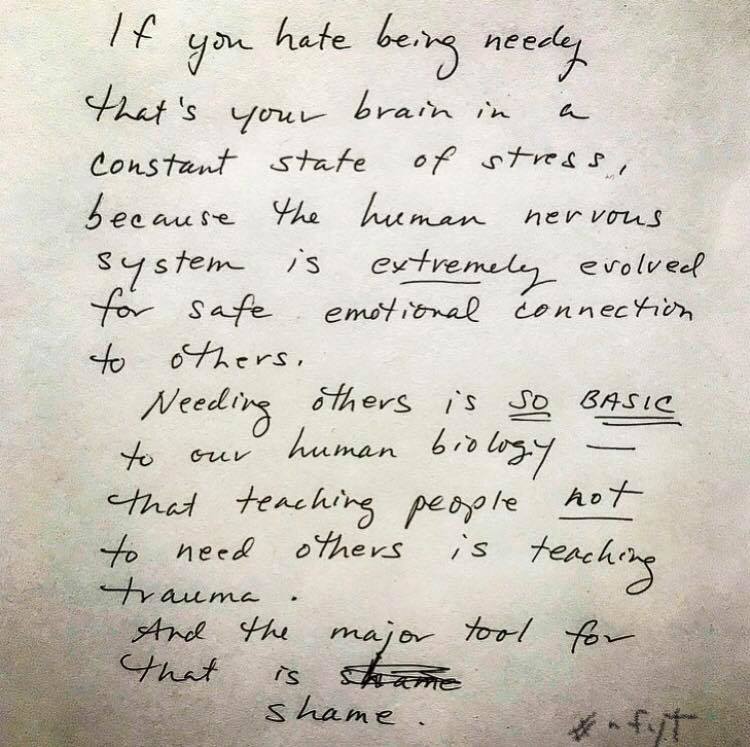
It’s not weak to need others.  Individual strength is necessary, important, and admirable.  So is interdependence, relational connection, and emotional cohesion.

https://www.allysondinneen.com/therapy-great-barrington

Simon Sinek interviews General Stanley McChrystal on his podcast on quiet service .  Their conversation resonates with me so deeply right now.  It’s not either self or group. It is always both and, in dynamic balance, holding tension for some competition, and also much collaboration, creativity, synergy, and progress.  See some highlights of the “A Bit of Optimism” episode below.

What are we each doing to keep the fabric of society from tearing? As we care for ourselves, how can we also care sincerely for others? How will our culture be better for our having lived?

3:34  Sinek suggests that the call to service has declined.  McChrystal:  “That sense of responsibility… has decreased… In some ways you say well, everybody’s their own person…  The problem is it’s hard to run a society like that… It’s hard to have those things which we do better jointly than we do individually.”

4:27  Sinek:  “There’s a paradox to being human…every day we are both individuals but we’re also members of groups, and we have responsibilities to both…  We’re all trying to learn how to take care of ourselves, but where are we learning how to take care of each other?”

5:40  On civilian national service for young Americans, McChrystal:  “You can plant a seed through behavior, getting them to do something for a year… They won’t like it every day, but they’ll come out of it differently,… more thoughtful…  Healthcare, education, the environment… there is so much room for people to give…  and they come out differently themselves—they are the real product.”

7:40  Sinek, on the race to get mine or else someone else will get it, referencing Naval commander David Marqet:  “Force a change in behavior, then people change what they’re thinking,” rather than the othe way around.  McChrystal responds with the example of someone running for public office, asked how they have served.  Sinek:  We should ask of polilticians, do they serve us or do they serve themselves?

11:30  On the push for equality, McChrystal:  “Every young person… should have a roughly equal opportunity in life, should be our goal, shouldn’t be able to argue against that… (13:00) for example healthcare—every American (should have) healthcare not because it’s fair but because it’s smart for society…”

15:35  Sinek:  “How the heck are we going to inspire people to want to do something that comes at personal sacrifice?”  McChrystal:  “I think people want to be inspired… they’re just…waiting to be asked.”

24:33  Sinek on quiet service, humility:  “A lot of the stories you tell are about quiet, and about being humble…  Maybe the lack of service is a symptom that we’ve lost our humility, as individuals, as a nation…”

Revel in the Awesomeness

What’s really awesome for you lately?

I had such an endearing conversation with a friend this week.  A new empty nester, he reflected on this new perspective.  Having spent so much time and energy focused joyfully and lovingly on his children the last couple of decades, he now has some of that time and energy ‘back’, to do with what he chooses.  And it seems he chooses in part to appreciate the awesomeness of his life a bit more.  Fabulous marriage, meaningful and fulfilling careers for both him and his wife, a chance to make a positive difference in the world around him, and happy, healthy kids.  Yay! 

I absolutely love hearing people revel in awesomeness, don’t you?  Is it not totally inspiring?  When was the last time you looked around and truly appreciated the goodness all around you?  It’s a vulnerable act, if we’re honest.  Too often it feels like tempting fate, ‘jinxing it’, to call out all that is going so well, so right.  So we keep joy at bay, we keep striving, always looking for how it could all be better.  Huh.

What happens when we allow awesomeness to envelope us, penetrate us, move us? 

I think the first thing we get is a deep sense of wonder.  How could it be so good?  How is it even possible?  And it doesn’t even have to be anything big.  I have a cold—fever, congestion, headache, fatigue, body aches, mental fog.  And yet I can hydrate, medicate, and slow down, and still work (not in person!) and take care of the family.  The parameters for normal operation in the human body are remarkably narrow.  And yet multiple systems can be widely deranged, and we not only survive, we function at about 90% or better for the most part.  What an amazingly evolved machine, with perfectly orchestrated and automatically, effortlessly effective redundancies!  HOW AWESOME!? 

For me, from wonder grows gratitude.  Some people can’t actually tolerate a cold so well, but I can.  Some people don’t have access to excellent healthcare, but I do.  Some people don’t have the marriage, career, and kids that my friend and I have—but we do.  And we are grateful.  We don’t have to feel shame or guilt for having it ‘better’ than anyone else.  Everybody has their challenges in life, us included.  And still, counting our blessings is a great way to get perspective in any time, hard or easy.

Gratitude, then, is the fountain from which generosity springs.  I wrote about this in 2015:

When I feel grateful, there is enough. I am enough. Even just saying the word, seeing it on the screen, brings me to a more peaceful state of mind and body. It brings to mind the people in my life—my parents, husband, children, friends, colleagues. I recall instances when someone went above and beyond to help me, or when they thought of me and took to the time to call or write. I feel humble. I feel connected.  I want to share what I have with others.

When we truly revel in awesomeness, then allow wonder to infiltrate our psyche, then bask luxuriously in deep gratitude, how can we help but wish for everybody to have what we have, to feel what we feel?  If I can have all this, when life is this abundant, how can I help but share?

Finally, I believe reveling in awesomeness is the seedbed for my activist heart.  I have much and I strive to share freely.  I wish for everybody with much to share with those who have much less.  I wish for our culture and society to make it easier, through policy, for all to have more than enough, for that to be the default.  These days I have cynicism-optimism whiplash at ever higher speed and intensity.  I see so much self-absorption, biting competition, and scarcity thinking.  Sometimes I just want to shake people and yell, “Look UP!  We have so much potential for good here, if we only choose to see it!”  But I realize folks don’t always appreciate this approach.  So for now I can simply revel out loud for myself, in all the awesomeness I experience every day.  And like my friend did, I can share the light I see—emanate it—and I can keep making a difference starting from there.