
Decide in Advance

be the lighthouse

NaBloPoMo 2018:  What I’m Learning

It’s the first Sunday of November of an election year.  The political ads are ramping up.  Tension rises; the agitation is inescapable.  Some media would have you believe that one outcome or another is all but inevitable, the world will positively end if one side or the other wins.  I admit, I have felt my share of darkness and despondence at the words and actions of some (many), not just the last two years, but for a long while now.  It’s hard not to feel sucked into an inexorable downward spiral of animosity and rage.

Thankfully, I still hear voices of uplift, words that speak to the optimist and idealist in me.  Let me share some of those voices and words with you here.

* * *

My friend Donna Cameron, an expert on kindness, reminds us that we have a choice, not just on election day, but every day before and after, about how we conduct ourselves with one another:

We have to ask ourselves now, before we know the outcome of the election: Do we want a united country? Are we still capable of coming together to productively and positively address the complex issues that have divided us?

Civility and compassion are not weak. It takes strength to accept loss and move forward with resolve rather than bitterness. It takes strength not strike back when our buttons are pushed or our values are derided. It takes strength to recognize the pain someone else may be feeling and not belittle those feelings or dismiss their right to grieve.

Don’t look to the politicians or pundits to lose—or win—with grace. They’re going to be gloating in victory and blaming in defeat. It’s up to us to model what constructive behavior looks like and to demand it of our elected officials.

But what can we actually do?  How will we know when to act, and what to do in any given circumstance?  Isn’t it just too abstract to say, “practice empathy,” or “be compassionate?”  Maybe.  But if these are values for us, then we can translate them into actions and practice.  Empathy manifests as active listening, holding one’s tongue while hearing someone else’s story, resisting the urge to interrupt and tell our own story.  It means relating to their feelings and expressing understanding and solidarity.  “That sucks, I know that feeling, Me, Too.”  Empathic listening, validating words, and simply sitting with and holding space are good practices to start with.
The Southern Poverty Law Center offers 10 concrete steps to fight hate.  Examples include:

Repair acts of hate-fueled vandalism, as a neighborhood or a community.

Use whatever skills and means you have. Offer your print shop to make fliers. Share your musical talents at a rally. Give your employees the afternoon off to attend.

Report every incident.  Pressure your representatives.

Finally, look for role models.  If you have not read Ari Mahler’s personal account of caring for Robert Bowers in the ER, please click on the link now.  He is ‘the Jewish nurse.’  What would you have done in his place, called to the trauma bay to care for the man who may have just killed members of your family for their religion?

I’m sure he had no idea I was Jewish. Why thank a Jewish nurse, when 15 minutes beforehand, you’d shoot me in the head with no remorse? I didn’t say a word to him about my religion. I chose not to say anything to him the entire time. I wanted him to feel compassion. I chose to show him empathy. I felt that the best way to honor his victims was for a Jew to prove him wrong. Besides, if he finds out I’m Jewish, does it really matter? The better question is, what does it mean to you?

* * *

Sometimes I wonder if my posts are redundant.  I have decided to think of them as iterative.  Looking back, I found a couple of posts relevant to today, written in similar periods/mindsets of portent, reflection, and seeking.  Right before January 20, 2017, I shared words I had written to friends.

They represent my intentions for managing myself in the coming years, of reinforcing my core values and focusing on my highest aspirations.  As Simon Sinek posted once:  ‘Fight against something, we focus on what we hate.  Fight for something, we focus on what we love.’

Months later I connected with conservative friends in an attempt at mutual understanding. It was not as comforting as I had hoped; I did not really feel heard or understood.  And I learned a lot about managing expectations.

I admit that I felt a little defensive at times, as if anything I said about the origins of my distress would be met with, “You’re overreacting,” and “You’re worried about nothing, please…”  We later agreed that it is never helpful to invalidate someone’s emotional response to a stressor, regardless of whether or not we can relate.

Last week I had a new opportunity to hear a colleague’s conservative point of view on gender.  With practice, I have become so much more comfortable sitting back, listening for understanding, quieting my inner debater.  My urge to counter and convince did not escalate.  I heard earnestness, confusion, some fear, and mostly a desire to understand and integrate, to find balance and peace.  I was not asked for my opinion, and this time I was okay with it.  I hope we can engage again and again in the future.

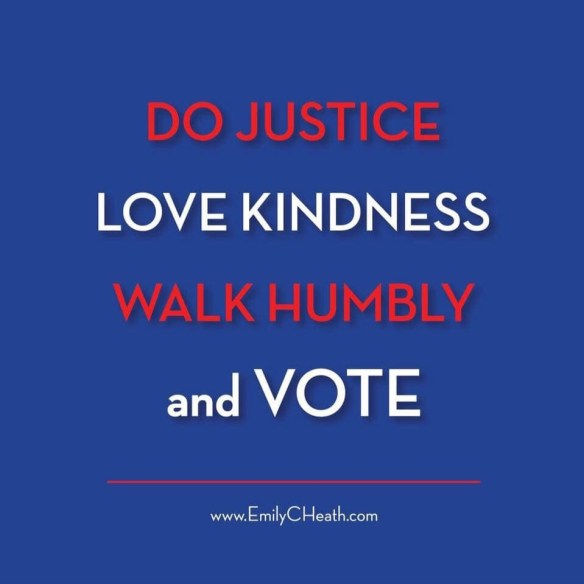
Today, two days before we all head to the polls (if we have not already—please please vote), we can decide what kind of neighbor, colleague, friend, parent, child, coach, teammate, employee, boss, coworker, and American we want to be.

What if we choose to be the kindest, most empathetic and compassionate ones we have ever known?

Moving On From the Last Two Weeks

N 10 Mile Creek Trail Aug

Hello again, friends!  Is this the longest I’ve been away since I started this blog?  Can’t remember, doesn’t matter!  Good to be back!  Hope you all are well. J

I aim to get back in the swing of writing before November’s National Blog Post Month, or NaBloPoMo, as it’s known… I have my list of potential topics all laid out, can’t wait can’t wait!  So here is the first of four weekly posts I hereby commit to attempting in October.

Soooo…  Is anyone else as mentally and emotionally exhausted as I am these past few weeks?  It would take too long to write it all out, and I am really trying hard to get to bed on time these days, so suffice it to say here that it’s been ugly and damanging to many, and we had all better figure out how to move forward lest we eat each other alive.

Throughout the debates on sexual assault, teenage promiscuity, alcohol use, judicial temperament, character, and integrity, I have truly appreciated voices that speak to our higher capacities for connection and understanding.  More specifically, I have sought people on one side of an issue seeking to bridge the gap between theirs and the other.  Now that the deed is done, I look back on the most thoughtful articles, the ones that give me hope for the future of civil discourse.

First, Benjamin Wittes wrote two pieces for The Atlantic.  Initially he laid out how Brett Kavanaugh could present himself such that we Americans could sleep at night with him on the high court.  Despite the impossibility of proving or disproving the allegations against him, Wittes argued, it was his responsibility to convince us that he is truly worthy of the post.  After his rageful and disrespectful performance at the second hearing, Wittes wrote again, expounding on why the judge, despite his legal qualifications, should not be elevated due to his apparent lack of candor and the caveat that would always follow his opinions.  In both pieces, Wittes makes clear that he has no problem with conservatism and Kavanaugh’s jurisprudence.  But as a progressive myself, I felt reassured by Wittes’s words that someone on ‘the other side’ understood my concerns and validated them.

I read a lot of social media posts pointing to the devastating sequelae for men when falsely accused of rape and sexual assault.  I felt gratified to find at least one article reviewing evidence and statistics for this, basically showing that the number is vanishingly low, compared to the incidence of actual sexual assault and violence.  When I post such articles, though, my friends who support Kavanaugh’s nomination are unlikely to read, and more likely to feel I simply ignore their concerns.  So when I found this article, written by Emily Yoffe, a victim of sexual assault herself, advocating due process for the accused, I wanted to share.  I thought that by acknowledging and validating ‘the other side,’ I might open a window for my point of view to enter my “opponents’” minds and prompt consideration.

I admire Senator Murkowski from Alaska, for voting and speaking her mind, pointing us all to the larger picture of the integrity and reputation of our democratic institutions, while also pointing to and maintaining the humanity of all involved.  And then this article by Howard Zinn from 2005 came across my feed this weekend, reminding us citizens of our role in the workings of government and societal progress.

Finally, I was able to unwind with the kids today by watching some Avengers movies.  We like Black Panther in particular, with its epic vistas, futuristic technology, and rich cultural backdrop.  At the end, when King T’Challa addresses the United Nations, his words struck me as exactly what we need across our country and indeed around the world today.  I may print and post them by my bed, to remind myself of how I want to think, speak, and act:

We will work to be an example of how we, as brothers and sisters on this earth, should treat each other. Now, more than ever, the illusions of division threaten our very existence. We all know the truth: more connects us than separates us. But in times of crisis the wise build bridges, while the foolish build barriers. We must find a way to look after one another, as if we were one single tribe.”

Now is the time, more than any in my life so far, when we must call loudly and desperately on the ‘better angels of our nature.’  How can we manifest them the most radiantly?


An Early Resolution

IMG_6536

NaBloPoMo 2017: Field Notes from a Life in Medicine—Last Post

It’s December 1 here in Chicago, but I have almost 2 hours before midnight in California, and 5 hours in Hawaii, so I’m still counting this post as on time.  Meh whatever, it’s my blog and I can do what I want—last post for NaBloPoMo 2017, woo hoooooooooo!!

Okay so, when was the last time you gave another driver the finger?  I can’t even remember myself, maybe high school?  Definitely by the end of college I had stopped, and I can honestly say I probably only ever did it a handful of times.  In college I was in a car with friends and the driver cheerily wagged his finger at another car that had cut us off.  He didn’t get angry, but rather acknowledged the rudeness with humor.  At least I thought it was humorous.  So I’ve been doing it ever since—but with varying degrees of good humor.

Last week I was driving to work (you know what’s coming).  As I approached an intersection about 1.5 car lengths behind the sedan in front of me, where we had no stop sign but the cross street did, I could see a car inching out at the corner.  I anticipated that it would try to make a turn after the car in front of me passed, thereby causing me to have to slow down.  Sure enough that’s what happened, and I wagged my finger.  I suppose my intent was to shame, I’m embarrassed to write.  If I were that driver, I might have felt ashamed, and also annoyed at the gesture.  He, in turn, showed me a stiff, straight middle finger, accompanied by an unmistakable expression of the very same message—eye contact and all.

That hurt my feelings, I’m also embarrassed to report.  Not quite sure why I’m embarrassed—because I kind of deserved it, or because we’re not supposed to let stuff like this get to us?  Whatever, it felt bad and I didn’t like it.  After reflecting over the next mile or so, I decided that from now on I will simply treat other drivers with kindness first, regardless of the crazy antics they perpetrate on the roads (and let me tell you, in Chicago it can get pretty crazy).  That is the resolution that makes me feel the best.  And now I’m even more embarrassed and ashamed because this is pretty much how my mom treats all drivers (all people, really) since I can remember.  Well, better late than never.

I’m trying to remember how I came to this conclusion, because it took like quick-drying super glue, and I have abided by it firmly ever since.  I tried to imagine myself in that driver’s place.  What would make me in such a hurry that I would intentionally inconvenience another driver, who has the right of way, to get going just a few seconds sooner?  Was he really late for work, or to see a sick relative in the hospital?  Was he just an impatient driver in general?  Regardless, was my finger wagging helpful to either of us?  Would it make him less likely to do the same thing again?  Maybe it would have been better if I had waved, offered some grace and generosity of spirit?  If I were him, I would certainly appreciate that more than a pompous finger wagging.

Exercising patience and generosity on the roads is easier said than done, though, am I right?  Surely I cannot be the only one challenged by this?  Now that I think more about it, maybe my embarrassment at feeling hurt by his gesture relates to the fact that society tells us in a lot of ways that we’re not supposed to treat other drivers as human—and thus not be affected by them.  Jockey for position, don’t let ‘em in, fuck ‘em.  Stupid gestures should mean nothing, because we’re simply expected to treat one another like garbage.  It feels like this when I let someone in my lane and they don’t wave.  No acknowledgement, no appreciation.  That doesn’t feel good, and it’s not who I am.

Long ago I realized that I almost never need to get anywhere so urgently that I need to cut people off or risk my safety, or that of my passengers, in the car.  Whenever I see someone signaling to get in my lane, I almost always make space for them.  I try to avoid entering intersections I cannot clear, because I hate when cars do that and cause gridlock, especially at rush hour.  But somehow I didn’t see the finger wag as contrary to these other acts of driving courtesy—in this respect I guess I was stuck in the ‘fuck ‘em’ mentality.  So it makes sense that after experiencing the other side, and so emphatically, I realized that the only thing to do for my integrity is to reject that behavior altogether.

So, no more finger wagging.  Maybe I’ll take a deep breath and find some other, more neutral expression?  It feels necessary to acknowledge my own frustration, but not necessarily to project it on the other person.  Maybe I need a mantra.  *Deep breath* “You be safe now.”  *Deep breath* “You do you, I’ll do me.”  *Deep breath* “Thank you for not hitting me.”  *Deep breath* “I remind myself that you are a fellow human being, and we are all here doing the best we can.”  Maybe a more succinct version of that last one.  I’ll work on it.  I’m sure I’ll be working on it for a long time yet.

_ _ _

Thanks to all who have read along this month, it’s been fun!  Now onto holiday cards, each of which I will once again attempt to write by hand this year.  It just feels like the right thing to do, and I get to break out my fun colored pens.  In case I don’t make it back in time, Happy Holidays to all, and best wishes in 2018 and beyond!