Thank you, Mr. Zander

Zander Cheng

Dear Mr. Zander, I met you almost 10 years ago and you transformed my life.

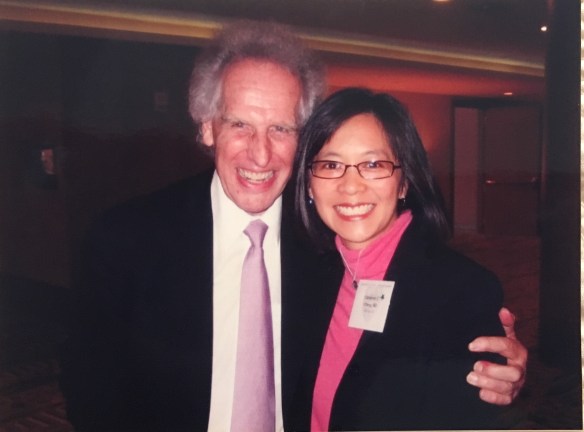
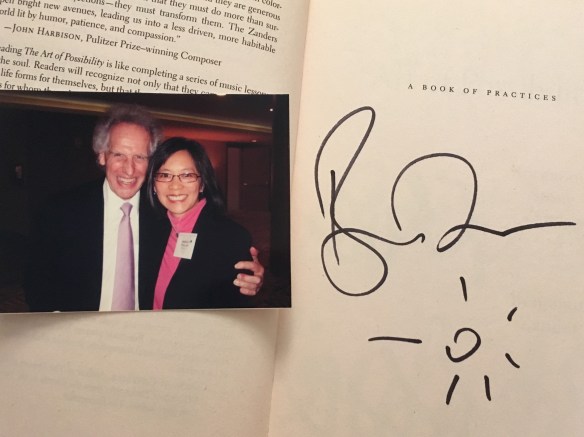
You and Ms. Zander gave the keynote address at the second ever Harvard conference on coaching in healthcare.  I was one of only a handful of physicians in attendance.  You discussed the central tenets of your book, The Art of Possibility.  I could not wait to get my copy signed, and you also graciously agreed to a photo.  I have since read and listened to your book at least a dozen times, and every time I gain something new and relevant.  The names of the practices ring in my consciousness on a regular basis:  Give the A, Rule #6, Be a Contribution, Lead From Any Chair, and Be the Board.  I describe the practices and their benefits, still, to anyone who will listen.

Zander book sig

Back in 2015 I boldly contacted the Boston Philharmonic to see if you could speak at the American College of Physicians Illinois Chapter Meeting.  You actually spoke to me on the phone and considered coming!  I was honored.  Though it did not work out (I knew it was the longest of long shots), it amazed me that someone as sought after as you would personally take a phone call from a random, unknown doctor in Chicago.  Later that year, when I attended the Harvard Writers conference (the birthplace of this blog), I had the honor of observing a master class where I witnessed you love some young musicians into their best selves.  They believed in themselves because you saw them, loved them, and believed in them.  That is the best thing any teacher can do for a student.

Throughout these last ten years, I have continued to seek, study, and attempt to apply learnings from authors, teachers, and mentors like you, people who see the world as broken as it is, and also the hope of humanity’s strengths and connections.  There is no shortage of people trying to help us all be better, for ourselves and one another, and no more urgent time or need for this teaching than now.  I count myself beyond fortunate to have benefited from your influence and inspiration so early in my life and career, to have you as my model.  No doubt I am only one of thousands, if not tens (hundreds?) of thousands, whose lives you have transformed for the better.  I wish you an ever broader and higher platform from which to reach countless more people and organizations.  I wish you peace, health, and joy in all your endeavors and relationships.

Please know how much you have meant to so many.

Sincerely,

Catherine Cheng, MD


Synthesis and Integration: Self and Other Focus

DSC_0439

Hey friends, how was your week?  Learn anything new and interesting?  Anneal any new ideas to existing frameworks in your already complex world view?  I did!  And it came in another big wave after my presentation on Friday.

I wrote last week about how I put together a new presentation.  For the first time, I added the idea of medicine as a complex adaptive system to a talk I gave to physicians at various levels of training and practice.  The objective of the presentation was for people to understand the scope of physician burnout, and leave with some ideas of how they could not only cope better themselves today, but also influence the system and move it toward a healthier, more compassionate state in the future.

As usual for my talks, I focused first on personal resilience.  Many physicians push back at this idea, and rightly so, as many medical organizations have instituted physician wellness programs aimed mainly at ‘fixing’ the doctors with yoga and meditation classes, while allowing the system that burns them out to continue its toxic trends toward over-regulation, loss of physician autonomy, and driving metrics that lie outside of, or even counter to, our core values.  I worried that my talk would be taken as just another attempt to tell physicians we aren’t good enough at self-care.

Thankfully, the feedback so far has been positive and I have not heard anyone say they felt berated or shamed.  I hope it’s because in addition to tips for self-care (eg 7 minute workout, picnic plate method of eating), I talked about how each of us can actually help change the system.  In a complex system, each individual (a ‘node’) is connected to each other individual, directly or indirectly.  So, difficult as it may be to see in medicine, everything I do affects all others, and everything each other does affects me.  This means I can be a victim and an agent at the same time, and the more I choose one or the other (when I am able to choose), I actively, if unintentionally, contribute to the self-organizing system moving in one direction or another [URL credit for image below pending].

Nodes in Complex System

My primary objective in every presentation is to inspire each member of my audience to claim their agency.  Before that can happen we must recognize that we have any agency to begin with, then shore up our resources to exercise it (self-care and relationships), and then decide where, when, and how that agency is best directed.


In 5 years of PowerPoint iterations, including and excluding certain concepts, I have always incorporated David Logan’s framework of stages of tribal culture.  Basically there are 5 stages, 1-3 being low functioning, and 4-5 high functioning.  The tribal mantras for the first three stages are, respectively, “Live sucks,” “My life sucks,” and “I’m great”.  Stage four tribes say, “We’re great” and in stage 5 we say, “Life’s great.”  The gap between stages 3 and 4 is wide, as evidenced by the traffic jam of people and tribes at the third stage.  In my view, the difference is mindset.  In the first three stages, most individuals’ implicit focus is on self, and subconscious mindset centers around scarcity and competition.  Victims abound in these cultures, as we focus on recognition, advancement, and getting ours.  We cross the chasm when we are able to step back and recognize how our mutual connections and how we cultivate them make us better—together—we see the network surrounding and tied to our lone-node-selves.

This week I realized that crossing the stage 3-to-4 chasm relates to two frameworks I learned recently:

The way I see it, in Logan’s tribal culture structure, one initially works toward self-actualization, essentially achieving it when fully inhabiting stage 3, “I’m great.”  But crossing to stage 4 requires self-transcendence, as described by Abraham Maslow, by recognizing a greater purpose for one’s existence than simply advancing self-interest.  In the same way, through stage 3 we live in what the Arbinger Institute describes as an ‘inward mindset,’ and we cross to stage 4 when we acquire an ‘outward mindset’, which is pretty much what it sounds like.  Essentially in stage 3 we mostly say, “I’m great, and I’m surrounded by idiots,” and in stages 4 and 5 the prevailing sentiment resembles, “We’re great, life’s great, and I’m so happy to be here, grateful for the opportunity to contribute.”

An astute colleague pointed out during my talk on Friday that we do not live strictly in one stage or mindset in serial fashion.  Depending on circumstances, context, and yes, state of mind and body (hence the importance of self-care!), we move freely and maybe often between stages, sometimes in the very same conversation!  The goals are to 1) look for role models to lead us to higher functioning stages more of the time, and 2) model for others around us to climb the tribal culture mountain with us, spending more and more mindset and energy at higher and higher stages.

The problem is the system, and we are the system.  So, onward.  Progress moves slowly and inevitably.  It will take time, energy, and collective effort.

We’ got this.

Self-Care:  Act Local, Think Global

IMG_1451

Gotta be quick tonight, friends, as I have sat in front of this screen too long already today!

Creating and putting together slides for three upcoming distinct and related presentations, I am happy to report continued synthesis in my position on the relationships between personal resilience, culture of wellness, and efficiency of practice in medicine.

Drivers of burnout are systemic, no question, and not related to individual physicians’ lack of resilience and strength.  And yet, it will be up to us physicians, more than any other group, to lead change and make the system better for all of us, physicians and patients alike.  But we will not do it ourselves.  We must engage so many other stakeholders—hospital administrators, nurses and other care providers, insurance and pharmaceutical companies (by way of their leaders), and, of course, patients.

How can we engage any of these groups of people effectively?  Do we expect productive conversations and collaborative decision making when we stomp on the offensive with righteous indignation and passive-aggressive name calling?  Even if our language is polished, people can feel our underlying attitude and can tell when we’re not fully authentic.

I still think it starts with self-care.  Because if I’m not well, I cannot show up my best for anyone else.

Be The Change You Seek:

Curious–Kind–Forgiving–Accountable–Humble–Empathic.

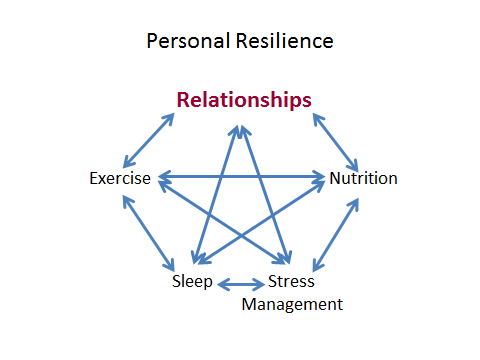
How can I be all of these things, which I referenced last week, if I am sleep-deprived, wired on caffeine, skipping meals, and not connected to my emotional support network?  I finally made my own visual for the reciprocal nature of our habits:

Reciprocal Domains of Health Star

If I am attuned and attentive, then the bottom four serve to hold up my relationships, which is how I interface and interact with the universe.  I am one node in multiple subsystems, all connected, overlapping and integrated in larger and layered super-systems.  So the best thing I can do for the universe—to keep the systems intact and optimal—is make myself the strongest, most stable, most reliable node I can be.  I recently attended a strategy meeting where I learned the SWOT framework: for any given project and the people trying to implement it, what are the Strengths, Weaknesses, Opportunities, and Threats?  It occurred to me to apply this framework to my habits:

Health Habits SWOT grid

It really does show how each domain relates to and influences each other one, and makes it all pretty concrete, especially how stress threatens almost everything.

So in the interests of self-care, and in order to care my best for everyone and everything around me, I will now do today’s free 7 minute workout and get to bed.

Onward!