

Polarity Management

Yes, AND.

This is the central tenet of polarity management. It’s about holding divergent and apparently opposing ideas or positions at the same time, understanding that their relationship is actually complementary and mutually strengthening rather than perpetually conflicting. Masculine/feminine, individual/collective, conservative/progressive, strong/soft, diplomacy/candor, top down/bottom up–what else? Can we frame any two antagonistic ideas in an infinity polarity loop of inextricable relationship? I say yes. Because it puts us into novel perspectives, prompting a mindshift into possibility, creativity, and connection.

I am waiting on permission to use a seminal image from Polarity Partnerships, the organization founded around the idea that in any polar dichotomy, there is a dynamic flow and balance between the advantages and disadvantages of focusing energy and action on either pole. When we can maximize the benefits and minimize the costs of each pole, then leadership and organizations thrive. It’s much easier to show than tell; fingers crossed I’m allowed to share the image; check out their homepage and you will see what I mean.

13 November 2023: Here it is!
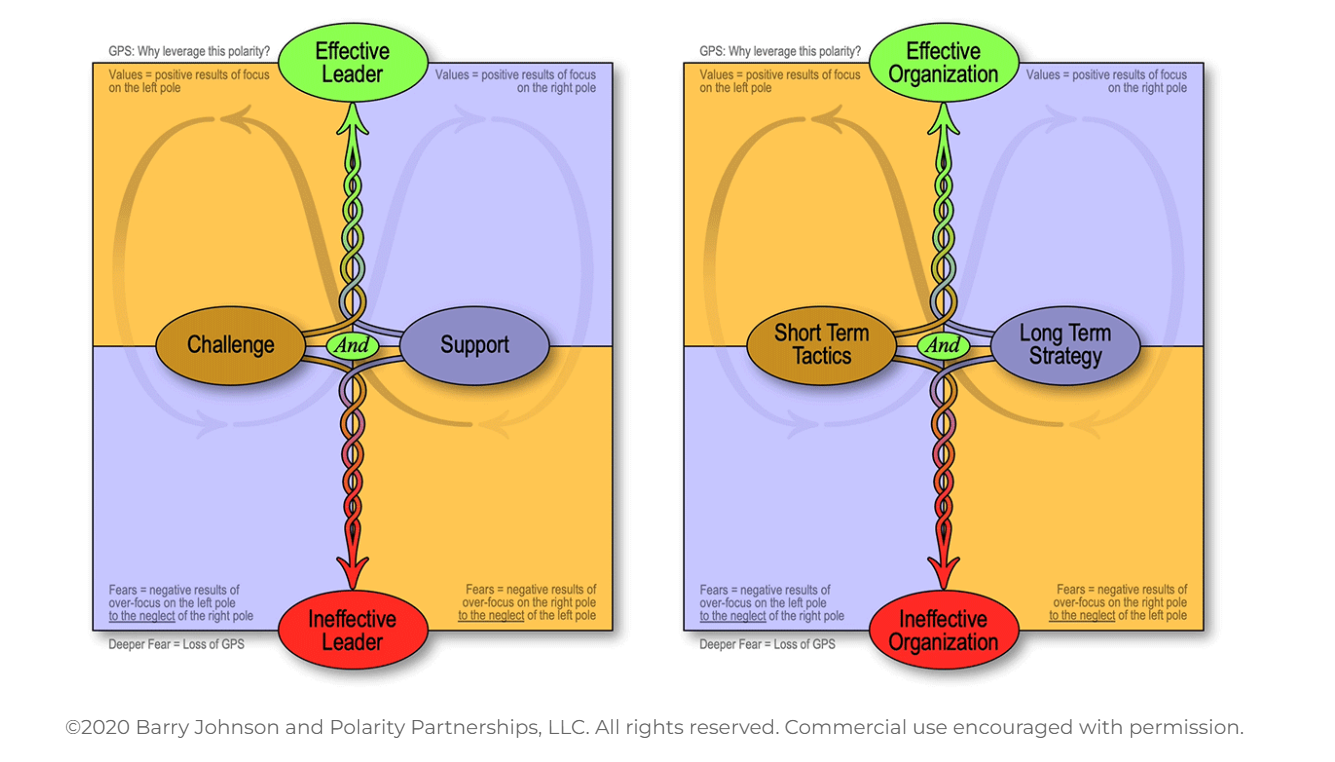
Polarity Map® is a registered trademark of Barry Johnson & Polarity Partnerships, LLC. Commercial use encouraged with permission.

How do I already manage polarities well?
–Since I learned the concept during leadership training in 2019, I now think easily in complementary polarities. I was primed c.2000 when my residency classmate introduced me to “Yes, AND”. She took an improv class and invited me to play a game in the workroom. Thanks, Carol! Now whenever I feel an initial resistance or opposition to something, I look for the juxta(op)position that gives that two-sided coin perspective.
–Polarity management and trade-offs feel related to me. I think in terms of the latter more and more, also since 2019, when I read Being Mortal by Atul Gawande. At the end of an elderly life, there is often tension between independence (goal of the elderly) and safety (goal of their family), and a peaceful end of life usually means compromises on both sides. Increasingly as I counsel patients on habit change, I acknowledge that trade offs will be necessary, and only they can define and decide which are and are not worth making, based on their values and goals. I find that approaching behavior in this way eliminates judgment, and also opens the door for flexibility and evolution without (or with less) regret. It is simply flow and growth.
–I definitely parent better from an integrated polarity perspective. Mostly it’s about letting go and hanging on, advising and commanding, that delicate and heavy handed balance. I tend toward a laissez faire parenting style, which risks the kids feeling neglected if I lean too far into my default. I’m getting better at seeing the pitfalls, and I still have some work to do.

How could I manage polarities better?
–Some people in my life prioritize their values and goals very differently from me. I sometimes sit in rigid judgment of this, dismissing their perspective as inferior in some way. I can do better at recognizing the benefits of having these people around to balance and bend my hard biases.
–I will look for strong polarity integration around me and call it out/forth. I will reinforce and amplify it. I will do my part to make both/and thinking, speaking, and leading visible, and move it into mainstream mindset.

How do we already manage polarities well as a society?

We don’t.

How could we do it better?

Where do you see successful, collective, Yes, AND in action?
I can think of two organizations that walk the talk.

Polarity Partnerships.
“In today’s world of increasing interdependency and complexity, it is vital to utilize problem solving AND both/and thinking to address your most strategic challenges and opportunities. The research is clear – leaders, teams and organizations that leverage Polarities well outperform those that don’t. Discover how to leverage your most strategic Polarities (AKA paradox, wicked problems, chronic tensions, dilemmas, etc.) to become more innovative, agile, profitable and competitive immediately and over time.”

Braver Angels.
“Our mission: Bring Americans together to bridge the partisan divide and strengthen our democratic republic.”
“We state our views freely and fully, without fear.
“We treat people who disagree with us with honesty, dignity and respect.
“We welcome opportunities to engage those with whom we disagree.
“We believe all of us have blind spots and none of us are not worth talking to.
“We seek to disagree accurately, avoiding exaggeration and stereotypes.
“We look for common ground where it exists and, if possible, find ways to work together.
“We believe that, in disagreements, both sides share and learn.
“In Braver Angels, neither side is teaching the other or giving feedback on how to think or say things differently.”

Every once in a while I read an article that does it well–not only describing two poles but explaining why each is/both are necessary and good relative to the other, and the importance of balance and flow between them. It’s pretty rare.

For practical application and guidance, I highly recommend Navigating Polarities by Brian Emerson and Kelly Lewis.

Like so many life practices I consider this month, polarity management and navigation is transformational and liberating. I had not realized it so starkly until now. When I get out of either/or, “Yes, BUT,” and “You suck,” accept what is and look for mutually complementary balancing points, new and useful insights almost always follow. My way out of conflict emerges faster and more clearly, and my relationships get stronger along the way. Very cool.

Self-Compassion

“I have found in my research that the biggest reason people aren’t more self-compassionate is that they are afraid they’ll become self-indulgent. They believe self-criticism is what keeps them in line. Most peole have gotten it wrong because our culture says being hard on yourself is the way to be.” —Kristin Neff

“Talk to yourself as you would someone you love.” —Brene Brown

I’m tired tonight, y’all. And this is a big topic. So I give myself permission to stay in the shallows for this post–no deep explorations and hours spent searching citations. Just some honest reflections and aspirations. To learn more about self-compassion and evidence for its benefits, visit Kristin Neff’s website and check out her book, Self-Compassion: The Proven Power of Being Kind to Yourself. From her website page on the definition of self-compassion:

“Self-compassion involves acting the same way towards yourself when you are having a difficult time, fail, or notice something you don’t like about yourself. Instead of just ignoring your pain with a “stiff upper lip” mentality, you stop to tell yourself “this is really difficult right now,” how can I comfort and care for myself in this moment?”

What’s already good in my self-compassion practice?
–I no longer call myself names. I own that I sometimes say and do thoughtless, inconsiderate, obtuse, and bitchy things. But I don’t label myself with these adjectives. I no longer say things like “I’m being a bitch,” or, “Oh my god, I’m so stupid.” I make clear on my social media accounts that ad hominem is unwelcome. There is also no place for it in my own head.
–I avoid self-indulgence by maintaining compassionate accountability to myself. This overlaps with (encompasses, maybe?) practices in honesty, mindfulness, integrity, forgiveness, judgment, and commitment, all topics to be addressed this month–everything is connected.
–Upholding my own self-compassion helps me maintain my growth mindset. While I allow myself to identify with fixed traits such as ‘smart,’ ‘creative,’ or ‘badass,’ I can hold these labels loosely and also allow for wild imperfection and failure–for myself to be human in all of my smart, creative, and badass endeavors. I am freed to be both wholly all of these things and more, and also a perpetual work in progress.

How could my self-compassion practice be better?
–Explore more the paradoxical polarity of enough and not enough–I am enough as is, and I am also always improving–so what do enough and not enough actually mean? “You are perfect, …and you have a lot work to do,” I read years ago. Love it. Makes to total intuitive sense, and I want to live into it more deeply.
–Look for the still insidious ways self-criticism appears, and hold it with kindness. I know there’s a lot there in my body image, especially as aging accelerates. And when I find self-loathing and -judgment, I can practice my compassion on that, rather than meta-judgment of the judgment, which doesn’t help anyone. I bet I could query arenas where I feel like an imposter; that’s probably pretty good fodder.

How does our society do self-compassion well already?

Awareness. Authors like Kristin Neff, Brene Brown, Tara Brach, Richard Rohr, and the Dalai Lama bring self-compassion concepts from esoteric academic and spiritual theory to practical life skills. Their books, articles, podcasts, interviews, and websites offer the lay public copious access to all things self-care, connection, and inner peace. Communities of folks seeking comfort and connection form, mindful presence ensues, and good things happen all around. Like mindfulness, self-compassion is making its way into mainstream consciousness as something to develop rather than to shun and dismiss.

How could we do it better?

Normalize it. The distinction between self-compassion and self-indulgence still needs reinforcement. Being kind to onself in a moment or period of hardship does not mean shirking responsibility, is not a character flaw, and does not lead to a future of fruitless debauchery. Allowing health habits to loosen a little in the midst of life chaos does not warrant harsh self-recrimination. The practice of imagining a friend going through the same challenges and what we would say to them, then saying that to ourselves, really helps here. Oh and we should say those things to our friends out loud, too.

Strengthen Accountability. Even if we succeed in distinguishing the above, I think people still need reassurance that we won’t all become listless moochers just looking for excuses and free rides for everything. As an aside, what is with that cultural fear of ours, anyway? By accountability I don’t mean punishment or shame. I mean owning our mistakes and the impact we have on others, standing convicted not in public opinion but in our core values. Accountability and self-compassion together help us present ‘strong back, soft front’ to ourselves, developing both intrinsic strength and courage as well as openness and vulnerability. Ultimately, the best outcome is that we then present this way to others, offering kindness and also holding them humanely accountable, and our connections and communities tighten in love.

Amplify the Benefits. When we see someone we care about lambasting themselves, we can help. As we show more loving kindness to ourselves, we are more willing and likely to do the same for others. Mercy, grace, empathy, tenderness–can we look individually and collectively inward and see the rewards of offering these to ourselves, and then to one another? It doesn’t take much to imagine, does it? We can start one on one, with people we care most about, whom we truly love. Then we can extend it to strangers, then to members of out-groups whom we may initially and automatically judge harshly by way of stereotype and prejudice. Strong self-compassion practice can translate to recognition of every person’s innate humanity, reframing even our most destructive behaviors in humane rather than dehumanizing light. “The smart, creative, wildly imperfect badass in me sees the smart, creative, wildly imperfect badass in you.” It all starts with healthy relationship to self.

So was this even coherent? Good night, all, I’m going to bed. Back tomorrow on polarity management, woohooooooo, that’ll be fun.

Mindfulness

Photo by Lyra Luu, Schalenbrunnen im Botanischen Garten, Munich, June 2023

I count 47 posts on this blog when I search ‘mindfulness.’ I talk about it almost every day with patients. Of all self-care practices I have acquired over the years, I think this is the most useful. Funny how I did not list it in the stress management post this month? Maybe because I see mindfulness as a way of being more than something I do? It really does bring me peace, for which I am both grateful and proud, as I have trained long to gain its benefits.

If you’re not yet familiar, I recommend starting at www.mindful.org. From their site:

“What is mindfulness?

“Mindfulness is the basic human ability to be fully present, aware of where we are and what we’re doing, and not overly reactive or overwhelmed by what’s going on around us.

“While mindfulness is something we all naturally possess, it’s more readily available to us when we practice on a daily basis.

“Whenever you bring awareness to what you’re directly experiencing via your senses, or to your state of mind via your thoughts and emotions, you’re being mindful. And there’s growing research showing that when you train your brain to be mindful, you’re actually remodeling the physical structure of your brain.”

Ok so, how do I already do mindfulness well?
–I have a strong informal practice. Often and at any given moment, I drop (or rise) easily into awareness of my environment, the people around me and their signals, and my own physical, mental, and emotional sensations. Even when it’s uncomfortable or painful, I can hold it loosely, with openness and curiosity. I wonder how many times a day I say or think, “Huh,” “What is up with that,” and “How fascinating”? This leads me often to novel questions, which I then express to others, engaging in unexpected ways, which is almost always more rewarding that I anticipate.
–My practice helps me be present to others as they need me. When I attend to what is, resisting the pull toward what I want or what I think should be, I can empathize, validate, and reflect with others, rather than go straight to problem solving, which is seldom what people want or need.
–Mindfulness makes me a more sensitive and agile speaker. As words and expressions form in my head and exit my mouth, I monitor their intent and impact in real time. I speak quickly and at times with sharpness and irreverence, but more often with kindness and passion, and rarely without thought to every word. Is that mindfulness or conscientiousness? Probably something mutually entwined?
–I lead by example. People say they feel peaceful around me, that I have a calming effect. I attribute this to my ability to be with whatever is, in the moment, without (or with minimal) judgment, together with others.

How could my mindfulness practice be better?
–I could establish a formal sitting practice. A daily session of breath and awareness, a mental discipline to quiet the monkey mind, to strengthen my parasympathetic nervous system, would likely make me healthier in all domains. I’m just not quite moved yet to commit. But maybe if it helps my writing…
–I could read more of the masters’ works: Jon Kabat-Zinn, Thich Naht Hanh, Sharon Salzberg, Pema Chodron. Then I’d be more knowledgeable, could maybe explain it better to people whom I think could benefit. ..and if it helps my writing…
–Overall I’m pretty satisfied with current state. I faced trials of the last several years with relative equanimity, and the challenges themselves strengthened my practice. I trust myself to know when I need to do more, because I’m mindful enough already to notice.

What’s already good about our collective mindfulness?

Awareness. John Kabat-Zinn developed Mindfulness-Based Stress Reduction (MBSR) as a meditative therapy method for stress management in 1979. I learned nothing about it in medical school or residency. I’d say the first ten years of my career, mind-body medicine was still considered fringy; colleagues would stare blankly or even roll their eyes when I talked about it. Today mindfulness and other techniques of meditation and mind-body practices live in the mainstream, their benefits available to everybody, and fewer people feel self-conscious about participating.

Language. “Be with what is.” “Hold the space.” “Withhold judgment.” “Breathwork.” One could say that mindfulness lingo has infiltrated our general vernacular. Good. These concise phrases can moor us to a mindset of alert and relaxed presence, which makes us calmer, less impulsive, more attuned, and healthier. Words matter; the more we can use them for mutual de-escalation and connection, the better.

Connection. As mindfulness gains awareness and its expressions spread, fellow practitioners can connect more easily in any forum. They become magnets for yet others, and communities form around this attentive way of being which, nourished by strong ties, makes us better leaders by example wherever we go, to whomever we encounter. Jeez, I’m making it sound like a cult.

How could we do better together?

Teach Mindfulness In School. Mindfulness skills are life skills. Learning breath work, body awareness, and mental discipline in iterative, age appropriate ways prepares children and adolescents to tolerate and navigate an ever accelerating world of volatile change and chaos. It would be easy to incorporate skills practice into play, sports, and academics at all stages of brain and social development.

Incorporate Mindfulness Into Leadership Training. Thinking of leaders you admire, what qualities and behaviors make them great? Mine give me their full attention, make me feel seen, heard, and understood. They emote relatably, easily, and appropriately, and also carry themselves with steady, unflappable confidence. They name what is with clarity, desireable and/or not, and hold it peacefully while working consistently for change and improvement. They are honest. Thus they attract and inspire followers rather than coercing them. Healthy mindfulness skills and practice amplify and maximize relational leadership strengths by grounding leaders in self-awareness and self-regulation as foundation for outward action.

Just writing about mindfulness lowers my respiratory rate and helps me attune to myself and my surroundings better. I feel gratitude and peace, confident in my ability to face and manage whatever comes around the corner, satisfied that I have lived the present moment to its fullest. I have very little to regret if I can keep this up.