What The Best Teachers Do

DSC_0638

NaBloPoMo 2018:  What I’m Learning

The post last night was a long time coming, maybe.  It took longer than I thought it would to actually write, edit, and publish, but it poured out in a flurry of energy that has built up over several months.  I received immediate feedback from members of my Counsel of Wisdom, supportive and encouraging, gratifying.

As I thought more, I realized that my best teachers growing up practiced emergent design and strategy.  Imagine you teach the same subject, the same skill, the same content, year after year.  Your approach is to do it the same way, expecting the same result.  Would you not get bored?  And if you’re bored, no question your students may want to gore their eyeballs out with their writing implements.  In medical school my classmate and I met a physician in his office for a lecture on his area of expertise.  We sat across from him in his big armchair behind a mahogany desk piled high with papers in disarray, the sun shining through the window at his back.  He spoke in a slow, bass monotone.  The words that dribbled forth practically fused together, such that I strained to distinguish and make sense of them.  And I kid you not, he literally put his elbow on the desk and rested his face in his palm while he spoke, as if he may have a near death experience from the sheer dullness of it all. That was not his best teaching moment, I’m sure he would agree.

My best instructors, on the other hand, engaged us learners in real time, with rapt energy.  They asked us what we knew about the topic, encouraged us to consider and describe how core principles applied in real life situations.  In classrooms, my best teachers were both goal-oriented and open-minded.  They had a clear learning objective but held the map only loosely. They allowed space for the learning journey and path to unfold before the class, always with an eye on the destination. We learners all got to choose the way, and we still ended up where we needed to be.  And every time I bet it was a little different for the teachers, so it was fun for them and they always learned, too.  I know that’s how it feels for me.  That’s what keeps any of us engaged and improving, I think—the confidence of knowing we hold the reigns coupled with the excitement of not knowing which new trail our class will blaze to apprehend the learning.

My Counselor friend described it as, “The map becomes a new and storied journey with each iteration of participant-cartographers.”  Is she not eloquent?  I have invited her to write a post with me soon.

Coach Christine reminded me, “What you describe is coaching at its best – the fundamental philosophy of the coaching I’m trained in is, the client is naturally creative, resourceful and whole. Not broken, doesn’t need fixing.  Capable of digging deep to find the answers within themselves, and /or where to find the help they need.”  Creative, resourceful, and whole.  I had not heard or seen those words in this context in a long time.  So grateful for the reminder—Thanks, Christine!

What are you teaching these days?  How might you hold your leadership map more loosely and allow those you lead to point to a new or different way?  What might you all gain in the process?

Less Phone, More BOOKS!

books 11-3-2018

NaBloPoMo 2018: What I’m Learning

Hi, I’m Cathy, and I’m addicted to my phone.

Last month I finally decided to do something about it, mostly so I could be more present to the kids.  It’s been a fascinating journey so far, and I’m proud to say I’ve already made progress.  First I banned Facebook after 6pm.  That went well until I traveled.  Then I took the Facebook app off of my phone.  The withdrawl continues to spike at times.  I also notice that I use other things to substitute—New York Times, email, Washington Post, email, WordPress Reader, email.  I notice an anxiety, a frustration, a kind of crazed, darting hankering– I crave that dopamine hit.

The awareness of it all, however, and the commitment to get disentangled from my screen, has cleared space for a recently dormant impulse to surface afresh:

READ!

* * *

At the conference last month I was turned on to the idea of complexity (or chaos) theory and how it relates to fixing physician burnout and turning our whole medical system around.  It was positively mind-blowing (for me—most others did not seem quite as lit).  The speaker was Anthony Suchman, my newest hero.  Some highlight ideas:

  • Every system is perfectly designed to get exactly the results it gets. Our current healthcare system evolved to this point precisely from serial and cumulative decisions made over years, even though the current state was never the intent.
  • We think of organizations as machines, with predictable, linear consequences of adjustments in one part or another. This is rarely how organizations (of people) actually work.  Rather, we can think of organizations as conversations, and let go our expectations of particular outcomes, the illusion of total control.  We can let things unfold and go where the outcomes lead us, all while holding to core values and goals.
  • Patterns are (re)created in each moment, and also self-organizing. So at the same time that a pattern (eg culture) seems inevitable and self-propagating, sometimes small, almost imperceptible perturbations can create new and dramatic cascades that lead to transformation (the butterfly effect).
  • Emergent Design thus embraces the approach of “finding answers we are willing to not know,” trusting that we will get where we need to go simply because we are paying attention (or that’s how I interpret it today).

This theory that everything within a system both results from and also contributes to the whole system (a fractal) validates an idea I have been advocating to my patients for years, and that I continue to personally relearn ad nauseam: It’s all connected.  The most concrete examples are Sleep, Exercise, Nutrition, Stress Management, and Relationships—I used to call them the 5 Realms of Health; now I call them the 5 Reciprocal Domains.  Each one is inextricably connected to every other one, and they all move in concert, with subtle or dramatic dynamics.

books 11-2-18

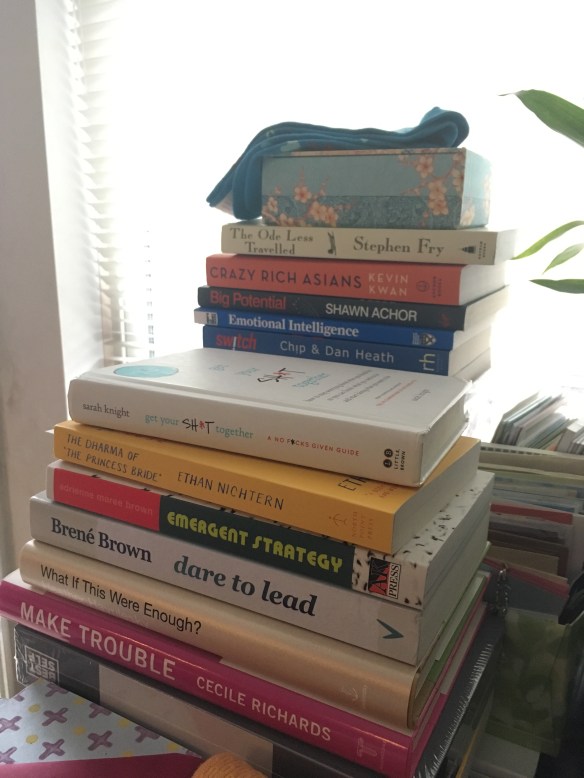
I browsed around my local bookstore a couple weeks ago and came across a colorful title on the shelf: Emergent Strategy by Adrienne Maree Brown.  So of course I snatched it up.  The blurb says:

Inspired by Octavia Butler’s explorations of our human relationship to change, Emergent Strategy is radical self-help, society-help, and planet-help designed to shape the futures we want to live.  Change is constant.  The world is in a continual state of flux.  It is a stream of ever-mutating, emergent patterns.  Rather than steel ourselves against such change, this book invites us to feel, map, assess, and learn from the swirling patterns around us in order to better understand and influence them as they happen.  This is a resolutely materialist “spirituality” based equally on science and science fiction, a visionary incantation to transform that which ultimately transforms us.

Holy cow, YAAAAS!!  I could not wait to read it!  So I bought it, along with Make Trouble by Cecile Richards, What If This Were Enough? By Heather Havrilesky, and The Dharma of “The Princess Bride” by Ethan Nichtern.  I had also ordered Leading Change in Healthcare, coauthored by Dr. Suchman and two others.  That copy arrived last week.

Suchman 1

I feel this as all part of a slow turn, getting off my phone and diving into books again.  I’m so excited.  I have done this before—buy a bunch of books and never read them.  They occupy whole shelves in my bedroom.  But I honestly feel a transformation coming on.  Yesterday I spent a couple hours reading, researching, and writing the blog post, then I turned off the computer and opened Brown’s book.  I read through the long introduction and resonated with sentences like, “Emergence is the way complex systems and patterns arise out of a multiplicity of relatively simple interactions.”  This is a quote from Complex Adaptive Leadership: Embracing Paradox and Uncertainty by Nick Obolensky (which I have also now ordered).  I also love (ha!), “Perhaps humans’ core function is love.  Love leads us to observe in a much deeper way than any other emotion.”  Also:

all that you touch

you change

all that you change

changes you

the only lasting truth

is change

god is change

That is a quote from Parable of the Sower by Octavia Butler.

Then before bed I opened Suchman et al’s book and found these words, also in the introduction:

Complexity theory here is enriched by the focus on relationships [Hallelujah!], rather than the more traditional reference to science.  “Relationship-Centered Care” is a way of thinking that brings love and all that is personal into a world, the world of healthcare, that is mostly interested in more control and more data-based, evidence-based practices.

The point is made throughout that administrators cannot bring real change into their healthcare institutions without going through change themselves.

(The book describes) the relationship-centered social dynamics that are at the heart of Lean and a major source of this method’s success.  Unfortunately, these social dynamics are overshadowed or even displaced by the analytic technique in some Lean implementations, compromising results.

Suchman 2

So I’m learning about new ways to think on change.   It’s changing how I approach trying to change my patterns, how I see my relationship to them, how I see all relationships.  Wow.

All of this to say, I feel a deeply personal, yet global and cosmic impulse for growth, for transformation—a shift into more mindful and intentional use of my time and energy, and how I manifest it outward.  Less distraction, more focus.  Less incidental information consumption, more integrated learning and coordinated application.  Less phone, more BOOKS.

What will be the outcome?  I have no idea, that’s what makes it so exciting and wonderful!  Onward!

 

It Must Be True Because…

Spider web South Shore 8-23-14

NaBloPoMo 2018:  What I’m Learning

Funny how fear crops up sometimes.  It’s especially distressing when you fear your own ‘team.’  But we are here to learn and grow, so we step forward. My point in this post is to practice critical appraisal of research data before accepting or integrating it; especially if I am biased toward it.

BI fox news worse 2012

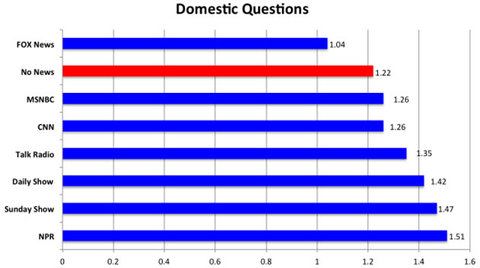
A fellow progressive Facebook group member posted this photo with a message of glee and encouraging everybody to disseminate.  I admit I also initially felt justified and righteous when I saw it.  But something kept me from sharing on my own page.  I should do this more often, perhaps—let something marinate for 24 hours before sharing, just to make sure it’s really something I want to engage with.  I ended up commenting that I think we should be careful about disseminating this kind of oversimplified graphic, as the data may not justify the claim.  I await the angry backlash.

After reading the article in Business Insider from whence the figure came, I had more questions than answers.  What are  Farleigh Dickinson University and Public Mind, anyway?  “Researchers asked 1,185 random nationwide respondents what news sources they had consumed in the past week and then asked them questions about events in the U.S. and abroad.”  What were the questions?  How were they chosen, and how do we know they represent broader knowledge of current events?  “With all else being equal, people who watched no news were expected to answer 1.28 [out of 5] correctly; those watching only Sunday morning shows figured at 1.52; those watching only ‘The Daily Show figured at 1.60; and those just listening to NPR were expected to correctly answer 1.97 [out of 4—why the ask one less for this?] international questions.”  Are these differences statistically significant?  And regardless, if the best we can do is answer less than 40% of domestic questions correctly, yikes.  How do we know this actually represents the population?  How does this data compare to similar research findings, maybe ones published in higher caliber, peer-reviewed journals?

The Business Insider article did link to the study report it referenced. I consider this to be a sign of responsible journalism—I look for it in the publications I read—access to the primary literature, so I can dissect and interpret ‘data’ for myself.  Turns out the study was a follow up in 2012 of an initial survey done in 2011 that reported similar findings.  The specific questions and statistical methods are included, as well as discussion of the results.  And while it’s not as rigorous as I am used to reading in peer-reviewed scientific journals, with sections for abstract, background, hypothesis, methods, results, discussion, and conclusion, I could follow the language and rationale of the authors, for the most part. I think they could have done a better job making a distinction between correlation and causation.  I also wished for a discussion addressing implications of the data and recommendations for further study.

Interestingly, I found a Forbes article entitled, “A Rigorous Scientific Look Into the ‘Fox News Effect.’”  I thought it was going to answer all of the questions I asked above.  It started out appropriately skeptical:

In 2012, a Fairleigh Dickinson University survey reported that Fox News viewers were less informed about current events than people who didn’t follow the news at all. The survey had asked current events questions like “Which party has the most seats in the House of Representatives?” and also asked what source of news people followed. The Fox viewers’ current events scores were in the basement. This finding was immediately trumpeted by the liberal media—by Fox, not so much—and has since become known as the Fox News effect. It conjures the image of Fox News as a black hole that sucks facts out of viewers’ heads.

I got excited when I read:

I have done similar surveys, both of current events and more general knowledge. In my research too, Fox News viewers scored the lowest of over 30 popular news sources (though Fox viewers did at least score better than those saying they didn’t follow the news). The chart’s horizontal black lines with tick marks indicate the margins of statistical error. Last Week Tonight with John Oliver, a news satire, had the best-informed viewers.

Turns out the rigor of this scientific look at the FDU data amounted to not much more than pointing out that correlation does not prove causation.  The author, William Poundstone, is a prolific non-fiction author and biographer of Carl Sagan, so I imagine he has formidable expertise parsing research data, though I don’t see any published research or surveys of his own.

In the end I’m satisfied, because I have done my homework on this topic.  I feel righteous again because, this time, I extricated myself from ‘liberal lemming’ (is that a thing? If not then I just coined it) mindset…  But it took some time.  And writing about it has cost me some psychic energy for organization and expression.

As I write this it occurs to me that it would be much more time efficient to just not believe anything I see or hear on any media platform—just be skeptical about everything and leave it at that.  Huh…  Nope.  That feels too much like willful blindness, which does not align with my core values.  It’s worth taking several minutes sometimes and disengagement, to verify the quality of what I take in on a daily basis.  I hereby commit to making this a regular practice.  I’ll let you know when I find anything really worthy of integration and dissemination.