What Flavor Is Your Narrative?

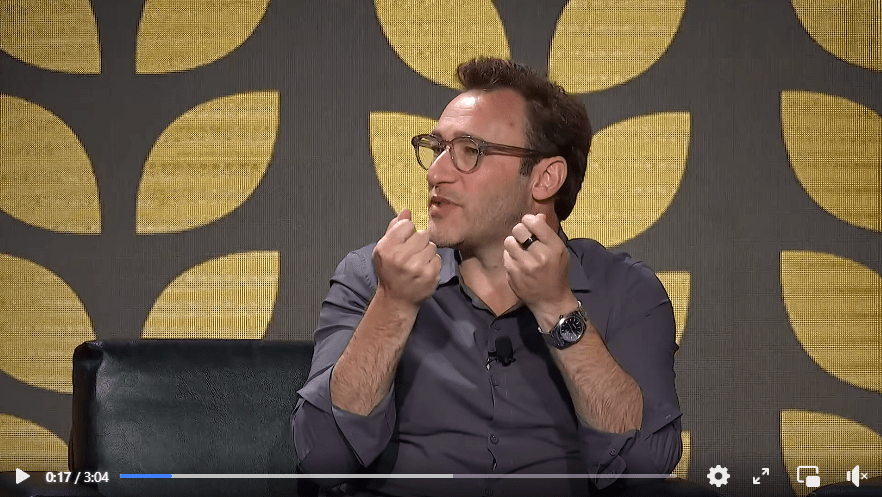
Simon Sinek describing narrative flavor

“Every day I get to ask people the most interesting questions I can think of, to help them know themselves better and live into their healthiest, most fulfilled selves.”

What if I answer this whenever someone asks me, “So, what do you do?”

How does this sound, feel, and taste different from if I just said, “I’m a doctor”? How interesting, to think of a narrative having a taste… What flavor do you assign my answer above, as you read it? Maybe I should add some toppings:

“I have the privilege and pleasure of doing work that stimulates both my thinking and feeling brains. I get to use all that I have learned throughout my life, both personally and professionally, in service of connecting with and serving other humans. I exercise deep expertise and knowledge, and am also humbled to learn something new every single day. I love what I do, I impact people’s lives, and it’s almost all ‘just’ by talking to people.”

Simon Sinek inspired this post when I watched the video clip of him describing why communicating through stories–narratives–is so important and effective. Thinking of narrative in terms of flavor–what a novel and elegant concept! It takes a totally different perspective on words, from thinking or feeling with emotions to putting it in our bodies. Smell and taste are a primitive sense, and highly associated with memory and emotion. It is literally visceral. So when we tell our stories about work, families, core values, realtionships, struggles–anything meaningful–what happens to that meaning when we correlate it all with a taste? Both for ourselves and those who hear/read our tales? How fascinating!

My first thought watching this video was ‘bitter.’ When I think of the deeply grooved, dysfunctional patterns in some of my relationships, I realize that my narratives—the biases and assumptions I make when interacting with (or even thinking about) certain people—set us up for conflict and discord from the outset in any given encounter. Yikes. For some reason, describing them as ‘bitter’, imagining the taste on my tongue, catches my attention, makes me stop and take notice, more than naming it all as resentment, anger, and grudges. It motivates me to change the narrative, to shift my perspective, make more generous assumptions, withhold judgment, and Give the A. Who wants to taste bitter all the time? I want to make these relationships sweet, savory, and refreshing.

How can we expand this metaphor beyond our own individual stories?

What is the story of your workplace culture? How do the mission/vision/values statements land on the workforce? How would you first describe it in the usual adjectives: restrictive, supportive, rigid, chaotic, backstabbing, upbeat? Then what emotions do you associate: happy, sullen, lighthearted, anxious, safe? What about bodily sensations: tense, relaxed, sleepy, wired, restless? And finally imagine a taste for it: bland, spicy, bittersweet, moldy, rancid, salty, aromatic? How does this exercise affect your perceptions/memories/thoughts/feelings about work? Does it move you to think, say, or do anything differently?

I have never before described my work in the exact words I used above. It feels liberating to find and articulate stronger language for my experience. And it did not take me long to land on ‘sweet’ (I often describe my job as ‘the sweetest gig’–funny how we use this phrasing for things that are just that good) and ‘umami‘ for its tastes. I love what I do. I crave it, savor it. I bask in not just the flavor, but the warmth (it’d definitely warm, not cold or hot) and the texture (rich, dense, smooth with bits of crunch and chew). OH this is fun! My work is the most satisfying meal: marbled, medium rare rib eye with a nice crust, roasted sweet potato, sauteed Brussels sprouts, tiramisu, and chai. Oh and there is some flower salt and pepper on the table.

I wonder how my patients would tell their stories of me and our relationships, and how they would translate those narratives into olfactory and gustatory experiences of us? Am I (are we) bran flakes, kale salad, mac ‘n’ cheese, burnt toast, chia pudding, meatloaf and spinach, blue cheese? The possibilities are endless! And it’s important to query and clarify our unique associations with the flavors we assign. I may think blue cheese is fragrant and lovely; my patient may mean it as putrid.

Now I’m thinking of employee engagement surveys. Wouldn’t it be fun, and actually engaging, to include novel questions like these? Surveyors could easily design questions to indicate whether responses are meant in positive or negative ways, and categorize different foods or meals to represent different aspects of work–breakfast as relationships, lunch as tasks, dinner as meaning, dessert as perks.

Okay that’s enough for now. What a fun diversion this was. Now I’m wondering about figures of speech that reference food and taste…what do we mean to evoke with this language? A post for another time, perhaps.

Onward in curiosity, novelty, learning, and connection, my friends!

The Sh*t Sandwich

“I have realized that I really enjoy learning about ***, but I don’t necessarily like studying it and being tested on it.”

And there it is. My mama pride swells at this concise, distilled insight of self-awareness that Son shared with me, about 6 weeks into college. So you really like ***. How much might you be willing to work/tolerate/sacrifice to stick with it? Will you keep *** as a hobby/interest, or can you see yourself making a career out of it? No rush to figure it out! And how cool to know there is a distinction to make?

How much are we willing to give for something we really want? Are we willing to eat the particular flavor of shit sandwich (a la Mark Manson–check out his blog and books!) that’s inevitably served on the path to our goal?

Sometimes we don’t even have to know what we want; clarity about what we don’t want–shit sandwiches we will not eat–is enough to set us on the right path for each of us. Some shit sandwiches I have rejected:

Three Dimentional Calculus and Vector Analysis: Freshman year in college, one problem on the final exam of this class took up 8 pages in the exam book. And why did I have to know it? How did the reasoning help me in life? No more math for me, thank you. I left engineering the following quarter.

Physical Chemistry: Having already gotten a C in physics (which happens when you fail the second midterm because you start dating your husband), empowered with an aversion to math, and knowing already that life is too short for this kind of suffering, I rejected chemistry and embraced biology as a major.

5:30am Rounds: General surgery, my first ever clinical rotation. My intern, the wonderful Gopal Kowdley whom I love to this day, looked at me and said, “You’re tempted, I can tell.” But OMG surgery–the egos, the bombast, the misogyny–AND getting up in the dark every day, forever? Nope.

Lifelong call: I love reading echocardiograms–ultrasounds of the heart, beating in real time. Second year of residency is when internists apply for subspecialty fellowships. That year my cardiology fellow stood right next to me at 10pm, monitoring a dying patient in the cardiac ICU. He had a little girl at home who missed her dad. Later that year, the attending cardiologist, my amazing teacher, sat across from me at the nurses station, in the middle of the night, reviewing the EKG of a lady with a likely heart attack. He had grandchildren already. He had to get up in the dark–in the middle of the night. No cardiology fellowship for me!

I live in Chicago when my home is Colorado. Wut? But Husband is from here, we trained here, and we both found jobs here that fulfill us and allow us to make a difference in people’s lives. WINNER! Love makes us do crazy things, like eat this. huge. shit sandwich. Without hesitation, no matter how it tastes. Every day. For 20+ years.

Through the long hallways of my career, at each door has stood a waiter offering some shit sandwich for me to taste in order to get through. I closed some doors, and walked through others. I wrote last month that I regret none of the work thresholds I’ve crossed to date. Since the beginning, nothing has been be-all, end-all. If I hadn’t gotten into med school the first time I’d have decided to try again or try something else. I committed to finish an internal medicine residency and pay back my student loans; those doors swung heavily one way. Other than that, I have always had the privilege of myriad opportunities to use my skills and credentials in new and interesting ways if I wanted to–generalists are needed everywhere. But the older I get, the more selective I am about what shit sandwiches I’m willing to eat. I think that’s normal.

As Liz Gilbert interprets Manson in her book, Big Magic: “So the question is not so much ‘What are you passionate about?’ The question is ‘What are you passionate enough about that you can endure the most disagreeable aspects of the work?’”

So ONWARD, I say to Son. Keep learning about yourself and the world. Try out different things, taste a little of everything as long as you’re sure it’s not toxic. Carve out your space. I am confident you will find your favorite flavor of shit sandwich.

Being An Officer

Chief Executive. Operations. Financial. Information. Wellness.

Officers.

What’s it like to be one, I wonder? How do you see yourself? What is your purpose? Whom do you serve?

I recently heard some business executives refer to themselves as ‘officers’ of their company, and it struck me, as if I were hearing the word for the first time in this context. The vibe was not arrogant or self-aggrandizing. It came off not as corporate speak, as some label used to separate (elevate) themselves from others in the organization. The feeling really reminded me of how Simon Sinek describes marine officers in his books–the ones who lead from the front, who put themselves in harm’s way first to accomplish a mission. The leaders I heard spoke with an air of respect for the role ahead of themselves personally. It was almost reverent, in a way, like being an ‘officer’ of the company meant, as Sinek puts it, not just caring about being ‘in charge,’ but caring for the people ‘in your charge.’

Officers sit at the top of organizational hierarchy. They enjoy rank, default status, and the highest pay and benefits. They also shoulder the greatest responsibility (and ideally, accountability). In the military this includes for people’s very lives. In business this includes people’s livelihoods, and thus also their lives and those of their families. Setting aside for now the premise that boards, and thus the execs who report to them, function to advance the interests of shareholders above all, I’m thinking about how hierarchical corporate structure and its attendant attitudes serve us, each and all of us, relationally.

I perceive three primary, intersecting answers to “Whom do you serve?”: 1. Shareholders 2. Mission 3. People of the organization. The first two can be abstract; the last is very concrete. I strongly believe that leaders who prioritize the health and well-being of their people above all else are the most successful. I don’t necessarily mean success in the conventional business sense–profits, stock price, US News & World Report ranking. I mean relational success–manifest in organizational loyalty/pride, team cohesion, mission focus, low turnover, and high moral and community standing.

I think organizations with relationship-centered leaders cultivate and elevate officers who respect, acknowledge, and attend to workers at all levels in their perspective and decision making. They ask, “How does this affect our people?” before, “How does this affect our bottom line or brand?” When the latter come under threat, they will look for every available solution before sacrificing the health and well-being of their people, even when doing so is the easy and obvious path to balancing books and looking good. Led by this example, lower level leaders can feel safe to behave similarly, and the culture of safety cascades down to the lowest level worker. Cultures like this foster creativity, collaboration, innovation, and then multi-dimensional success.

I write all of this so easily as a non-officer. I understand that leading large, complex organizations is a practice in agile and dynamic balance of disparate interests in the midst of shifting markets and diverse stakeholders. I try to assess leaders fairly, and always with the heavy burden of their work in mind.

Still, I hold our highest designated leaders wholly accountable for their relational output. They set the cultural tone and attitudes for the organizations they lead. As a worker, I want to follow my officers wholeheartedly and without reservation. They have a hand in cultivating that loyalty in me. I want to show up every day proud to be part of an organization that does good–more good than just making money for the folks who own company stock, more good than meeting some external benchmark of ‘excellence’. In order to do that, I need to feel that my leaders establish and uphold a culture that cares about me as a person, as a member of the organization who matters and contributes. I want to be seen as, to feel like a unique and valued individual, not just a money making cog.

The officers I heard speaking of their roles with self-awareness and benevolence inspire me. They palliate my cynicism that corporate power and status bloat ego and ecclipse selflessness. They make me consider my own role as physician. Though I no longer hold any designated leadership title, I still lead–like it, want it, know it or not–just by virtue of my MD and role on the patient care team. I argue, too, that any team member also leads to some degree. We all take our cues from one another; we self-organize around collective priorities and norms of behavior, reinforced implicitly more than explicitly, every day. Even so, we may often think of ourselves as mere minions, that we just come to work and ‘do a job.’

What if we all thought of ourselves more as Officers like the ones I heard? What if we all took some personal responsibility to uphold a culture of valuing one another as important contributors to a mission of caring and meaning? Could we, as a groundswell from the bottom up, elevate and inspire our own officers’ attention to and value of the whole of us, from the top down? Can we all support and uphold one another from all corners, more visibly, audibly, and audaciously? Wouldn’t that be amazing?