Resistors In Series

Estes 2011

As nerd stuff goes, biology has always been more my speed than physics.  When my group in AP bio got to dissect a fresh frozen elk heart instead of a preserved sheep heart, I was positively overjoyed.  I remember so clearly the size (almost as big as my head) and weight of it, the texture of the muscle.  I can still see the valves, the heartstrings, and coagulated blood in the right and left atria.  So it kind of surprised me when I thought of a physics metaphor for our politics today.  I, the daughter of a PhD in applied mechanics, earned the lowest grade of my college career in first quarter physics.

Like many science nerd adolescents of the 80’s, I looked forward to new episodes of “MacGyver” every week.  The handsome, mullet-sporting Richard Dean Anderson always jerry-rigged his way out of life-threatening situations using everyday chemistry and such.  How fun that my kids can now enjoy the same drama with the CBS “MacGyver” reboot, starring Lucas Till.  We bond over TV, my kids and I.
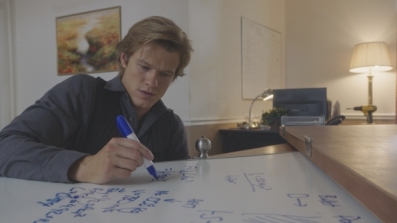
macgyver white board

In the “Chisel” episode, Mac and his team find themselves barricaded inside a US Embassy, under attack by terrorists.  On a white board, he calculates how many inches of paper to place in front of the windows to stop incoming machine gun bullets—it’s 8 in this case.  [As an aside, the Mythbusters showed that paper is a plausible form of body armor.]  This got me thinking: one sheet of paper, so thin and flimsy, is easily shredded.  But layered in redundance, it can stop a barrage of deadly bullets.  It feels a lot like our national political activism since last November.

Women, scientists, environmentalists, educators, people of color, the LGBTQ community, Native Americans, writers, actors, physicians, patients, religious groups, law enforcement, legislators, and the press—We have all found our legs and our voices; we have stood and proclaimed not only our opposition to 45, but our commitment to our core values of inclusion, equality, respect for the planet, and respect for one another.  I submit that we are resistors in series.
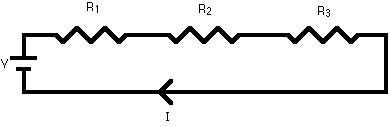
resistors in seriesYou may recall from physics class that when resistors are placed end to end in an electrical circuit, their total resistance is the sum of their individual impedance units.  As the current passes through one resistor, it encounters the next one, and the next, one after another, slowing its progress.  I like to see today’s activist groups in this way, each contributing several layers to the dense, thick paper barricade at the windows of democracy as we know it, defending it against attack.  And the more we can stand united, supporting one another, the stronger we will be.  Could our resistance even be exponential, rather than simply additive?

Tyrants and authoritarians divide to conquer–they like resistors in parallel, where the total impedance is actually a fraction of each individual unit’s resistance.  By pitting each group against every other, a despot can trample them each/all with ease, and they might never see it coming—the same voltage directed across multiple, isolated resistors transforms them into conductors of the oppressor’s will.resistors in parallel

Perhaps this was our orientation prior to the last election.  We each had our pet causes, for which we felt varying degrees of personal activism.  We saw ourselves as detached, benignly unconnected.  But as we have witnessed a progressive threat marching against everything that we care about, a shared, collective threat, a new current has sparked.  Perhaps this mutual unease has reorganized us to connect in succession, to close ranks.

I was reminded of this idea when I read this piece by Charles M. Blow in the New York Times.  He posits that “America regularly experiences bouts of regression, but fortunately, it is in those regressive periods that some of our greatest movements and greatest voices… found their footing.”  Then I came across another article from The Atlantic, suggesting that even our legislators may be reorienting themselves into more serial, additive connectedness:

In hindsight, the Democrats’ decision to not allow partisanship to subsume collegiality or compassion, to cheer McCain along with their Republican colleagues, to embrace a friend even as he cast a decisive vote to move forward with a bill they despised, no longer seems naive. “I hope we can again rely on humility, on our need to cooperate, on our dependence on each other to learn how to trust each other again and by so doing better serve the people who elected us,” McCain had said in his speech.  

Had Democrats met that vote by attacking McCain, he might not have voted no [on the Senate’s ‘skinny repeal’ of the Affordable Care Act] last night. He might not have been so immune to the entreaties of his colleagues. He might not have resisted the arm-twisting of the president who never spent a day in public service before winning an election, who mocked him so cruelly two years ago. He might have decided against casting a vote to derail his own party’s seven-year crusade to dismantle the Affordable Care Act, a goal he still endorses.

I know my analogy vastly oversimplifies our political landscape.  Still, it comforts me.  I feel particularly focused on healthcare today, and I like to think that even if healthcare is not someone else’s chief concern, she will stand up with me when our healthcare system is under attack, just like I will rise with her in defense of our natural treasures, etc.  We stand, shoulder to shoulder, hand in hand, to resist and defend.  This vision of unity and cohesion is my hope and aspiration, not just now, but for generations to come.


Support for the Inner Work

546505_3541050719516_553644737_n

Things were a little crazy this week.  I have an idea for a post and still have not sat down to write it out.  But I want to share something that came out on my Facebook page (of course) tonight.  One of the reasons I love writing is that insights pop out when you least expect them.  Writing exchanged with others is even better, because those insights are then shared, and their meaning amplifies.

I posted this article from the Washington Post yesterday: “Nearly half of liberals don’t even like to be around Trump supporters.”  It’s a summary of a recent Pew Research Center survey, which finds that 47% of liberal Democrats “say that if a friend supported Trump, it would actually put a strain on their friendship.”  It posits, among other things, that liberals are less tolerant of dissenting ideas because they are clustered in urban areas, lending to louder echo chambers.  By contrast, only 13% of Republicans answered that “a friend’s support of Hillary Clinton would strain their friendship.”

From the survey report:…Nearly nine months after the election, most people (59%) say it is ‘stressful and frustrating’ to talk about politics with people who have a different opinion of Trump than they do; just 35% find such conversations ‘interesting and informative.'”

I consider myself a socially heavily left-leaning, fiscally centrist Independent, but I identify more with liberals than conservatives, by a large margin.  This article made me sad, that my ‘tribe’ shows itself to be much more intolerant and judgmental than I would like.

I posted this comment along with the article:

Ooohh, so much data here, so much potential for blame, and also for self-exploration. Humbling, no question.
“Be extra kind with your comments on this one please, friends. No need to reopen barely scabbed wounds. I mean for my page to be a safe place for all of us to engage. We are all in it together, and the sooner we *all* figure out how to deal with 45 and one another, the better we will all be.
“Also, I’m bummed that Asians are always left out of the data set.”

I got some comments from my liberal friends about how hard it is to talk to Trump supporters, so much so that they avoid talking politics with those friends altogether.  But one friend exemplified my aspiration for all of us.  She wrote:

“… I recently had dinner with a very close friend who voted for Trump. Typically I think I’m a really good listener, listening with curiosity and a desire to raise the conversation and all involved to a higher level. However, when our conversation turned to politics I found myself cutting her off, getting defensive and bordering on being critical of her. I was horrified by my own behavior. I think this article hits on it – the support or opposition of Trump feels like less of a political stance and more of a statement of a person’s values and morals. I don’t think that’s necessarily true- I think a large population of Trump voters (my friend included) were actually voting against Washington more than for Trump. While I can’t get behind Trump I can get behind a vote to change the system. I wonder what might happen if more of us looked for what we can stand behind together?! Thank you for continuing to be a voice for this movement!”

Exactly!  Immediately I felt connected to my friend in a higher calling, and a shared struggle.  I replied:

“(My dear friend), I derive so much of my strength and curiosity from you. How many of us can own up publicly about our own flaws and failures, like you did here? And I know you know I use the word failure in the most empathetic and loving, mutually understanding way. I think that is the first step–complete humility and openness to our own imperfection. It’s so fucking hard. And I’m so lucky to have friends like you, (these four other dear friends), and others… I know now, better late than never, that we cannot do this work without unwaveringly reliable support, no matter how motivated we are.  And for those of us who are already well-supported, I think it’s our responsibility to look outward and support others. You never know when or where someone may be standing on the edge of openness, and when your small gesture of encouragement may nudge them on. Thank you for your loving support, my soul sister!”

It really is true, we cannot dig deep and bring out our best selves by ourselves.  We are meant to hold one another up and accountable, to bring out the best in each other.  It breaks my heart when I interview patients, and learn how sparse and frail their emotional support networks are.  There is no stereotype for this scenario, it can happen to the best of us.  Past experiences, circumstances, timing, life events—they can all combine to undermine our relationships, thereby weakening our capacity for self-awareness and exploration.  So we fall back on default modes of defensiveness, righteousness, denial, and blame.  Whether it’s quitting smoking, sticking to a healthy eating plan, or elevating our political discourse, we are truly stronger together.

I share this tonight because I so admire my friend for owning her whole self.  I am so grateful to her for sharing her imperfections and vulnerability with humility and hopefulness.  She gives me strength to keep going, despite how fucking hard it is.  And I hope I can do the same for many, many others.

Innocence, Indignation, and Idealism:  An Optimist’s Reconciliation

I took my daughter to see “Wonder Woman” last weekend.  I highly recommend it—such a strong, complex, and inspiring portrayal of humanity at its best and worst, with a hopeful ending.

Today I’m (somewhat) inspired in parallel by (some) politicians, three Republican senators in particular, calling for transparency in drafting healthcare reform.  I hereby present my attempt to integrate that exquisite Wonder Woman Experience with my current political outlook.

***WARNING*** THIS POST MAY CONTAIN SPOILERS FOR THOSE WHO HAVE NOT SEEN THE MOVIE.

Innocence

Diana of Themyscira grows up believing in the innate goodness of humans.  The Amazons are educated, independent, strong, and proud, and also collaborative, compassionate, kind, and sensitive.  When Diana learns of the horrific war waged by mankind outside of her paradise home, she relates it to the story of Ares, the God of War, who corrupts the hearts of men to commit acts of hatred upon one another.  So, naturally, she sets out to kill Ares and fix it.

We journey with Diana through challenge and triumph, as she learns that, of course, it’s not that simple.  She kills the man she thought was Ares, and nothing changes, the war rages on.  She must reconcile the possibility that the heart of mankind is not actually pure goodness.  Even without an insidiously corrupting God of War, humans are prone to their own malignant beliefs and actions.  Her innocence is pierced.

In the summer of 2009 or 2010, my best friend from college and his wife came to visit.  He, a molecular biology and political science double major and emergency medicine physician, and she, a worldly intellectual and future legal counsel for a major media outlet, were the first to burst my innocent political bubble.  For some reason, likely due to the tremendous inspiration of Barack Obama, I had gone from thinking all politicians were liars and performance artists, to seeing them as genuine public servants, working to advance their authentic ideas of how society functions better for all citizens.  I know, La-La Land!  My friends described an alternative, more realistic path to politics: Person succeeds at business, rubs elbows with regulators and influences them (with money or otherwise) to facilitate his/her business success.  Said person then realizes s/he could actually become one of those regulators and make a more permanent positive impact on these business interests, and so runs for office.  I still remember how deflated I felt, shoulders slumped, spine rounded, at this sudden and stark realization.

Indignation

As with everything, I’m sure political reality lies somewhere in the messy middle between pure altruism and blatant, self-serving avarice.  But these days, for someone who loved Obama and almost everything he stood for, it’s hard not to see the whole of our current political landscape as the latter.  I think, Really, WTF?  Can those in power really see nothing valid whatsoever in anything accomplished the past 8 years?  Do they really think that see-saw policy-making, each administration reversing everything from the previous one, replacing wise, experienced public servants with ignorant neophytes (my opinion), is the best way to govern?  OMFG, you have got to be kidding me.  I seethe.  But what can I do?

Ares reveals himself, and taunts Diana in her most vulnerable moment with his arrogant disdain for man’s weakness and corruptibility.  He also reveals that she is, in fact, the only one who can vanquish him—only a god can kill another god.  Diana, daughter of Zeus himself, possesses the power to Kick. His. Ass.  Yet he dismisses her out of hand, oblivious to her inner strength of conviction and compassion (I know, so much to expound on here, maybe in another post!).  Nope.  Righteous indignation rises.  She digs deep, finds that core courage, and obliterates him.  Fist pump.  He never saw it coming.

Idealism

In the end, Diana realizes that humans are a paradox: a big jumble of contradictions, perpetrators of horrific rage and destruction, and also fully worthy of love, forgiveness, and compassion.  She somehow finds peace in this enigma, loving the best of humanity and vowing to protect us against our worst selves, helping us to become better.

This resonates with the idealist in me.  This is how she helps us, and how we can help ourselves.

How Can We Help?

We can choose to fight against one another, and thereby focus on what we hate (about ourselves).

Or, we can choose to seek the good in one another, and focus on what we love— even better, focus on love itself.  We all want access to healthcare, and to be free from bankrupting medical expenses.  Everybody wants to be safe from gun violence.  We all want an efficient government that sets reasonable regulations, protects citizens’ constitutional rights, and spends money wisely and with accountability.  We all want to feel protected and free, loved and free to love.

The messy middle is the how.  That is where we negotiate.  That is also where the magic happens, as Brené Brown says, and that is where we must go, where we must persist.  We can bring our best selves to meet others’ best, in mutual respect.  It can be high risk, so we can enter slowly, strategically, with realistic expectations and a few trusted friends.

To this end, I will continue to seek out and hold up elected officials who call for more thoughtful political processes.  My friend Triffany and I have made a habit of writing thank you notes to Members of Congress to validate their cooperative acts.  We harbor no illusions about purity of intent, but we also know that positive reinforcement works.  We can be Diana to anybody’s Ares.

Focus on and fight for what we love: common goals and interests, shared humanity, connection, and one another.  It’s a lifetime’s worth of work, and well worth the fruits, if we can stick with it.

IMG_7023 (1)