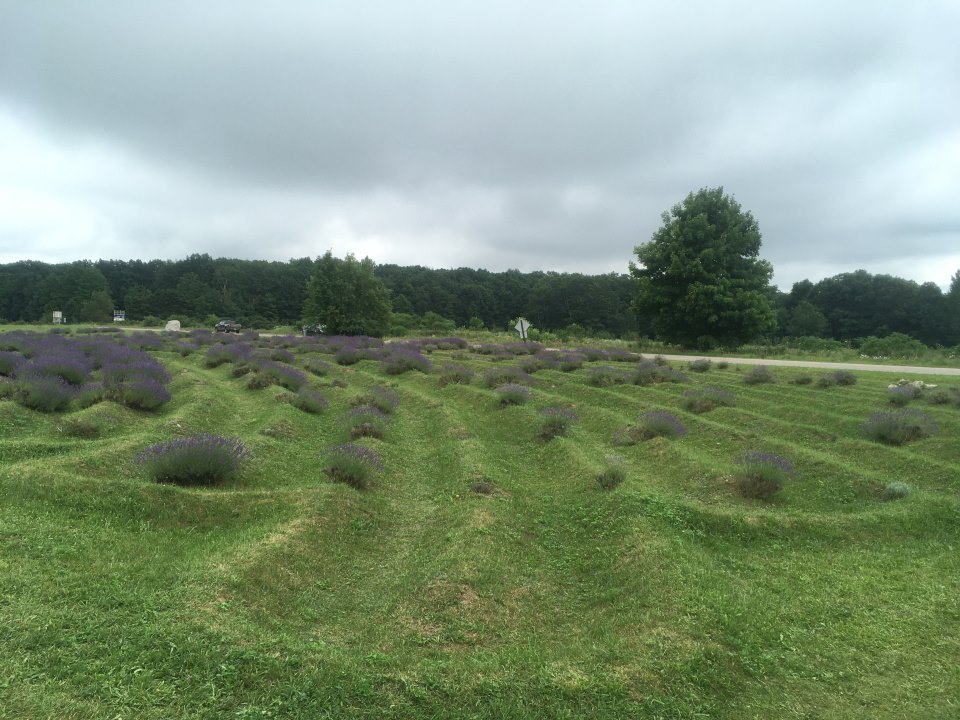
The lavender labyrinth at Cherry Point Farm and Market, Shelby, MI
NaBloPoMo 2021: Do Good, Kid
“You don’t have to decide right now.”
These words usually cause me relief. Maybe because I’m a procrastinator at heart? And maybe because I just don’t like to be rushed into things, and for sure I do not like to be told what to do, no sir. I will make up my mind when I am damn well good and ready, thank you very much. Yes, that’s definitely part of it.
But for many people, putting off decisions (or actions) incites anxiety, no? Maybe you need a plan, and to feel secure that you know what will happen, where you’re heading? I think this comes up a lot in medicine, when doctors and patients share decisions on plan of care. Cancer screening and diagnostic testing protocols seem cookbook on the surface, but in order to make the best decisions for individuals in a large, complex system, we often need to think harder about what to do and when.
In the Knowledge Project podcast episode with Bill Ackman, he considers the utility of putting off decisions. Just because you can make a decision now, does not mean you should. Instead, assess and decide when you will need to make the decision. The question to ask here, he says, is, “When will the risk picture change, and how?” Basically, how much time from now until it’s do or die? What factors should I monitor, and what are/will be my options now, compared to then?
What will we do with the information from any given diagnostic test? What are the possible/likely results, and how reliable will they be? Which results will answer our most important questions (what are those questions, anyway? What are our primary goals?), and which will provoke more questions, thus complicating the picture for no benefit? Screening and diagnostic tests are one way doors—once done, they cannot be undone. The information revealed, reliable or not, actionable or not, is now forever discoverable and requiring explanation. Many a wild goose chase are instigated based on benign, irrelevant, incidental findings from unwarranted and excess testing (my opinion). My minimalist bias stems from a deep aversion to wasting resources—time, energy, and access as importantly as dollars. In our quest for certainty, sometimes we get exactly the opposite.
That said, the suites of risk that matter most to you, me, or anyone else are both unique and overlapping, no? Their weight and prioritization evolve in constant fluidity over time, and non-linearly, which I think we don’t attend to enough. At the end of many elderly folks’ lives, they prioritize independence and quality of daily life now. But their loved ones may prioritize safety now and longevity later. Grandma may be willing to sacrifice months or years lived for staying in her house, and she might also change her mind multiple times before the actual end of life. She may have a very different framework for deciding when/what/how to do things, compared to Son and Daughter-in-law. You may be completely willing to risk finding colon cancer at a later, less treat/curable stage, because the intrinsic costs of the prep, sedation, or whatever else about the test are just that high for you. Or you may be willing to have multiple breast biopsies, risking pain, bleeding, infection, scarring, and increasing likelihood of future abnormal mammogram findings, just so you can be assured every year that you do not have breast cancer now.
As loving family members and conscientious healthcare teams, we must always negotiate for optimal outcomes, subjective as well as objective. May we all approach ourselves and one another in respect, peace, love, and mutual support, and hold space when and where appropriate.
If you’re a child of the ‘80s and you’re looking for 45 minutes at a time to flash back during mindless cardio, I recommend Halt and Catch Fire on Netflix, a historical fiction series about the advent and uprising of personal computing and the internet. It’s like watching a slow motion, multi-car emotional pile-up on the highway in your home town. You see the speeding Porsche coming around the bend, just as the drivers of the F150 that rear-ended the Corolla and pushed it into the MAC truck, all friends of yours, start to realize what just happened. You feel dread rising, your muscles tense, you know what’s coming. You cringe and mutter (shout), “Nooo, don’t do it, slooow doooowwnnn!!” And you can’t look away.
Hubris, ego, vision, Machiavelli, **relationship**, complexity, trauma, identity—I tapped these words onto my iPhone notepad during one particularly vexing episode, while bouncing on the elliptical. I find myself both cringing and knodding at the raw, intense, and artfully, lovingly rendered drama of human foibles on this show. There is something about every character that I can relate to. I’ve been there, I think (feel?) so often. I’m invested in these characters and their relationships; I want them to succeed—to ‘do good’. Halfway through season 2 now, I notice what makes me squirm the most: Witnessing decisions made in the throes of emotional hijack—hurtful words slung in rage, impossible promises made under threat, carnal impulses followed in limbic heat. It’s fiction, which gives me safe distance to reflect on how I know better, while recognizing my own absolute vulnerability to these same and other lapses.
It doesn’t take much, when someone treads too close to a strongly held identity, a fiercely held belief, or an otherwise sensitive spot in my psyche, to upend my attitude from calm clinician to defensive tackle. I may not lash out in words right away, but I wonder how this affects my decision making going forward, especially at work. When I experience recurrent threat, rejection, disdain, or disrespect, real or perceived, from or toward you, what stories do I start telling about you (us)? How do these morph into entrenched assumptions that then cloud my judgment and compromise my objectivity? In short, how does my being a normal, emotional human put my clinical decision making, and thus my patients’ health and outcomes, at risk? How so at home? It’s all potentially dangerous.
I can think of a few ways to guard against relational and decisive pitfalls here:
To calm down, I can take a few deep breaths, remind myself that we are all humans. We have the same fundamental needs to feel seen, heard, understood, accepted and loved. I can ask questions, like, ‘What part of me or the other person is not having a need met here?’
Practice ODP: Observe, Describe, Participate. This is a mindfulness tool from dialectical behavior therapy that I learned of recently. I can take my subjective reactions and judgments and substitute objective observations and neutral descriptions. This helps me slow down, get space and clarity. Then I can refrain from speaking and acting from a place of hijack.
I can also practice RAIN: Recognize, Allow, Investigate, and then Nurture my experience, to gain both understanding and acceptance of myself and my circumstances. Radical acceptance and compassion form the foundation of right relationship with self and others.
Consult objective others. Colleagues, friends, extended family, therapists—people outside of the index relationship and who have no stake in its workings can give valuable perspective and insight. Even better if they can make honest observations about me and my hijack patterns, so I may learn and adjust, over and over.
Our lives are most meaningful, I agree with my friend, when we find deep connection with others. But too often it is our encounters and the very relationships we have with people that keep us from connecting. How ironic. Wow, these posts (and this blog) really do revolve around only a few central themes…
Self-awareness and -regulation are key to a life well lived—that is, a life at the end of which we are more likely to look back with the fewest regrets. Keeping practices and connections that tether us to our highest and best selves, even as the gales of life threaten to blow us away, is how we exert positive agency. We make the best decisions and tell the best stories about ourselves and other people when we are truly grounded and stable.