Feel Everything: The Hedonic Stoic

Okay friends, time to get loose with some words!

The title of this post may not make any sense to you, and it makes all the sense in the world to me! It manifests my deep desire and commitment to embrace and exude healthy paradox, emerging in the form of fun, which I absolutely love. Suspend disbelief and take a dive with me, ya? Maybe you’ll have some fun too:

Stoic: “a person who can endure pain or hardship without showing their feelings or complaining.” — Oxford Languages

Hedonist: “a person who believes that the pursuit of pleasure is the most important thing in life; a ‘pleasure-seeker'” –also Oxford

I got a lot of ‘stoic’ messages growing up, some healthy and some not so much. I fell onto a sprinkler head while playing in the water one young summer, gouging a dime-sized chunk of flesh out of my knee, the kind of wound that would only heal by filling in scar tissue from the edges over a couple of weeks. As my nurse mom applied medicine, her demeanor was calm and clinical, and she told me to be still, be brave– (yong gan). Looking back, there was no shaming or denial of my pain, just reassurance that everything would be okay, and I had it in me to endure. It was validating and encouraging. Years later, as I cried audibly in the theater during the most tragic movie I had seen to date, a male relative pinched my thigh–hard–to get me to stop. I understood that message clearly, and it was neither validating nor encouraging.

Feel it maybe, control it always, show it never. How many of us could identify this, or something similar, as an unspoken mantra in our families of origin? Or in our collective culture today? When someone is sad, or even happy, how (un)comfortable are we with their tears? Or our own? What are the acceptable expressions of emotion? Smiling, laughing, hugging, drinking, yelling, honking, gesturing, throwing, slamming, dismissing, deflecting, turning away–including with/at/from ourselves? What does this cost us in psychic energy, physical health, and most importantly, human(e) connection with self and others? And how is it both useful and harmful?

Contrary to what some may think, stoicism is not about repressing, denying, or expelling emotions. It’s more about a commited self-awareness and self-regulation practice, so as to not let intense emotions hijack us into poor decisions and ruined relationships. It’s about balancing feelings with reason, clearing the path for (inter)acting according to our highest goals and core values. It makes sense, then, that a dedicated practitioner may end up with what we colloquially call the ‘stoic’ demeanor–straight posture, neutral expression, generally undemonstrative carriage. And, not necessarily. I think it’s possible–preferable, actually–for a true stoic to live an expressive life; just not excessively or gratuitously so. And even if not outwardly obvious, an ardent stoic can (and does, in my opinion) still experience, even revel in their deep, powerful, and moving emotions, while still keeping a leash on it all. For many, this may be easier said than done; that is why the sister practice of mindfulness comes in so handy, particularly skills that help us manage difficult emotions. Stoicism, then, is a practice of inner peace.

Life is so full of sensations–movement, sound, temperature, texture, taste (omg all the flavors!!), light, color, mass, frangance–I feel giddy just seeking the words! And all of this in addition to the infinite complexities of emotion, relationship, and community, holy cow! We are here for such a short time, how sad would it be to live an entire life without full and vibrant awareness, attention, and appreciation for all there is to possibly sense and experience? This is why I love the idea of ‘healthy hedonism’–an all-in, sensually fulfilling relationship with pleasure, yes, but really I think it’s about joy–the quintessential manifestation of joie de vivre. Hedonism is not the same as debauchery. I think of it as liberated and exuberant engagement with all that our sensory world has to offer, within healthy boundaries–actually similar to stoicism in its grounded mindfulness of and devotion to a Why–living a full and fulfilling, attuned and connected, self-actualized and purposeful life.

Feel it all, manage it well, effuse it appropriately: A new personal mantra in progress, maybe. Allow the feelings, apply good reason, express for connection. Practice withstanding severe discomfort. Equip myself to plumb my emotional depths with confidence. Be with it, surrender–to pain, joy, love, loss, uncertainty, confusion, awe, outrage, fantasy, all of it–and then self-regulate: Do the work, learn the lessons, and apply in relationship, the ultimate human expression. As I write this, it’s so clear that besides mindfulness, self-compassion is another key skill for a hedonic stoic to practice.

To face all feelings without fearing them, to embrace a full spectrum of sensation and aliveness, and to emanate unfettered joy, all while solidly grounded in an ethos of love and contribution: This is the essential spirt of the hedonic stoic.

Sign me up.

What Does It Cost?

What does your work cost you, in terms of your health?  In your relationships?

There is always a cost for the money we make.” says Simon Sinek.  There is always a cost (for the reward) of any choice we make, no?

Friend and I recently bonded over the challenge of disconnecting from work when we go on vacation.  It took going overseas for me to finally feel mostly (not totally) guilt-free deferring all urgent patient care, temporarily, to a colleague.  Friend also went abroad for spring break, yet he still logged onto work email for 30 minutes every day (was it really only 30 minutes, I wonder?).  As a high-level organizational leader, and thus a gatekeeping decision maker, “things stop for a week if I go away, and I hate that idea, that I’m the [rate limiting step of the org’s operations].” 

I get that. Maybe it’s different from medicine. It’s more work to cover another doc, no question. We answer calls from patients we don’t know, often prompted to sift through a tangled morass of electronic medical records that now often includes documents from multiple facilities across the country. We don’t readily know the patient’s current health status, communication preferences, or personality quirks. But in the end, we can all take care of the patient. And in a week or two, we hand them back off to their primary care doc, hopefully with questions answered and problems resolved (‘tucked in’), or at least an appropriate care plan well underway. Because of this, many of us ‘cover ourselves’ when we go away, especially if it’s a short time, like a holiday weekend. So over a year, my patients maybe have to live without my immediate, personal assistance a total of three or four weeks. We docs trade off, and it feels fair and manageable. I asked my friend if no one could cover him similarly, be available in a pinch so he can relax with his family? Yes, he answered without hesitation, it’d be easy. What would it cost him and the workplace, I asked. “Nothing.” And yet he has never done it; not really even considered it, maybe? We were walking, and I stopped suddenly, stymied in surprise and empathy.

How fascinating. 

In our thinking brains we know what to do and how to do it—to make it safe and seamless to get away. Logical calculations tell us that disconnecting from work for a little while is low risk for organizational operations. Our colleagues are more than capable of handling things in our absence; the place and its people will not actually grind to a screeching halt. And yet the social pressure of staying connected, of never putting down the yoke of work, even for a little while, looms heavy and thick. “The graveyards are full of indispensable men,” Charles de Gaulle said. And it’s not that we think ourselves truly indispensable—it’s not arrogance. It feels, at least in part, more like a fear of being seen as a slacker, a freeloader, not pulling our weight. Most concretely, it can cost precious time, attention, and connection with our loved ones. And it’s not just on vacation. Our 24/7 work lives invade our homes, stealing us from our children so insidiously that we don’t even notice. But because home is where we feel safe and un(less)conditionally loved, it’s much easier to withdraw from that account to pay work.

Beyond that, what are the myriad costs to those we lead, and thus to our organizations, and our society as a whole?  When my direct reports see me sending emails at midnight on Saturday, what example and expectations do I set?  Even if I write explicitly that I do not expect a response outside of business hours, the implicit message is the opposite.  I lead by example, like it or not.  “Do what I say, not what I do,” fails just as surely at work as it does at home.  This is how the status quo of burnout and disengagement, even (especially?) among the most passionate and well-intentioned workers, perpetuates.  What a vicious cycle, I say, all of us trying so hard to prove our worth every day, not trusting that our value is seen and appreciated just by virtue of our contributions and relationships. 

And whose job is it to break the cycle, to reshape this flawed culture of relentless, imbalanced, and unhealthy self-sacrifice? I think it’s the leaders’, first and foremost. It’s so much easier said than done, and it cannot depend solely on one person in any given place. Culture is self-organizing and perpetuated through the mundane, momentary, miliary interactions between all of its members. So we all matter—we contribute—in the big picture. But I am convinced that no significant change occurs without direct influence from those at the hierarchical apex. Thus, I commit to doing my best to support, encourage, and advocate to leaders themselves and on their behalf, one person, one vacay, one interaction at a time. We will all be better for it, co-creating a world where we can all rest sometimes, taking turns pulling the cart. The immediate social costs of bucking the system can be borne more easily the more of us support one another in the effort. The current status quo already costs us productivity, morale, and lives, literally.

At the ends of our lives, will our work rewards have been worth all that we paid?

Unloading the Primary Parent

My friends:

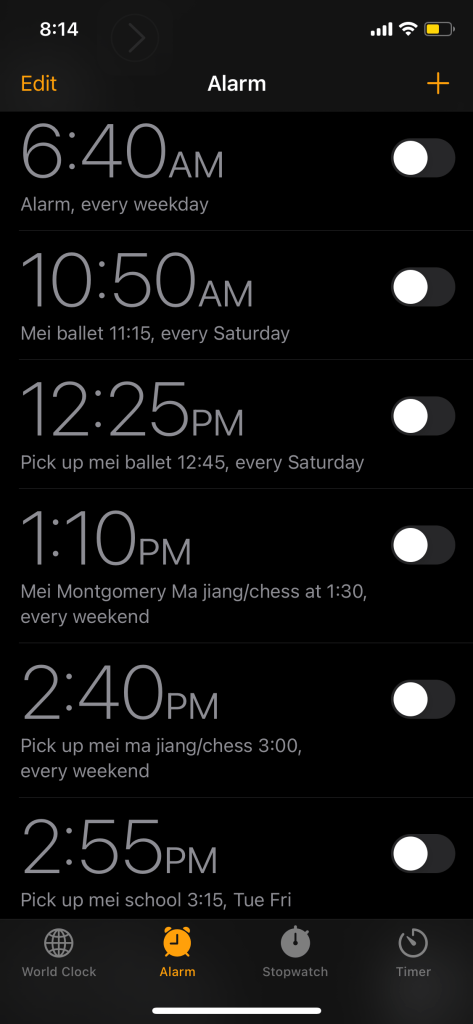
These are the alarms I get to silence as we go on spring break.

There will be much movement and stress while traveling in the coming week. I must call forth every skill for self-awareness, self-regulation, and effective communication I have ever learned. Oh and some self-compassion and good humor will also help.

But at least I can put down the phone for longer intervals, and enjoy some quality time with the family.

I’ve downloaded some new romance audiobooks and packed lots of pretty paper and colored pens. I will sleep in every day if possible. I’m ready!!

Wishing you all a beautiful, peaceful, and connecting start of spring. See you on the other side of jet lag!