November 4:  Setting Limits Makes Me Better

IMG_0052_preview

NaBloPoMo 2019

How many of you are the chubby one of the family?  That’s me.  My two sisters have been positively svelte their whole lives, with apparently very little effort, as far as I can tell.  Yes, I envy them.  But whatever, ya work with what ya got, right?

I have never been a dieter, as I hate feeling restricted.  But I have had some success with setting limits sometimes.  The best experience was after I stopped nursing my daughter.  I was finished having children, no more human to hippopotamus transformations, hallelujah!  I thought, I can get my body back, woohoooo!  But how?  I had two little kids.  I worked.  I had neither time nor motivation to exercise, and even less energy to police my own food choices.  I’ll just eat half, I thought one day.  It was so simple and easy.  So for the next year I simply ate half of what I would normally eat.  This was not too difficult, as my portions were clearly just too big.  But for some reason it was the perfect method for me in that moment.  I don’t remember feeling hungry, and more importantly, I did not fear the hunger.  It was almost unbelievable, even as I lived it, how easily I could adhere to this plan.  I lost 25 pounds in nine months, and I felt well.  I managed to keep most of the weight off for several years.

bunny bao

Now, in my mid-forties, the story has evolved.  Kids are older, work has advanced, and I’ve acquired a boatload of fun and interesting extracurricular activities.  I achieved the sisterly figure ever so briefly, and now, tee-hee, not so much.  Eating half definitely does not work today!  Fascinating.  So I have to find new, more effective limits to set.  I have to say, I’ve managed to blow through most of my recent attempts: sweets only on weekends, no eating after 7pm, lights out at 11:00pm, and screen time?  What?…  I did manage to get all social media off of my phone a year ago, though.  That was a big deal, and I’m much better for it.  When I remember to bring my own takeout container to restaurants, and move half of my entrée into it at the beginning of the meal, I don’t overeat.  And if I agree with my friends at the outset to forgo dessert, voila, calories averted.  So I’ll keep working on the health habit limits… Maybe take my own advice…

The best thing about setting limits and then violating them is learning.  It makes me pay attention, ask more questions.  I am forced to practice curiosity and non-judgment, lest I wallow in that deep hole of failure and self-flagellation.

This month I commit again to daily blogging.  My family still needs me, I still need to work out, and I want to read real books more than I did this time last year.  I also need to just get more efficient with writing in general.  So I set myself a limit of 60 minutes, start to publish, for each post—perhaps it shows in the quality of writing?  Well, that will be a learning, too!  My first attempt lasted about 70 minutes, but I can’t say I kept good track.  Last night I actually set my timer, and it was a total disaster, I think 2+ hours beginning to end.  It was so enlightening, though, watching my distracted self throughout the process.  The TV was on (my desk is in the family room—the double edged sword of being near the family but not totally with them), our shows playing from the DVR. It’s a wonder I don’t get whiplash, turning to crane my neck toward the TV from my non-swiveling chair.  People were talking to me, even though I had my earbuds in.  I kept opening my email, Facebook, text, email again.  OH my gosh it was a total circus, and I felt the chaos in my whole being.

IMG_1869

Tonight, however, is a different story. I’m alone here at the desk, Shawn Mendes and Dierks Bentley playing softly while I type.  No TV, no earbuds.  I feel calmer; the house and I are both much quieter.  The ideas and words flow forth with ease and joy.  Fascinating!  You might say, Um, Cathy, DUH.  Of course you’ll write better when your environment is more conducive, everybody knows that!  Yes, of course, we know it.  But to experience the glaring contrast here on two consecutive nights really brings it home—the doing makes it real.

So maybe I’ll make a deal with the family the next 26 days.  I get 60 minutes of peace and quiet each day; time of day/night negotiable.  They are banished or gagged in that time, no audible devices allowed, and it’s my job to make the most of it.  Write, edit, select photos, categorize, tag, and publish.

I have 12:25 left.

IMG_1842


November 3:  (Sun)light Makes Me Better

IMG_2975

NaBloPoMo 2019

Happy Standard Time Change, friends!

How do time changes affect you?  What about the shorter days here in the higher northern latitudes this half of the year?  I don’t have seasonal affective disorder, but no question, the absence of light affects me.

I grew up in Colorado (really, I know you could not possibly know by reading this blog), taking the sun for granted the whole time.  Blogging makes me read more, which makes me more honest.  I’ve been bragging to my friends lifelong about 320 days of sunshine per year in Colorado; turns out it’s more like 245.  But it’s still more than the US average of 205.  (Arizona has 299; Chicago has 189.)

IMG_2976

Utterly anomalous, then, that I decided to go to Northwestern for college.  I already wrote this summer about my campus visit—rain, rain, and more rain.  I never saw the sun that whole weekend.  But maybe it was the lake, viewed from the student center, that called me—that vast blue expanse, a smooth surface concealing untold life and tumult beneath.  There was no other school for me; I was meant to be there, sun or no sun.

Fall quarter freshman year, recalled now by a typically skewed mid-life memory, was a BLAST.  Independence, new friends, beautiful campus (deciduous trees with fall colors other than yellow, YAY!), being a small intellectual fish in a much bigger, much more diverse and interesting pond—I was in heaven.  Going home for Christmas, once I overcame the stark reality that life had clearly continued without me (what?), was also joyous. I caught up with old (HA! ‘old’ at age 18) friends and curated more items to bring back to school.  Life was sweet!

IMG_2977

So two weeks into winter quarter, I really had to wonder why I felt so down.  Mopey.  Low energy.  Sad.  Not severely, but noticeably.  I remember the moment, walking south on Sheridan Road in front of Tech, the giant engineering building (third largest building under five stories after the Pentagon and the Kremlin, they told us on the campus tour—found no reading tonight to verify this).  I looked up at thick gray-white clouds blanketing the sky.  I saw everywhere bare branches, orange and maroon leaves long gone, and only dirty snow, ice, concrete sidewalks and holey asphalt on the ground.  I had not seen the sun since returning to school, and I realize now as I write, there was simply no color anywhere outside, other than the bright neon Columbia jackets my friends and I wore in those days.  So of course I felt sad!  I think that was the day I started hating the climate here.  After that I never worried about my mood in the winter, grumpy as it was.

Fast forward about 17 years:  Winters were taking their toll: waking to blackness every morning, getting two little kids ready and out the door by myself, working indoors in a windowless office, and coming home again in the dark to the same little kids, hubs, and chores.  Maybe I was getting more cranky than I realized (she says innocently)?

My infinitely patient and loving husband was, finally, completely and justifiably fed up.  For Christmas, perhaps out of desperation, he bought me a dawn simulator, which may have saved our marriage.  It’s basically an alarm clock dimmer, which you can set to gradually turn on a bedside light to simulate the rising sun.  For the past decade or so, pitch black mornings outside have given way to a soft, emerging glow of light in my bedroom sanctuary.  By the time the audible alarm sounds, my surroundings are already warmly lit by the full spectrum bulb that came with the device—it really is kind of like dawn.  And I kid you not when I say that I am a much happier person all day—all year—for it.

IMG_2973

Since this realization, I make sure to get by a window every day in the winter, even on cloudy days.  Any light is better than none, and it makes a huge difference for me and everyone who comes in contact with me.  With age I have also gotten better at noticing how my environment affects me.  It’s a slow and continuous awareness.

The sun always shows itself eventually, my friends.  Maybe you’re like me and a dawn simulator or light box could improve your life.  It makes me think, though—meanwhile, how can we all be a little light for one another?

IMG_2978


November 2: Reading Makes Me Better

Mesler book window

NaBloPoMo 2019

Today I share a Facebook comment series I wrote in response to a prompt from a progressive friend, in its original form.  His post made me look up and read 7 additional articles, all of which I linked in my comments.  In the end I became more aware of my own biases, and recommitted to finding common ground with people who think differently from me.  So I think reading makes me better.  What think you?

wsj divided nation 2019

Friend’s post:  (Cathy):  I’d be interested in your perspective on this article in terms of your work to bridge divides and create civil conversations.   [Wall Street Journal slide deck describing the economic basis of party divisions in the US—it’s a fast click through which I recommend.]

My comments:

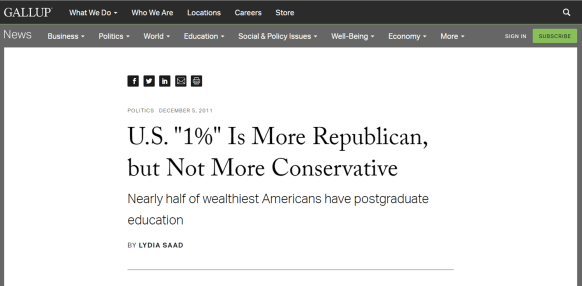
Thanks for sharing, (Friend)! Okay, I will take the time to make a long comment thread, as this is really interesting to me. Thank you for asking the question you did–I’ll get to it eventually! First: The information presented in this slide show is consistent with what I have read before. The facts presented are real. And they are incomplete. It looks at differences between districts, which is the best way to highlight division. I think this is a direct consequence of gerrymandering, which is designed exactly to create districts that will reliably vote one way or another. And we have all seen the US map showing blue clustered around big cities and red everywhere else. AND, this report ignores the glaring truth that despite the economic divisions by district and income, a much larger proportion of the top 1% is either declared or leans Republican than Democrat (though not necessarily more conservative):  https://news.gallup.com/poll/151310/u.s.-republican-not-conservative.aspx

Gallup 1% 2011

Second: The suburbs are where Reds/Blues live amongst one another, and this report ignores them, pretty much. That said, even without gerrymandering, we Americans have sorted ourselves ideologically. Bill Bishop wrote a fascinating book that details the economic and social evolution, _The Big Sort_ (listened to the whole book a year ago, I highly recommend it): http://www.thebigsort.com/home.php

I think suburbs are where work like Better Angels has the most potential to spark civil discourse, except that people are hesitant to engage, for fear of upsetting the tenuous and silent politeness that constrains their ability to talk openly about politics. That cultural noose is hard to untie.

Dem demographic 2019

[Below are a] couple of other links that have additional demographic information that gives context and texture to the WSJ slide deck. The point of all of this is that when we I read articles that start out with nihilistic, Vader-like proclamations of “America’s political polarization is almost complete,” I see an implicit agenda to actively contribute to that polarization for the good of the publisher. Brené Brown reminds us to beware of those who tell us things are absolute, either/or. Reality is almost never this dichotomous, and whenever we hear it is, we should look for who benefits from us thinking it is. Economic demographics of Democrats: https://www.debt.org/…/economic-demographics-democrats/

Economic demographics of Republicans: https://www.debt.org/…/economic-demographics-democrats/

Okay finally, to answer your question, on my “perspective on this article in terms of (my) work to bridge divides and create civil conversations”: My favorite visual is this table from the first article I linked to. In some ways we are ‘almost completely’ divided, as the Vader article posits. In other ways, we are not. I think of the surveys showing a majority of Americans being in favor of background checks for gun ownership, in agreement that abortion is generally not something we want happening all the time. I think of all of the conversations I have with pretty much any other human, and how we are all 90% more alike than different. But this article and 90% of the articles we see highlight the other 10% of differences, and worse, the most vehement and violent expressions of those differences. So my perspective on this article is that it contributes significantly, if not blatantly, to the division it reports. And it does not serve us in any way. And, I hope I would have the same response if it were published by the New York Times. 😉

top 1% demographics 2011

HANG ON. I just saw that this favorite article I cited is from 2011. I have found a couple of more recent ones; will review and continue the thread….

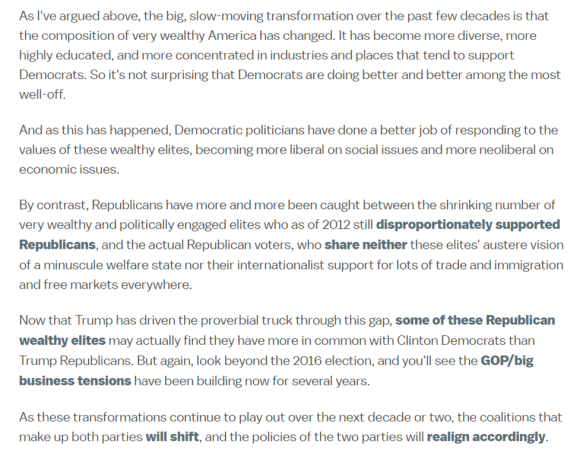
vox welthy dems 2016

Okay, here is an article from 2016 by a poli-sci expert who, [Bill Bishop-style], explains well the progressive evolution of the top 4%. Very interesting:  https://www.vox.com/…/6/3/11843780/democrats-wealthy-party

And hey, here is one from Forbes this year, which quotes the author of the Vox article, highlighting how a sizable number of Republicans actually align ideologically with Democratic policies:

“The fact that lower-income Republicans, largely known as the ‘basket of deplorables,’ support more social spending and taxing the rich was a key takeaway from this year’s report, says Lee Drutman, senior fellow on the political reform program at New America, a Washington D.C.-based think tank… ‘It is pretty striking that about a fifth of Republicans had views closer to the median Democrat than their own party,’ he says. ‘A lot of them actually want a sizeable social welfare state. It’s a little bit of a puzzle why they don’t vote for the Democratic Party, other than long-standing cultural ties maybe and other ballot issues. What we have here is just one of the two parties stands out to have a bunch of its supporters in opposition to some of the party’s economic platforms but still gives them their vote.’” https://www.forbes.com/sites/kenrapoza/2019/06/24/how-democrats-and-republicans-differ-on-matters-of-wealth–equality/#13e06ab8702f

More from the Forbes article:

“But when looked at closer, a plurality of voters (72%) across the spectrum said the government should provide tax credits for low-income workers. Some 60% are in favor of raising the minimum wage, and 58% were in favor of raising taxes for those families earning over $200,000 a year.

“Across party lines, Democrats were the ones who were most interested in a higher tax burden for the wealthy, though it is unclear if they considered themselves to be part of the income group that would be hit with higher taxation in a more progressive tax structure.

“An overwhelming majority (79%) of Democrats earning under $40,000 a year wanted to tax the rich more. Democratic Party voters earning over $80,000 were 83% on board with taxing higher incomes at higher rates. For Republicans earning under $40,000, 45% were in favor of taxing the rich. Republicans who earned over $80,000 didn’t like the idea. Only 23% were in favor.”

[In conclusion:]  Complexity does not make for headlines, sadly, and we should take this into account when we read and share. Thanks for posting on my page and asking the question, [Friend], you have made me think and thus made me better! 😀