
Nutrition

Ok friends, now we get to talk about hard stuff: Food. GAAH, I JUST LOVE IT SO MUCH. My indiscriminately joyous palate and hedonist tendencies conspire to make me positively fat, and I have spent decades resisting that outcome. I feel an internal truce developing with age, though. I wrote my post on leading vs lagging indicators of health back in February, and share it regularly with patients. Each conversation reinforces my thesis: that numbers, be they body mass, body fat, glucose, or cholesterol, do not tell a remotely complete story about our overall health.

After reading Anti-Diet by Christy Harrison at the recommendation of a therapist friend, I can own my insidious internalization of our cultural obsession with thinness. I diverge mildly from some of the author’s opinions and assertions. I still greatly appreciate her understanding and validation of the complexity that is body weight, and the reality that we do not and cannot necessarily control it. Despite what many say, body mass does not simply equate to calories in minus calories out. Metabolism takes myriad inputs and outputs, both intrinsic and extrinsic, always in flux. Genetics play a large role, more for some than others, in body habitus changes over a lifetime. Sometimes acceptance is a healthier, more peaceful strategy than resistance.

Reconciling body mass and shape to health and well-being, especially for folks like me who are not naturally thin, costs loads of psychic energy. It can cause layers of stress and discomfort, much beyond moving around in a heavy body. I focus on weight/body mass and appearance in this post on nutrition becuase when my dietician colleagues and I talk to patients about food, a majority of the conversations are centered here. If American culture is obsessed with exercise, then we are brainwashed about thinness. I can think of few domains where both collective and individual judgment is more harsh and destructive. And when we judge weight, judgment of food and eating follows closely behind. Let’s see if we can shift this, shall we?

When I look at my eating habits today, I nod approvingly. Not because they are perfect or even admirable, but because they are so much healthier than in the past. This year especially, I’m able to practice mindful eating:  More often than before, I ask myself:  What’s driving my eating at this moment?  If it’s not truly hunger, will the calories be worth it?  What else do I need (water? sex? laughter? connection? movement?), and is food a good enough substitute?  I understand my non-hunger eating drivers (eg visual cues–never watch Big Bang Theory after dinner–and omg stress) and can anticipate them farther in advance. I can take precautions like not keeping ice cream in the house, and buying sweets in easily portioned units (thank you, Trader Joe’s frozen macaron varies!). I know my sleep requirement threshold below which mindless eating easily takes hold, and make strides to get to bed on time. My snacks are healthier–I pop blueberries as I write this–and I attune to my saiety much better with age–just ate my last blueberry of the writing session.

Here’s what I’m still working on, the mantra I have yet to integrate: “Enjoy every bite!” Whether it’s mac ‘n’ cheese or pecan pie, mashed potatoes or Haagen-Dazs, I am sure to indulge when offered. The visceral and limbic pleasures of flavor, texture, and sharing with friends act like jet fuel accelerating utensil to mouth oscillation speed. The greatest potential food joy quickly and easily devolves into an automatic race to consume, and it’s over before I realize. Not only have I then obliviated a peak plesaurable sensory experience, but I have also likely overeaten, and the sadness and guilt compound. “Enjoy every bite,” if I can remember and repeat, reminds me to slow down and attend to the full experience. Temperature, texture, flavor, aroma–just thinking of it all now relaxes and uplifts me. Good food, enjoyed mindfully in real time and especially in good company, connects and delights. I will continue to practice this not only for the most indulgent foods, but also the most mundane. The simplest foods can make me positively giddy: a poached egg, buttered toast, watermelon. Holy cow I just realized: If I truly enjoy every bite this way, how much more amazing could my sensory life be? Could I even stand it?


So what’s already good about American nutrition? Let me put down my cynic hat for a moment…
The United States is self-sufficient in food: we can produce enough to feed our own population (though 17 million households were food insecure for some part of 2022).
–Many of us have access to non-local, non-seasonal food, which we often take for granted (though economic and ecological costs are high).
–Information about healthy eating (though not necessarily healthy food) is more and more easily accessible.. though misinformation and fads cost us millions of hard earned dollars every year.
–Oh here’s a good one: Reasonably healthy meal prep and delivery services are increasingly available for busy families…. who have the funds to outsource planning/shopping/cooking.

Okay let’s just skip to what could be better.. no holds barred here, full fantasy mode engaged:
–Portion options at restaurants, with coinciding pricing scale. This prompts diners to assess and decide more mindfully when ordering. Or offer to present takeout container when entrees are served, so diners may save leftovers at the beginning of the meal and eat mindlessly thereafter (I try to bring my own boxes)
–Elevate nutrient quality of meals served in schools
–Effectively incentivize purchase and consumption of locally produced plants and animals by both individuals and businesses
–4 day work week. This could actually solve, or at least improve, intersecting problems in all 5 reciprocal domains of health: sleep, exercise, nutrition, stress management, and relationships. See evidence for benefit from The World Economic Forum, the Wall Street Journal, and the UK/EU
–Cultivate a collective mindset of slow, selective activity and connection, both personal and professional, rather than the frenetic, competitive, have-and-do-it-all mentality that drives us all to the brink and over the edge of burnout and insanity

Huh. At a collective, cultural, societal level, turns out I feel pretty pessimistic about meaningful positive changes in nutrition patterns. So it’s basically up to us individuals and small groups/organizations to continue swimming upstream against forceful currents of hyperprocessed food supply, agribusiness, and thinness obsession despite all systems trying by default to make us fat and sick.

HA! I’ll think more about this. I’m not hopeless or sad, more just fascinated. How are you feeling about it?
Exercise

“There are two kinds of people: those who exercise regularly because it’s who they are and they can’t help it, and those who do it because they know they should.”

When my teacher in medical school said this, I took it as truth. I now see it as partial truth. It reminds me of what little I know of Ayurvedic doshas, an eastern medicine idea of inborn constitutions; the first kind of people above are vata dominant, always active, high energy. The second kind are the rest of us. That said, these ‘constitutions’ are not cut and dry; they exist along a multidimensional spectrum. I don’t know what Ayurvedic medicine says about maleability of constitution, but the older I get the more I think we are all a living paradox: We are who we are from a very young age (before we are even born, in my opinion), and we are constantly changing and evolving throughout our lifetimes.

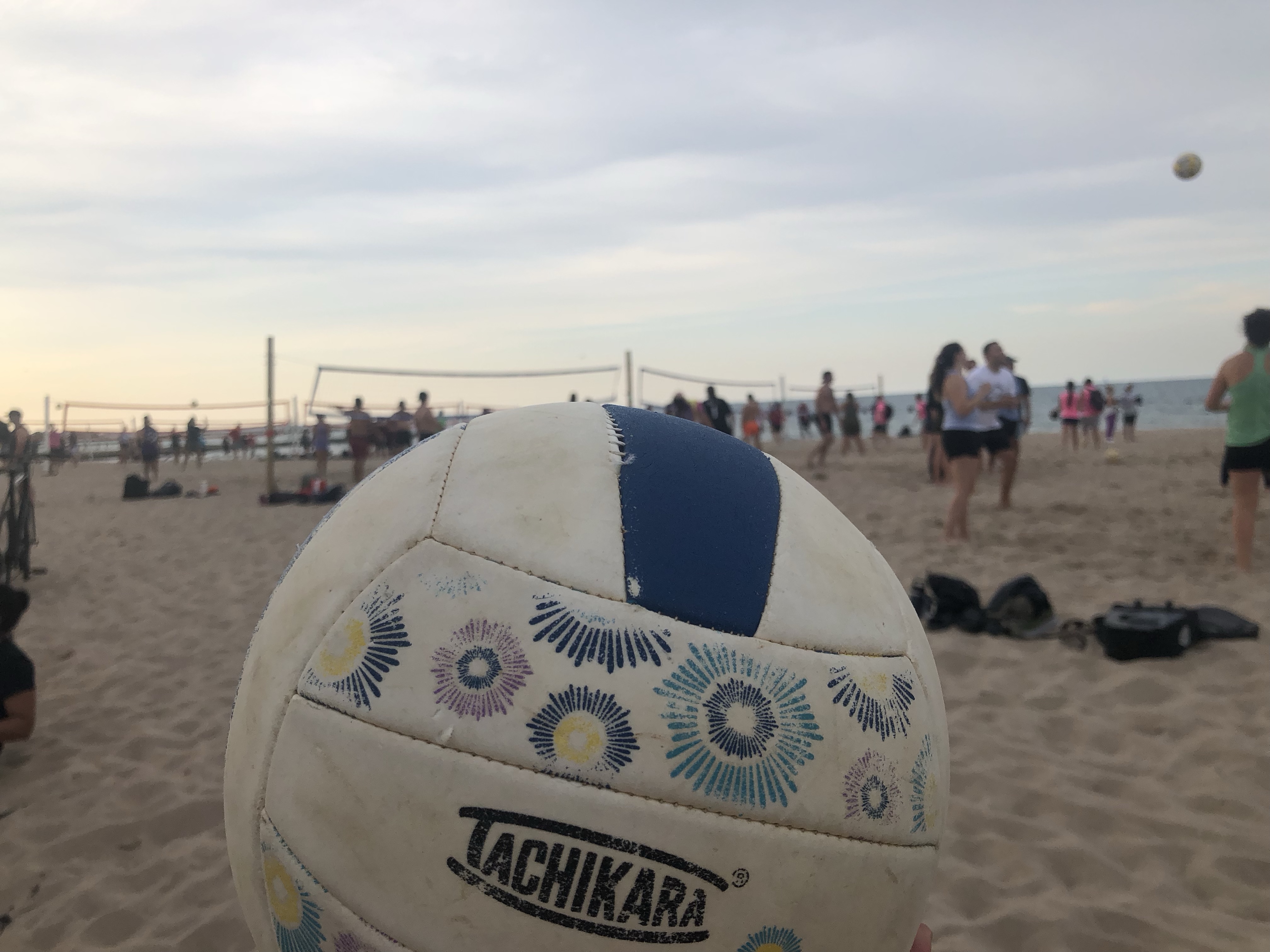
“You’re an athlete, Cathy.” Wut? My trainer Melissa stated it with a tone of irrefutable certainty. We had worked together maybe four months in 2014; she had observed me try and fail at many new movements, and also make noticeable progress along the way. Before that day I would have identified more as ‘mathlete’. In high school, classes were easy. Volleyball was hard. I participated fully in practice and drills, gave full effort in the weight room, all to be an okay player on the team. I did no other sports. But I kept playing at open gyms, college and med school intramurals, anywhere and anytime I could. To this day, I can still hold my own on a volleyball court. That sunny summer day running through her neighborhood, Melissa assigned me a new distinction, one I may never have considered. I have now proudly claimed it, and today my fitness program is firmly established and thriving. Since Melissa met my Ethos coaches six months ago, I have resumed learning, practicing, and training new movements, awakening dormant muscles and integrating them with what’s already strong and stable. My weight is unchanged, yet my clothes fit better. I’m stronger. I feel better about myself.

Consistency. Results. Progress. Tribe. My exercise pattern today is the best I’ve ever experienced. I wonder what it will look and feel like with another six months of training and beyond? After tearing my ACL in 2017, I know to appreciate any session that doesn’t end in injury. So how could my fitness be better? I must stay on the path, no matter how it winds and climbs. Surgery and changes at work disrupted my personal training schedule. So I rehab’d on my own at home. COVID prevented me from joining Ethos in 2020. So sibs and I did HIIT workouts at home over Zoom for three years. I can work out by myself; I know now that I do it exponentially better and have ‘way more fun with others. So that’s the plan–stick with the group that teaches me and holds me up. If I can do that, I’ll live to be STRONG OLD LADY, not frail old lady.


How would we describe American fitness? What is our exercise identity? ‘Bipolar’ and ‘ironic’ come to mind. On one hand we positively obsess over it all. If you live in any urban or suburban setting, you can practically fall out your front door and land in a gym of some kind. Sports apparel’s new fashion (genre?), Athleisure, now accounts for nearly 20% of online clothing sales. So you can at least look like an athlete when you walk around outside of the gym. On the other hand, according to the CDC, “60 percent of US adults do not engage in the recommended of activity,” and “approximately 25 percent of Americans are not active at all.” Well duh. Let’s take a look at just two correlates:

Infrastructure. American geographic sprawl necessitates transportation in the static sitting position, in cars, trains, and buses. Neither roadways nor transit culture make cycling or other self-powered locomotion appealing or feasible to anyone but the most determined, avid, and resourced. Most of us barely walk anywhere anymore, to the point of having to track daily step counts to goad us into getting up and moving at all.

Work culture. “Moreover, more than 80% of American jobs involve mostly sedentary activities,” statistics reported in 2021. This worsened for many with the pandemic, as remote work tied to a fixed computer video screen eliminated incidental movement within and between office spaces and in transit (walking to the train station or parking lot is still walking), reducing workday steps to the distance between bedroom, bathroom, and kitchen.

How can we make this better? Some simple, though not easy, ideas:

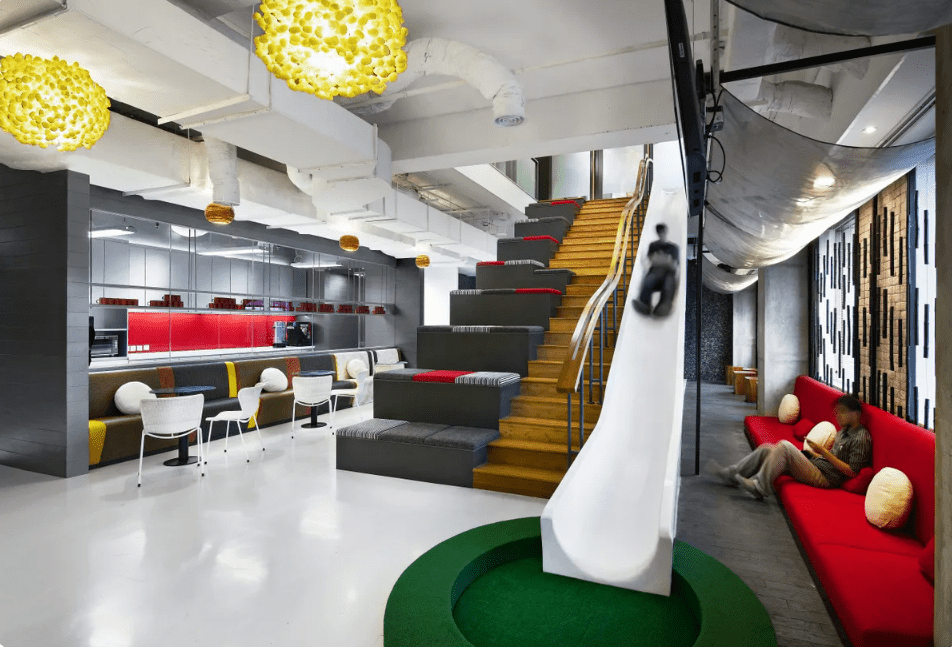
Stairs. Build them beautifully and out in the open, as centerpieces of our public spaces instead of last resort, emergency egress. Make it normal and the default to take the stairs instead of the elevator.

“5 of the best office staircase design ideas” –www.robinpowered.com

Get off camera. Do you really need that Zoom meeting? Do you need to meet at all? Whatever can be converted to a (concise!) email or voice call, do it. Hold folks accountable for preparation and brevity so all time spent meeting is valuable and productive. Then give them the time back so they can get away from their desks, accompish more tasks both personal and professional, and get more sleep, so they can be more motivated for the workouts they can now fit into their days.

Sit to stand desks. Make them standard in offices and reimburse workers to get them at home.

Give people balance boards and mini steppers as remote work onboarding gifts.

How else can we modify our systems and structures to lower the threshhold to get off our butts? What do you see around you that’s working already?

NaBloPoMo 2023: What’s Already Good, and What Could Be Better?

“Tell me about your eating patterns: What’s already healthy, and where is there room for improvement?”

In the last few years, I have found this to be the most agreeable way to start the conversation with patients about nutrition habits. We get defensive about our eating–so fascinating! Behavior change is complex; we all have our hangups, barriers, and motivators, and they all vary with context, always in flux, which can be so frustrating.

Starting from a strengths perspective, looking at what we do well–where our actions already align with our values and goals–frames habit change as taking the next step on an existing path of progress, rather than as self-judgment and remediation. It invites us to approach self-improvement with curiosity, creativity, and experimentation. When I had this idea of already good/could be better a week ago, I knew it had some connection to my book, and now I see it clearly. SO exciting! All of this inner work–the doing and writing about it–these last 8.5 years, has been in service of the Big Fat Hairy Project (BFHP) that could possibly come to fruition in the now foreseeable future… Wow.

This year, I will use NaBloPoMo as a writing lab of sorts. I will try a new challenge of setting 30 public prompts in advance. This will provide both constraint and freedom–oooo, fun–or not, we shall see! I will play around more with poetry, maybe? Storytelling? Resource lists? By the end of the month I want to feel joy, accomplishment, and wonder, having learned more about my process and evolved it a little, and produced some posts worth sharing and referencing. I will do my best to leash my inner critic, muzzle but not blindfold it, honor its innate purpose while keeping it in a corner, out of reach from my writing implements. I give myself permission to interpret my prompts broadly and respond in kind. And who knows, maybe after 30 days of (near) daily writing, I will have established an actual book writing habit!

I intend to approach each topic below from both a personal and a collective perspective. What’s already good about my own sleep, for instance, and also our sleep as a society? What could be better for me, and what would a system look like that facilitates optimal sleep for a population? Oooo, this could be cool. I often think vaguely, obtusely, in this individual/collective mindset, but this may be the first time I apply it to 30 topics in a row, directly and explicitly. Ohmygosh, how exciting.

Let’s see what happens, eh? Giddy up!

NaBloPoMo 2023 Prompts:

  1. Sleep
  2. Exercise
  3. Nutrition
  4. Stress management
  5. Relationships
  6. Reading
  7. Honesty
  8. Mindfulness
  9. Self-Compassion
  10. Polarity management
  11. Forgiveness
  12. Social media
  13. Integrity
  14. Accountability
  15. Balance
  16. Perspective
  17. Leadership
  18. Presence
  19. Romance
  20. Love
  21. Judgment
  22. Commitment
  23. Gratitude
  24. Flexibility
  25. Acceptance
  26. Creativity
  27. Education
  28. Politics
  29. Writing
  30. Debrief