Will we see one another through a lens of love and connection more than division and derision?
How will we show up with what we share, more than with our differences?
How will we contribute to a pleasant gathering for our loved ones, rather than one to be dreaded?
I feel similarly about Thanksgiving today to what I wrote in 2016. Wow, that was a lifetime ago. Things feel worse in so many ways now, which I would not have thought possible then.
Still, gratitude holds me up every day. I also still resent a socially designated day for professed thanksgiving, with conventions of gathering that are so famous for their discord that people resort to dark humor to cope. The dissonance is deafening. If you’re looking for advice on how to behave, it’s everywhere; try here, here, and here.
Okay, time to manage my cynicism now. I commit to showing up joyful for all that I have, all the people who make my life full and rich, for those who teach me through challange, and for healthy body, mind, spirit, and tribe. I will strive to emit light rather than darkness. Today is as good a day to practice as any.
Early morning moon at Sylvan Dale Guest Ranch, Loveland, CO, January 2020
“Why do I feel so sad all the time?” I asked myself in mid-January, 1992.
I had been two weeks back at Northwestern for winter quarter of freshman year, after spending two weeks in sunny Colorado. The melancholy was visceral, making me fatigued and slow. Suddenly the joy of college and friends had evaporated and all I felt was positively glum.
I remember standing outside of the mammoth engineering building, noticing the sky as if for the first time. Homogeneous gray-white, thick and oppressive. I had not seen the sun since I left home. High humidity, subfreezing temperatures, and relatively unfriendly locals all made my mood plummet deeper. I never came close to depression, though. Somehow, just recognizing the cause helped me stop worrying and the rest of the quarter progressed normally (as I recall, 30 years later).
In November of 1999 I was an intern, rotating in the ICU. Rounds on critically ill and non-interactive patients started around 6am, so I got up and drove to work every morning in the pitch dark. Before I could even think about going home at the end of each workday, the sky was black again. The ‘unit’ had no exterior walls, so the passage of daylight barely crossed my consciousness, given that I spent every third night on call. By Thanksgiving that year I just wanted to sleep until Christmas. This must be why our rotations were only ever 4 weeks. We could do anything for 28 days. I made it through without incident, and felt proud of the work I had done.
Years later with two little kids and a full attending patient load, rushing every morning to get three of us out the door, I started getting resentful. Somehow dragging myself up in the dark that autumn felt harder, more fraught. The kids slept in their school clothes for the next day, just to have one less thing to worry/fight about in the morning. This time my mood was rapidly deteriorating, and I was getting noticeably snarky at home.
Husband saved the day by buying me a dawn simulator for Christmas that year. Come to think of it, he may have saved the marriage, too. Waking slowly to a graduated, warm, full spectrum light is, I must say, almost pleasant. And that’s saying a lot from a hard core night owl like myself. My mood improved quickly and our morning routine streamlined nicely. Thank God.
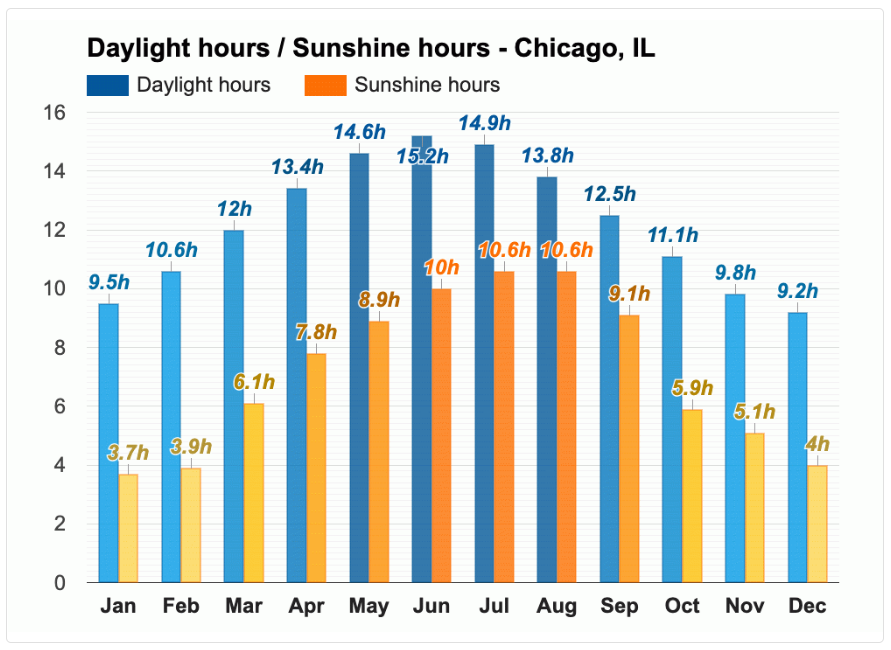
Daylight savings ended over two weeks ago. I really felt it this past weekend, maybe because it was the first truly cold weather we’ve had this season–unseasonably late. Now reality has set in: I will not see sun for days on end at a time, from now until about April. I spoke today to my friend who moved to Hawaii. She described her surroundings driving to work every day–lush vegetation carpeting mountain peaks kissed by whispy clouds out one side of the car, deep blue rolling ocean out the other, and bright sun above. This as I sat under a dirty chalkboard sky, clumped snow chunks blowing at angles against my own vehicle. I recalled winters in Colorado, which are just as cold as Chicago. But the sky there is clear blue over 300 days a year, and the evergreens that dot the landscape offer steadfast contrast to any snow that sticks. And it often sticks only briefly, melting between snowfalls, so that what’s on the ground is actually white (making it that much blindingly brighter), not resembling pipe sludge like in Chicago. And because it’s so dry, the sensation of cold is also much milder.
I know they’re all good reasons. And I’m grateful that I can travel home often. I like thick turtleneck sweaters and hot beverages, books, socks, and blankets. I have a home gym, a sleeping bag coat, good boots, ski goggles after the last polar vortex, and a 4WD that I love. I guess I can make the best of this season–again. Now, gotta plan my escape for January…




 Healing Through Connection