
Who are your colleagues?
What connects you?
What do you share with these people that others do not and cannot understand or relate to?
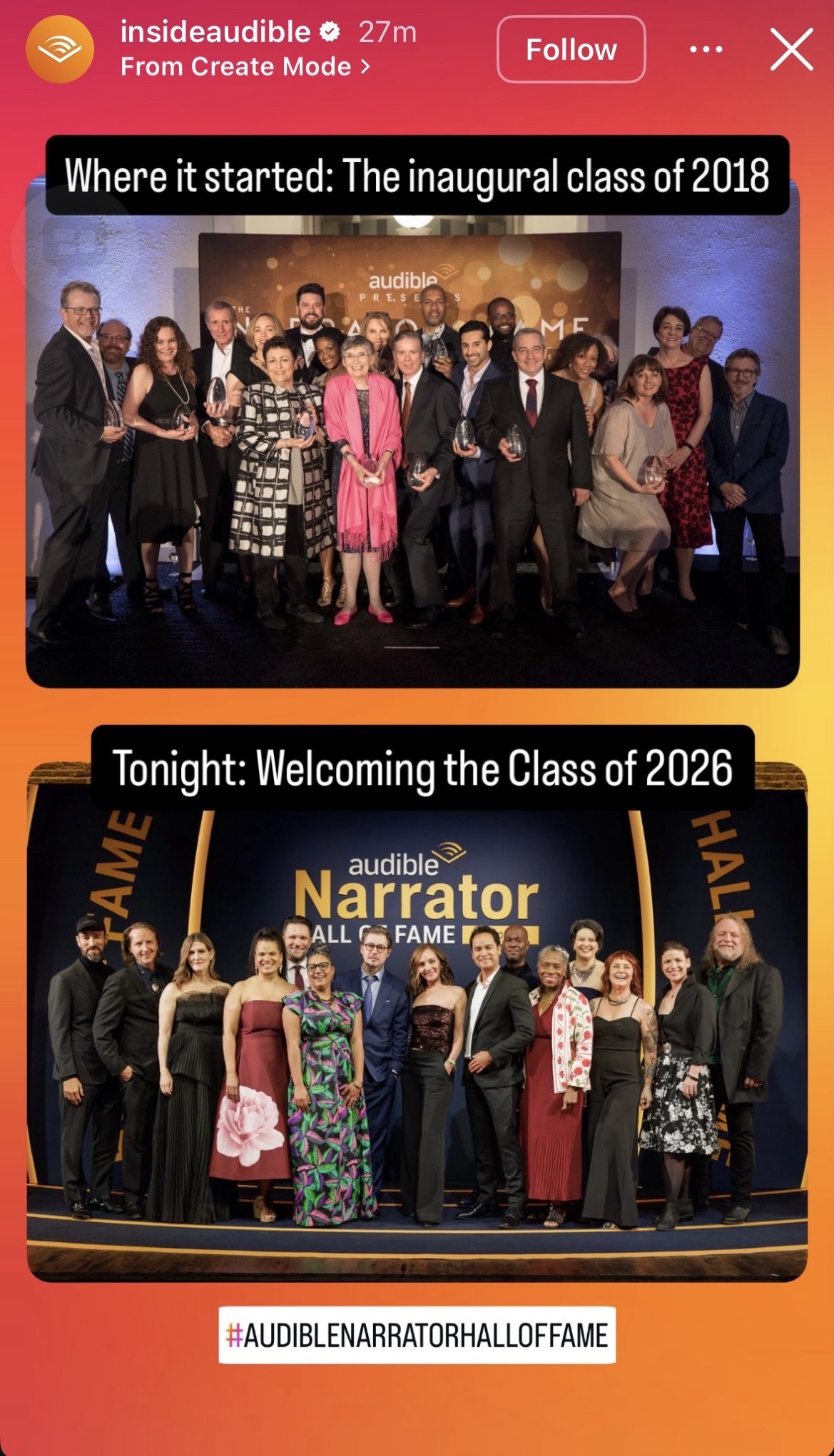
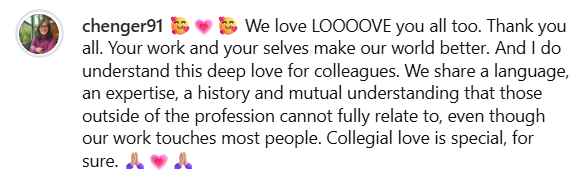
Last week Audible celebrated their second cohort of Hall of Fame narrators, including a couple of my favorites, Andrew Eiden/Teddy Hamilton, and Steve West/Shane East. Andi Arndt, Hall of Fame Class of 2018, gushed about her colleagues on Instagram the night before, reminding me of that deep collegial love that I feel every day in medicine. My impromptu comment on her post stuck with me all week.
The photos of celebration and connection, the joy and energy of the Audible event moved me, too. I haven’t been to an American College of Physicians national meeting since 2019 (it was next weekend in San Francisco, but I came to Portland, Oregon instead, to visit with friends–hence this delayed post), and I miss seeing my colleagues from all over the country, going to sessions and learning together, having coffee, sharing stories, catching up.
Voice acting can be very solitary work, so I imagine these artists relish opportunities to gather and commune, especially when it centers around celebrating their shared love of the work.
I wrote to a VA acquaintance once, “I hope (imagine) that you get enough positive feedback, validation, and reinforcement for your work! 😀 I also hope you get enough contact and connection with your colleagues. I can always walk down the hall and consult mine on challenging cases or difficult encounters. We are friends. My professional support network is at my elbow and fingertips; I hope yours is too!”
I spent time this weekend with Christine, my life coach and friend of 20+ years. She described her experience of ‘supervision,’ wherein she was required to debrief with elder colleagues during a segment of her training, exploring potential personal pitfalls and blind spots that client work may uncover, and how to beware of and manage it all. As coach and physician, our conversations weave in and out of mutual support and informal ‘supervision’ in organic and collegial ways. Our work overlaps with that of therapists, nurses, and probably any other helping profession. Walking along the Willamette River with Grant today, we reflected on how easily we can apply our professional training and skills in any domain where humans interact.
Back in 2017, the night before presenting at general surgery grand rounds (unusual for an internist), I wrote about tribal pride and tribalism:
“We all need our tribes. Belonging is an essential human need. To fit in, feel understood and accepted, secure—these are necessary for whole person health. And when our tribes have purpose beyond survival, provide meaning greater than simple self-preservation, our membership feels that much more valuable to us. But what happens when tribes pit themselves against one another? How are we all harmed when we veer from ‘We’re great!’ toward ‘They suck’?”
Nine years on, how do we assess the relationship between tribal pride and tribalism in any given domain on the current geopolitical landscape? Surgery vs. medicine, staff vs. leadership, conservatives vs. progressives, advocates for vs. against AI… How can we maintain our human connections above all, no matter what our divergence? I have often thought of myself as a ‘lumper’ as opposed to a ‘splitter’–always looking for connection, commonality, and relationship everywhere, among all people. In the same message to my VA acquaintance:
“Acting and medicine: What do you imagine are the overlapping aspects of our respective work? I see it mostly in story—empathy for and holistic understanding of the full human experience, from the euphoric highs to the most sorrowful lows. For both of us, to be truly excellent at our work, we must call forth real and sincere empathy from our own depths, which is vulnerable and courageous in a lot of ways, don’t you think? For you, the stories are complete, and you get to interpret and bring them to life, to present them for our benefit. I get to elicit the stories, coax them to emerge in real time, and interpret them along with my patients. What stories do people tell about their health, their lives, their agency to influence it, and the outcomes they can/not achieve? We get to dissect and discuss and then act on our shared interpretation. We edit and revise together over time.”
So this weekend I communed with two of my coaching friends. I spent quality time with Phara who has a degree in psychology, and Heather, a fellow writer. We bonded over parenting–the unique mental load of moms, especially working moms. This theme has emerged powerfully in my medical practice, no matter the moms’ day jobs and no matter our kids’ ages.
Colleagues share language, training, experience, and perspective. We compare notes, tell stories, and connect. But we do this not just in professional circles. Our tribal memberships intersect and overlap, often in ways we could not predict or design. So really, we can find love in commonality anywhere, with anyone, if we just open up and ask, no?
What a fun exercise to come across an idea on social media, feel it in my heart, react in real time, then process it for days and see what arises in stream-of-consciousness blogging while stuck at the airport! Tomorrow I get to co-present on health and wellness to the Illinois Judiciary–another esteemed tribe of helpers, as I see them. What a privilege.
My tank is so full from a long weekend of deep and thick connection with my amazing friends here in the Pacific Northwest. I will miss this year’s chance to commune with my fellow internists nationally, but I’ll get back to the office this week and soak it all up locally. How lucky I am, truly. I hope whatever your profession, whomever you call colleagues and friends, that you get to enjoy this deep, collegial love born of shared humanity. And if you can recognize and strengthen it across domains, even better. That’s what will save us all, I am convinced.

