Tomorrow Is Not Promised.

“The tumor has shrunk.”

It was the best news I could possibly get on my 51st birthday on Friday, from one of my best friends. Diagnosed with metastatic lung cancer some months ago, their future is now forever altered from what we had assumed and taken for granted.

Another classmate, teammate, and amazing human has terminal brain cancer, dammit.

I write this from my happiest and most contented place on Earth, the Colorado Rockies. For five days I get to hike, read, write, and be. Having received so many messages of love and connection on my birthday, starting the moment I woke up, it was clear that the only way for me to move through this long weekend is in deep gratitude.

Framing everything this way makes my perceptions of and reactions to any and all life occurrences different and better–more tolerable and peaceful. On arrival, my greeting from family: “Hi. So you’ve gained a lot of weight recently, huh?” WTAF, really? –pause– Gratitude. Reframe: This encounter triggers me because it evokes my own inner fat-shame and body image issues. Long standing, multifactorial, and slowly improving, I am shown here that I have more inner work yet to do: self-compassion, self-acceptance, and self-discipline, among other things. Deep breath, forgiveness, thank you for this awareness; now I can let go and move on.

Gratitude makes me revel in my friendships–any and all opportunities to be present and attuned to the amazing humans I have the great, unearned fortune to know and love. In recent weeks I have had the opportunity to connect with my two friends above, and they humble me. Confronted with their own mortality in the prime of life, they exemplify grace. In our honest and loving conversations, they show me the absolute essence of vulnerability, courage, and perspective, and leave me in utter awe. We discuss frankly what it means and what it takes to get to peace with death. It reinforces my three take aways from Being Mortal by Atul Gawande: 1. We need to talk about death early and often, get comfortable with and accept it. 2. End of life decision making is about goals and trade-offs, and those of the dying take precedence. 3. The more peaceful the dying can feel at the end of life, the less suffering for those left behind. How lucky am I that my two friends lead by such wise and peaceful example?

We talk about grief, regrets, relationships, legacy, and meaning. We marvel together at the mind boggling advancement of cancer treatment in our lifetime, and the miracle that is the human body. We laugh, cry, and connect. I am shown starkly and in no uncertain terms that the most important thing in life is relationship, full stop.

One day, one moment, one breath at a time, my friends.

May we be present to all of it, as much as possible, in love and mindfulness, in mutual respect and humble communion. I’m sad, yes. And it’s okay. I revel in every day, every moment, every breath that my friends yet live. My highest goal and wish for them is to know how much they are loved and embraced, how they will never be forgotten, how all of us who know and love them will hold their spirits with us until we die ourselves. And that’s assuming something doesn’t take my own life before theirs end.
Tomorrow is not promised for any of us.

So knowing this, how will we choose to really live? Clarity on this visits me much more often as I age, and once again I am profoundly grateful. I get to choose love, respect, meaning, courage, and connection over resentment, disdain, judgment, and separation.

I can choose peace.

There will be time later to mourn, to grieve. Now is the time to honor, uphold, revel, and live fully in one another’s love and light.
Polarity Management

Yes, AND.

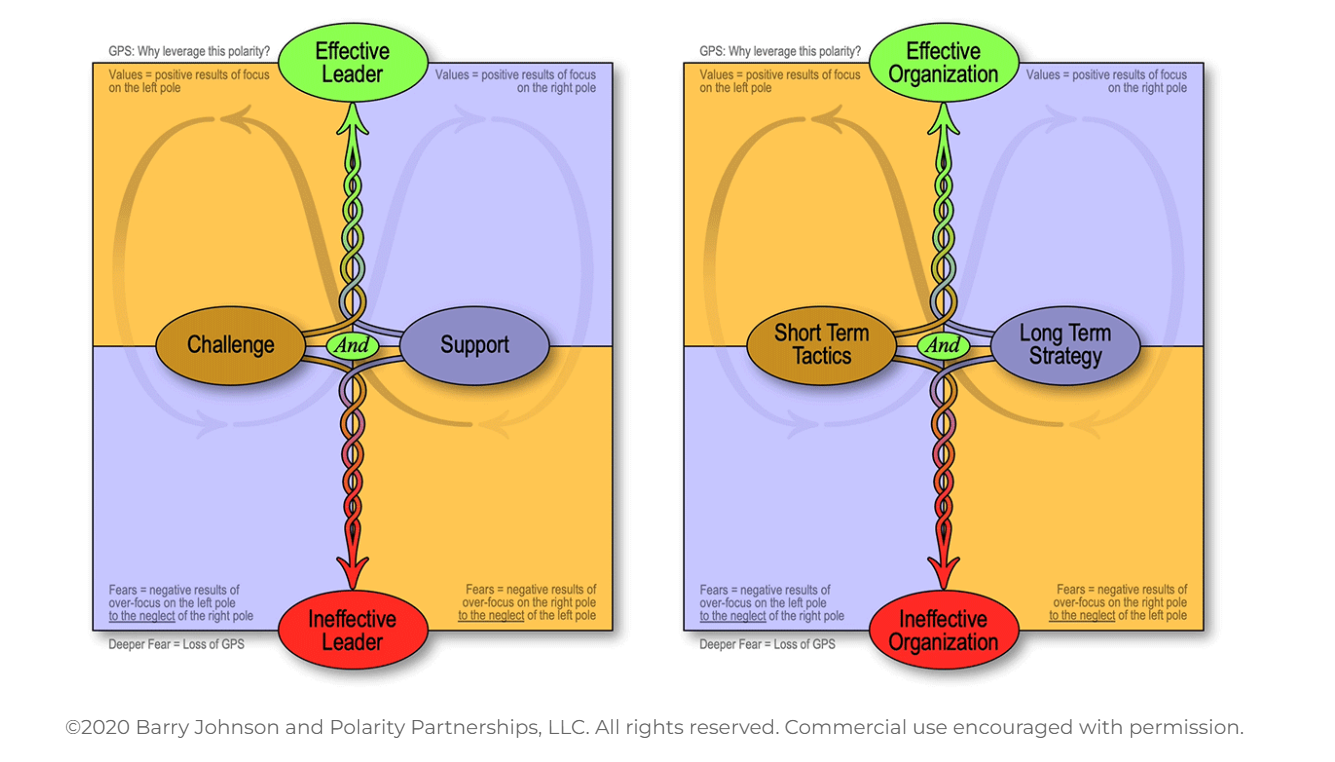
This is the central tenet of polarity management. It’s about holding divergent and apparently opposing ideas or positions at the same time, understanding that their relationship is actually complementary and mutually strengthening rather than perpetually conflicting. Masculine/feminine, individual/collective, conservative/progressive, strong/soft, diplomacy/candor, top down/bottom up–what else? Can we frame any two antagonistic ideas in an infinity polarity loop of inextricable relationship? I say yes. Because it puts us into novel perspectives, prompting a mindshift into possibility, creativity, and connection.

I am waiting on permission to use a seminal image from Polarity Partnerships, the organization founded around the idea that in any polar dichotomy, there is a dynamic flow and balance between the advantages and disadvantages of focusing energy and action on either pole. When we can maximize the benefits and minimize the costs of each pole, then leadership and organizations thrive. It’s much easier to show than tell; fingers crossed I’m allowed to share the image; check out their homepage and you will see what I mean.

13 November 2023: Here it is!

Polarity Map® is a registered trademark of Barry Johnson & Polarity Partnerships, LLC. Commercial use encouraged with permission.

How do I already manage polarities well?
–Since I learned the concept during leadership training in 2019, I now think easily in complementary polarities. I was primed c.2000 when my residency classmate introduced me to “Yes, AND”. She took an improv class and invited me to play a game in the workroom. Thanks, Carol! Now whenever I feel an initial resistance or opposition to something, I look for the juxta(op)position that gives that two-sided coin perspective.
–Polarity management and trade-offs feel related to me. I think in terms of the latter more and more, also since 2019, when I read Being Mortal by Atul Gawande. At the end of an elderly life, there is often tension between independence (goal of the elderly) and safety (goal of their family), and a peaceful end of life usually means compromises on both sides. Increasingly as I counsel patients on habit change, I acknowledge that trade offs will be necessary, and only they can define and decide which are and are not worth making, based on their values and goals. I find that approaching behavior in this way eliminates judgment, and also opens the door for flexibility and evolution without (or with less) regret. It is simply flow and growth.
–I definitely parent better from an integrated polarity perspective. Mostly it’s about letting go and hanging on, advising and commanding, that delicate and heavy handed balance. I tend toward a laissez faire parenting style, which risks the kids feeling neglected if I lean too far into my default. I’m getting better at seeing the pitfalls, and I still have some work to do.

How could I manage polarities better?
–Some people in my life prioritize their values and goals very differently from me. I sometimes sit in rigid judgment of this, dismissing their perspective as inferior in some way. I can do better at recognizing the benefits of having these people around to balance and bend my hard biases.
–I will look for strong polarity integration around me and call it out/forth. I will reinforce and amplify it. I will do my part to make both/and thinking, speaking, and leading visible, and move it into mainstream mindset.

How do we already manage polarities well as a society?

We don’t.

How could we do it better?

Where do you see successful, collective, Yes, AND in action?
I can think of two organizations that walk the talk.

Polarity Partnerships.
“In today’s world of increasing interdependency and complexity, it is vital to utilize problem solving AND both/and thinking to address your most strategic challenges and opportunities. The research is clear – leaders, teams and organizations that leverage Polarities well outperform those that don’t. Discover how to leverage your most strategic Polarities (AKA paradox, wicked problems, chronic tensions, dilemmas, etc.) to become more innovative, agile, profitable and competitive immediately and over time.”

Braver Angels.
“Our mission: Bring Americans together to bridge the partisan divide and strengthen our democratic republic.”
“We state our views freely and fully, without fear.
“We treat people who disagree with us with honesty, dignity and respect.
“We welcome opportunities to engage those with whom we disagree.
“We believe all of us have blind spots and none of us are not worth talking to.
“We seek to disagree accurately, avoiding exaggeration and stereotypes.
“We look for common ground where it exists and, if possible, find ways to work together.
“We believe that, in disagreements, both sides share and learn.
“In Braver Angels, neither side is teaching the other or giving feedback on how to think or say things differently.”

Every once in a while I read an article that does it well–not only describing two poles but explaining why each is/both are necessary and good relative to the other, and the importance of balance and flow between them. It’s pretty rare.

For practical application and guidance, I highly recommend Navigating Polarities by Brian Emerson and Kelly Lewis.

Like so many life practices I consider this month, polarity management and navigation is transformational and liberating. I had not realized it so starkly until now. When I get out of either/or, “Yes, BUT,” and “You suck,” accept what is and look for mutually complementary balancing points, new and useful insights almost always follow. My way out of conflict emerges faster and more clearly, and my relationships get stronger along the way. Very cool.

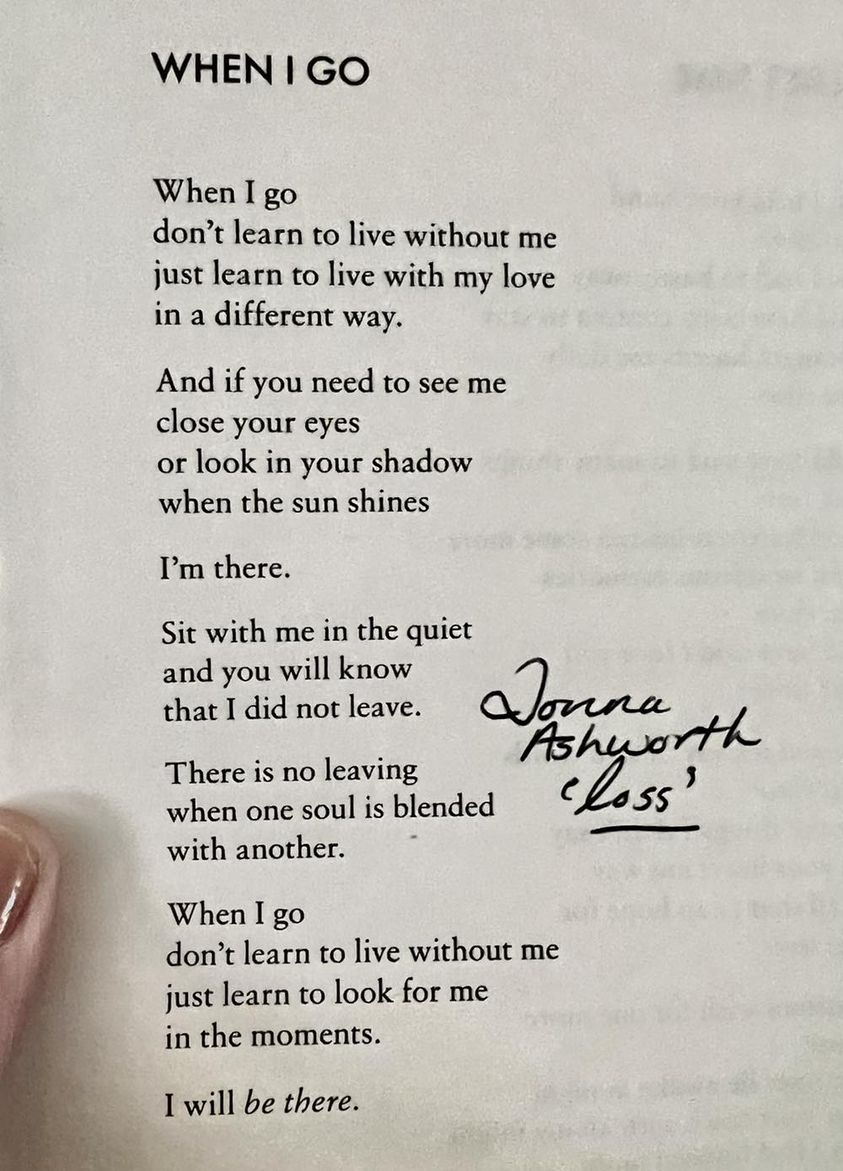
“When I Go”

From _Loss_ by Donna Ashworth

After Friend and I talked about her BEAST lawyer last week, somehow we got to thinking about being at peace with death. I told her I’m okay with it–if it were my time tomorrow, I could accept it. She confirmed that my declaration did not feel delusional or arrogant. I have no intention of dying, and I would not want it or like it, but I would have few regrets, I think. Let me be clear: I would certainly regret any pain and suffering that my death might cause my loved ones. But maybe knowing that I’m at peace with my own mortality would help mitigate their pain? In Being Mortal, Atul Gawande tells us that if the person whose life is ending is at peace (it’s redundant, but there isn’t really another expression for it, is there?) with their own end, then their loved ones are far less likely to experience depression and prolonged grief after their death. This is what I wish for my people. I can go first, literally and figuratively.

A few years ago, another dear friend announced his retirement after nearly 30 years with his company, many of them in leadership roles. His LinkedIn page filled with gushing expressions of gratitude and admiration. I thought about him all day, and wrote him spontaneously in the evening:

…And what will the organization and its people be/feel like without you? 

When my kids were little I used to be afraid to die.  I was afraid they would forget me, and that I would not have a chance to pass down my core values, to have a hand in helping them become excellent people.  But then I realized that as long as I am here, I am the one responsible for that, so nobody else thinks to do it for me.  But if I died, and if I lived well, then people would take what they loved best about me and sustain it for my kids in my place.  If I were successful in building the village around them, then they would not be dependent on me alone to get what I most wanted them to get.  

So now I don’t worry so much about it–partly because they are older and I have had time to instill some things, both by example and by teaching.  But also because I trust that my own circle will enclose them and nurture them if/when they are needed.  That reminds me, maybe I should remind and thank my circle for doing that. ðŸ˜„

Today I have even more confidence. The kids are three years older, their complex adolescent personality formation accelerating. I see my imprints deepen, for better or worse, and we have reflected together how they see my influence in their attitudes and expressions. We agree to help one another identify and manage our respective deficits. The tribe is still strong and willing, and I have hopefully been more explicit about my gratitude and aspirations. But really I just trust Son and Daughter to keep me with them, alive or dead, near or far, like Ashworth’s poem says.

I wrote my 30 ethical earworms for posterity last year, saved now among 504 total posts on this blog so far. If they read one a week starting if I died today, that’s almost 10 more years of me in their mind’s ear. They will continue to become who they are, and find the places where I fit, to carry me most comfortably and usefully.

On the path of life, we leave pieces of ourselves all along the way, accumulated and spread among our relationships. What do we do when our loved ones die? We honor them by nurturing, strenthening, and cultivating those parts of them that live within us, more intentionally and meaningfully than when we had them physically with us.

So it’s a Peace & Mortality Mindset of living, I suppose. Try to not take any day, any moment, with any person, for granted. Take advantage of any and all opportunities to connect in meaning and love. Act with reckless abandon on any and all impulses of empathy, kindness, generosity, and compassion. None of us knows when the end will meet us or those we love. What can we do today to make any of it just a little less painful?

Let’s get on it, ya?