Self-Compassion

“I have found in my research that the biggest reason people aren’t more self-compassionate is that they are afraid they’ll become self-indulgent. They believe self-criticism is what keeps them in line. Most peole have gotten it wrong because our culture says being hard on yourself is the way to be.” —Kristin Neff

“Talk to yourself as you would someone you love.” —Brene Brown

I’m tired tonight, y’all. And this is a big topic. So I give myself permission to stay in the shallows for this post–no deep explorations and hours spent searching citations. Just some honest reflections and aspirations. To learn more about self-compassion and evidence for its benefits, visit Kristin Neff’s website and check out her book, Self-Compassion: The Proven Power of Being Kind to Yourself. From her website page on the definition of self-compassion:

“Self-compassion involves acting the same way towards yourself when you are having a difficult time, fail, or notice something you don’t like about yourself. Instead of just ignoring your pain with a “stiff upper lip” mentality, you stop to tell yourself “this is really difficult right now,” how can I comfort and care for myself in this moment?”

What’s already good in my self-compassion practice?
–I no longer call myself names. I own that I sometimes say and do thoughtless, inconsiderate, obtuse, and bitchy things. But I don’t label myself with these adjectives. I no longer say things like “I’m being a bitch,” or, “Oh my god, I’m so stupid.” I make clear on my social media accounts that ad hominem is unwelcome. There is also no place for it in my own head.
–I avoid self-indulgence by maintaining compassionate accountability to myself. This overlaps with (encompasses, maybe?) practices in honesty, mindfulness, integrity, forgiveness, judgment, and commitment, all topics to be addressed this month–everything is connected.
–Upholding my own self-compassion helps me maintain my growth mindset. While I allow myself to identify with fixed traits such as ‘smart,’ ‘creative,’ or ‘badass,’ I can hold these labels loosely and also allow for wild imperfection and failure–for myself to be human in all of my smart, creative, and badass endeavors. I am freed to be both wholly all of these things and more, and also a perpetual work in progress.

How could my self-compassion practice be better?
–Explore more the paradoxical polarity of enough and not enough–I am enough as is, and I am also always improving–so what do enough and not enough actually mean? “You are perfect, …and you have a lot work to do,” I read years ago. Love it. Makes to total intuitive sense, and I want to live into it more deeply.
–Look for the still insidious ways self-criticism appears, and hold it with kindness. I know there’s a lot there in my body image, especially as aging accelerates. And when I find self-loathing and -judgment, I can practice my compassion on that, rather than meta-judgment of the judgment, which doesn’t help anyone. I bet I could query arenas where I feel like an imposter; that’s probably pretty good fodder.

How does our society do self-compassion well already?

Awareness. Authors like Kristin Neff, Brene Brown, Tara Brach, Richard Rohr, and the Dalai Lama bring self-compassion concepts from esoteric academic and spiritual theory to practical life skills. Their books, articles, podcasts, interviews, and websites offer the lay public copious access to all things self-care, connection, and inner peace. Communities of folks seeking comfort and connection form, mindful presence ensues, and good things happen all around. Like mindfulness, self-compassion is making its way into mainstream consciousness as something to develop rather than to shun and dismiss.

How could we do it better?

Normalize it. The distinction between self-compassion and self-indulgence still needs reinforcement. Being kind to onself in a moment or period of hardship does not mean shirking responsibility, is not a character flaw, and does not lead to a future of fruitless debauchery. Allowing health habits to loosen a little in the midst of life chaos does not warrant harsh self-recrimination. The practice of imagining a friend going through the same challenges and what we would say to them, then saying that to ourselves, really helps here. Oh and we should say those things to our friends out loud, too.

Strengthen Accountability. Even if we succeed in distinguishing the above, I think people still need reassurance that we won’t all become listless moochers just looking for excuses and free rides for everything. As an aside, what is with that cultural fear of ours, anyway? By accountability I don’t mean punishment or shame. I mean owning our mistakes and the impact we have on others, standing convicted not in public opinion but in our core values. Accountability and self-compassion together help us present ‘strong back, soft front’ to ourselves, developing both intrinsic strength and courage as well as openness and vulnerability. Ultimately, the best outcome is that we then present this way to others, offering kindness and also holding them humanely accountable, and our connections and communities tighten in love.

Amplify the Benefits. When we see someone we care about lambasting themselves, we can help. As we show more loving kindness to ourselves, we are more willing and likely to do the same for others. Mercy, grace, empathy, tenderness–can we look individually and collectively inward and see the rewards of offering these to ourselves, and then to one another? It doesn’t take much to imagine, does it? We can start one on one, with people we care most about, whom we truly love. Then we can extend it to strangers, then to members of out-groups whom we may initially and automatically judge harshly by way of stereotype and prejudice. Strong self-compassion practice can translate to recognition of every person’s innate humanity, reframing even our most destructive behaviors in humane rather than dehumanizing light. “The smart, creative, wildly imperfect badass in me sees the smart, creative, wildly imperfect badass in you.” It all starts with healthy relationship to self.

So was this even coherent? Good night, all, I’m going to bed. Back tomorrow on polarity management, woohooooooo, that’ll be fun.

On Malice, Validation, and the Butterfly Effect

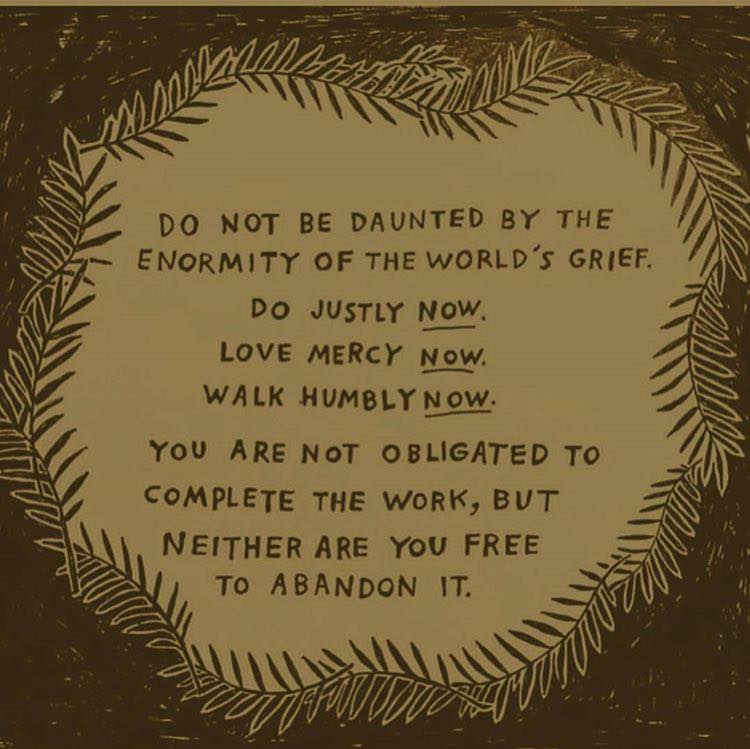
A mash-up quote; still helpful.
Image from https://www.facebook.com/BlessedAreTheWeird/posts/i-like-this-whoever-wrote-itupdate-appears-to-be-a-translation-of-text-from-the-/947443432078922/
Likely sources: https://merrimackvalleyhavurah.wordpress.com/2018/06/23/fake-news-fake-quotes/

Friends, here is my latest confluence of ideas for making a more lovingly connected world, from three articles I have read this month:

Malice

Readers of this blog may know that I’m a big fan of David French. He writes columns for The Atlantic and The Dispatch, and serves the latter as senior editor. He is politically conservative and one of my intellectual role models. Last weekend he posted an article, “A Blow Against the Malice Theory of American Politics,” which I highly recommend. Some highlights:

“Negative polarization (or negative partisanship), as I’ve written many times, is the term for politics that is fundamentally motivated by animosity for the other side more than affection to your own party’s leaders or ideas. 

“Under the malice theory, the key to electoral victory is unlocking that anger. That means highlighting everything wrong with your opponents. That means hyping their alleged mortal threat to the Republic. Because of pre-existing animosity, your message will fall on fertile soil.

“In this context, it’s easy to see how kindness and graciousness are seen as weakness, or at least as a lack of conviction.”

Basically, if we think of our political opponents as a ‘them’, an other, we make them an abstraction. If we paint them with broad brushes in various shades of ‘evil,’ then we make ourselves fundamentally susceptible to tyrants who manupilate that fear and hatred for their own purposes. We follow blindly out of emotional hijack, deluding ourselves that we are being totally rational. The ultimate tool of such tyrants is dehumanization, making ‘the other’ a thing rather than a person, something we could not possibly relate to or care for.

Validation

One potent antidote to dehumanization and malice politics is emotional validation. I found this article while writing Monday’s post on how to be less shitty to one another. If you read any of the essays from this post, read this one! More highlights:

“Emotional validation is the process of learning about, understanding, and expressing acceptance of another person’s emotional experience. Emotional validation is distinguished from emotional invalidation, when a person’s emotional experiences are rejected, ignored, or judged.

“Validating an emotion doesn’t mean that you agree with the other person or that you think their emotional response is warranted. Rather, you demonstrate that you understand what they are feeling without trying to talk them out of or shame them for it.”

When we talk about people on the ‘other’ side of politics from us, what do we say? Do we speak in generalizations? Do we assume nefarious motives, declaring that they are just bad people? Maybe we say we ‘can’t imagine,’ ‘don’t understand’ how anyone would vote the way they do? What assumptions do we make about how they live their lives and how it must be completely different from us? Validation requires us to put down these generalizations and see each other as individuals, humans, people with whom we are in relationship (and we are all in relationship)–to move in closer, as Brene Brown asks us to do. It’s a practice in empathy and ultimately, a neutralizer of negative partisanship.

Why should we validate one another’s emotions? Because it helps us connect, especially across difference. When we feel validated, we let our guard down. When we feel seen, we de-escalate. Then we are more likely and able to engage in discussions, even disagreements, with more openness and curiosity, respect and collaboration. But someone has to take the first step on the path to de-escalation, to lead by example and invitation.

The Butterfly Effect

In my Quirky Nerd post, I mentioned this idea at the end, in passing. I like to include links to interesting ideas, and found the essay on Farnam Street by Shane Parrish and/or his team. Parrish hosts The Knowledge Project, one of my favorite podcasts. Ever since learning about the self-organizing nature of culture, I have felt validated (ha!) and increasingly confident to point out how the impact of any given node in any system both impacts and is impacted by that system–because everything is connected! I define myself as a node, and I am a member of multiple systems at once (we all are). Some systems are nested (family, neighborhood, city, state, nation); some overlap (Chinese-Americans, physicians, working moms). Looking from the most complex and simultaneous perspective, we can then see how the state or movement of any one node may have direct and indirect ripple effects that propagate and eventuate in dramatic multi-systemic change.

Or, it may not. It’s a paradox–anything you and I do can have transformative effects or no effect at all. I wrote about this as the Optimistic Nihilist. From Farnam Street: ” John Gribbin writes in his cult-classic work Deep Simplicity, ‘some systems … are very sensitive to their starting conditions, so that a tiny difference in the initial ‘push’ you give them causes a big difference in where they end up, and there is feedback, so that what a system does affects its own behavior.’

“We like to think we can predict the future and exercise a degree of control over powerful systems such as the weather and the economy. Yet the butterfly effect shows that we cannot. The systems around us are chaotic and entropic, prone to sudden change. For some kinds of systems, we can try to create favorable starting conditions and be mindful of the kinds of catalysts that might act on those conditions – but that’s as far as our power extends. If we think that we can identify every catalyst and control or predict outcomes, we are only setting ourselves up for a fall.”

My point here is that when I start to feel too small to make a difference, I just remember my role as node. I may not see the waves that my attitude, words, actions and relationships create in the world. But I believe wholeheartedly that I can and do make a difference–a big one, potentially. I just don’t know exactly which day, which conversation, which post, which relationship will incite the shifts I agitate to make–toward mutual understanding, accpetance, cooperation, and connection. Thus, anything and everything I do matters, so I keep it up. I commit to playing the infinite game of human connection, and my just cause is to de-escalate, defuse, and disarm us, in service of interpersonal peace. But anything I do could not matter at all, so I don’t have to burden myself with perfection and exhaustive hamster wheeling.

It’s a perfectly joyous paradox.

Thanks for reading to the end of this long one, folks. Past the halfway mark of 30 days, woohoooooo! I’m still having a lot of fun, hope you are, too!

Peace out, my peeps—ODOMOBaaT.

https://www.facebook.com/soulsistersmemorial/photos/a.1462513750611588/2068742843322006

Check Thyself

More off the cuff than usual today, friends. It’s been a year so far, with few signs of relief upcoming. Breathing deeply:

Do you speak and act out of fear and a strong desire for control, in situations where you cannot have it?

Signs that this may be happening to you:

1. Your muscles get tense

2. Your chest feels tight

3. You feel your heart thumping

4. Your ears ring

5. Your speech becomes louder, higher pitched, faster

6. You feel ANGRY, especially if it’s sudden and intense rage

7. You interrupt people and start gesturing more

8. You feel self-righteous

9. You feel certain that everybody around you is stupid, ignorant, and/or either out to get you personally or totally corrupt and willing to destroy anything in their path to forward their own interests

10. You feel physically, mentally, and emotionally drained after a brief encounter

What else?

Words spoken and actions taken in the throes of active emotional hijack can wreak lasting damage on our relationships, social function, and collective culture. The emotions themselves, however, are temporary. They serve to call our attention to something we need to address, something important to our safety, security, and well-being.

How we address the somethings is key to our personal and relational success or failure.

Self-awareness and self-regulation are the core skills to train here.

Some tips (from dialectical behavior therapy [DBT] and elsewhere):

–Ride the waves of emotion like an expert surfer—balance atop them as they complete their natural journey to dissipate on shore, delivering you to the beach again and again

–Check the FACTS of the situation–distinguish between what can be observed and described objectively and what you assume/judge/project subjectively–recognize how you may have it wrong

–BREATHE. Deep breaths stimulate the parasympathetic nervous system, lowering blood pressure and heart rate, countering the activating effects of fight or flight. Slow, steady breathing grounds us and allows us to see, hear, and think more clearly

–Ask yourself, “How will what I’m about to say/do really make things better in the long run, and at what cost?”

–Slow down. Count to ten. Call a time out. Step away. If it’s worth saying or doing, it can wait this little bit.

More and more I see impulsive behaviors, in reaction to acute on chronic individual and collective stress, destroying relationships and shredding our social fabric. It’s so frustrating, mostly because I see it as so preventable.

Self-awareness and self-regulation:  The concepts are simple. The skills acquisition and execution constitute a lifelong pursuit of wildly imperfect mastery.

YES, things are shitty everywhere. YES, we are justified, if only partially, in our fear, anger, frustration, impatience, and dissatisfaction.

AND we can choose, at any time, to manage these intensely uncomfortable emotions in ways that either connect us in solidarity and cooperation or divide us in mutual denigration and destruction.

Recognize emotional hijack. Breathe through it.   

Let us speak and act from our core values ahead of impulsive, fearful, and self-righteous rage.

And let us thank one another for the effort.

Read more along these lines from one of my heroes, Brene Brown.