Attune and Differentiate:  One Week’s Synthesis

IMG_0226

Friends, don’t you just love when an idea you resonate with recurs in your consciousness from disparate sources in short order, further deepening its meaning?  I share three pieces with you this week, which all deepened my commitment to embracing the paradox of attunement and differentiation.

CO fall 2018

First, I listened again to Brené Brown’s Braving the Wilderness.  I highly recommend this book to help us all, conservatives and progressives alike, to engage (not avoid) one another this election year with a lot more compassion, civility, and mutual respect.  Throughout the book Sister Brené shares personal stories as well as evidence from her research that define true belonging, which I think of as another expression for self-actualization and self-transcendence.  In her words:

True belonging requires us to believe in and belong to ourselves so fully that we can find sacredness in both being a part of something, and standing alone when necessary. But in a culture that’s rife with perfectionism and pleasing, and with the erosion of civility, it’s easy to stay quiet, hide in our ideological bunkers, or fit in rather than show up as our true selves and brave the wilderness of uncertainty and criticism.

Attune and differentiate:  these two practices are not only not mutually exclusive, they are essential and integral for whole person and societal health and well-being.  Read the book to adopt her four practices to advance true belonging, for yourself and for all of us:

  1. People Are Hard to Hate Close Up. Move In.
  2. Speak Truth to Bullshit. Be Civil.
  3. Hold Hands. With Strangers.
  4. Strong Back. Soft Front.  Wild Heart.

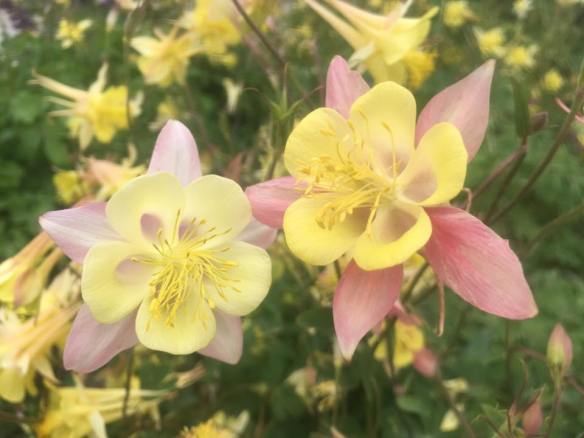
Sister columbines

Second, I met Massimo on Ozan’s last Inner Circle Zoom call.  He is a designer and facilitator from Italy—thank you again, Ozan, for connecting so many of us all around the world!  Massimo has launched a blog, which resonated with me because he also advocates finding your voice (differentiating) as well as finding a community of belonging (attunement) as a reason to write:

…Meet new people and to interact with them

Learning adventures can make you feel on a solitary path, too much unbalanced on the input, reading and digesting side without much interaction. Expand your network, look for more interactive exchanges with whom might provide an alternative, critical point of view compared to yours. Exposing your opinions leads self-selecting people to network and resonate with you. Find your tribe. We need many and none at the same time. You need different communities where to manifest and explore your interests. On the other hand, you need to better focus on creating those which are more fertile ground to nurture your continuously changing interests and aspirations.
IMG_7689

Third, I read David Brooks’s article in The New York Times on the ethos of Scandanavian education.  Eloquent as usual, he synthesizes a complex set of ideas into language we can all understand:

19th-century Nordic elites…realized that they were going to have to make lifelong learning a part of the natural fabric of society.

…(Their system) is devised to help (students) understand complex systems and see the relations between things — between self and society, between a community of relationships in a family and a town. 

…Nordic educators also worked hard to develop the student’s internal awareness. That is to say, they helped students see the forces always roiling inside the self — the emotions, cravings, wounds and desires. If you could see those forces and their interplay, as if from the outside, you could be their master and not their slave. 

…Their intuition was that as people grow, they have the ability to go through developmental phases, to see themselves and the world through ever more complex lenses. A young child may blindly obey authority — Mom, Dad, teacher. Then she internalizes and conforms to the norms of the group. Then she learns to create her own norms based on her own values. Then she learns to see herself as a node in a network of selves and thus learns mutuality and holistic thinking. [See Changing on the Job by Jennifer Garvey Berger for more on this theory of adult development.]

Scandanavians…have a distinctive sense of the relationship between personal freedom and communal responsibility.

(Meanwhile, in the United States…) If you have a thin educational system that does not help students see the webs of significance between people, does not even help students see how they see, you’re going to wind up with a society in which people can’t see through each other’s lenses.

IMG_1804

In 2020 more than ever, we need to cultivate much stronger relationship skills.  We must identify and honor our core values and stand up for them, even when attacked by those closest to us—perhaps even especially then.  How we honor our best selves determines how we honor others.  When we show up at our most honest and authentic, we can call forth the same in others to meet us.  We can relate as fellow humans, inextricably connected, mutually interdependent, and all in it together.  Once we realize this, we can know in our hearts that we truly belong to ourselves and to one another, and we can more easily get on with the world’s most important work—connecting humanity in health, safety, and love.

November 24:  Alone Time Makes Me Better

IMG_2520

NaBloPoMo 2019

How many hours do you get to yourself at a time?  I mean not just in the shower or commuting, or to work out. I mean how much time do you get to really, only take care of yourself?  When there are no kids to pick up or drop off, no meals to plan or prepare, no immediate work deadlines, no call, no commitments?

I had 36 hours this weekend—there are about 25 minutes left.

I realized at the end of Wednesday that my irritation at fellow drivers was probably a projection of anxiety and agitation about my kids being away this weekend, each to a different place, a first experience for both of them and me.  Anxiety often manifests as anger and irritability for me.  I called forth many of my cognitive behavioral and mind body practices to manage the fear and worry, so that I could actually enjoy this amazing alone time—the first such stretch since the elder kid’s birth.

And holy cow, I’ gotta do this more often.

I will spare you the list of restorative activities!  But suffice it to say that I managed to balance sleep, music, food, productivity, creativity, solitude, and connection.  It really was a perfect rhythm.  Deep breath.  And now I’m ready for the family’s return and re-entry into life as usual, a little more relaxed and peaceful.

This year has been intense, fast-paced, and dense with learning, both personal and professional.  I think we all appreciate the idea of alone time, and we understand its importance intellectually.  But like so many things, to actually experience it first hand, for real, is completely different and profound.  I finished listening to Range this morning.  In it David Epstein describes how teams do best when members have a balance between solitary and interactive, collaborative work, as opposed to all one or the other.  Coaches know that training for any skill, be it athletic, musical, or otherwise, requires alternation between periods of sustained, focused practice and rest, time away.  New neural pathways require downtime to fully integrate.  This weekend, I was able to synthesize ideas from Epstein’s book on diversity of experience, and assimilate them with what I’m reading in Ozan’s book, Think Like a Rocket Scientist, on combinatory play.  In the quiet of an empty house, freed from rushing off to the next activity, insights arose more freely, and I connected dots to previous experiences and learning much more easily.  Today I started The Infinite Game by Simon Sinek.  More transformative ideas (simple and profound) to start incorporating into my world view and leadership practice, and to write about later—Yahoo!

I wondered if I’d be lonely this weekend… Nope, not at all.  This time alone was exactly what I needed.  Loving thanks to the family for gifting it to me.

November 16:  Loving Subversion Makes Me Better

IMG_1901

NaBloPoMo 2019

Friends, do you already follow Seth Godin’s blog?  His post from Thursday stirred something a little irreverent in me.  It was about ‘allies and accomplices’:

To be an ally means that you won’t get in the way, and, if you are able to, you’ll try to help.

To become an accomplice, though, means that you’ve risked something, sacrificed something and put yourself on the hook as well.

We need more allies, in all the work we do. Allies can open doors and help us feel a lot less alone.

But finding an accomplice–that’s an extraordinary leap forward.

I thought immediately about my fellow Better Angels volunteers.  We have all committed time, talent, and treasure to the depolarizing of America.  We do it in public, in front of audiences and cameras, to reporters and members of our communities.  We openly challenge the prevailing culture of ad hominem, oversimplification, and overgeneralization.  We all come to it from our own internal optimism and hope.  But in the face of entrenched polarization and a culture of self-protection above all, we could never make any headway as individuals.  It is only together—as mutual accomplices—that we can truly claim and exercise our collective agency.

I feel even more buoyed by Ozan’s latest post.  He describes a series of well-known studies showing that people will organize themselves into in-groups and out-groups with remarkable loyalty, even around random and arbitrary distinctions like taste in abstract art.  This, of course, carries grave and important implications for prejudice and discrimination.  Ozan then points to two exemplars of the opposite, Dr. Martin Luther King, Jr. and Barack Obama.  In their most famous orations (see links), these remarkable leaders speak directly to what unites us as the foundation for solving our problems, rather than what divides us.

MLK:  The marvelous new militancy which has engulfed the Negro community must not lead us to a distrust of all white people, for many of our white brothers, as evidenced by their presence here today, have come to realize that their destiny is tied up with our destiny. They have come to realize that their freedom is inextricably bound to our freedom. We cannot walk alone.

Obama:  The pundits, the pundits like to slice and dice our country into red states and blue States: red states for Republicans, blue States for Democrats. But I’ve got news for them, too. We worship an awesome God in the blue states, and we don’t like federal agents poking around our libraries in the red states.  We coach little league in the blue states and, yes, we’ve got some gay friends in the red states.

I get goosebumps just reading the words.

It really feels like a loving subversion—of cynicism, scarcity, antagonism, and fear.

Who’s not better for that?