Tribe, Community, and Mission to Connect

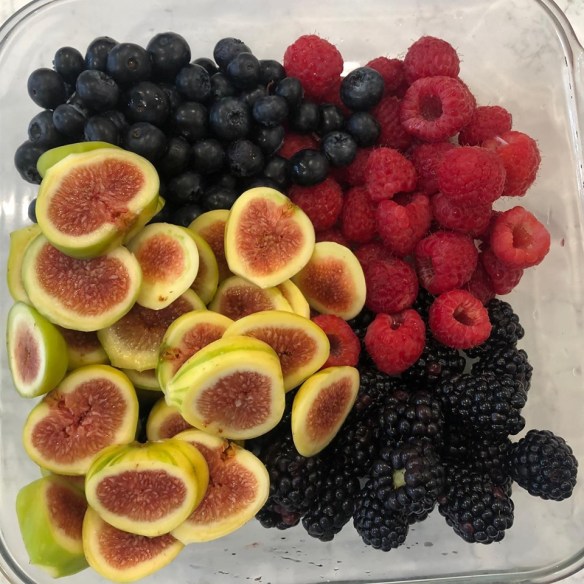
berries figs regina 9-2019

Fruit for Regina’s sweet galettes.  These are tiger figs, available at Trader Joe’s. 🙂

Friends, don’t you love those synthesis/cohesion moments when all of a sudden something important to you—a passion, a core value, a project—is validated from multiple angles?  That happened for me this weekend and I am positively giddy from it!

Tribe

My new group of medical students promises to be just as engaging and fun as every other I’ve had, yay!  They are only three rotations into their third year and already wise beyond their training.  This month we discussed tribalism.  They considered stereotypes, barriers to overcoming them, and how they might lead by example.  And they identified experiences in which such barriers are already breaking down.  “Finding your people” came up as both an aspirational as well as a potentially divisive ideal.  We discussed the benefits of ‘We’re Great!’ and the risks of ‘They Suck’ attitudes.  The conversation did not veer into political arenas, but it crossed my mind.  I tried to point out how the skills of professionalism we address in medical training apply well beyond the bedside and medical teams.  Our tribal memberships can save us and also keep us from living fully.  I’m so grateful to have these reminders on a regular basis.

Community

Some of you may notice I reference Ozan Varol increasingly this year (see coda below for why I think he’s so great).  I started following him in the winter after reading his post on why facts don’t change people’s minds.  This summer I joined his Inner Circle, a private forum of diverse and like-minded folks who subscribe to Ozan’s newsletter and wish to connect.  Yesterday Ozan generously hosted a conference call for three of us to get feedback on current projects.  At 2:00pm Central Daylight Time, I logged on from Chicago.  I met Ozan and his wife in Portland, OR.  J, a Canadian, called in from the Dominican Republic, where she has lived the past 24 years.  C, an organizational psychologist interested in humane-ness in the workplace, logged on from Germany.  And R, an education leader working on emotional intelligence workshops for schoolteachers, called in at 12:00am from India.  C, R, and I presented our projects and everybody gave generous, honest, and encouraging feedback to help us all do and be our best.  I could hardly contain my enthusiasm, gesticulating wildly and barely staying in the webcam frame sometimes.

I wrote to Ozan afterward:  “I’m still wrapping my brain around what you have done here–stimulated so many people to think more critically and also openly… Convened a community of us all and given us a forum to interact, at our own pace and in our own words, from around the world… and invited us to help one another, to contribute to lives that we would never otherwise touch…  What a privilege, a pleasure, and an absolutely ecstatic experience!!!”

Mission to Connect

I think it’s fair to say that part of Ozan’s mission is to connect people.  But not just for the sake of connection—to make us all more thoughtful, curious, and collaborative beings.  A man after my own heart!

Maybe my passion for such connection stems in part from my immigrant roots?  Today my daughter and I embarked on another food adventure at home:  Onigiri and chong you bing (but ours are much easier than the linked recipe!).  The former turned out to be less labor-intensive than I expected, so we made a bunch, both salmon and chicken versions.

onigiri chicken

Tonight’s teriyaki chicken onigiri selection

My Korean-American friend of 20 years, Regina, posted photos of her own culinary accomplishments today—savory and sweet galettes.  Mei and I may try those next!  Our ensuing text thread included my laments about the unhealthiness of onion pancakes (but oh, salt, fat, and starch—yummo!).  Her kind reply: “Making food together with your kids, carrying on food culture, bonding, it’s a win-win!!”  I knew I loved her for good reason.  And how lovely that we have stayed in touch all this time!  If not for that, I could never have recruited her to join my work team this year.  And holy cow, talk about a win-win!  Her kindness, generosity, curiosity, openness, and conscientiousness have elevated the team even higher than we could have dreamed—Thank you, Regina!  What a blessing our connection has been for so many.

My new German friend C is thinking of launching a blog to explore humane-ness and its effects and importance in the work environment.  She thinks maybe next year.  Yesterday Ozan and I both encouraged her to start now.  Asked whether I would follow, I said HELL YES.  Not only will writing about her topic develop her ideas and thesis faster; the interface with fellow readers and writers on a blog, the opportunity to join a community of thinkers, and the connection with folks from who knows where, doing who knows what amazing things, may very well yield untold treasures of relationship and development—as it has for me—so why wait?

Tonight my heart bursts with gratitude for membership in such thriving, complex, diverse and overlapping tribes.  I treasure the various communities that welcome me and give me a chance to contribute.  And my mission to make as many and meaningful connections as possible between all people stands validated and sustained once again.

Onward, my friends.  As Simon Sinek says, Together Is Better.


Ozan about

Why Ozan’s So Great:

  1. Humility.  So many bloggers and podcasters are so full of themselves.  It’s obnoxious.  They may have expertise and knowledge, maybe even wisdom.  But I cannot get past my aversion to their ego.  I have no such issue with Ozan. đŸ™‚
  2. Goldilocks content.  The blogs are the perfect length!  Enough words to make his point eloquently, and not so many that I lose interest before the end.  He contacts subscribers at just the right frequency–weekly emails and biweekly podcasts.  And the newsletters are also the perfect blend of blog, quote, and other interesting material.  So many other authors inundate the inbox that I first ignore and then unsubscribe.  Ozan has really found the perfect touch.
  3. Resonance.  Though Ozan’s podcast topic is failure, what he really addresses is humanity in all of our complexity and fascinating ironies.  I LOVE that!  And he does it nonjudgmentally, always from the perspective of curiosity and learning.  I really respect that–the generosity of spirit and growth, exploratory mindset.
  4. Consistency and reliability.  Ozan is clearly disciplined and intentional when it comes to this work (and so I imagine he is also this way in life).  His podcast script has a reassuring cadence and authenticity to it.  When he says he’ll reply to all messages, he actually replies (that is what most impresses me about him–his responsiveness and how he makes me feel like I matter).  He says he will update us on something and then he does.  All in all a truly stand up and stand out guy among so many!
 

We Are Really Bad At This

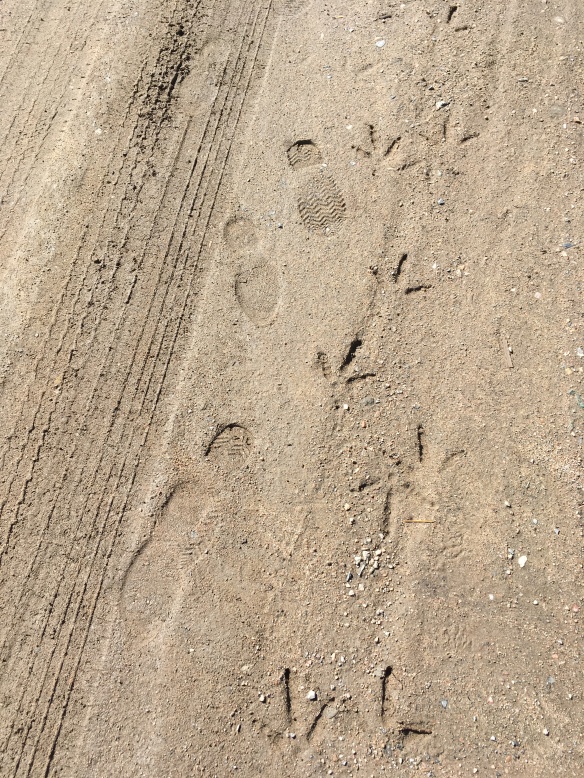
turkey human car tracks

Sylvan Dale Guest Ranch, Loveland, Colorado, March 2019

How many truly meaningful and fulfilling conversations do you have in a day?

How many such relationships do you have?

Though I wrote my Pit Crew post almost a year ago, its ideas recur regularly.  I have linked to it on multiple subsequent posts.  I share it with patients and reference it in conversations often.  My patients are leaders of large corporations and organizations.  My colleagues and I lead teams in the hospital, the medical group, and the medical school.  My friends lead their families and communities.  When I think about our health and its consequences, it’s about taking care of those for whom we are responsible, ourselves included.

Are you generally the one who always takes care of others?  How does this affect your style and effectiveness as a leader?

Who Takes Care of You?

I estimate that about 20% of the time when I ask this question, my patients say that nobody takes care of them; they do it themselves.  They don’t mean that nobody cares about them.  It’s that they don’t really depend on anyone for counsel and/or support.  They hold everything together themselves.  I always have mixed feelings when the conversation takes this turn.  On one hand I feel admiration and respect, especially when they seem generally healthy—apparently unaffected by physical, mental, and emotional dysfunction.  On the other, I get curious.  How do they sustain this Lone Ranger method?  And what does it cost them?  I believe we all need tight, vulnerable, and safe connections through which we can get raw and real, and work through life’s ultimately messy sh*t.  We need others, even if it’s only one or two, to help us truly hold it all together.  My default assumption is that if we don’t have such connections, we are not living into our full potential.

And today I feel cynical.  I think we are getting really, really bad at taking care of each other.

Driving to work this week I wondered to myself, why do we feel the dearth of mental health services so acutely these days?  Is it that more of us are living on the psychological razor’s edge of mental health and illness?  Are we not diagnosably mentally ill but simply, profoundly, stressed to our limits of sanity and function?  Is that why none of my patients can get in to see a psychiatrist or therapist for weeks to months?  Is that why physicians are increasingly leaving the profession and killing ourselves?  Why do we feel so hopeless?

It’s easy to blame social media.  And I do, partially.  The cruelest irony lives here.  My non-evidence based impression is that cyberbullying bears equally life-threatening consequences as face to face bullying.  If you know of evidence to support or refute this premise, please share.  Negative interactions on social media, which rage so easily like wildfires, are now understood to contribute significantly to the rise in loneliness across the country.  Worse, cultivating truly positive relationships via social media is much harder and more complex, even deceptive.   So on balance the risks and harms of social media may far outweigh the benefits.  There simply is no substitute for personal, physical contact, for sharing the same space, breathing the same air, experiencing another’s full presence.

Worse yet, too often we can’t even get that right!  Ozan Varol wrote about this in his last post, “3 Ways to Be Insufferable In Coversation.”  They are:  1. Always turn the conversation back to yourself; 2. Pretend to listen; and 3. Ask no questions.  How many people have you already met today who do this on the regular?  If you’re honest, how many times today have you committed these relational sins?  It’s okay, we all do it sometimes.  As GI Joe says, knowing is half the battle.  The other half is doing something about it!

IMG_1547

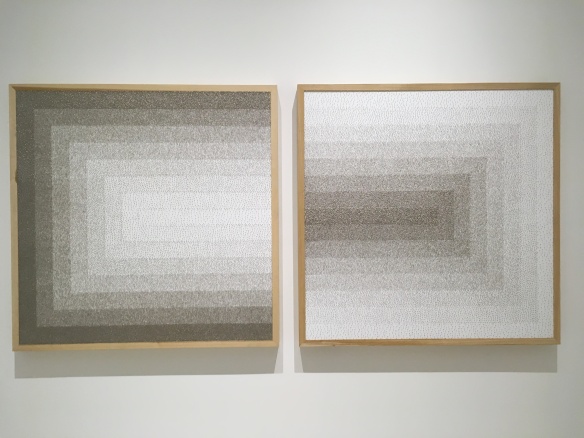
Smart Museum of Art, Chicago, July 2019

So what do we do?

First, Attend.  Pay attention.  How much time do I spend on social media?  What do I get out of it?  When does Fear Of Missing Out (FOMO) drive my scrolling?  Am I really connecting?  Or am I stalking, comparing, judging, flaming, agitating the echo chamber, and otherwise wasting time and energy?  How can I set alerts and redirect my routine?

Second, Intend.  What is the best use of my time?  If I want to see how my friends are doing, rather than check my Facebook feed, why not call them up?  Send a text, photo, or—gasp—a handwritten note just to say hi, I’m thinking of you?  It may cost you time, energy, and $0.55 in postage.  But aren’t your real friends worth the investment?  You can do it on social media too—if you slow down and think about it first.  Consider the return—brightening someone’s day, feeling that personal connection.  Dopamine drives FOMO, and is also associated with addictive behaviors.  Bonding behaviors elevate oxytocin, the hormone that mediates empathy, safety, and connection.  There is even evidence that higher levels of oxytocin correlate with increased longevity of romantic relationships, or even a person’s own life span (could not find a reliable, peer-reviewed source for this claim—I just believe it intuitively).

Third, Get Curious.  This was the first skill I (re)learned in life coaching, ‘way back in 2005, and it serves me well every single day.  If we let go of the competitive, scarcity-based thinking that surrounds us, what more could we learn?  What novel and inspiring stories could we hear from anyone we meet, or even our closest friends?  If we listen to understand rather than to reload and refute or one-up, what vexing problems could we solve, together?  Just wondering about it makes me feel lighter and more optimistic, what about you?

Subscribe to Ozan’s newsletter, the Weekly Contrarian, to get his list of solutions to conversation insufferability this Thursday, 9am Central Time (I have no financial interests in Ozan’s site; I just really admire his work and the community of critical thinkers he has convened).  And today, I challenge us all:  Monitor our attitudes and facial expressions.  Manage our self-absorption for a few minutes at a time.  Look strangers in the eye and smile as if they’re already our friends.  Ask a Facebook friend what they did this weekend that really made them feel alive and well.  Let’s all get our caring on, shall we?


The Status of Women, 1999-2019

IMG_1282

What happens for men when women speak Feminism?

I intend to ask this question to more men in my life from now on.  What do you hear as Feminism?  Where do you think it comes from?  What do you think women are trying to accomplish by talking about equity and representation?  What moves a man to ally with women in this movement?  What keeps him from doing so?  What are the risks, costs, and benefits for us all when he does and does not?

AP QUICK HITS THE 99ERS S SOC FILE USA CA

Women in Sports

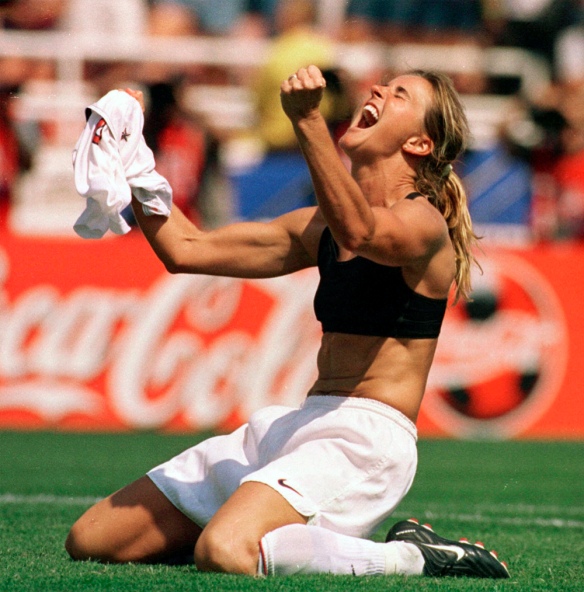
The US Women have just won their fourth World Cup Soccer title, kicking balls and ass, I like to say.  What an accomplishment, and how far they’ve come since winning the first ever Women’s World Cup in 1991, the year I graduated high school.  I don’t follow soccer, but as an American woman, this victory carries meaning for me.  At halftime this morning I read about Brandi Chastain, the 1999 US World Cup champion midfielder who famously, spontaneously, took off her jersey in unadulterated celebration after firing the winning penalty kick in double overtime against China to win it all.  The New York Times featured her story yesterday, commenting on the evolution of our perceptions and treatment of female athletes over these 20 years:

In that pivotal moment of arrival for women’s team sports in the United States and around the world, viewers saw Chastain removing her jersey and twirling it like a lariat, spinning around and falling to her knees, pumping her arms in exultant triumph. What resulted was perhaps the most iconic photograph ever taken of a female athlete, a depiction of pure spontaneous joy.

It was a moment of freedom and liberation, Marlene Bjornsrud, a longtime women’s coach and an influential sports executive, once told me. She called it a “casting off the burden of everything that kept us down and said, ‘You can’t do that because you are a woman.’ It was a moment that screamed, ‘Yes, I can.’”

Title IX was signed into law by President Nixon in 1972, one year before I was born.  So I took it for granted that girls could play sports just like boys in school—not every sport, but most.  I also took for granted the inherent assumptions about women in athletics—that we cannot be as fast, as strong, or as competitive as men.  I have so much more appreciation now for icons like Billy Jean King, Martina Navratilova, and Pat Summitt. I think about the WNBA, and women coaching in the NBA, NHL, and NFL, and I marvel at how far we have come.  Take a look at this timeline of women’s sports in the US to get a fuller perspective.  I know many will say we have a long way yet to go.  But today, let us joyfully celebrate all that we have accomplished already.  Wahoo!! [fist bump and dancing woman emojis]


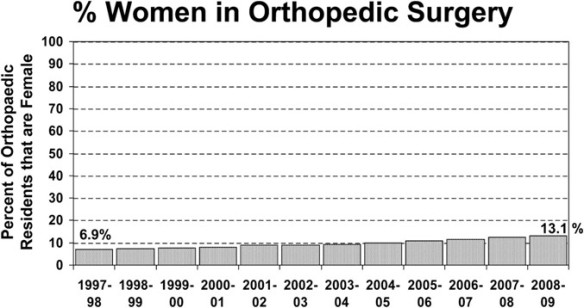
Ortho women residents 1999-2013 jbjs jan 2012

Journal of Bone and Joint Surgery, January 2012

Women at Work

I’m thinking about the culture of orthopaedic surgery.  In the twenty years since I graduated from medical school, I see more and more women in this field (as well as other surgical specialties), which makes me proud.  While women comprise only 5% of practicing orthopaedic surgeons, 15% of American orthopaedic residents are now women, which is roughly double the percentage in 1999.  But what’s it like to be a woman in orthopaedics?  How do these women present, perhaps differently, at work compared to in their personal lives?  Is it truly safe for them to be themselves as surgeons?  The American Orthopaedic Association held their annual meeting recently.  My orthopod friend returned from the conference and commented that the rare women leaders in his field seem ‘fierce’ and ‘tough’—but in a good way?  It struck him to wonder if they are just like that in general, or do they have to be that way to navigate their male-dominated specialty.  He wondered how they would be seen if they displayed sensitivity and emotion, “because a man can be seen as sensitive and kind” and not only does it cost him nothing, his social status is likely to be elevated because of it.  My friend was not sure this is the case for his female colleagues, and he seemed both empathetic and powerless at the idea.  Looks like gender parity may take a bit longer in medicine than in sports.

At work in general, women’s status varies considerably.  But research points to common issues such a 22% pay gap and too few women in leadership (5% of US corporate CEOs), though these are improving.  One need not look far for abundant evidence that having more women on the corporate team improves earnings and morale.  Much is also written on strategies for improving gender equity at work.  Two of my favorites are exit interviews and work-life balance initiatives for all employees, not just women.  But as I wrote last week, it’s not just about including women as participants in the workforce.  It’s about truly appreciating the diversity of experience, biology, and contribution that women bring to any group they serve.


561204_3707569082371_72213499_n

Women and Men

There is no way I can do justice to this topic in the remainder of this post.  So let me just share some ideas and resources I will continue to explore in the months and years to come.

I asked at the beginning what happens for men when women speak Feminism.  A corollary question is what happens for all of us when we hear the words ‘toxic masculinity’?  My guess is men get defensive and women get aggressive.  Personally I love the phrase because it’s so incisively descriptive.  But it can also be a flashpoint phrase, one that immediately incites conflict and emotional hijack.  Let me be clear: toxic masculinity does not imply that men and manhood are toxic by nature.  Quite the contrary, the phrase refers to a culture of expectations of men that is just as toxic for men as it is for women.  Male surgeons may well benefit from being sensitive and kind, but not too much so, lest they be seen as weak.  This is a vast oversimplification, by the way; the history and complexity of toxic masculinity are explored articulately here.

Readers of this blog know how much I love BrenĂ© Brown.  Her explanations of how shame (where toxic masculinity is born) manifests and organizes around gender—and why it is toxic for both men and women–are the most poignant and real.  Read her first hand comments to Ms. magazine here, and a stay-at-home dad writer’s interpretation of them here.  If you seek a nonjudgmental, objective, and real-life exploration of the complex dynamics between men and women, read The Gifts of Imperfection and Daring Greatly.  Sister (she’s not old enough to be Aunt) Brené’s books are the most accessible form of evidence-based, all-around relationship advice I have ever read, and I’m so grateful for her.  From the Ms. Interview:

What role do you think vulnerability played in the #MeToo movement?

Know what I love about the #MeToo movement?—and, me too—I thought until I was 25 or 30, that sexual harassment was just the price of entry.  The greatest casualty of trauma is the ability to be vulnerable. So this #MeToo movement is re-defining and re-claiming vulnerability, and putting vulnerability in the context it belongs in, which is power and courage. 

 What gives you hope?

The thing that scares me about the world today is the same thing that gives me hope. I believe we’re witnessing white male power over. It’s making its last stand right now. And it’s scary because last stands are dangerous, and people get very backed into a corner. I think this is the last stand, and that we’re going to see a shift, mercifully, from white male power to inclusive power with it too. And I think from that paradigm, we can do anything, change anything, and be anything. 

And it’s not just women who can claim agency against misogyny and sexism.  Men who identify as feminists serve as allies for gender equity and respect.  But men can also help themselves and each other break free from the restraints of machismo and chauvinism.  Movements like The Good Men Project and Evryman give men a forum for honest, vulnerable emotional expression and connection.  Just like women surgeons and corporate executives, all men need inclusive spaces where they can feel true belonging, where they are free to be all of themselves—hard emotions and all—for all our sakes.

Men I admire in this space include Nate Green, Ozan Varol, and David Brooks.

* * * * *

To lift my spirits here at the end of this long post, I’m listening to a song on repeat: Woman, Amen by Dierks Bentley.  It’s such a shining anthem of a man’s unabashed love and appreciation for his partner.  I can also imagine modifying the lyrics and hearing Faith Hill singing about her man Tim McGraw.

Thanks for reading to the end, friends.

Our relationships kill us or save us, and we really need to be better at taking care of each other, locally and globally.  We, men and women alike, are all in this together, inextricably, in sickness and in health, forever.

Only Love can save us.  Let’s get on it.