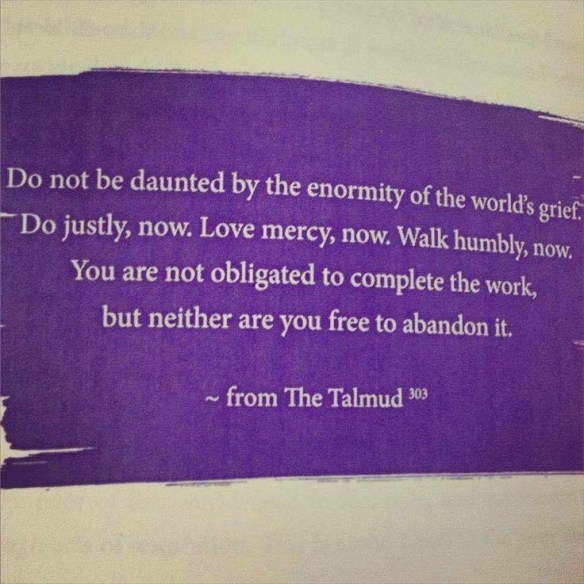
Holding the Space for Personal Acts of Peace—On Listening

IMG_2700

In honor of those who lost their lives this past week:

Alton Sterling, Baton Rouge, LA

Philando Castile, Falcon Heights, MN

Brent Thompson, Lorne Ahrens, Patrick Zamarripa, Michael J. Smith, Michael Krol, Dallas, TX

What can I, one person, do, in the face of such tragedy and pain? How can I help?

I write this post to document my personal intentions for living peacefully. Maybe that’s what I’ve been doing all along on this blog—recording the insights, keeping the journal—so I can remind myself of my ideals and aims, when things get confusing and I lose focus.

The way I see it, the temporal juxtaposition of killings on/by ‘both sides’ of the racial divide this past week led to an important shift in the national conversation on race and violence. I know I will not do justice to all the complexities of our issues in one blog post, but I ask your forbearance for my interpretation, as it has led me to greater conviction for what I can do, I, one person.


Listening to Understand

The first step to peace is to get quiet and listen. This is a central practice of Holding the Space.  Before we can solve our problems, especially problems between individuals or groups of people, we must slow down and really hear the narratives of all sides.  But when tragedy, especially violence between groups, strikes, I usually see and hear more shouting, blaming, and demanding, than listening.  At once people stake their positions around an issue, such as racial discrimination or gun control/gun rights.  I see words hurled on news and social media pitting one group against another, each claiming the only right opinion.

I think this is why I have not fully embraced movements like Black Lives Matter and Everytown for Gun Safety. To be clear: my values and opinions align with these groups, no doubt.  I believe that our country has a long way yet to go, to recognize and reconcile institutional racism and a runaway gun culture.  That said, when I claim membership in such a visible umbrella movement, I may be instantly perceived as less open-minded than I am.  “She supports Black Lives Matter; she must be anti-police.  I can’t talk to her.  I can’t tell her why I support cops and I why (her) movement upsets me.”  This sentiment, or something akin, may be conscious or unconscious.  With the person who feels it (and I do think it’s more of a feeling than a thought), already I have lost an opportunity to hear and learn from ‘the other side.’  When that happens, we both (all) lose.  When someone with an opposing view thinks I will not listen, am unwilling to hear them, then what else can they do but shout, blame, and demand?  So by not shouting and demanding loudly from my own camp, I leave myself open to approach, and be approached by, anyone.  I send an implicit invitation for communication and exchange of ideas.

This is the difference I see in the past week. More than debate over police reform and gun control legislation, I see pleas for increased compassion and understanding.  It feels less inflammatory and more contemplative.  Finally, the suffering seems to have quieted us, and we seem ready to engage more civilly.

Others have written and spoken about listening this week, more eloquently than I:

Brené Brown, on her Facebook page, July 7:

I believe that healing racism will require honest conversations about race and class privilege – with our friends, our neighbors, our co-workers, our families, and our children. Yes, these are hard, uncomfortable discussions and we can become paralyzed by the fear of saying the wrong thing or being misunderstood. But we have to be braver than we’ve been because the cost of not having these conversations is paid in lives.

Maria Shriver, on her Sunday Paper, July 10:

There are times in life when answers aren’t what we need. We just need to listen. Listen without judgement. Listen to the wails, listen to the fear. Listen to the divide. Sometimes when someone is screaming for answers they are really screaming to be heard, to be acknowledged, to be understood. Sometimes there are no answers to our questions large and small. Sometimes demanding answers won’t get us the answers we need.

Father James Martin, on his Facebook page, July 10, on the Good Samaritan parable; those you despise have something to teach you:

…Not just that we are called to be compassionate to people that we despise, or think we despise, but that people we despise, might help us. They might have something to give us, to teach us.  That is, we’re called to the person we hate as someone we need…  The Black Lives Matter protestor has something to learn from the Trump supporter.  The Trump supporter has something essential to be taught by Hillary Clinton herself. The fundamentalist Christian has something to learn from the same sex couple.  The pro-life advocate has something important to be taught by the person who works for Planned Parenthood…  Because in times of division, we often think that being kind means telling people that they’re wrong—for their own good, of course.  …Telling them that they’re wrong, or that they’re evil, or that they’re not a real American.  But the deeper message of the parable is a lot harder…  The one you think you hate is about to help you.  The one you think is wrong has something to teach you.  Upon the person you hate depends your soul.  And once you realize this, you cease to hate them, of course.  Jesus is telling us once again that there is no ‘other’.  There is no person who cannot teach you something.  Learn from the one you think you hate.  Listen to him.  Open your mind to her.  That’s your neighbor.  So the Good Samaritan (parable) is not just about the good Samaritan who helps.  It’s (also) about the man by the side of the road, who receives help from the one he thought he hated.

I shared House Speaker Paul Ryan’s remarks on my Facebook page this week.  He used words like respect, compassion, and common humanity.  He cautioned against anger that would “send us further into our corners.”  He upheld the president as ‘rightfully’ saying justice will be done.  I don’t like Paul Ryan, and I don’t particularly trust him.  But I posted his words to remind myself that I need to pay attention—to listen—when I hear people I normally oppose, say something I agree with, even if I am skeptical. Otherwise I contribute to perpetuating the divisions that I say I want to heal.


Listening to Heal

I imagine those who would say that listening is not enough. It will take too long to iron out our differences, if that’s even possible.  We need to act, and act now.  We demand justice now, gun control now, new laws now, change now, end the violence now!   We need boldness, aggressiveness, decisiveness.

I propose that taking time to stop and really listen to our opposition is, in fact, a bold and decisive act.  It certainly goes against convention these days.  If we said to our protesting and rallying peers, “Wait a minute, maybe they have a point… Maybe we should take a moment and hear them out,” how would most of the group respond?  Peer pressure can snuff the flame of inquiry faster than we can imagine.  But make no mistake, listening can and does make a difference in real time.

Recall the fabled story of a depressed teenager on his way home from school. He plans to kill himself this day.  Somewhere along the way, a classmate approaches, and walks with him.  They spend the afternoon in each other’s company, talking, throwing a football, maybe listening to music.  The suicidal teen decides to live another day.  He feels seen and heard, maybe even understood.  Someone has noticed him; he is no longer invisible.

On April 4, 1968, Robert Kennedy made a whole city feel heard. During a presidential campaign stop in Indianapolis, he remarked on the assassination that day of Dr. Martin Luther King.

…Martin Luther King dedicated his life to love and to justice between fellow human beings. He died in the cause of that effort. In this difficult day, in this difficult time for the United States, it’s perhaps well to ask what kind of a nation we are and what direction we want to move in. For those of you who are black — considering the evidence evidently is that there were white people who were responsible — you can be filled with bitterness, and with hatred, and a desire for revenge.

For those of you who are black and are tempted to fill with — be filled with hatred and mistrust of the injustice of such an act, against all white people, I would only say that I can also feel in my own heart the same kind of feeling. I had a member of my family killed, but he was killed by a white man.

What we need in the United States is not division; what we need in the United States is not hatred; what we need in the United States is not violence and lawlessness, but is love, and wisdom, and compassion toward one another, and a feeling of justice toward those who still suffer within our country, whether they be white or whether they be black.

So I ask you tonight to return home, to say a prayer for the family of Martin Luther King — yeah, it’s true — but more importantly to say a prayer for our own country, which all of us love — a prayer for understanding and that compassion of which I spoke.

We can do well in this country. We will have difficult times. We’ve had difficult times in the past, but we — and we will have difficult times in the future. It is not the end of violence; it is not the end of lawlessness; and it’s not the end of disorder.

But the vast majority of white people and the vast majority of black people in this country want to live together, want to improve the quality of our life, and want justice for all human beings that abide in our land.

According to his granddaughter Kick Kennedy, 34 American cities rioted that night, but not Indianapolis.  It was the only city with a large black population that didn’t.  I think this is pretty good evidence for the healing power of listening.  It was not an interactive encounter, but Bobby Kennedy aligned himself with the best of people’s hearts that night—and isn’t that the essence of real listening?

We have hard days ahead. I want to help.

I intend to avoid:

-Speaking and writing in sweeping generalizations

-Following snap judgments about groups, or individuals based on their group membership

-Labeling and shaming people or groups as ‘racist,’ ’ignorant,’ ‘stupid,’ ‘lazy,’ etc.

Instead, I resolve to:

-Ask more questions; say things like, “Tell me more…”

-Listen to people’s stories

-Look for what we have in common—shared interests and values, rather than opposing positions

-Practice awareness of my own biases and how they influence my perceptions, words, and actions


I will listen for peace.

Holding the Space: Beyond ‘Agree to Disagree’, or, A Discussion of White Male Privilege

IMG_2099

I recently found myself engaged in another oppositional conversation on Facebook… and it was a very good thing.

It was the ‘Week of Brock Turner,’ the Stanford swimmer convicted of 3 felony counts of sexual assault of an unconscious woman behind a dumpster. He was sentenced to 6 months in the county jail, only 3 months of which he would likely serve.  Social media erupted more violently each day with outrage and revulsion.  I, like many others, concluded that this represented a stark case of white male privilege at play, and I stated as much on my page.

A friend quickly denied the concept. We agreed that the sentence for Brock Turner’s heinous crime was absurdly lenient.  I wrote that I might have been more accepting of the outcome if he had owned his wrongdoing, and conveyed a sincere apology to the woman for violating her so egregiously.  My friend replied, “You’re nicer than me, I think he should have his balls chopped off.  But I’m old school.”  We both saw the result as unacceptable, but explained it from totally different points of view: he attributed it to the Turner family’s high socioeconomic status, and not to privilege of race or gender.

I shared this article, which I thought explained the phenomenon, one of unconscious bias, with relevant scholarly references.  He shared this article, claiming that white male privilege is an idea promoted by the political left to retain power over minorities.  I posted a link to Michael Kimmel’s TED talk, explaining the essence of privilege—that it is invisible to those who have it.  My friend then posted this article, a logical refutation of white male privilege based on what the author describes as the fallacy of critical race theory.  We each followed the other’s links, and criticized the content thereof (with civility, of course).

Several screens into the thread I realized we were each trying to convince the other, to change the other’s mind. It wasn’t working, duh.  I found myself sucked, again, into a typical tit-for-tat, back and forth argument over positions.  It started to feel like an exercise in futility.  Finally I wrote to my friend that I will study more (I still don’t really understand critical race theory), and meanwhile we can agree to disagree.  I thanked him for engaging, and we concluded the conversation amicably.  It got me thinking though:  Once we agree to disagree, what then?  Where do we go from there?  I still believe strongly in the existence of white male privilege, and he still strongly does not.

Let’s assume that both he and I—indeed most of us—are, in fact, kind, decent, compassionate, and intelligent people. Let’s assume also that we all seek productive and positive relationships with others.  What, then, are the best and worst manifestations of our respective beliefs?  I think it’s an important question.  How could we Hold the Space for the answers?  Here is my attempt:


White Male Privilege Exists

Worst manifestations

  • “All white men are misogynist pigs, oblivious to their inherent, unearned privilege, who perpetuate the oppression of women and people of color.” This attitude oversimplifies, generalizes, and stereotypes.
  • “All institutions are insidiously and irrevocably driven by white male privilege, and the only way to overcome this oppression is to treat it/people aggressively. We need to shame them in public until they get it.” This militant attitude incites and provokes, further alienating the very population it seeks to convert.

Best manifestations

  • “We all cannot help our unconscious biases—they are indoctrinated from a very early age and operate beneath conscious awareness. It does not automatically make anyone an inherent racist, sexist, or otherwise a bad person.” I see this as a nonjudgmental, objective, and mindful framework. It recognizes things as they are, however much we dislike them, with patience. It does not pit one group against another, and allows us to approach one another with openness.
  • “We can do our best to call attention, with civility, to white male privilege when we see it playing out in the workplace, social settings, etc.” The goal here is to bring it from unconscious to conscious awareness, where it can be better managed by intellect and reason. This is exactly how we work to overcome stereotypes and other unconscious biases. The first step is awareness, which can come much more easily in settings of nonjudgement, curiosity, and shared humanity.
  • “I will monitor my own biases in all realms, and look for contradictions to my assumptions.” Because I believe white male privilege is so prevalent, I risk over-attributing. It is my responsibility to check my perceptions against reliable and objective truths, or at least seek others’ perspectives for balance.


White Male Privilege Does Not Exist

Worst manifestation

“The concept of white male privilege is colossal lie, confabulated by the political left to wield power over minorities. Anyone who ascribes to this fallacy is unworthy of intellectual discourse.”  This attitude dismisses not just the idea, but the people who believe it.  It leads easily to name-calling and accusations, defensiveness and contempt.

Best manifestation

“I don’t believe in white male privilege, but I recognize other important contributors to poverty and social disparities. I will reject attempts to shame my point of view, and refrain from slinging insults in kind.  I pledge to work with others to effect positive change though good-faith pursuit of shared values and common goals.”  This is what I wish for someone on ‘the other side’ to say.  It takes the conversation beyond ‘he said, she said,’ and allows both parties to stand side by side to tackle important issues from different, and possibly complementary perspectives.


I am grateful to my friend for engaging with me on this topic. If not for him, I would never have come across the articles he posted.  I would not have questioned my position, or thought to consider the origins and merits of an opposite one.  The conversation called on me to practice critical appraisal as well as openness.  And while my opinion remains unchanged, its application is now more nuanced and thoughtful.  I like this idea of getting beyond ‘agreeing to disagree.’ By identifying the best manifestations of our respective beliefs, we can all contribute to a more just future.

Holding the Space for: Fear

IMG_1692

Here is my best explanation for my unintended blogging hiatus: I’m afraid.

Afraid that the A to Z Challenge was such a success (as assessed by me), that nothing I write hence forth will measure up. Afraid that I used up all my good ideas in the challenge and I have nothing more useful to say.  Afraid that if I keep writing, I will only repeat the same tired ideas, and become noise.

I am also afraid of disapproval. I feel called to write about sensitive topics (I know, this is the third time I’ve brought it up—it’s coming, I promise, I’m setting the stage here), and I fear backlash from readers.  I’m afraid of being attacked—for both my position on a given issue, as well as for my effort to consider all sides.  “How can you hold this view, you must be ignorant and stupid!”  Or, “How can you call yourself a (fill in the blank group) while you allow (the opposing group) space on your blog to promote their ignorant and stupid views?”  I want to do the right thing, which is allow—even invite—opposing opinions.  But I am afraid of losing control of the whole process, of getting sucked into verbal wars over opinions and beliefs.

On April 28, at 12:15am, I commented on Emily Heath’s post, “On Restrooms, Gender, and Fear.”  It’s the 11th comment.  Rereading it now, I cringe at how condescending it sounds, even as I meant to express empathy and connection.  Two readers replied in opposition, one who asked me if I was insane and wrote, “How insulting.”  For two days I debated whether to reply, and finally decided against it, as I unilaterally concluded that both of these people were likely not looking for an ongoing conversation.  I realized that while I thought of my comment as speaking directly to Emily, I was, in fact, writing to her entire audience.  It made me think twice about expressing my opinions publically, and I learned an important lesson about writing for public consumption:  Comments are not the best space to express my opinion fully, and I never know how anyone will respond.  And, I should probably not write about emotional topics in the middle of the night.

Still, I feel a need to contribute my voice to the important conversations. And while I am agitated that it’s taken me so long to get started again, I see now that I needed this time to work out a plan.  I needed a pause to regroup and distill my purpose.  I needed space to define my focus: not taking sides on the issues, but rather exploring nuances of idea exchange.  I may write something that offends someone.  It will not be intentional.  I may need to field some personal attacks, or attacks on my ideas.  That’s okay, I can decide how I will manage each on an individual basis, and on my terms.  This blog is my space, after all.  Most importantly, though, I have a wide and deep network of people who can help me monitor my words and provide perspective on the words of others.  I’ve got this.

Impatience with myself has disrupted my sleep and distracted my days these last weeks. Why could I not just pull it together and write something already?  Now I know, I was Holding the Space for my fears.  I knew something different and significant was coming around the corner, and I had to take a breath before treading this new path.  Part of me has worried about what readers think of my absence—perhaps sensing my fear and hesitation, losing confidence in my writing, as I may have, for a while?  Maybe I’m just projecting.  And just as I wondered if I would ever come back, I found this piece on bravery by Glennon Doyle Melton, who writes the blog Momastery.  She writes, in reference to people yelling for two kids to dive from a cliff into the ocean:

Over time I have come to believe that brave does not mean what we think it does. It does not mean “being afraid and doing it anyway.” Nope. Brave means listening to the still small voice inside and DOING AS IT SAYS. Regardless of what the rest of the world is saying. Brave implies WISDOM. Brave people are not simply those who JUMP every time. They do not necessarily “do it anyway.” Brave people block out all the yelling voices and listen to the deepest voice inside the quietest, stillest place in their heart. If that voice says JUMP, they jump. And if that voice says TURN AROUND – they turn around, and they hold their head high. Often the one who turns around shows GREAT BRAVERY, because she has been true to herself even in the face of pressure to ignore her still, small voice and perform for the crowd.

Brave is: To Thine Own Self Be True. And Brave parents say: I trust you, little one – to Be Still and Know. I’ll back you up.

My still small voice was saying, “Wait, wait for it. You’ll know when you’ve got it, and then you’ll move.”  Now I know, I’ve got it, and I’m moving.  I’m excited to see where the next leg of this blogging journey takes me, and what I will learn along the way.