#AtoZChallenge: Humbling and Honoring

Though I was born in the United States, I grew up very Chinese.  Honor and respect for elders was one of the highest values in my family, as it is in the culture at large.  It would never occur to me to be on a first name basis with anyone in my parents’ or grandparents’ generation; they were all uncles, aunts, and surrogate grandparents.  Teachers, as well, always had a title.  In the presence of these zhang bei (senior generation), I would sit or stand up straight, pay attention, and never interrupt.  So it feels Humbling to find myself friends—equals!?—with so many of my elders—

Joe, my 7th grade math teacher,

Dawn, my 7th grade English teacher,

Kathy, Joe’s wife and the music director for the 8th grade play,

Barbara, my 9th grade geometry teacher and freshman volleyball coach,

Lisa and Jerry, my varsity volleyball coach and her husband, one of the football coaches,

Mary and Dan, my confirmation sponsors in college, pastoral associate and pediatrician, respectively, and

Keith, my clinic preceptor intern year.

I always wondered, what did they see in me, so young, naïve, and ignorant, that would make them want to know me as a friend?  Then about ten years ago I found myself befriending students and other ‘young people.’  I gradually realized the rewards of the exchange—new perspective, fresh ideas—connection across generations, cultures, experiences.  I felt a sense of mutual admiration and understanding, despite the age gap—an appreciation that bridged the separateness.

Somehow this reminds me of a morning I spent volunteering in a free clinic a few years ago.  As per usual, patients filled the waiting room and clinic workflow bore no resemblance to anything efficient or modern.  But the atmosphere pulsed with purpose and kindness.  First and second year medical students helped run this clinic, relishing the chance to hone their history taking and physical exam skills.  They saw the patients first, synthesized all relevant data, and presented a summary to one of a few attending physicians staffing the clinic that day.  After some discussion on pathophysiology and care plan, the attending led the team of students back to the exam room to finish the encounter.  If you have ever been a patient at a teaching hospital, it’s much like that, only much slower and often with profound technical barriers and almost no support.

That morning I walked in with my team to greet an elderly Pakistani man for follow up of his blood pressure and diabetes.  I knew he had been waiting a long time.  It was almost noon and he had not eaten all day, in preparation for fasting labs he knew he needed to have drawn.  Upon greeting him, I automatically apologized for the wait, put my hands together, and bowed slightly, while I thanked him for his patience.  I felt bad about the whole situation, and I wanted his pardon.  His face lit up and he immediately turned to the students and said something like, “See?  That is how you treat an old man!”  He was not angry or crotchety in any way.  He seemed honestly and happily surprised to be treated with Honor and respect—as if he suddenly felt seen and appreciated for who he was—a member of an older, wiser generation than all of us.

In Pakistan this gentleman had been a middle- to upper-class professional.  Here in the US his resources were drastically curtailed, such that he had no health insurance and depended on the free clinic to get treatment for his conditions.  I wonder if he was used to feeling like just another immigrant patient in a busy, understaffed clinic where there were few occasions for others to ask about and listen to his story.  Since I was a periodic volunteer, I had that chance.  I get to choose when I am willing to donate my time and energy to the free clinic—everything I do there is on my own terms.  The patients there have no such choices.  If they want care, they have to show up—early—on the day the clinic is open, regardless of what else is going on in their lives.  There are no appointments, and almost no continuity with providers.  It’s a completely different world from where I make my living, on the Gold Coast of Chicago.

I am Humbled by the opportunity to meet people from all walks of life.  Students arrive at medical school from diverse backgrounds.  Patients may hail from all corners of the world, many having come through experiences I can scarcely imagine.  It is my Honor to care for all of them, and I wish to maintain this perspective of respectful service.  I have those who support, teach, and guide me in life—older and younger.  So it is my privilege to give back—to offer my own knowledge, expertise, and maybe sometimes wisdom—and help make a positive difference in people’s lives.  I can’t remember exactly, but I think I said something to this effect to the medical students that day.

Physicians have power by default and design in the medical setting.  We can wield that power with more grace and efficacy when we remember Humility, and Honor our patients as whole, rather than broken or defective.  Be they students, friends, political opponents (yeah, stuck that in there), teachers, or patients, there is always something to learn from someone else’s perspective.  Cultivating the Humble and Honoring perspective, when I can muster it, makes all of my relationships infinitely richer.

#AtoZChallenge: On Belay!

Lately I feel like I berate my kids. Could you please rinse your spoon?  How many times do I need to tell you to pick up your clothes?  Please, thank you, please, thank you, please?  Maybe I’m tired, stressed, sleep deprived; maybe I’m just irritable.  I don’t like it.  I’d rather guide them with more patience and love.  Like Toni Morrison said, “You think your affection and deep love is on display, because you’re caring for them.  It’s not.”  She asks, “Does you face light up” when you see your children?  In other words, can they see and feel your love for them when they see your face?

I don’t want to berate. I want to belay!

I first learned this word at a ropes course, maybe in high school. It’s a climbing term many of you will know.  Dictionary.com’s mountain climbing definition of belay is as follows:

  1. To secure (a person) by attaching to one end of a rope.
  2. To secure (a rope) by attaching to a person or to an object offering stable support.

I remember hearing, “On belay!” as part of the climbing sequence. A quick Google search of the phrase yields this explanation:  “Your belayer…lets you know that he is on belay and that it is safe for you to climb, saying, ‘On belay.’”  The voice commands before climbing commences are:

Belayer: “On Belay.”

Climber: “Ready to Climb.”

Belayer: “Climb” or “Climb on.”

Climber: “Climbing.”

I want to be the belayer, the anchor—of character, behavior, confidence, and love—from which my children can cast themselves. They need to know that I am here to secure them, the stable place from which they can strive for new heights.  In order to do this, they need to know that I believe in them, that I see their essential worthiness.  I could say something more like, “Hey, I know you’re a good kid and you want to help out.  It really helps keep our home clean if you pick up your clothes from the floor.”  It’s much more mindful.

Recently the actor Tom Hiddleston appeared on The Late Show with Stephen Colbert, to promote his new movie, “I Saw the Light.”  Hiddleston, a Brit, plays Hank Williams, the iconic American folk singer.  I already love both Hiddleston and Colbert, so I could not wait to watch the video of them singing a duet on the show.  It turns out that Hiddleston had never sung before this role, but did all the singing himself in the film.  Colbert invites him to sing, live and impromptu, on the show, and what follows is a perfect study in belaying.  Allow me to dissect and interpret:

2:18   Stephen first invites Tom to sing.  Tom expresses apprehension.  The crowd goes wild and he looks conflicted, as if he mostly does not want to sing.  He tries to quiet the crowd but they are rowdy.

2:33   Stephen lightens the mood by playing spoons on the desk.  He makes it safe for Tom to consider the invitation, buys him some time to decide.

2:36   Tom says if we want to see him sing, we should see the film.  He looks almost deflated, like he feels at once dutiful to have plugged his movie, and disappointed that he might have passed up a chance to perform.

2:41     Stephen chuckles playfully and says, “Okay, uh, we’ll see.”  He’s thinking of another way to coax Tom out a little.

2:45     Stephen promptly finds a way to relate to Tom—says he grew up on Hank Williams.  He appeals to Tom’s admiration for the singer, makes a connection.  He suggests they sing “I Saw the Light,” the title track from the movie.  Tom still looks disinclined.

2:56   Stephen gets a riff from the band, and sings the first line of the song.  It’s pitch perfect, and completely authentic.  He puts himself out there first, an honest and vulnerable invitation for Tom to join in.  On belay!

3:03   Tom has been holding his breath, and lets it out in a reluctant puff, shaking his head.  You can still see his conflict, and you’re rooting for him.  Jump in, Stephen will hold you up!

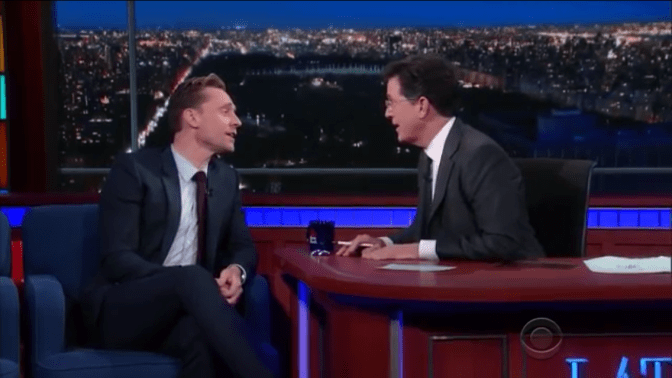
3:10-5   Tom sings the second line with Stephen, slowly, and in perfect harmony.  He’s still sitting back, a little stiff, hands clasped in his lap, cautiously accepting the invitation.  Ready to climb!photo 1.PNG

3:26   Tom starts to lean forward toward Stephen, engaging more.

3:29   The band starts playing in earnest and the audience immediately starts clapping enthusiastically.  At this point you just want to get up and dance, the energy palpably rising.  Climb on!

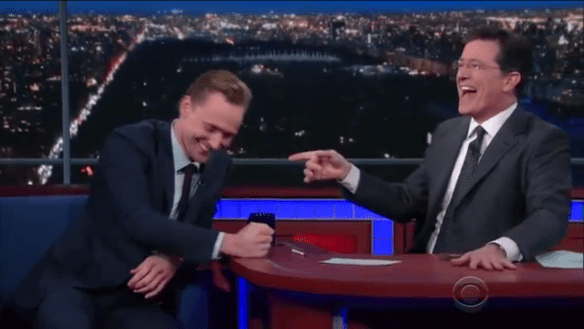
3:34   Tom breaks a smile while singing—a big, joyous smile.  photo 2+.PNG

3:37   His shoulders relax, he gets animated.  He leans in further, starts to really have fun.  Climbing!

3:45   Tom turns to the audience to encourage them in return, while Stephen interjects, “Everybody!”  Tom starts to clap, and sings to the audience.

3:55   Tom’s really enjoying himself, he’s into it.  If you’re not moving your body by now, there might be something wrong with you.

4:06   The finale starts.  Tom leans into Stephen again, following timing cues as the chorus slows.

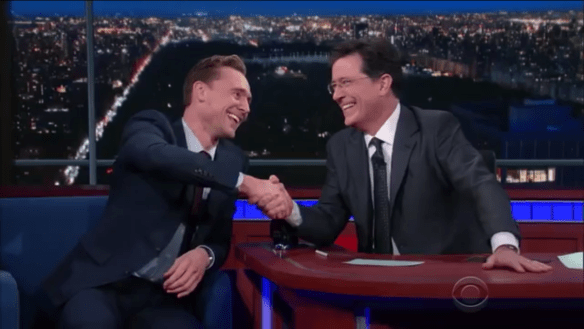
4:15   He looks to Stephen, grateful and maybe a little relieved, and also very glad that he took this chance to sing and have fun.  photo 3.PNG

4:19  After shaking hands, Tom lightly hits the desk with his fist.  I bet he’s thinking, “Nailed it.”  photo 4.PNG


The interview starts with the two men talking about Hank Williams’ troubled life, his ‘formidable demons,’ as Hiddleston puts it. He expresses compassion for this, as I have seen him do in previous interviews about other characters he has portrayed.  He describes how Williams rose to stardom quickly, but ‘with no real support, no one to anchor him.’  Funny how he uses that word, anchor—like belayer.

We all need our anchors, our belayers. They are the people in our lives to whom we secure ourselves, and who look out for us.  Thanks to them, we can climb on, toward new experiences.  From their stable posts, we can stretch out and grow.  And when one of us grows, we can all grow.  Or in the case of this video, we all at least have a great time!

We can belay one another in seemingly the smallest ways…or maybe they’re not so small after all.  I bet Tom will remember this duet his whole life.

#AtoZChallenge: Assumptions and Appreciation

Welcome to my first attempt at the Blogging A to Z Challenge!  26 posts in April, one for each letter of the alphabet (I get one day off per week).  I will explore meaningful words to apply to perceptions, attitudes, behaviors, and relationships. It’s a personal journey, part of my mission of self-assessment and development through writing.  Thank you for stopping by, and please feel free to comment! 🙂


Yoga instructors. Football players.  ER nurses.  Asian college students.  Old white men.

Hold these likenesses in your mind’s eye for a moment. Who do you see?

Was the yoga instructor a man or woman? The football player?  It’s impossible not to make assumptions, to apply stereotypes.  Such constructions help us make sense of the world.  They allow us to move through countless human encounters quickly and automatically.  And, they can limit us far more than we realize.

One spring day my kids and I sat in the car, waiting to exit the parking lot after church. Three men, Caucasian, in their 60s, crossed in front of us.  They were well-groomed and overweight—grandpas, likely.  Their expressions were neutral, absorbed in conversation.  One of them looked a little winded from walking.  They were perfectly unremarkable, and they did not notice us.

I felt an acute flash of fear.  It was visceral, as if, at any moment, they could decide that my kids and I were not worthy of being at that intersection, and that they somehow had the power to impact my life in ways that I could not control or influence.  Three apparently unassuming white men.   Fascinating.

I remembered this story when a friend and colleague recently shared this blog post on our assumptions about surgeons.  I realized that despite being married to a surgeon, having multiple surgeon friends, and trying every day to live with an open mind, I still ascribe to the stereotype of the mean surgeon.  It comes out when I hang up the phone after a pleasant conversation with an ENT fellow.  “Wow, he was so nice,” I think, surprised.  Or when I feel righteously annoyed after a terse and condescending interaction with his attending.  “What do you expect,” I say to myself, “he’s a(n old, white, male) surgeon.”  Nobody would ever say that about a pediatrician.

I don’t shame myself for harboring the mean surgeon and old white men stereotypes. They were born of a certain reality and make me appropriately cautious in new situations.  I don’t think I behave badly because of them, and I readily acknowledge when the stereotypes are broken.  But the realization that I hold these assumptions so deeply—subconsciously—gives me pause.  What other assumptions do I carry, and how do they limit my relationships?  I think it’s fair to say that we all carry shards of racism, classism, and other forms of blatant prejudice.  Here’s what I also think:  It’s okay.  We can’t help it, that’s just how it is.  Denying it just makes it that much more insidious, subversive, and toxic.  I’m prejudiced, you’re prejudiced, we’re all prejudiced.  The more we say it, the less scary it gets.  The first step is acknowledgement without shame.

But we cannot, and must not, stop there. We can’t only say, “We can’t help it, that’s just how it is.”  We must take the next step, which is to manage it better.

I think an excellent antidote to toxic assumptions is appreciation.

Dictionary.com includes the following definitions of appreciate:

  1. To regard highly; place high estimate on: to appreciate good wine.
  2. To be fully conscious of; be aware of/ detect: to appreciate the dangers of the situation.

Let us first fully appreciate (be aware of/detect) the scope of our prejudices: Their cultural, familial, or experiential origins, their subtle influence on our perceptions, and the covert ways they manipulate our thoughts, words, and actions toward others.  Awareness is key.  It is also hard.  It’s hard because we know we shouldn’t be prejudiced, it’s bad.  Prejudiced people are bad, they do bad things, we don’t want to be like them; if we admit our prejudices then that means we are bad, that we are not worthy.  STOP.  The only way to keep from acting on our negative stereotypes and perpetuating racism and xenophobia is to fully acknowledge their existence and confront them, head on.  They do not define us.  They are not all of who we are and what we stand for.  Their presence does not negate all that is good, generous, and inclusive about us.  AND, they are part of us.  We cannot escape them by way of denial.  If we can call ourselves out honestly, lovingly, and with forgiveness, we can then integrate our prejudices, and put them in their place.  Appreciation does not mean approval of, or abject subjugation by, our biases.  It is simply the first step to living wholly, to knowing and owning all of ourselves, and moving with intention and mindfulness.

Then, let us apply the other definition of appreciation to others. Let us regard more highly those whom we may automatically, however subtly, belittle in our subconscious.  How might we do this?  Look for that which we share.  She is a mom.  She must love her kids as much as I love mine.  What are their circumstances, what lessons is she trying to teach them, and what would I do in her place?  Why did he become a doctor?  He must want to help people like I do.  I could never do what he does, so high risk, so much responsibility.  God bless him, we need people like him.

Let us then solidify the process with words, out loud. “I can tell you really love your son.”  “Thank you for caring so much about our patient.”  It may sound trite, even silly, at first.  But we can never underestimate the impact of a few kind words, not just on others, but on ourselves.  When I acknowledge myself in you, I make a connection.  I see you, I recognize you, I appreciate you, as I do myself.  Prejudice thrives in silence and denial.  It cannot long survive being spoken out loud and it certainly withers in the presence of true connection.

We will always make assumptions.  Tempered with some well-placed appreciation, though, perhaps we can get through life with a little more love and a little less suffering.