Seek the Stories

IMG_7397

Do you have time in your doctors’ appointments to tell the story of your problem?  Do you even think of it as a story?  More and more I find myself saying to people, after they have given a list of symptoms in no particular order, “Tell me the story, starting from when you last felt well/normal.”  Then it all comes out in an interesting narrative, often with new insights as to causes, connections, and exacerbating factors along the way.

Do you read more fiction or nonfiction?  I have always been a non-fiction gal.  I appreciated The Grapes of Wrath and devoured the Harry Potter and Percy Jackson series, but usually I avoid novels.  My favorite books this decade are The Art of Possibility, Rising Strong, Big Magic, Start With Why, and Give and Take.  I realize now that these books are also full of stories—just real-life ones.  I have tried to incorporate more stories in my writing, and I find it challenging and awkward.  But I will keep trying, maybe take a creative writing class someday.

I have heard some amazing stories recently, and I will get some details wrong, but I want to share them with you, in case they touch you as they touched me.

A doctor attends a mindfulness workshop because he is interested in mind-body medicine and always looking for new methods to explore his inner world.  Part of the workshop is a professional quality of life survey, on which he scores very high for compassion satisfaction and low for burnout.  He says it’s because this is a second career for him.

He always wanted to be a doctor growing up.  He was accepted to medical school in his home country, but his family could not afford it.  So he stuck with science and went to school the cheapest way possible, and graduated with a biology degree.  Over the years he got married and immigrated to the United States.  He never forgot his dream of being a doctor, but progressed nevertheless in his graduate basic science studies.  When he applied to allopathic medical school here in the 1980s, he was told that since his BS was from abroad and the class was already ‘culturally imbalanced,’ he would not be admitted.

He was offered a spot in an osteopathic school, however, and grabbed it.  Meanwhile his wife was pregnant with their first child.  He had to move away from her and his parents for residency, and while he was away his father died.  Sometime in there his wife also started medical school, and they made it through training and the births of two children (with two weeks maternity leave each for her) intact.  They are now both well-respected primary care physicians in a small outlying community.  He is a physician educator and leader.  They sit side by side at the dining room table on Sunday nights catching up on notes.  They call these their “Epic dates.”  [Epic is the name of a widely used electronic health record.]  Both of their children are doctors.  He never feels burned out; he is living his dream.

Another doctor, a leader in his field and his institution, and a black man, described everyday racism that most of us cannot fathom.  A neighbor approached him on the beach of his own lake house, accusing him of trespassing.  Passing drivers backed up to confront him at his mailbox, suspecting him of stealing some white person’s mail.  A cop pulls him over around the corner from his suburban home in a nice neighborhood, asking, “What are you doing around here?”

A man in his 50s breeds guppies for fun.  It started with his 5th grade teacher, who was his mom’s best friend.  He used to go over to her house with his mom, and got interested in her guppy tanks.  Now he has hundreds of his own tanks, and he knows everything there is to know about inbreeding, crossbreeding, guppy circadian rhythms, and where the world’s experts on guppy breeding live and work.  Now I know this is a thing.

Mr. Rogers is quoted as saying, “There isn’t anyone you couldn’t learn to love once you’ve heard their story.”  I wholeheartedly agree.
 

Hopey, Changey Hero Making

IVY Litt 11-8-17

NaBloPoMo 2017: Field Notes from a Life in Medicine, Day 8

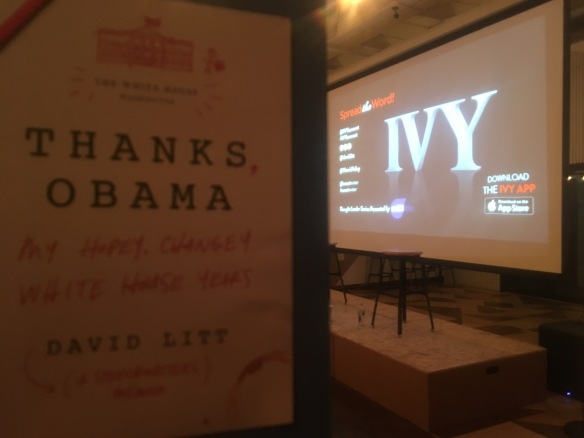
Funny how I just wrote last night about connecting new dots to old dots.  It just happened again tonight!  A couple of weeks ago I responded to an online ad for an IVY Ideas Night with David Litt, author of Thanks Obama: My Hopey, Changey White House Years, entitled, “How to Inspire, Persuade, and Entertain.”  Litt was a senior speechwriter for President Obama, so I thought I could learn new tips for presentations, and feel a little closer to the president whom I miss so much.

I’ve done public speaking since eighth grade, when our speech teacher first taught us abdominal breathing and I discovered the thrill of holding the attention of a room full of people with only my words.  I work at an academic medical center and I hold zero publications, but my CV documents over 10 years of professional presentations to various audiences.  I thought I was pretty good at this speaking thing.

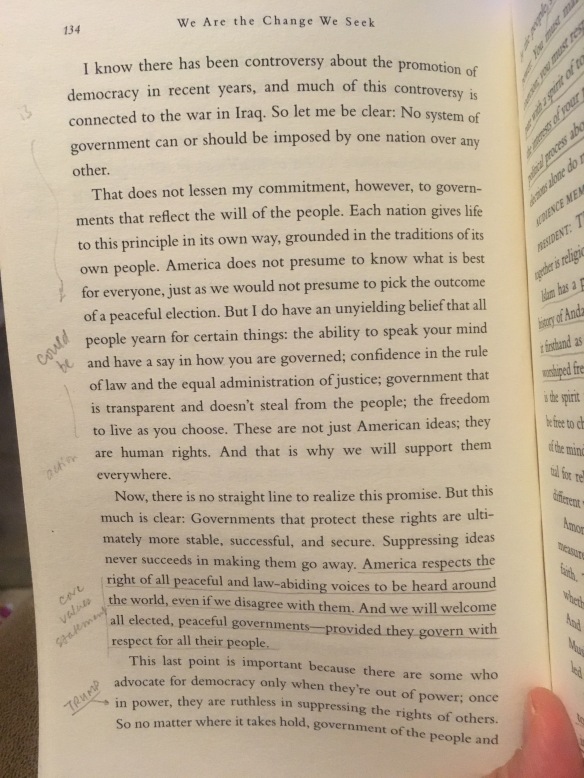
Three years ago I came across this TED talk by Nancy Duarte, whose ‘secret structure’ of great presentations I have used since I subsequently read her book, Resonate.  Essentially, she recommends that we invite audiences on adventure stories, create active tension between what is and what could be, and most importantly, make the audience the hero.  I have done this better and worse since then, but I always recognize the framework when I see it.  Those familiar with this blog know that I am also a fan of Simon Sinek, whose central message is that we perform at our best when we are crystal clear about our Why.  “People don’t buy what you do, they buy Why you do it,” he says.  Barack Obama employs both authors’ principles with eloquence and finesse, which I noticed reading We Are The Change We Seek, a collection of his speeches as president.  The best speeches delivered in this construction create audiences who are inspired, motivated, and empowered to hail a meaningful call to action.

Obama is could be core values

That’s basically what David Litt conveyed tonight.  When asked what advice he was given that served him best, he said, “Imagine someone in your audience will tell their friend tomorrow about your talk.  What is the one thing you want them to say about it?”  What is the Why of your talk?  Even though he no longer writes speeches for the most powerful person in the world, he expressed a desire to continue inspiring, empowering, and promoting personal agency in all whom his work touches. Make each and every audience member their own hero.

It turns out, however, that this approach applies to much more than public speaking.  On my 50 hour, 500 mile, aspen-pursuing weekend in Colorado last month, I described to my dear friend my favorite moments at work.  At the end of a patient’s day-long physical, after I have spent 90 minutes listening to their stories of weight gain and loss, work transitions and complex family dynamics, and reviewing their biometrics and blood test results, I meet with them for an additional 30 minutes to debrief.  This is when I present an integrated action plan compiled by the nutritionist, exercise physiologist, and myself.  It is a bulleted summary of our conversations throughout the day, centered on the patient’s core values and self-determined short and long term health goals, and crafted with their full participation.  I get to reflect back to my patients all that I see them doing well, and shine light on areas for potential improvement.  It’s an opportunity to explore the possible—to Aim High, Aim Higher, as the United States Air Force exhorts.  I often present the plan with phrases like, “Strong work!” “You’ got this,” and “Can’t wait to see what the coming year brings!”  My friend turned to me as we wound through autumn gold in the Rocky Mountains, a bit tearfully, and said, “You make them the hero of their own story.”  Yeah, I do, I thought, and I got a little teary, too.

Words are powerful.  They are our primary tool for relating to each other, for making another person feel seen, heard, understood, accepted, and loved.  You don’t have to be a public speaker or a presidential speechwriter to make a positive difference with your words.  At work, in your family, with your friends, with people on the street and in the elevator—what is the one thing you want someone to remember from their encounter with you?

I Hereby Commit to NaBloPoMo 2017! Day 1: Shitty First Drafts

DSC_0358

2015 November Gratitude Shorts

2016 Letters to Patients

2017 Field Notes from a Life in Medicine

Day 1:  Shitty First Drafts

I first heard this concept listening to Brené Brown’s book Rising Strong.  It refers to Anne Lamott’s writing process, described in her book Bird By Bird.  Brown uses it as a way to work through strong emotions.  When something hard happens, intense emotions can get the best of us.  Anger, resentment, defensiveness, judgment, shame, and a multitude of other difficult feelings can overcome our senses.  How can we keep from getting sucked into a raging emotional vortex, dragging others along with us?

Write a Shitty First Draft, or SFD for short.  I have done this a few times recently.  I take a pen and paper and let loose.  I vent, rant, SWEAR IN ALL CAPS, draw angry faces, scrawl everything I feel, with total abandon.  This is the first, most subjective and raw version of the story I just experienced.  Man, it feels good, documenting everything from this (self-)righteous point of view!  But it doesn’t stop there.  Sometime later—whenever I’m ready, I return to the SFD to edit and revise.  Curiosity is key here.  What other versions are also plausible?  What am I missing from the other side(s)?  What other story will allow me to suffer less?  What makes me so attached to the SFD?  What core value has been violated here?  What is the most generous assumption I can make about the other people involved? I also learned that last one from my girl B2.

Turns out some SFDs are easier to edit than others.  Seems it depends on the circumstances, relationships, and (inter)personal stakes involved.  In the end, though, it’s well worth the effort.  I realized it this week and posted a musing on Facebook, and my friend offered me a chance to expound:

“CC: Curiosity, Transparency, Integrity, and Openness are saving me right now.

“Friend: I’m glad they are but curious to know how they are?

“CC: They are keeping me focused on the best and most meaningful contribution I can make to the team. As more moving parts get added to the process, I can stand on these practices to respond effectively. In the end, regardless of the project outcome, hopefully I can look back and know that I have very little to regret. …And if I do regret anything, hopefully I will have at least also learned some valuable lessons.”

The more I practice my SFDs, the sooner I can get to healthier iterations of my life stories—ones that allow for forgiveness, equanimity, gentleness (on myself and others), and inner peace.  I used to secretly berate myself for not getting to the peace part faster, easier, more efficiently.  But now I know, the healthiest way out of the shitty feelings is straight through.  The Shitty First Draft is the perfect vehicle for getting to the other side, and I get to drive every time.