November 11:  Fierce Optimism Makes Me Better

IMG_1860

NaBloPoMo 2019

On Ozan’s Inner Circle forum today, another member posted about his admiration for Dr. Martin Luther King, Jr.  It reminded me of a favorite MLK quote, which came to mind on Saturday as I prepared for the Better Angels workshop:  “The arc of the moral universe is long but it bends toward justice.”  I have referred to this quote many times over the years, and a phrase that I often add goes something like, “Bend that arc!  Hang on it with all your might!”  Meaning the arc bends toward justice only because we make it so, by working tirelessly for it, by acting visibly in accordance with our core values, and by consistently walking the talk.

I texted my friend the morning of the workshop: “I’m 90% excited, 10% nervous…Maybe 15%…”  Then I thought about the people I know who like the idea(l) of Better Angels, but don’t want to participate.  I thought about my friends who express hopelessness at any possibility that people on opposing political sides can ever connect, that we can actually work together across our differences to get things done.  I thought about the pushback I might get, that the Better Angels mission is futile, a waste of energy and time.  I felt something akin to a tidal wave rise within me, and I texted my friend again, spontaneously, “I intend to make today a day of fierce, infectious optimism.”  At that moment I knew my goal that day was to take every example and experience of kindness, connection, empathy, openness, generosity, magnanimity, conviction, and hope, and channel it to the workshop and its participants.  Because though it was to be a skills workshop, teaching a way of doing, what we really need are all of the qualities I just listed—they are the way of being that brings the skills to bear in the most meaningful ways.

This idea marinated for a couple of hours while I pictured the venue, reviewed the workshop content, made notes about delivery.  I thought again about my friends who feel like our world is crumbling around us, that so much progress made the last century is being eroded.  I completely empathize with this perspective, and I understand how it makes us feel we have to fight, to be aggressive and confrontational, to come at the opposition full force, like a bullet train.  Do they think listening and speaking skills focused on curiosity and openness too passive and ineffective?  Does optimism, the hopefulness and confidence that things will be okay, make me lazy about the issues that matter to me?

Below are the words I texted my friend to describe what I mean by ‘Fierce Optimism’.  Normally I would not share such nascent ideas on the blog, but whatever, it’s all an experiment, who knows what better ideas may come from this early sharing?

IMG_1898

Fierce Optimism Is:

Urgency with Patience

Or should it read, “Urgency without Impatience”?  What I mean here is simply that most things worth doing take a very long time.  All important social movements occurred (and continue) over generations.  At times confrontation and revolution are necessary.  But they are not enough.  Consistent, slow, organic, grass roots change on the local level is what sustains consistent progress, keeps it from regressing.  The acute urgency I feel to address my deep concerns (for instance, the profound rifts in our relationships) drives me to action.  But when that action is directed at another person, I must attune.  I have to set realistic expectations for how much I can move this mountain today.  Pacing myself, practicing persistence with patience, conserves energy and prevents burnout.  It also allows me to look up every once in a while and adjust to my surroundings, adapt to subtle changes, like when someone starts to soften.  If I’m bulldozing with strong words and heavy dogma, I am more likely to plow over and through any crack in the door of someone’s mind that might have swung open freely had I taken a more gentle approach.

Strength with Flexibility

Better Angels does not seek to make everybody—anybody—a moderate.  Rather, the goal is to hold our positions firmly and with principle, and practice seeing why someone else may hold a different position with equally strong principle.  In doing so, two things often happen:  First, by challenging our own beliefs and values, we can reinforce them.  Telling stories about the experiences that led us to our core values reconnects us with their origins, grounds us in and strengthens our own personal truth.  Second, hearing others’ stories helps us broaden our perspective.  Most of the time we only see things from our own point of view—this is our default setting.  But when we share personal experiences, really learn about each other, the curtains open on a vast landscape of understanding that we may never have imagined.  So while I may still hold my goals and objectives firmly, I can more easily release the rigidity of my method, tolerate setbacks with less suffering.  Earlier this year I listened to The Warrior Within by John Little.  He describes Bruce Lee’s life philosophy, which included a metaphor of the bamboo and the oak.  Both are admirably strong, but under intense forces of nature, the oak may break while the bamboo simply bends, sometimes to the ground, but without breaking.  Both stay rooted where they are planted, but one is more resilient.  Listening with openness and curiosity is not weakness.  Allowing for nuance and the possibility that my mind may be changed in some ways, while holding steadfast to my core values, makes me calm, agile, adaptable, and, I think, more effective.

Conviction with Generosity

This is about the assumptions we make.  Too often we cast ‘the other’ in abstract as sinister, evil, less than.  We hold up the most extreme members of the opposing group as representative of a dull and dumb monolith.  We oversimplify and overgeneralize, and then approach any individual we identify as belonging to that group as an assembly line package, a completely known entity.  We think we know all about them already, even if we have never met them, just because they identify today as “Red” or “Blue.”  In so doing, we make ourselves small.  We become exactly as narrow minded and prejudiced as the folks we accuse on the other side.  How ironic.  Now more than ever, we need generosity.  In my mind this encompasses empathy, vulnerability, sincerity, humility and a willingness to allow the complete humanity of every other person, regardless of their political, religious, racial, cultural, or any other persuasion.  Conviction without generosity too easily becomes tyranny, for individuals as well as organizations and governments.

*sigh*

Well, like I said, these ideas were just born two days ago.  Have I expressed them at all coherently?  Have I shown you intuitively apprehensible paradoxes?  Can you feel the dynamic balance of agitation and peace?  Tension without anxiety?  Potential and kinetic energy?  If not, that’s okay.  I’ll keep working on it.  That’s the essential outcome of Fierce Optimism, after all—we keep working, steadily, to bend that arc.

IMG_2046

November 10:  Experimental Questions Make Me Better

IMG_2654

NaBloPoMo 2019

What’s the most interesting question your doctor asks?  What effect does it have on you?

I get to ask some really fun and interesting questions of my patients.  They often come about spontaneously, then I realize how helpful they are, and I integrate them into my routine interview.

It was almost ten years ago now that I was seeing a pleasant young woman for the third time.  She had recurrent, nonspecific physical symptoms, and felt down.  She was having a really hard time at work, and it was having a significant impact on her overall health and well-being.  Around the same time I saw another patient, a young man.  He felt well overall, but was also not happy in his job.  I remember casting around in my mind, looking for a quick and easy way to quantify the negative effect of these patients’ negative work experiences on their health.  I can’t remember which visit sparked the 0-10 stress and meaning scale questions, but it was one of them, and then I repeated the questions on the other soon after.  These were my first two, unsuspecting, experimental question subjects.  On a scale of 0 to 10, how high do you rate the overall stress of your work?  That was easy, but I also had to figure out whether there was some benefit that was worth the cost of the stress.  So: On the same scale, how high do you rate the overall meaning of your work to you?  The bottom line is that we can tolerate very high levels of stress if the work is meaningful—for sustainable work, the meaning-to-stress ratio needs to be 1 or greater, and overall meaning is best at 7 or higher.  That year I realized I could create deeper, more helpful, more insight-revealing questions in my patient encounters.

My own work meaning rating rose by at least a couple integers almost immediately.

IMG_2628

Since then I have consistently asked about body signs of stress, resilience practices, the proportions of threat vs. challenge stress at work or home.  Since I last wrote about these questions in 2016, I have continued the experiments.

By 2016 I was also using the elite athlete analogy with my patients, asking every year about habits in the 5 reciprocal domains of health (after talking about stress and meaning at work): Sleep, Exercise, Nutrition, Stress Management, and Relationships.  But after asking the same questions for a couple years in a row, both my patients and I get a little bored.  So in 2017 I went a little deeper in the relationships category.  After confirming marital status, ages and health of children, I started asking, “Tell me about your emotional support network,” because the more I am reminded of the critical importance of emotional support in our health, the less it makes sense to not ask about it directly.

With each additional set of questions, I learn more about my patients. I learn how people understand the questions—sometimes it’s totally different from my own understanding, and the conversation about the meaning and objective of my asking gives me wonderful insights into people.  Patients are remarkably open and honest in their answers, which always reminds me of the honor and privilege of my role as physician.  The answers to these questions are what allow me to imagine my patients in their natural habitats, engaging with their work and the people in their lives.  The answers provide context and texture to the other patterns we uncover in health habits, and we often come together to a better understanding of both the origins and consequences thereof.  I can’t speak for my patients, but I always come away feeling just a little more connected.  I get goosebumps just thinking about it.

This year I’m excited to introduce 4 new questions.  It started out as three.  The third one wasn’t landing quite right initially.  I wasn’t asking what I meant, and I couldn’t quite articulate what I was after.  So I experimented with the wording until I got to the current state:

  1. In the coming year, what do you see as the biggest threat to your health?
  2. What is the biggest asset?
  3. Having answered these, how does this affect your decision making going forward? …And other iterations I can’t remember anymore
  4. One year from now, when we meet again, what do you want to look back and see/say about your health, relationships, and whatever else is important to you?
  5. (then the corollary question that occurred organically once and I then incorporated–) In order to make this vision a reality, what support do you already have or need to recruit?

I have asked these questions since July.  I always think to myself how I would answer for my patients, based on what I know about their circumstances, habits, and biometrics.  About two thirds of the time, our answers are the same.  Patients seem to receive them well, too.  One asked me to email them to him, so now I offer to email them to everybody.

IMG_2664

You might imagine that I think these questions make me a better physician.  That may or may not be true.  All of these questions make me better—a better, more self-aware person—because I also ask them of myself.  What is my meaning:stress ratio today?  This week?  This year?  I assess the threat/challenge ratio of my own life stressors, especially the acute ones.  I have had the same body signs of stress for many years, but in 2019 I may have developed a couple new ones, darn.  What’s the biggest threat to my health?  My hedonist impulses, no question.  The biggest asset?  My Counsel—those best friends and confidants.  What is my vision for my health a year from now?  I only answered that for myself a week ago (and I’ll keep it to myself, thank you).  And what support do I have/need?  I’m still working on that one!  That I don’t already know the answer to this one surprises me—I assumed I knew, but when I sat down to think about it formally, I realize that this may be the missing piece that holds me back from achieving some of my personal health goals.  HUH, how fascinating!  Did I not just write about how I question some of my patients’ ‘Lone Ranger’ method of self-care?  Well hello kettle, I’m pot!

Now, off to ponder some more, yay!


November 9:  Steady Pacing Makes Me Better

IMG_2620

NaBloPoMo 2019

*sigh*

I’m not a swimmer or a runner, but isn’t there something in these athletes’ training about breathing, pacing, and strategies for long distance endurance?   The last 22 days have felt like a physical, mental, and emotional marathon of sorts.  I’ll spare you the list of meetings, engagements, and tasks—you may have already read about them!  Looking back, I realize I have had to live every day in acute mindfulness, attending to whatever was right in front of me in the moment, including the unexpected.  Prioritizing was key, completing one task/event/conversation before moving onto the next.  I had to put my head down for some parts, come up for breath and a brief aerial view, then dive deep again.  Today I crossed a finish line, and I feel proud.

I started my journey with Better Angels in May of this year, at a skills workshop.  Since then I have attended two additional workshops, one that was featured on the Van Jones Show.  I committed to moderator training, and today I led my first skills workshop.  I had the honor of working with the three Wonder Women who ran the workshop back in May.  They prepared me so generously, so kindly, and I am forever grateful.

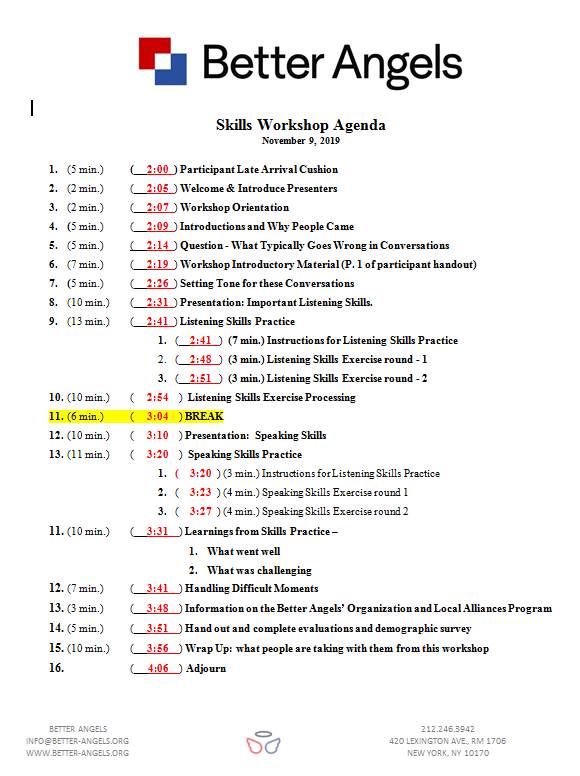
There was a hiccup, though.  When we initially arranged with the Wilmette Public Library for the event, we mistakenly told them the event would last two hours.  The workshop is designed to last 2.5 hours.  We could not change the website or registration, so we meticulously shaved 24 minutes from the schedule.  We warned participants of our impending heavy handedness on time, and dove in.  Mande and I set timers on our phones for each segment.  Mary Lynn gave me hand signals from the back of the room (though I did not always look or see).  I had the handy timeline that Sharon typed out for us all.  We ran ahead at times and behind at others, and ended right at 4:06pm, as planned.  We kept pace.  Engagement and discussion was lively, and attendees gave overwhelmingly positive feedback.  Many people stayed afterward to talk more, explore ways to get involved, and exchange information.  We were invited to present at other organizations.  Overall we felt it was a wild success.

Workshop timeline 11-9-19

Everything was a group effort these last three weeks. Each meeting, workshop, video call, or presentation, whether for the American College of Physicians, my clinical practice sites, or Better Angels, required a team of people, each with delegated and specified roles and task lists.  We all had to agree on timelines and deadlines.  Text, email, Zoom; more email and text—it felt like running through a Venn diagram of relay races, passing batons in and out of each circle as I crossed from one to another.  I had to pace myself, and also match the pace of others as I came alongside.

Having a calendar with everything written in one place definitely helped.  I keep a checklist of every task, no matter how small, and carry it with me everywhere.  Excellent hydration is key for optimal mental and physical performance—I’m always reminded when I forget.  Timely, frequent, and clear communication—need I say more?  All of these practices help me plan and maintain a steady pace, checking off the list, completing each day, each trip, each week, slowly, surely, and competently.

Now I can slow down, breathe deep, and tread more lightly for a little while.  Every athlete, even an amateur, requires rest and recovery between races.  Once again I dedicate this month of daily blogging—a quintessential practice in steady pacing—to all those who go before me, showing me how it’s done.  Thank you.