

“What observations/discoveries/learnings have you noticed in these weeks?”
In phone calls, emails, and snail mail to friends, I find myself asking this question repeatedly. This exercise yields two wins: 1) I’m connecting to my people all across the country; 2) I get to answer for myself, and new insights emerge each time.
How are you connecting with your people in these weeks of physical separation?
What have you had to reframe, create, and experiment with to make life work in our sudden new reality? How does it feel? What are you learning?
* * * * * *
Inconvenient Emotions
Very early in the pandemic, when I realized my clinical volume would drop to practically nothing, I started to feel something akin to survivor’s guilt. I still feel it—I am not on the front lines; I myself am not in harm’s way, as so many of my colleagues are. I feel relief for not having to be there (yet). Then I feel guilty for feeling relieved. So I try to make myself useful, giving Zoom presentations on wellness to colleagues and firesides on Instagram for the public. Life has settled into something of a routine. I do video calls, helping with operations management and team organization from an armchair (standing desk). Turns out I enjoy working from home! And I feel guilty for enjoying anything about this time of unprecedented global disruption. Hello, mental and emotional whiplash, my inescapable human companion. Thankfully, self-compassion practice keeps me sane.
* * * * * *
Acceptance with Agency
“The first step to changing your circumstances is to accept them.” Wut? I have grappled for years to understand this concept; today I think I finally got it (thank you, Donna!).
Today I choose to define acceptance as a state of possibility, rather than of resignation or victimhood. Sometimes it helps to describe something by pointing to its opposite: What happens when we refuse to accept what is? Often we cling to what we think should be. What should be is a narrow set of unmet expectations that keeps us anchored to the past, or at least to an unreality that simply does not exist.
What happens when we finally accept what is? We are liberated to ask some important questions: How do I feel about what is? What are the best and worst potential outcomes from here? What do I want to be different? How can I effect that change? What is my work here?
Accepting what is brings us over the threshold from the narrowness of what should be to the wide possibility of what could be, where our agency is what we make of it.
* * * * * *
Optimism + Cynicism = Peace
Some days I get so excited, reveling in human ingenuity and resilience! Look at the transitions we all made, practically on a dime, moving healthcare and education online, organizing COVID testing and creating treatment protocols, constructing hospital wards in convention centers, initiating clinical trials, and sharing experience and data internationally at breakneck speed! All this learning and application, holy cow, how could we not be smarter, more connected, and better after all of this?
By being human, that’s how. Despite our great capacity for survival and adaptation, we are creatures of habit and products of our environments and relationships. We revert more easily than we convert. On cynical days I think, “Nothing will change. We will stay the same stupid species we have become, just a couple hundred thousand deaths closer to our own stupid, eventual extinction. And we will deserve it.”
Here’s the fascinating thing, though: I vacillate in this false dichotomy lightly, even though the emotions on both sides can get intense. We humans are such a complex enigma, capable of profound love and selflessness, and also unfathomable hatred and destruction. That’s simply what is—we are all of these things, intricately complicated in our nature. Each one of us possesses an infinite set of potential vectors for connection and/or destruction. But I still get to choose what to do with my time, energy, and resources in this lifetime. It’s my call. So I’m okay; I’ got this.
* * * * * *
Co-Creation: The New Normal
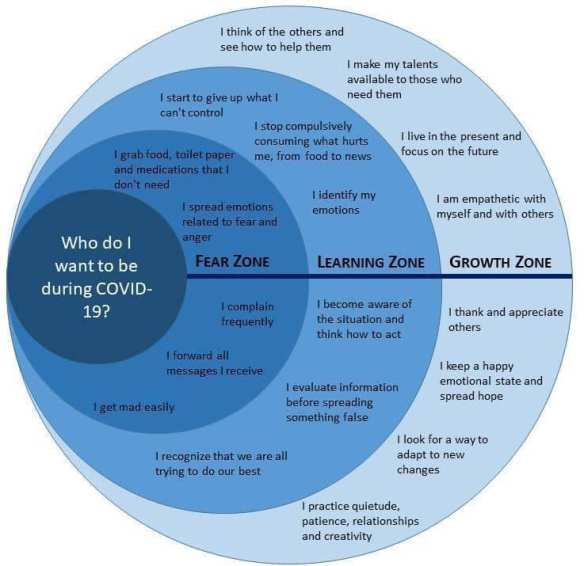
The last two years I have had the privilege to work with colleagues around our vision, mission, and values. I have studied various work cultures, observed and interviewed associates and teammates. LOH taught me the language and framework to synthesize my own, evolving style of relational leadership. During this downtime—this unearned vacation—I have time and space to consider a bigger picture. What about our culture best manifests our mission and values? How did this facilitate our successes in reorganization and mobilization? What held us back? What needs to happen (change?) in order for us to emerge from this crisis in learning and growth, rather than in fear and trauma? These questions apply professionally, personally, and societally.
My strengths lie in relationship and connection. Throughout this long journey to flatten the curve (and it will be months), I can contribute my insight, observations, and talents at synthesis, creativity and vision, to make our new normal as mindful, intentional, collaborative, and functional as possible. I can paint a vivid picture of where we could go. I can embrace dissenting voices and find alignment in apparently divergent interests. I can help us be better. This is the contribution I can make.
What will your contribution be?




 Healing Through Connection