We Choose Our Stance

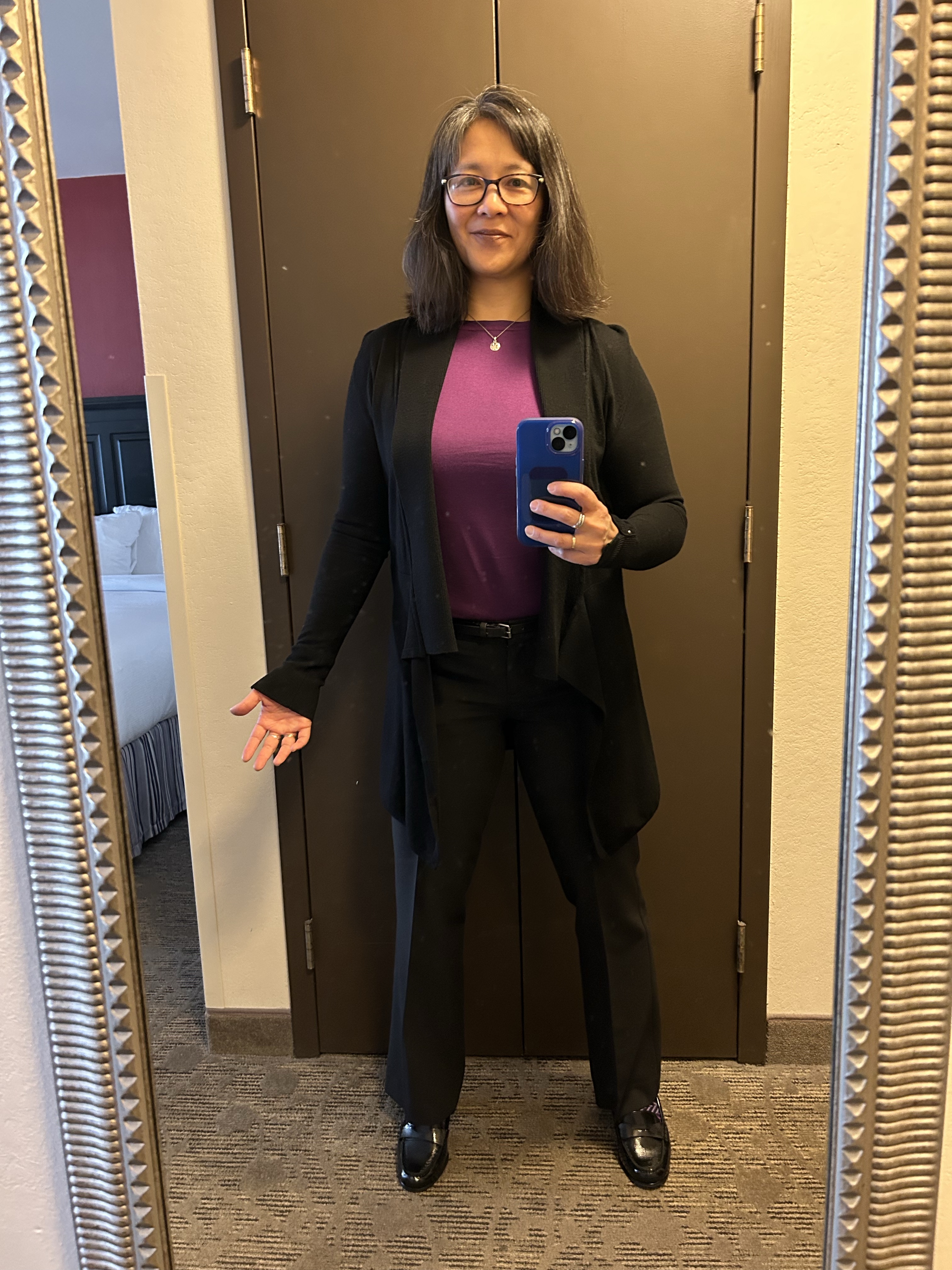
December 2023, before addressing members of the Judiciary on health and wellness

Tomorrow a new presidential administration takes office in the United States.
Wherever you are, whomever you’re with, whatever you’re doing, please be kind–everywhere and every day–but especially here, tomorrow.

I can’t say how long it took me to feel mostly back to normal after November 5, but it was sometime after completing 30 blog posts about the election and political discourse. Regular life resumed and my attention drifted away from politics… until now. I have continued to consume news sparsely, and with critical eye and ear. Still, like many of my progressive friends, I anticipate the next four years with tension and severe concern. I remember the last Trump administration as chaotic and disruptive–an intrusion on my daily life and consciousness–and I expect the next four years to echo that experience. I hold anticipatory stress and fatigue. I know many readers do not necessarily feel the same; I ask you to please hold space, empathy, and compassion for those of us who dread, regardless of how you judge us and the alarm we feel.

That said, I also feel a tremendous sense of opportunity and possibility. We–progressives, conservatives, and everyone else–get another chance to navigate together the unique jungle of a Trump presidency. I feel confident we can count on unprecedented words and actions, regularly occurring shock and dismay, and escalating emotion and rhetoric. To be clear, I expect this from both ends of the political spectrum, not just the people in office and their affiliates. We are humans, susceptible to triggers that provoke the worst in ourselves as well as one another–that trait knows no political identity.

So how do we choose to show up?

These images come to my mind:

https://thekaratekid.fandom.com/wiki/Crane_Kick?file=Daniel_vs_johny.png
https://www.youtube.com/watch?v=YGJX4XukJEA
https://www.economist.com/books-and-arts/2019/08/15/reagan-and-gorbachevs-tantalising-nuclear-talks-in-reykjavik

Adversarial energy.

It’s a fight, we say. They are our political opponents. Everything is on the line–the economy, our personal safety, our civil rights, democracy itself–our very way of life (and consider that had the election gone the other way, these fears would be the same, just expressed by a different subset of people). Transitions of government should not feel this existentially threatening. And here we are.

How much agency do we each, as individuals, recognize and claim, to influence and impact this sense of adversarial doom and conflict? How much do I, one person, believe I can change how we all do the next four years?

“‘What can I do, I’m only one person?’ said seven billion people.”

I think I/we can do a lot.

First, assess our sense of threat and challenge.
These are distinct yet overlapping stress states, with divergent physiologic responses and consequences. In threat we feel fearful and anxious. Heart rate, blood pressure and blood sugar rise, pupils dilate; gut and immune function shut down. It’s fight or flight, live or die. Threat sensation makes us reactive and impulsive; cognition and judgment play minimal if any role in our thoughts and actions here. Challenge, in contrast, is a state of paradoxically calm activation. I think of it as how elite athletes feel before competition, or how I feel before giving a meaningful presentation. We anticipate with excitement and look forward; we lean in. Cardiovascular, endocrine, cognitive, digestive, and immune functions all remain unimpaired. We are alert and open of mind and perception. We feel stable, strong, flexible, agile, and resilient.
In most stress situations we feel both threat and challenge; the key is to recognize the ratio. If we feel more threatened than challenged, what do we need to modify that balance?
In my experience as student, athlete, physician, parent, friend, speaker, writer, and citizen, the better I recognize where my agency lies, the more my stress scale tips solidly toward challenge. With agency comes empowerment; both victim and perpetrator energy yield to creator vitality and vision. I see how I can help invent a better outcome and future rather than succumbing to or wielding war for it.

Second, decide how we want to show up.
Calm. Commited. Respectful. Mature. Professional. Fully in our integrity. Humane.
Present. Curious. Open. Seeking connection. Humble. Generous. Kind.
What happens when we encounter someone who emits these energies? It’s nonverbal and often ineffable; we feel it, even if we don’t recognize it consciously. Then we mirror it–especially, I think, if that person has status or authority over us (think boss, teacher, parent).
If I choose a fighting stance or the hard and unyielding posture of enemy, how does that immediately affect my counterpart’s nervous system, thus determining how they show up to me? I think we can all recall scenarios of internal fight or flight sensation that either escalated or diffused based on the vibrations and actions of those with power over us.
If you have any influence, any status, any power–potential or real–over anyone, please consider how your energy affects those around you.
And I would argue strongly that we all have this power, know it, like it, want it or not.

Today, this image represents the stance I choose, the energies above that I aspire to effuse:

https://www.iemoji.com/view/emoji/2500/smileys-people/palms-up-together#google_vignette

It feels vulnerable, no question.
But make no mistake, it is not weak.

I Never Thought of It That Way by Mónica Guzmán

Pam Kirst over at Catching My Drift and I have started reading/listening to Mónica Guzmán‘s I Never Thought Of It That Way: How to Have Fearlessly Curious Conversations in Dangerously Divided Times, or INTOIT(W) (pronounced ‘intuit’), as she refers to it. It’s a book of attitudes, skills, and practices, not unlike my favorite book ever, The Art of Possibility. “INTOIT” is the catch phrase that reminds us how to show up in these ‘dangerously divided times’ to de-escalate and diffuse antagonism, to cultivate, maintain, and strengthen our connections. This book and its author speak directly to my personal activist heart–it’s about talking to people, Hallelujah! And let us be clear–respectfully, Mónica–curiosity in political conversations (or any conversations of conflict) is not fearless; it is courageous. It requires self-awareness, self-regulation, and both objectively and subjectively effective communication skills, executed despite that threat stress sensation.
Later this winter, Pam and I may discuss our reflections of the book live on Instagram. Stay tuned!
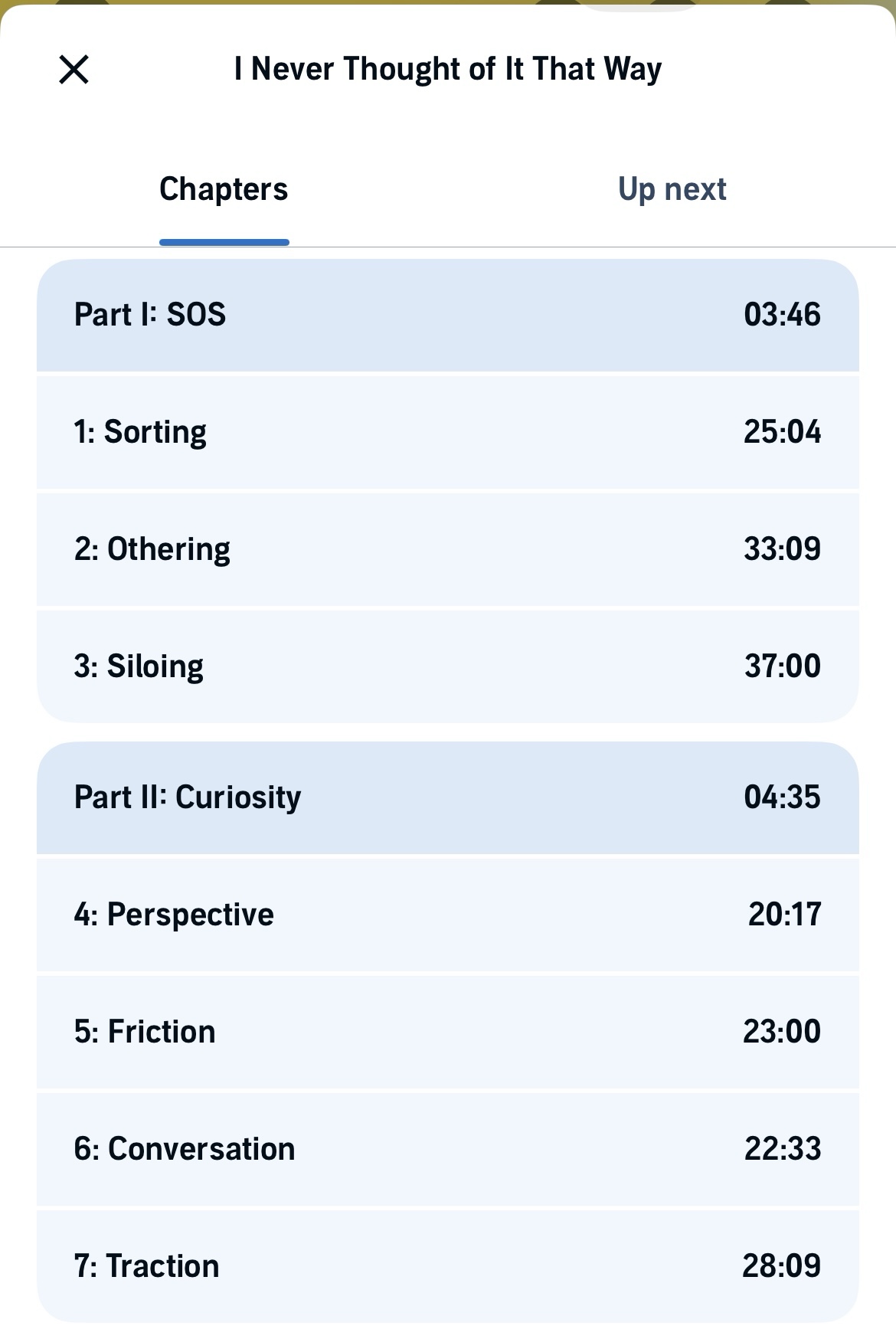
Chapters of I Never Thought of It That Way

What are the values we perceive as violated by those in power? What values did our advocates violate, in our ‘opponents” perspective?

What do we not know?

What assumptions do we make about our ‘adversaries’, and how do they impair understanding, stoke division, and thus perpetuate conflict?

What do we need to influence others to show up more curious, open, humble, generous, and collaborative?
I think we need to be these things ourselves first.
Like I said, vulnerable.
And thus courageous.

Brave. Curious. Humble.
Strong. Stable. Generous. Kind.
Committed. Discerning.
Do no harm. Take no shit. So maybe 🤲 and also 💪 and 🖖.

My stance may change over time, depending on how I can manage my own state of alarm and distress. It’s possible to be respectful and kind playing contact sports. I commit to practicing and training the attitudes and skills that help me show up to any encounter in ways that align with my values of Agape love and connection, so I may have the fewest relational regrets at the end of my life.
I intend to lead by imperfect and dedicated example.

What stance do you choose?

Isolation and Public Scrutiny

What aspects of your work do you share with other professions?

I have presented on health and wellness to members of the judiciary for some years now, and the more I learn about judges’ work, the more I admire. How humbling to be invited to speak to this audience; I think judicial work is severely misunderstood and thus unfairly judged (bad pun) by many. Imagine serving as the sole arbiter in complex cases at the multilane intersections of human behavior, relationship, and the law. Legal rules and regulations constrain process and thus outcomes that you may advance, and hardly anyone outside your profession understands any of it. In your lawyer days you had close colleagues with whom to confer, commiserate, and confide. As a judge it’s just you; your built-in community has suddenly and largely disappeared. On top of that, you are a public figure whose words and decisions are subject to scrutiny by anyone and everyone, who may all feel entitled to opine on your work and even you as a person from any perspective, informed and educated or not. And in this world of echo chambers that so easily incite violence, your and your family’s personal safety are now also potentially threatened.

I have reviewed academic and clinical resources to help judges address these risks to health in their work. That body of knowledge and support has grown significantly of late.
Then it occurred to me recently that my author and voice actor friends may also cope with isolation and public scrutiny, albeit in different ways from judges. So I queried them for reflections, insights, advice, and solidarity.

The response absolutely bowled me over in its immediacy, kindness, thoughtfulness, generosity, and discernment. One artist even offered to Zoom and we talked for 2.5 hours, with a future date to continue the conversation already on the books. Wow.

How wonderful when we can share human experiences across domains? My query post reads: “This feels like a great thing to crowd source! To see and understand similar challenges of divergent professions makes us more open, curious, and empathetic. And that makes the world better, no?” I attempt here to compile and synthesize my friends’ wisdom and add my own reflections. My deepest thanks to all who responded. I have quoted with permission and otherwise paraphrased with care and respect.

I hope this post may serve as documentation, reference, and solace for anyone who feels weighed down by isolation and public scrutiny.
May my friends’ and my words help lighten your load:

Connect Proactively
Physical and social isolation are a fact of life for folks with solitary jobs. You may need to initiate contact more often with both colleagues and friends, as the rest of us take for granted that we see one another in our default environments. Attend conferences, schedule dates, keep up with your hobbies. Set boundaries on time alone and honor them–honor yourself and your needs for connection in this way. And practice self-compassion for your imperfect efforts. If these are new skills, they will take time to establish. How can you recruit help? Connection means not doing things on our own. Even the Lone Ranger had at least one reliable and loyal companion. I ask patients at least every year about their emotional support network. We need that sense of security that when we reach out, whether for a joke, a jog, or acute and serious assistance, someone will reach back without hesitation and sit, stand, walk, and be with us in unflinching solidarity. This kind of deep and steadfast relationship requires active and attentive cultivation, and if it takes overcoming circumstantial isolation to achieve it, then that’s what we must do. The investment yields priceless returns.

Talk Shop, Then Step Away
We all need people who speak our language, with whom connecting is as effortless as it is meaningful. Confidentiality regulations limit judges’ speech more than most professions. And still I have to imagine, as in medicine, we can discuss case scenarios in lieu of specific cases; we can commune with colleagues around the experience of the work, if not the details. The cognitive, emotional, and relational stressors of any case (medical or legal) can weigh heavily because we engage with and affect, sometimes profoundly, the lives of our fellow humans. Folks who live the work first hand don’t need confidential details to relate to our experience. They empathize already. Their immediate presence and understanding soothe us in uniquely needed ways. “I’m having a hard time with…” “I’m feeling the weight of…” When we hear our esteemed colleagues utter these words, we stop what we’re doing, listen, and care.

That said, collective navel gazing has pitfalls. Fresh perspectives from outside our usual circles broaden our minds, challenge our assumptions, and make us deeper, more considerate thinkers and professionals. I asked authors and narrators about their experiences, intending to relate them to that of judges, and found myself relating, too.
The outside perspective can both enliven our work and provide a much needed escape from it. How often do we stumble upon insights and solutions randomly, while engaging with activities and people in completely unrelated contexts? The most innovative, creative, and revered professionals in any domain practice consciously stepping away from the deep work intentionally and regularly, freeing mind and soul to receive the EUREKA– or not. It’s okay and healthy to just hang out and have fun, too.

Discern the Voices That Matter
On the subject of public scrutiny, many thanks to Will Watt, voice over and performance artist, for your wisdom:
“The first thing to acknowledge is that you cannot escape scrutiny. Whether it’s personal or professional, it’s a fact of life. It is not a mark of judgement, although it can feel like it. There will always, always be someone with a dim or contrary view of you or your work, and that’s okay. When it comes to who you are as a person, in a professional environment, it’s important to try to disengage the personal from the professional. It’s easier said than done…
“When it comes to your work itself, scrutiny is important and should be expected. Nobody is ever 100% right 100% of the time. That’s why we have due process and peer review. Again, what’s important is that separation of person and profession. It can feel tedious or disheartening to get professional blowback for something you worked on in earnest, but that blowback should be seen as an opportunity for growth. We learn from mistakes, and we learn from exchange. It’s not a faux pas to get something wrong. It is a faux pas to be surly or bullheaded in the face of getting something wrong. Being proven wrong is like drawing a dead-end on a treasure map. It’s helpful. It gives you – and others – direction and purpose. It helps you for next time.”
“Sublimate,” my friend and writing mentor says. “Try to see whether the criticism has some basis… ignore the often hurtful feelings, and learn from it.”

Here again, context and perspective count. Whose scrutiny and criticism actually matters? I see an important paradox here. Every voice matters to some degree, and even the most innane or ignorant expression may yield important insight, however inadvertently. Most opinions also carry some degree of projection and bias, which needs parsing–it’s often not about us at all. Multiple writers and actors impressed upon me the importance of not taking things personally, even (especially) the ad hominem attacks. “Check the facts,” as the dialectical behavior therapists say. If someone’s opinion–positive or negative–affects me disporportionately, what is that about? Understanding our own patterns of reaction to scrutiny is half the battle of navigating it more easily.

In the end, we all must decide which voices deserve space in our consciousness. Authors and actors, and even physicians don’t read or internalize every consumer and patient review. Every opinion is not equally valid, relevant, or useful.

Practice Integrity, Accountability, and Humility
Does the work you do–your output–align with your Why for doing it? Is it consistent with your professional oath and ethos? Can you stand behind it with your head high, shoulders back, and defend it with integrity? If so, how do you know?

Those close colleagues can tell you. If you’re connected well enough, they see you, know you. And if you care about one another, they will tell you honestly (and hopefully kindly) when you need to reset perspective, stop deluding yourself, or get a grip. What Will said about separating the personal from the professional is important. I would also suggest that it cannot be a complete and total separation. We are who we are in both our personal and professional–in all aspects of our lives. The most meaningful work, I believe, is an expression of ourselves, no matter the domain. So assessing the relevant scrutiny, acknowledging mistakes and missteps, learning from them, and maintaining a growth mindset are all part of living an accountable life, professional and otherwise. This robust root system of integrity and accountability, in turn, makes the isolation and public scrutiny more tolerable.

So often my writings return to the same ideas. Here I land on confident humility. Whether we are doctors, lawyers, judges, writers, or actors, we have trained. We are experts in our fields of study and work. And yet none of us knows it all. There will always be more to learn. However we are right, it’s always only partially. Humility, in addition to integrity and accountability, liberate us. They keep our minds and hearts open to what we don’t yet see, know, or understand. They keep us connected to our fellow humans, no matter where we’ve been or what we do.

The other recurring idea in recent years is goals and trade-offs. Whatever line of work we choose, assuming we choose it, we must decide for ourselves what we want out of it. Then, what are we willing and not willing to do, to sacrifice, to get it? I think this assessment should be made regularly and frequently. Goals and trade-offs can change over time; we learn, grow, and evolve over a life. If we feel isolated, and/or if public scrutiny feels heavy and restrictive or threatening, we can ask first, are we okay with it the way it is? Are the rewards worth the risks and costs, to us and our loved ones? If not, then what needs to change, and how? That question feels like an invitation to me, an expression of possibility.

If we can move our focus from isolation and public srutiny to community and relevant appraisal, then I believe we will suffer less and live more joyfully in our lives, both professionally and personally.

Smiles to Start 2025

Happy New Year, friends! The season’s spirit still saturates me, and I will ride it as long as it lasts! Wishing that residual lightness and joy on you all, too!

Today was day 334 of Morning Pages, so I’m on track to hit 337/365 or so by the one year mark of this new habit–not bad! I don’t recall missing any blog posts in 2024–did I? So yay, the writing is consistent! This is post #670. With an average of 700 words each, that’s 469,000 words written in a little less than ten years. I can confidently say I have established a solid body of work. Book will happen eventually, and I’m okay with whatever cosmic timing is at play here.

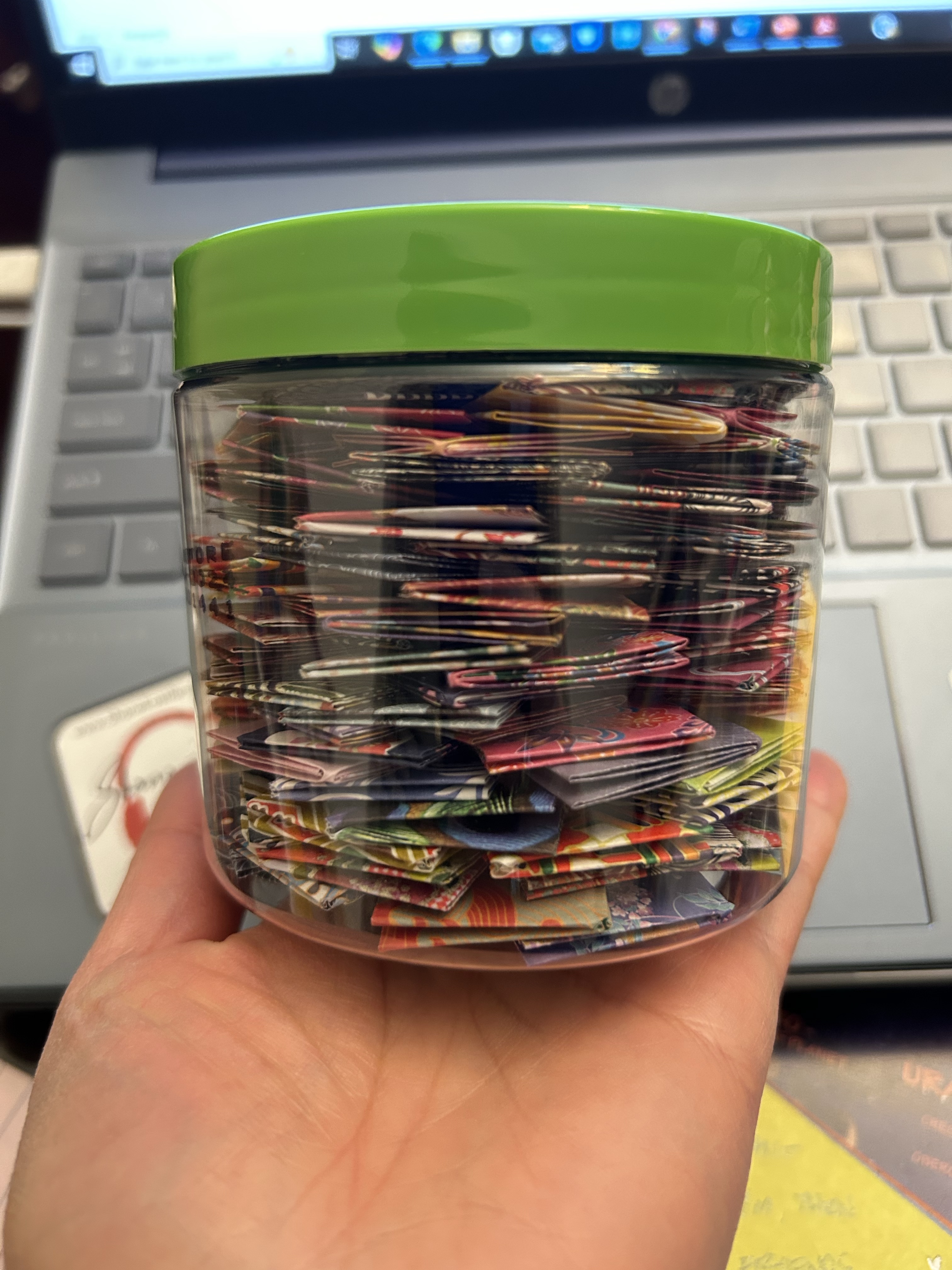
This season, however, all I want to do every day is write jar smiles. Inspiration can come anywhere, from music to audiobooks to movies, to conversations. Messages occur to me spontaneously while driving or looking out the window, and even falling asleep at night. I’m having so much fun capturing them on pretty origami paper. I’m using all my fun pens, and folding them is positively meditative.

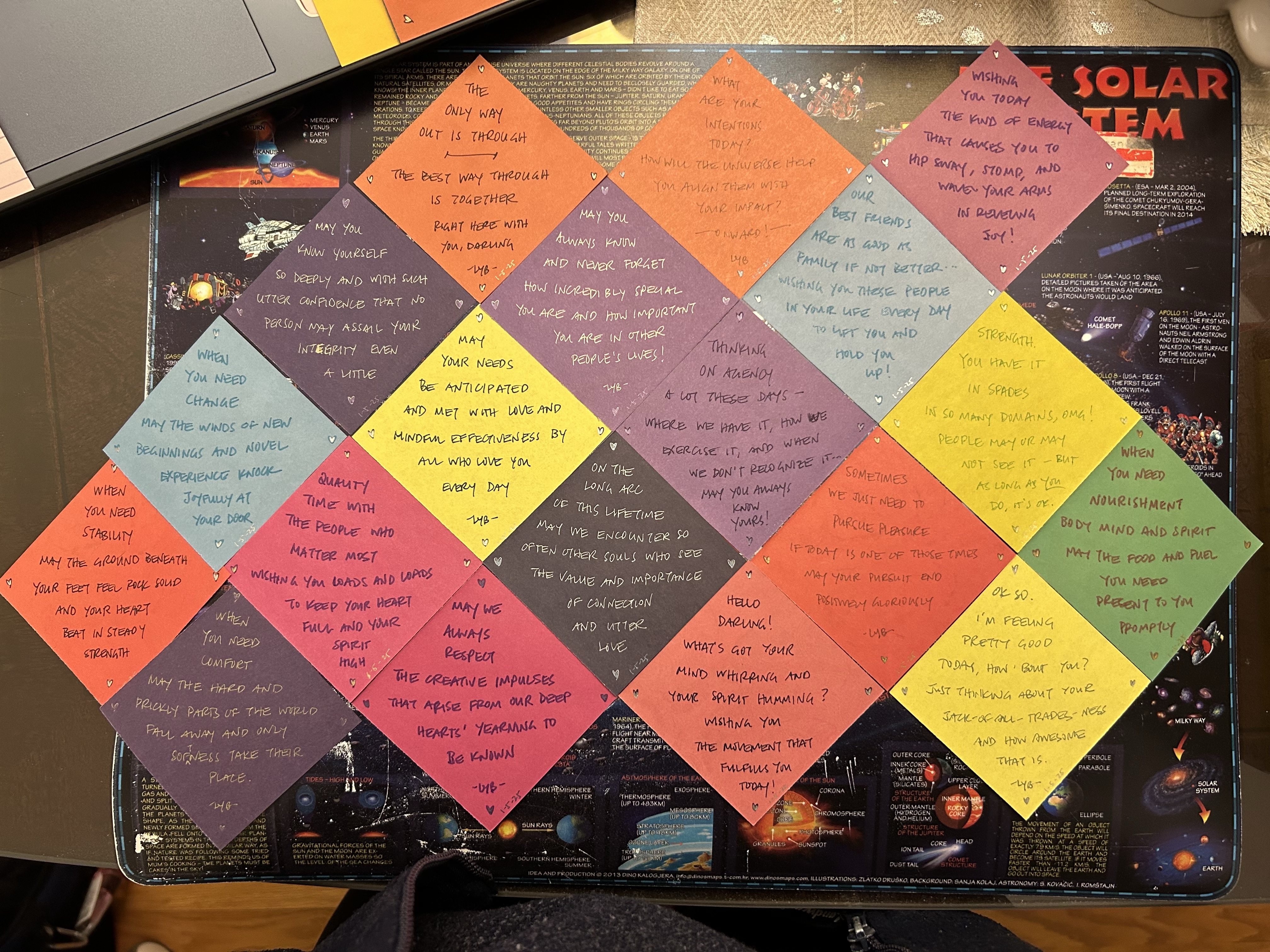
I don’t generally set explicit goals or concrete intentions ‘for the year’, but I feel a slight leaning that way at the moment. Letting it marinate rather than write about it tonight–maybe next week. But these tiny love notes! They make me so happy! So tonight I thought I’d share the latest batch here, in case they lift you also.

Maybe you’ll bookmark this post somewhere and come back to it when you want a little encouragement. Maybe you’ll point someone you care about this way, so they can get a little love, too. Regardless, I hope that by sharing these notes here, many more people may benefit from the expressions than just me and the people who read them on paper. Not sure how long I’ll end up writing them, but given the similarly joyful meaning and reward to writing this blog and Morning Pages so far, I have a feeling the jars I have started around the country and soon around the world may stay filled a while yet.

Peace, friends. Onward in solidarity and love:

Hello Love! Had a great HIIT workout at the gym, then connected with friends. Wishing you this awesome of a start to your day often!

When you need nourishment – body, mind, and spirit – may the food and fuel you need present to you promptly.

Wishing you today the kind of energy that causes you to hip sway, stomp, and wave your arms high in raucous joy!

Strength. You have it in spades in many domains! It’s a quiet force that we feel and respond to–you have impact.

Hello Darling! What’s got your mind whirring and your spirit humming? Wishing you the movement that fulfills you today!

Sometimes we just need to pursue pleasure. If today is one of those times, may your pursuit end positively gloriously.

May we always respect the creative impulses that arise from our deep hearts’ yearning to be known. Peace, dear one.

On the long arc of this lifetime, may we encounter often other souls who see the value and importance of connection and utter love.

Thinking of agency a lot these days – where we have it, how we exercise it, and when we don’t recognize it – may you always know yours!

Our best friends are as good as family if not better – wishing you these people in your life every day to lift you and hold you up!

When you need comfort, may the hard and prickly parts of the world fall away and only softness take their place.

What are your intentions today? Wishing the universe to help align them with your greatest positive impact!

When you need stability, may the ground beneath your feet feel rock solid and your heart beat in steady strength.

Quality time with the people who matter most: Wishing you loads and loads to keep your heart full and your spirit high.

May your needs be anticipated and met with love and mindful effectiveness by all who love you every day!

May you always know and never forget how incredibly special you are and how important you are in other people’s lives!

When you need change, may the winds of new beginnings and novel experience knock joyfully at your door.

May you know yourself so deeply and with such confidence that no person may assail your integrity even a little.

The only way out is through; the best way through is together. Right here with you, dear one.