Exploring the Rules of Engagement: A New Blog Series

dsc_0158

The Descent and the Rising

The past two weeks have assailed, masticated, consumed, digested, and expelled important parts of my psyche.  A week after basking in peaceful solidarity at the Women’s March, I found myself losing sleep and breaking out—both signs of acute distress.  My mind swam with questions of identity, purpose, and action.  I wrestled with fears around policy, violence, and integrity.  All of a sudden I wasn’t enough, I wasn’t doing enough.  Resist!  Call your representatives now!  Support this march and that protest!  And on the internet, rage escalated everywhere.

I read this article, which I highly recommend, on how to stay engaged and not lose your mind.  The author recommends that we focus our actions on one or two issues, and gives useful self-care tips.  After a few days, I was surprised to find that no particular issue moved me enough to passionate advocacy.  I began questioning my dedication.  But thank God for therapy (which the author also recommends), hallelujah!  I had a breakthrough in session last week, wherein I realized that I am, actually, enough.  And I do actually affirm one key interest: Relationship.

Duh.

For me, it’s less about specific issues than it is about how they’re addressed.  While generally I favor a progressive social agenda, I abhor the entrenched, partisan, winner-takes-all attitude that infects our government operations and civic discourse.  I also deplore the rhetorical, broad brush generalizations that people make about one another, based only on how we voted or an oversimplified position on one issue.  I wrote about this recently, though I buried the thesis in what should have been a separate discussion of healthcare reform.

Looking back, of course, relationship and communication have always been my core concerns—I launched this blog specifically to discuss them, for crying out loud!  Over and again I find myself in the role of mediator—between family members, Chinese and American culture, conventional versus alternative medicine, and between patients, physicians, and the healthcare system.  My whole life I have practiced, sometimes under duress, the art of mutual understanding and negotiation.  Maybe I’ve just been training for this moment in history.

How Talking Politics Is Like Eating Healthy

We could all learn and apply better practices.  We know the theories—more vegetables, less judgment, whole grains instead of processed, less name-calling and more calm, reasoned debate.  But so often the opposite happens:  junk food, sugary sodas,  pointless shouting and blaming—especially on social media.  We feel ashamed and frustrated at the futility of it all.  We figure screw it, I’ll never change (and neither will they), so why bother, it’s too much work, and anyway, it’s not the end of the world.

Never mind that your rising blood pressure and glucose accelerate the formation of atherosclerotic plaque each passing year, and that your risk of dying from a heart attack or stroke escalates exponentially as a result.  Never mind that the less we engage one another in meaningful ways, the farther apart we drift and the more we allow the most extreme factions of our parties to run the show.

The Challenge

In the coming weeks, I will share my own key learnings on healthier engagement practices.  I make no claims to have all the solutions, and I do not mean to be preachy.  These posts will serve mainly as reminders to myself, aspirational pieces to hold my own feet to the fire, marshaling my highest ideals of thought and behavior.  I will try to minimize promoting my own political views, though I suspect they will surface one way or another.  I hope you will follow with an open mind, and a heart that yearns to connect with the best of humanity, especially in those with whom you may disagree.

I’ve said it before and I’ll say it again:  It’s our relationships that save us.  Right now they desperately need repairs.  So let’s get to work.

Getting Past ‘You Suck’ as Dialogue

img_4284

Hello again friends, and Happy New Year!  It feels good to be back.  Diving right in with long form again…

This recent article from Wired got me thinking (again), there are so many layers and moving parts to healthcare reform, that no one player stands to lose all or benefit all from any changes.  And yet so much of what we read and hear has an, ‘it’s so simple, they just don’t care about you, but I do’ tone.  The piece describes why insurance companies, who may have advocated most fervently against implementing ACA regulations, actually have a stake in maintaining its current status.  Nothing in our healthcare system is black or white, all good or all bad.

So when I see politicians (and friends) speaking and writing in oversimplified sound bites, and vilifying a whole group (all liberals, all Republicans) over one aspect of their point of view, it really frustrates me. That is exactly the opposite of productive dialogue.  It just makes people stop listening, because they don’t feel heard or understood.  So they have no incentive to hear or understand you.

Many use the car insurance analogy to explain health insurance.  It’s not exactly parallel, but it makes some sense.  The law requires every car to be insured.  (Drivers of) cars that don’t violate traffic law get lower premiums, the longer they stay ‘safe.’  The more traffic law violations, the higher the risk, the higher the premium.  I have an actuary friend, who works for a health insurance company, who advocates, in part, for higher premiums for those who ‘use’ the healthcare system more—like the higher risk cars (drivers).  I understand this logic.  But this idea of making older and sicker people, and women pay more, just because they ‘use’ the system more (and thus financially speaking cost more), does not sit well with me.  People are not cars.  Not everybody maintains their cars well.  But poorly maintained cars do not necessarily lead to increased accidents and traffic law violations.  Poorly maintained health often leads to a human body’s multi-car highway pile-up equivalents.

My friend advocates for insurance coverage for catastrophic care (also aligned with the car insurance model), but not necessarily for preventive or primary care.  There are different ways of ‘using’ the system. If you get preventive care, like recommended cancer screening and annual exams, it may cost more at the time. If you seek help for your back pain early, from your PCP, chiropractor, and physical therapy, that costs money.  But if these early interventions prevent future, more catastrophic and costly outcomes, should we really penalize those who make them?  Illness and infirmity come with age.  So, often, do fixed incomes.  Is it right to make our elderly pay more for their care?

There are costs and benefits to care other than money, which is where health insurance and car insurance diverge sharply, in my view.  I know they are harder to quantify and assign, but they matter.  That secure feeling that I can get care when/if I need it, that my children and I have access to professionals dedicated to my health and well-being, a sense that in our society, I matter just as much as the next person, regardless of my net worth—these things all matter.  Each individual’s health or illness contributes synergistically to the health or illness of a society.  A mother’s depression, untreated and uncontrolled because her health plan does not cover mental health services, can negatively affect every aspect of her and her children’s lives, emotionally, physically, financially, and socially.  We cannot only look at healthcare on dollar spreadsheets of ‘use.’

Maybe it’s about priorities and philosophy—ideology?  Do we feel all people have an equal right to equal care, or do we differentiate what people deserve based on particular group memberships or other characteristics?  Do we feel we should only be responsible for ourselves, or are we called to look out for one another?  I personally believe in equal access to care and ‘look out for others as yourself.’

I also believe that people need to understand–personally and concretely–that everything does cost money, we all pay for one another’s use (and disuse, and misuse) eventually, and more care is not necessarily better.  So I understand and partially agree with my friend’s argument that people need to have ‘skin in the game’ to control overuse of services for no benefit.  One great example is end of life care.  I like this article from Fobres, which describes the conundrum succinctly:

According to one study (Banarto, McClellan, Kagy and Garber, 2004), 30% of all Medicare expenditures are attributed to the 5% of beneficiaries that die each year, with 1/3 of that cost occurring in the last month of life.  I know there are other studies out there that say slightly different things, but the reality is simple: we spend an incredible amount of money on that last year and month.

Dr. Susan Dale Block, Chair and Director of Psychosocial Oncology and Palliative Care at the Dana Farber Cancer Institute and Brigham and Women’s Health Care, recently shared some data with her colleagues.  In the Archives of Internal Medicine, a study asked if a better quality of death takes place when per capital cost rise.  In lay terms … the study found that the less money spent in this time period, the better the death experience is for the patient.

 
Cost, longevity, quality of life, quality of care, value, perceptions, public health—these and other aspects of health and medicine are all inextricably enmeshed, though definitely not integrated.  Any decisions about one must be made in the context of all the others, carefully, transparently, and honestly.  Whenever we hear, ‘if we just do this, everything will be better,’ red flags should fly.

I wrote the first draft of the paragraphs above on my Facebook page.  I ended the post with, “So let’s each educate ourselves on the facts, as well as we can, and try to look at the big picture. It’s so messy.  And it’s what we’ve got, so let’s deal with it–with maturity, patience, professionalism, and equanimity.”

Another friend, a fellow liberal, commented, “This has nothing to do with healthcare. It’s about reducing taxes on the wealthy, reducing benefits for the poor, and denying the democrats credit for anything good. If they actually cared about healthcare, they would fix the obvious problems with the ACA. And because the ACA was the republican plan, they will continue to tie themselves up into pretzels to disown it and put something else in place. That being said, I hope the American people continue to demand access to affordable healthcare for all. It’s a right, not a privilege.”

I had to reply: “(My friend,) I understand your point of view, and I share your passion for equality.  But your statement exemplifies exactly the broad brush, ‘you suck’ attitude that I see holding us all back.  I refuse to believe that all Republicans are only motivated by making the rich richer, and that none of them care anything about the poor, as so many of us on the left say.  We must extricate ourselves from this destructive narrative and learn to hold space for everybody’s complex views and experiences.”

My point here is that nothing is as simple as we’d like.  It’s so much easier to blame those who disagree with us for being stubborn, selfish, or evil, than to cope with the discomfort that our system is deeply flawed, there are no easy answers, and our fundamental philosophical differences make it that much harder to agree on the best way forward.  And yet, this is what we are called to do.  It’s up to each and every one of us to change our language.  Each of us has, I believe, the opportunity and the responsibility to create an environment in which open, respectful discussion and debate are the norm, rather than echo chambers and verbal warring.

I am only one person.  I have no designated leadership titles or widely visible platform.  But my words have power.  So do yours.  Please use them wisely.

 

On the Full Body CT Scan: Don’t Do It.

caduceus

NaBloPoMo 2016, Letters to Patients, Day 27

To Patients Considering Full Body CT Scans:

Please reconsider.

Forgive me for putting on my preachy doctor hat for this post.  I will also break my NaBloPoMo 500 word limit for this one.

As we approach the end of the calendar year, many of you may have met your health insurance deductibles.  Maybe now would be a good time to get in some tests to ‘check under the hood,’ as some of you have said.  I share below some of my screening  recommendations, along with rationale.

Keep in mind that for this article, I define ‘screening’ as looking for a disease in a person with a) average risk for developing the disease and b) no symptoms.

Please also know that the opinions I express here are my own only and do not necessarily represent those of my colleagues, employer, or professional societies.


  1. Full body CT scan: This is not recommended by any clinical guideline or medical professional society as a screening test for anything.  As I will describe below, specific screening tests are recommended for specific diseases, and the best ones obtain actual cells or tissue, rather than imaging alone.  In addition, a full body CT exposes you to significant radiation, the long term consequences of which are still not fully understood.  Lastly, CT scans inevitably detect incidental abnormalities that have no clinical consequences, but that often lead to invasive tests that can cause real harm, such as bleeding, pain, infection, and anxiety.  This article from the FDA and this one by a radiologist at Harvard explain pretty clearly how the risks of this test far outweigh the benefits.
  2. Colonoscopy (colon cancer): This is the one test that nobody argues.  It is both diagnostic (can see signs of early disease) and therapeutic (can take it out).  Start at age 50, and repeat every 10 years if normal, barring new symptoms.  Read the full guideline from the US Preventive Services Task Force (USPSTF) here.  I know the prep is a pain, and I know you have to take a day off of work to have it.  But on the whole, the returns here are well worth the investment.
  3. PSA and digital rectal exam (prostate cancer): This is perhaps the most personal decision of all cancer screening. Population-wise, we have yet to show mortality benefit from screening of any kind, such that the USPSTF now recommends against screening until better tests become available.  But it’s not really that simple, because prostate cancer affects so many men, and is the second leading cause of cancer deaths in men in the US.  The most important thing here is to decide which risks you are more comfortable with: potential serious harm from screening and unnecessary treatment, or finding cancer at a later, potentially more high-risk stage.  This article from the New York Times may help, and this one from the National Cancer Institute.cancer-cases-and-death-2016
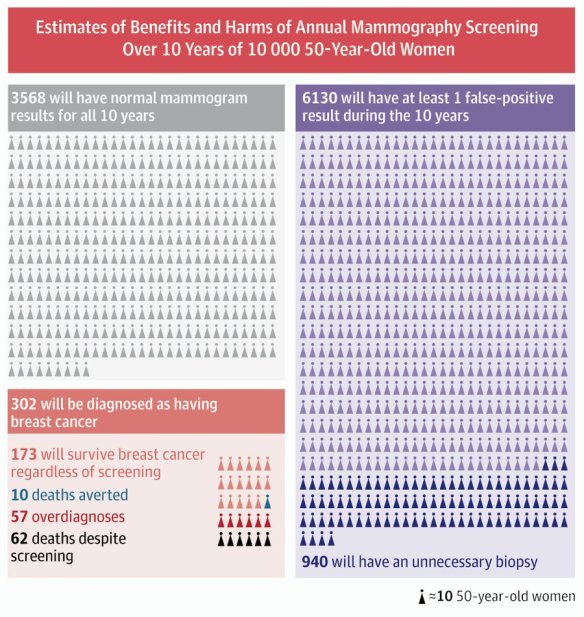
  4. Mammogram (breast cancer): It’s hard to walk back from more screening to less; people fear loss of security. When I started my training over 20 years ago, the recommendation was to screen every woman every year, starting at age 40.  Since then epidemiologists have kept track, and similar to prostate cancer screening, the mortality rate from breast cancer has not decreased proportionally to the amount of screening done.  Diagnosis has increased dramatically, due to early detection.  Again, screening increases the risk of certain harms:  anxiety (so much, for so many), pain, deformity, infection (from invasive biopsies), and then commitment to repeated testing (a vicious potential cycle of imaging, needling, more imaging, and more needling), while likely not saving your life.  Here is the USPSTF guideline, and a helpful infographic .  Like prostate cancer screening, this is one you have to decide for yourself, with the help of your doctor.mammo-infographic
  5. Pap smear (cervical cancer): Again, former guidelines called for annual screening. Today, if your test is repeatedly normal and your sex habits are low risk, the interval can be lengthened to 3 to 5 years, and can start later in life (over 21).  Cervical cancer is highly correlated to exposure to human papilloma virus, or HPV, which is sexually transmitted.  Positive pap results, which range from mild to severe, occur far more often in younger women, and of those, many will revert to normal without progression to cancer in a woman’s lifetime.  The main risk of over-screening, again, is unnecessary procedures when true disease not present.

In summary, these are the most common conversations I have with patients about screening.  You may rightly infer that my personal bias is minimalist:  Primum non nocere.  Unfortunately, we have no good screening tests for some diseases, such as pancreatic cancer, ovarian cancer, and liver cancer, and the screening guidelines in other countries (eg Taiwan screens adults regularly for liver cancer) do not apply here because prevalence rates differ so widely.

This is why I think it’s important to establish care with a primary care physician and get regular check-ups.  That fatigue you feel is likely just life and chronic sleep deprivation.  You’re probably constipated because you eat too few stems/stalks/leaves and don’t move enough.  You and your doctor can review your general health together, and if there is suspicion for some underlying health risk, it can be addressed personally and specifically.

To look up USPSTF guidelines yourself, I recommend searching Google for “USPSTF (disease) guidelines” and look for the hit that starts with “Final Recommendation Statement…”  I have no financial or professional interests in Google or the USPSTF.  Other respected sources for screening recommendations include the National Cancer Institute, the American Cancer Society, and the American Medical Association.  As an internist, I recommend the American College of Physicians.

I hope this piece has helped illuminate the complex decision-making behind screening and diagnostic testing.  I have only scratched the surface; the links contain the data and full rationale.  Please take the time to read through them and discuss them with your doctor.