30 Days of Snail Mail and Reflections on Writing

Paper Source, Instagram

Friends, this is going to be FUN.

It’s National Card and Letter Writing Month! Apparently the United States Postal Service invented it back in 2001, expanding their annual celebration of handwritten greetings sent from a distance from one week to an entire month. And I am HERE FOR IT!

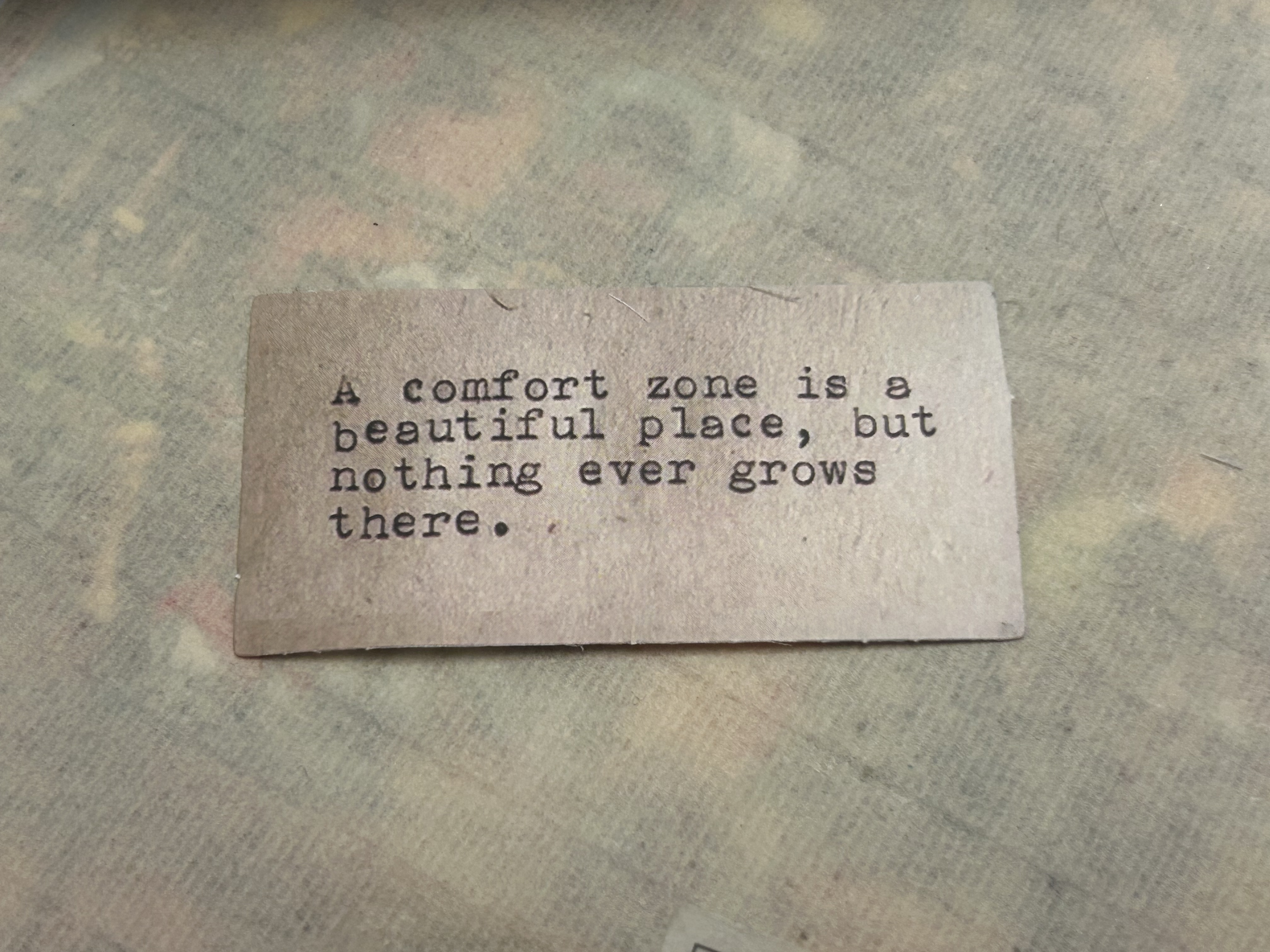
My favorite stationery and craft store, Paper Source, posted 30 pen pal prompts on their Instagram last week and inspiration has flowed freely since. I pulled out a small stack of washi tape cards from their storage and mentally prepared the recipient list. The first two cards are in the post to Son and Daughter, which I thought was a nice way to kick off this month of handwritten notes. So grateful for these two amazing humans in my life.

Then it occurred to me to invite friends to request notes! I’ve received two so far, and will continue to solicit all month. Meanwhile, the crafting bug bit me this weekend and after a great HIIT workout at Ethos yesterday morning I’ve basically been sitting, cutting, taping, stickering, and writing for two days (and listening to Of Prophecies and Pomegranates by TC Kraven–highly recommend!).

Front section from c.2022, back two sections made this weekend
My Audible review for Of Prophecies and Pomegranates by TC Kraven

It reminds me of the year I wrote one thank you note a day for 365 days–turns out I blogged about that, and my washi tape card making was already well underway by then, 2019. Huh. We are who we are, I guess.

I realized recently that when the pandemic started, I had only been writing this blog for five years. It’s eleven years old this month. Looking back, it’s been both an intentional and unintentional (more unplanned for this duration) exercise in consistency and practice, a clear and strong What to my Why. This post marks 777 in the library, and I have no plans to stop anytime soon–148 drafts and infinite impromptu new posts await.

My morning pages practice stutters along. I carry that journal with me everywhere so I’m ready when new ideas strike. I write brain dumps, emotional processes, blog ideas, and any other words that occur to me in these A7 size books, and my stash of empty ones continues to grow–plenty of back up and capacity. I have now filled four pretty journals since March 2023 with writing and media I want to keep for posterity and inspiration. I traffic in words, people, and I fully embrace it!

I started another weekly writing project in January, which will eventually organize into Book. I will share more about that in time. Suffice it to say I have finally found it, after these eleven years, and it feels absolutely right. Every book idea before now has felt boring, formulaic, nebulous, or otherwise slog-like. With each outline or proposal attempt, “This could be great!” quickly devolved into “Ugh, I do not want to write that book.” But with continued weekly blogging, voracious reading/listening that has expanded from psychology to memoir to fiction, science fiction, romance and erotica, another decade of clinical practice, and now a newly empty nest, the essence of Book has finally emerged, and I am convinced it just needed to take this long. Big thanks to Grant Gosch, whose insightful and patient questions and reflections have helped me distill the myriad, disparate yet intersecting book ideas into this initial, unified project. I look forward to each writing session with curiosity, love, and excitement! In the end, whatever the project outcome, I will have had fun and connected to people in some meaningful way–another, bigger, What to my Why. When people read it, I wish for them to feel inspired, empowered, activated, and connected. I feel confident I can accomplish this, because that’s how I feel when I write it.

Ever since I learned about writing and mailing letters in second grade, I have relished written correspondence with disproportionate fervor. Even my clinical summaries for patients at the end of an executive physical feel like love letters–here are all of my wishes for your best health until we meet next year!

What is your relationship with snail mail, or just a handwritten note, card, or letter?
When and what was the last piece you received? Sent/given?
How did it feel?
To whom would you write today if you had a fun card, some nice stationery, or even just a Post-It and a few minutes?

There are so many ways we humans find connection, love, belonging, and peace. Giving and receiving personal, handwritten messages stands out to me as one of the most special. I hope you may enjoy more of it this month and beyond.

In Person, Face to Face, One on One: Crowns Lesson #3

“Openness to our minds changing is NOT weakness. It is the strength of intellectual humility.”

How do you come to really understand and know anyone, then overcome differences?

Many of my friendships have begun remotely–on Facebook, this blog, interest groups, even on the phone. But they do not solidify until we meet in person. It is the natural progression of relationship, to be in each other’s presence. The energy is profoundly different, the connection tangible and tactile.

Throughout the Crowns Trilogy, relationships develop and transform through repeated in person meetings, between lovers, adversaries, allies, strangers, and family members. Communication occurs through letters and messengers, posture and political actions, but it is the face to face encounters that challenge biases, build trust, and solidify alliances. Repeated rupture and repair in indispensible relationships, committed and restored in person through words, expressions, or acts, reminds us that there is no substitute modality for true connection.

Physical proximity is not enough. Connection requires emotional and psychological presence, the offering and acceptance of attention, and the mutual willingness to engage in good faith.

The main characters in Crowns overcome traumatic and tragic barriers to connect, and save their kingdoms, driven by two primary motives: Love and Peace. Why can’t we do the same? Norah, Mikhail, Alexander, and Soren engage one another and also themselves with intensity, ambivalence, and serious conflict. But they keep showing up, never abandoning their commitments to do the necessary bridging work for the people and causes that matter most to them. Consider how the following patterns apply to your encounters with people who disagree with you, politically or in any other domain. Can we practice these for the sake of love, peace, and saving ourselves from one another?

Multiple meetings. Important issues almost never resolve in one try. Anyone who leads knows this. The larger and more complex the organization or issue, the more iterative the solutions necessarily must be. Sustainable progress only occurs when participants practice transparency, honesty, and accountability. This requires vulnerability, courage, and a willingness to compromise over time. Sometimes meeting is unavoidable, such as in family or workplaces. We can choose to stonewall or refuse to engage in this case, but that is not an option for connection and conflict resolution. Concerted effort in repeated negatiation and exchange in good faith–diplomacy–is a life skill.

Cultivating connection. All of the above does not emerge immediately. We humans sense threat and danger acutely. It takes multiple meetings to prove safety and earn trust, during which commitments are honored and confidences kept. This is how relationships are built. I identify with Norah in Crowns because she is so often the one initiating and sustaining contact and engagement, and she almost never declines invitations offered by others. She exercises patience, persistence, and celebration of any progress, as do I.

Mutual respect. Over and again, Norha, Mikhail, Alexander, and Soren recognize and acknowledge their rivals’ strengths and merits. They and the supporting characters exercise objectivity in assessing one another’s achievements. When in the other’s domain, each learns and adheres to customs therein, even as they disagree with the beliefs behind them. There can be no peace or lasting conflict resolution without mutual respect.

Commitment to possibility despite heavy resistance. Countless times others tell Norah that peace is not possible, that war and death are inevitable, that people and systems cannot change. They cling to wariness and stubborn disbelief, rigid negative assumptions and prejudices as if they are immutable truths. But she holds possibility in front, with the primary assumption of and commitment to preserving shared humanity. Because of her advocacy and mediation, spanning the boundaries of belief and experience, the others eventually, begrudgingly, recognize and acknowledge the limitations of their prejudices and come around. Her idealism overcomes their cynicism and wins the day.

In the end everything has a cost.
Polarization, division, and mutual adversarial attempts to vanquish the opposition, at their worst, cost lives, whether through small violent confrontations or full on war. Social, operational, and economic costs also escalate, with lasting deleterious effects.

What does bridging work cost? For us regular people, it costs our comfort, for sure. It takes time, energy, and even resources to acquire and practice the skills. What would bridging work cost elected leaders, in addition? What if they all sat down in person, face to face, one on one, more often and earnestly?

What are the costs of not bridging our differences? I have heard too many stories of relationships torn apart by unresolved disagreements; the loss and grief are real and tragic. Openness in relationships also suffers, causing people to self-censor honest expression for the sake of ‘keeping the peace’–a fragile and hollow peace. These psychological and relational costs are exactly what fester and fray our social and personal fabric.

We all get to decide what benefits of bridging work are worth what costs to ourselves. I am convinced that in order to elect leaders who possess the skills and capacity to engage regularly, respectfully, and in good faith, we must be willing to do so ourselves, as citizens. It is now the era when we regular people must lead by example.

Because if not us, then who?

Rupture and Repair: Crowns Reflections Continued

Image by ededchechine on Freepik

Years ago I noticed a developing hole in my jeans, from the corner of my phone rubbing against the fabric in the pocket. I had no attachment to those jeans; I had just worn them for years so they were comfy, and they had a perfect place to put my little Nokia.
But as soon as I sewed the cute little flower patch onto the hole by my hip, they instantly became my favorite jeans. I loved them and kept them for years after I could not fit my hips into them anymore.

When we put effort into preserving, fixing, strengthening, and reinforcing something, it becomes more valuable to us, no? It could be old furniture, hand me down dresses, kintsugi pottery, or relationships. When we care about something, when it’s important to us, and when it’s irreplaceable, we repair it when it breaks. Which relationships in your life fit this description? Renowned relationship researchers John and Julie Gottman posit that repair after rupture makes us stronger together.

Looking back on nearly thirty years of marriage, now that the kids are out of the house, I think I see more clearly, and with new perspective, how much Hubs and I have really worked at this union. We are very different people who approach almost everything from polar opposite perspectives. I shake my head a little in amazement that we have lasted this long, honestly. But now I feel confident that we can last even longer, having basically grown up together. Each of us would not be who we are today if not for the other. And that’s pretty awesome because I really like who we are, individually and together.

***SPOILER ALERT*** If you have not read or listened to Nicola Tyche‘s Crowns trilogy, You may want to skip to the end here–after the Builders image.

As I think on the development and evolution of intricate relationship webs in this series, I marvel at the multiple, redundant, and quintessentially human conflicts between characters and their ultimate resolutions. As they persist and progress through the complex morass of emotions, uncertainty, and high stakes political intrigue, each main character grows in self-awareness, self-regulation, and effective communication. They learn about themselves and one another by observation, earnest reflection, and counsel from trusted confidants. Over years they feel out how to interpret one another’s words and actions. All of them speak impulsively and act out in times of distress. They get angry, fearful, and hurt; things rupture, sometimes severely. But bids for connection and repair occur consistently and more strongly than their divisions. Throughout the series, we witness and empathize with the characters’ ambivalence and resistance when duty trumps desire, loyalties compete, and circumstances force them to make heartbreakingly difficult choices. I could write a whole post for each of the relationship dyads below, they are all so lovingly and humanely written. But I challenge myself here to distill to one line each core relational essence. Every instance of repair and connection in this epic story elevates my oxytocin and serotonin; this must be why I return to it over and over, and why each listen lifts me just as much as every one before it.

Norah – Alexander: Tragically fated un-mates, redefining romantic to deep Agape love
Norah- Mikhail: Enemies to strategic allies to pair bonded souls in transcendent commitment
Norah-Soren: Slow, steady, and strong evolution of deep platonic love despite wildly divergent dispositions
Mikhail-Soren: Fierce love and loyalty tested to its limits and bonded ever more strongly for it
Alexander-Soren: Mortal enemies to honored brothers, by way of protecting Norah and mutual commitment to integrity, overcoming the greatest barrier to connection of the whole story
Norah-Catherine: Generational, political, and cultural discord overcome by loyalty and love
Alexander-Adrian: Fraternal love that mitigates friction and integrates the traditional with the progressive

All relationships experience rupture. Which ones do you repair consistently? How have these conflicts and resolutions evolved over time? When we consider losing these relationships, after all we have invested to maintain and uphold them, what would that loss mean for our individual and mutual wholeness? On the other hand, when unrepaired ruptures fester and cumulatively fray the weave of a relationship’s fabric, when that connection finally disintegrates, it’s a whole other experience, an entirely different sense of regret, no?
I don’t assign right/wrong or better/worse to either scenario.
I just wish for us all to see, feel, and communicate more clearly and intentionally in our most valuable relationships, so that love may always repair and overcome ruptures from anger, prejudice, fear, resentment, loneliness, and the like. Life is just better that way.