
Toxic Individualism and Service

At first I called it ‘abject individualism.’  Not sure which will be my final phrase—which will catch on?  Do you already know what I mean? 

It goes beyond selfishness, really.  It’s a culture, an ethos; it took root somewhere in early American history and has infiltrated the collective psyche with exponential acceleration in my lifetime.  This mindset values winning over service, status over integrity. “Eat What You Kill.” It is myopic, and it so permeates our daily interactions that we hardly even notice.  It steeps us in competition, scarcity thinking, and righteous anger.  Toxic individualism, while not the sole driver, contributes mightily to division, negative tribalism, and violence.

I won’t go into detail here, but I see it in so many realms: media, finance, environment, education, and healthcare, among others.  A cumulative movement in policy and deregulation that favors competition over collaboration, and removes incentives for long term resource renewal and sustainability in favor of short term gains, grips our culture.  It’s all about looking good and getting mine, to hell with everyone else.  Most of us probably don’t identify with this most of the time, but consider how we think and act under stress.  When we feel our own families threatened by circumstances like a pandemic knocking at our door, how did we instinctively respond?  Contract, protect, and suspect.

Of course, this is a natural survival response to threat.  I would never advocate for ridding ourselves of it.  And, when a culture’s balance between self-protection and group connection tips too far and too long toward the former, especially under collective stress, bad things happen.  Successful social living is always a give and take proposition.  In order for us all to be well, we all have to make sacrifices sometimes for the greater good, namely and often first and foremost, our comfort.

I will have facilitated two calls this week on ‘elevating our conversations.’  The central premise is that in order to communicate effectively across differences and disagreements, to problem solve in the face of divergent perspectives, we must tolerate more discomfort than our current cultural ethos often allows.  We must stand in openness, curiosity, humility, generosity, and fairness.  Too often today we are rewarded (instantly gratified) more for standing rather in defensiveness, stubbornness, righteousness, and ad hominem. 

This hyper-individualist attitude translates to the collective:  If you’re not with me (us) all the way, you’re with the enemy.  Dissent within a tribe is quickly suppressed and punished.  It’s us against them, black and white, right against wrong, no exceptions, no nuance, no discussion.

The antidote for this poison is service.  A service mentality puts the collective good at least on even footing with that of the individual, if not elevating it.  Service activities and professions center around giving, selflessness, and responsibility for others.  Teachers, healthcare workers, and military servicemen and women understand this intuitively.  We need one another—for us all to be healthy, we all need to look out for each other, thereby keeping each other healthy—for society, and thus all of its individuals, to truly thrive.

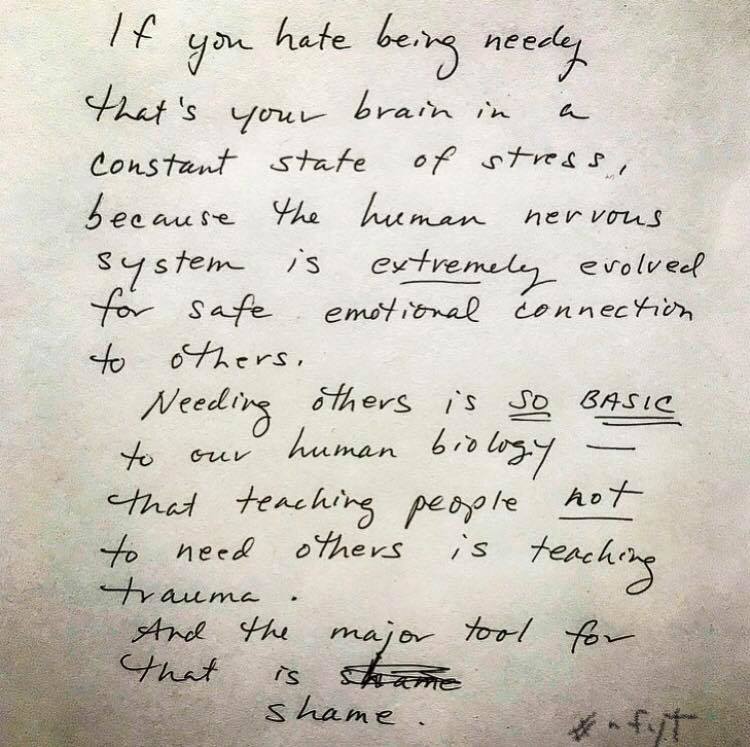
It’s not weak to need others.  Individual strength is necessary, important, and admirable.  So is interdependence, relational connection, and emotional cohesion.
https://www.allysondinneen.com/therapy-great-barrington

Simon Sinek interviews General Stanley McChrystal on his podcast on quiet service .  Their conversation resonates with me so deeply right now.  It’s not either self or group. It is always both and, in dynamic balance, holding tension for some competition, and also much collaboration, creativity, synergy, and progress.  See some highlights of the “A Bit of Optimism” episode below.

What are we each doing to keep the fabric of society from tearing? As we care for ourselves, how can we also care sincerely for others? How will our culture be better for our having lived?

3:34  Sinek suggests that the call to service has declined.  McChrystal:  “That sense of responsibility… has decreased… In some ways you say well, everybody’s their own person…  The problem is it’s hard to run a society like that… It’s hard to have those things which we do better jointly than we do individually.”

4:27  Sinek:  “There’s a paradox to being human…every day we are both individuals but we’re also members of groups, and we have responsibilities to both…  We’re all trying to learn how to take care of ourselves, but where are we learning how to take care of each other?”

5:40  On civilian national service for young Americans, McChrystal:  “You can plant a seed through behavior, getting them to do something for a year… They won’t like it every day, but they’ll come out of it differently,… more thoughtful…  Healthcare, education, the environment… there is so much room for people to give…  and they come out differently themselves—they are the real product.”

7:40  Sinek, on the race to get mine or else someone else will get it, referencing Naval commander David Marqet:  “Force a change in behavior, then people change what they’re thinking,” rather than the othe way around.  McChrystal responds with the example of someone running for public office, asked how they have served.  Sinek:  We should ask of polilticians, do they serve us or do they serve themselves?

11:30  On the push for equality, McChrystal:  “Every young person… should have a roughly equal opportunity in life, should be our goal, shouldn’t be able to argue against that… (13:00) for example healthcare—every American (should have) healthcare not because it’s fair but because it’s smart for society…”

15:35  Sinek:  “How the heck are we going to inspire people to want to do something that comes at personal sacrifice?”  McChrystal:  “I think people want to be inspired… they’re just…waiting to be asked.”

24:33  Sinek on quiet service, humility:  “A lot of the stories you tell are about quiet, and about being humble…  Maybe the lack of service is a symptom that we’ve lost our humility, as individuals, as a nation…”

Revel in the Awesomeness

What’s really awesome for you lately?

I had such an endearing conversation with a friend this week.  A new empty nester, he reflected on this new perspective.  Having spent so much time and energy focused joyfully and lovingly on his children the last couple of decades, he now has some of that time and energy ‘back’, to do with what he chooses.  And it seems he chooses in part to appreciate the awesomeness of his life a bit more.  Fabulous marriage, meaningful and fulfilling careers for both him and his wife, a chance to make a positive difference in the world around him, and happy, healthy kids.  Yay! 

I absolutely love hearing people revel in awesomeness, don’t you?  Is it not totally inspiring?  When was the last time you looked around and truly appreciated the goodness all around you?  It’s a vulnerable act, if we’re honest.  Too often it feels like tempting fate, ‘jinxing it’, to call out all that is going so well, so right.  So we keep joy at bay, we keep striving, always looking for how it could all be better.  Huh.

What happens when we allow awesomeness to envelope us, penetrate us, move us? 

I think the first thing we get is a deep sense of wonder.  How could it be so good?  How is it even possible?  And it doesn’t even have to be anything big.  I have a cold—fever, congestion, headache, fatigue, body aches, mental fog.  And yet I can hydrate, medicate, and slow down, and still work (not in person!) and take care of the family.  The parameters for normal operation in the human body are remarkably narrow.  And yet multiple systems can be widely deranged, and we not only survive, we function at about 90% or better for the most part.  What an amazingly evolved machine, with perfectly orchestrated and automatically, effortlessly effective redundancies!  HOW AWESOME!? 

For me, from wonder grows gratitude.  Some people can’t actually tolerate a cold so well, but I can.  Some people don’t have access to excellent healthcare, but I do.  Some people don’t have the marriage, career, and kids that my friend and I have—but we do.  And we are grateful.  We don’t have to feel shame or guilt for having it ‘better’ than anyone else.  Everybody has their challenges in life, us included.  And still, counting our blessings is a great way to get perspective in any time, hard or easy.

Gratitude, then, is the fountain from which generosity springs.  I wrote about this in 2015:

When I feel grateful, there is enough. I am enough. Even just saying the word, seeing it on the screen, brings me to a more peaceful state of mind and body. It brings to mind the people in my life—my parents, husband, children, friends, colleagues. I recall instances when someone went above and beyond to help me, or when they thought of me and took to the time to call or write. I feel humble. I feel connected.  I want to share what I have with others.

When we truly revel in awesomeness, then allow wonder to infiltrate our psyche, then bask luxuriously in deep gratitude, how can we help but wish for everybody to have what we have, to feel what we feel?  If I can have all this, when life is this abundant, how can I help but share?

Finally, I believe reveling in awesomeness is the seedbed for my activist heart.  I have much and I strive to share freely.  I wish for everybody with much to share with those who have much less.  I wish for our culture and society to make it easier, through policy, for all to have more than enough, for that to be the default.  These days I have cynicism-optimism whiplash at ever higher speed and intensity.  I see so much self-absorption, biting competition, and scarcity thinking.  Sometimes I just want to shake people and yell, “Look UP!  We have so much potential for good here, if we only choose to see it!”  But I realize folks don’t always appreciate this approach.  So for now I can simply revel out loud for myself, in all the awesomeness I experience every day.  And like my friend did, I can share the light I see—emanate it—and I can keep making a difference starting from there.

Excavating the Dark Side of the Shitpile

Who’s ready to get off this roller coaster?

Bazinga, no dice!  We are strapped in like fat toddlers to professionally installed car seats and this hellish ride ain’t stopping anytime soon. 

What am I talking about?  COVID?  Racial injustice?  The economy?  Politics?  Riots and looting?  Wildfires?  Square dancing hurricanes?  Climate change?  Well, all of it, of course.  We are in it, my friends.  Oh. Yeah.

*sigh*

As always, my friend Donna enlightens me and I feel better.  In our recent conversation I recalled her assertion a decade ago that humanity pushes toward ever increasing consciousness and enlightenment.  Right after the 2016 election I may have laughed out loud (or cried) at this idea.  But today I take a different perspective.  How can I say this in the middle of all the tumult and crisis?  Because tumult and crisis are exactly the evidence of impending breakthrough.  Anyone who has done any truly deep, inner work knows that enlightenment cannot come without a whole shit-ton of pain and suffering.  We also know that on the other, light side, when we get there, the effort was always worth it.  My “Sh*tpile” post may be only the second or third I ever wrote on this blog:

Everybody has one.  We inherit large parts of it from our parents, whose parents passed theirs down, etc.  Life experiences add mass and odor as we grow up.  It sits squarely in the middle of the house of our existence.  For the most part, we simply live our lives around it, walking past every day, careful not to knock any pieces off.  The surface gets dry and crusty; we grow accustomed to the smell.  No big deal.

Once in a while, something moves us to start digging, like that sudden urge to clean out the closet.  We quickly learn that sh*tpile insides stay fresh and painful, like unhealed wounds when scabs suddenly get torn off.  Our eyes water, our senses are overwhelmed, and we want to escape, and fast.  Maybe we avoid that room for a while, or we come back driving a tank to flatten the pile, to the destruction of other property.

Then last year I wrote about the poop flinging that happens when somebody else knocks off a piece of our shitpile, in “All Hail Your Dark Side”: 

What triggers you?

I don’t mean your pet peeves (please, stop using “there’s” when speaking about anything in the plural).  I mean what gets under your skin and affects you viscerally, really hijacks you?  I’m talking about the thing that escalates you so fast or intensely it’s like an out of body experience—you know you’re overreacting, you know it’s irrational, and yet all you can do is sit by and watch it unfold, powerless to control or direct it.

I submit that we are at this moment, collectively, neck deep in our triggered societal shitpile. I’m thinking mostly about systemic American racism, but I also include our profoundly political, ideological, and cultural polarization.  We’ got some serious reckoning to do, my peeps.  How the hell did we get here, and how the f*** do we get out?

“What if this is not the darkness of the tomb, but the darkness of the womb?”  Valarie Kaur asks.  What if this is exactly the Work we all need to do to reach that higher plane of human relationship?  What if we are all called to participate—fully, both feet, deep end—with only one another as life preservers?  Brené Brown calls it “Day 2,” the messy middle between realization and resolution, where the Reckoning, Rumbling, and Revolution happen.  It’s the second act in Joseph Cambell’s hero story arc, after the hero has tried every way of avoiding, denying, deflecting, and averting the task, and finally resigns, and rises, to meet it.  The gripping, tense, thrilling part of any story is this messy middle, the part we dread and relish at the same time.

In the Shitpile post I assert that we can use our life manure to cultivate a life garden that brings joy, fulfillment, and peace.  I use the metaphor of wise gardeners and tools that we can recruit to make the Work easier and more meaningful.  The pile is deep, pungent, and squishy in that way that creates a vacuum, sucking you further in every time you move, apparently impossible to escape.  But we can do it.  Look for help from people who already wield the most effective implements—Curiosity, Humility, Respect, Openness, Non-judgment, Kindness, Empathy, Self-Awareness, and Self-Control.

I present below my hardware store of other tools, accumulated to date, that help me relish ‘way more than dread.  They inform, educate, challenge, and stimulate me.  Along with my pit crew, these resources and practices give me the vital energy and strength, and really the joy, to pursue the hard conversations, to engage ‘the opposition,’ and to make a God. Damn. Difference.  I hope at least some of it resonates with you.  What else would you add to the store?

The Books

Talking to Strangers by Malcolm Gladwell

Four Days to Change by Micheal Welp

How to Be and Antiracist by Ibram X. Kendi (still getting through this one—it’s the esoteric lecture)

Me and White Supremacy by Layla F. Saad (will revisit this one—it’s the life workbook)

But I Don’t See You as Asian by Bruce Reyes-Chow

Caste by Isabel Wilkerson

The Websites/Groups/Resources

Braver Angels—depolarizing America, one conversation at a time

Uprooting Inequity –Ayo Magwood—American history scholar teaches history of racism in America online.  I’ve taken two of her classes and recommend them highly.

The Root—“The Blacker the Content the Sweeter the Truth”

The Dispatch—conservative news

All Sides—news from left, center, and right organized around topic/issue

David French, The French Press

Chris Ladd, Political Orphans, and formerly GOPLifer

The Concepts and Practices

Technical vs Adaptive Challenges and Change—Heifetz and Linsky

PEARLS:  Fostering connection in communication—a copyrighted framework from the Academy of Communication in HealthcarePartnership, Empathy, Acknowledgement, Respect, Legitimation, Support

Asking truly Open, Honest Questions—Parker Palmer, Center for Courage and Renewal

Cone in the Box:  Perspective taking—Judy Sorum Brown

Managing Polarities—Barry Johnson