Culture of Medicine, Part II

IMG_4481

NaBloPoMo 2018:  What I’m Learning

So, what did you think of how trainees described the Culture of Medicine?  If you’re in medicine, how much did you resonate?  If you’re not in medicine, how much were you surprised, or not?  How do you think this affects our relationships with you, our patients?

Do you wonder how we get through any given day?

I asked the group:  What are characteristics or traits of Culture of Wellness (COW) Leaders?  Once again, I present their responses here, in order of discussion.

  1. “They ask how people are doing.” They are proactive about it, opening the door, making it safe to talk honestly about how we really are doing.  They exhibit the ‘body language of listening.’  It’s still hard to talk about it, one student pointed out.  The best leaders explicitly carve out time to talk, to invite feedback.  It also matters what they do with the information once they get it—empathizing and acting on it if needed, rather than dismissing.
  2. Mentor. This is someone who knows you and whose role it is to help you ‘unconditionally,’ different from any of your evaluators—maybe an advisor.  It can be an informal relationship, maybe just someone you want to emulate.  Trainees agreed that it often happens organically, and they seek it actively.  One resident identified her program director as ‘absolutely a COW leader.’
  3. Walk the Talk. Examples: work/life balance/integration, acceptance of mistakes, admitting when you don’t know something.  NO DEFLECTING; OWN YOUR SHIT.  This one hit home with me—this is Integrity.  As Brené Brown says, integrity is “choosing what’s right instead of what’s fun, fast, or easy.  It is living your values rather than simply professing them.”

The next several descriptors emerged in a flurry.  The atmosphere in the room swelled with positive energy as one label after another of what we admire about our teachers and colleagues overtook the downtrodden mood just moments before:

  • Consistency
  • Proactivity
  • Openness
  • Empathy
  • Personally engaged
  • Curiosity
  • Caring
  • Kindness
  • Vulnerability—willing to share
  • Positivity—seeing mistakes as learning opportunities. Encouraging—“We’ got this!”
  • (Understand the importance of) Food: attending to physical needs
  • Humor—acknowledging the challenge and weight of the work and also holding it loosely
  • Validating
  • Appreciative
  • Grateful

The last one triggered a story.  One student rotated on an inpatient service.  Critically ill patients poured into the hospital; all work hour restrictions were necessarily violated.  Nerves were more than frayed, and people were at their worst.  He witnessed open hostility by senior residents toward interns, backstabbing, undermining.  The attending, present only minimally, was oblivious.  And, “They never said thank you.”  The student, who had planned to enter this field, considered switching.  It was that bad.  But somehow, he was able to get perspective and remind himself that this one bad experience did not represent the whole of this specialty.  It had been an unusually busy month at the end of a long, hard year.  Maybe the cumulative exposure to some of his COWL role model traits had rubbed off, and buoyed him when he stepped onto a leaky boat.

A senior student admitted that when she started medical school she had heard of burnout.  “I initially didn’t believe it could happen to me…  Then later I realized it can happen to anybody—it could absolutely be me, if I don’t take care of myself.”  I asked what that means, taking care of yourself?  They answered:

  • Sleep
  • Nutrition: “Any food your intern year; choices matter more when you’re PGY (post graduate year) 3!”
  • Outside interests
  • Finding a practice situation that fits: eg caring for the underserved, women’s health, hospital medicine, etc.
  • Find Your Tribe. The trainees did not use these words, but this is what I wrote in my notes—they expressed a need for belonging.
  • People at work: truly collegial relationships, especially across specialties
  • Confidants: safe people to share with, your emotional support network
  • Physician-Patient relationships: mutually vulnerable and open

I asked them what they needed to take care of themselves.

  1. Purpose
  2. Time—to be given by the system, and also to be responsible and efficient with themselves.
  3. Habits—established and also adaptible

Overall the discussion felt productive and successful in the end.  We had just mapped out the way(s) to Be The Change we seek in our profession.  Some of them took pictures of my notes (so Millennial), which made me feel gratifyingly connected.  I had tried to question more than lecture, to explore and facilitate more than ‘teach.’  I wanted each of them to own their own path to leading from any chair, now and forever.  I proposed that they could start the moment they walked out of the conference room door—no elevated status or title necessary.

This is why the calling still resounds compellingly, why our enthusiasm for the work persists resolutely, despite the hardships.  It’s Hope.  And at its foundation lies the bedrock of our best relationships—with ourselves, with one another, and with our patients.  On the march toward a true Culture of Wellness, real leaders go in front and set the example.  The rest of us learn by mimicking.  Thus we all have leadership potential and, dare I say, responsibility.  We are the system; we make the culture—each and every one of us makes a unique contribution.  Nothing we do is too small to matter.

Onward.

Culture of Medicine, Part I

12657_4331869529492_1472680046_n

NaBloPoMo 2018:  What I’m Learning

Recently I met with a group of medical trainees from different institutions, ranging from pre-med to senior resident.  The topic was leadership in medicine and culture.  My objective was to lead a discussion on how we see leadership, and to encourage physicians at all levels of training to see themselves as leaders, regardless of designated status.  I often invoke Benjamin Zander’s invitation to ‘lead from any chair.’

We started out discussing the current state of medical culture.  My summary of the labels, in the order we discussed them, follows here.  I strive to hold these observations with minimal judgment, and to practice radical acceptance.  This is simply the way things are, not good or bad, it just is.  That includes how we feel about it all, and that we want to change the parts we don’t like.  Tomorrow I will continue with Part II, characteristics of Culture of Wellness leaders.  For now I invite you, especially my friends in medicine and healthcare, to review the list dispassionately, objectively, from a distance.  See how it lands.  How do you feel reading this list?

  1. Intense
  2. High stakes—we hold people’s lives in our hands.
  3. Imbalanced. When asked to say more, this trainees explained, “It encourages a lack of balance—we are not supposed to mind the long hours.  Our priorities are skewed—we say patients first (but it feels like patients above all else, at any cost?).  There’s the paperwork, the burnout.  You can’t go home if the patient needs you (internal medicine), and in some fields there is no such thing as a shift.  It never ends. (surgery)”  These trainees felt no work-life balance.
  4. Resistant to change. It’s an attitude—“When I was your age…”  Anything different and new in terms of work hours, work load, etc. is deemed bad or inferior before it’s even considered.
  5. Hostile. Between staff members, between doctors and nurses, between doctors themselves, nurses themselves.  The trainees saw this as a key contributor to everybody’s burnout.
  6. Hierarchical—especially surgery (they pointed this out explicitly). For example, walking in the halls, there is an order in which people enter patient or operating rooms.  One student reported entering before her team, because she knew the patient, and making small talk.  Later, she reported, “the senior resident yelled at me, said to go in order, and do not talk to the patient.  In 2017.”  In the OR, when students cut sutures, they must always cut the attending’s suture first.  One medical student was admonished loudly in the OR for this.
  7. “You’re expected to know everything already, even though you’re supposed to be learning on the job.” Trainees agreed that they expect to have to prepare for each day at work.  But as trainees, they cannot always know how to prioritize information as they study in advance for what feels like daily examination.  And they are belittled and shamed for not reading their instructors’ minds and knowing exactly what the teacher is asking for (‘pimping’ the students, as it’s known).  “I never feel like enough.”

At this point you may suspect that I somehow planted the seeds of negativity in these trainees’ minds, goaded them on to blast our profession and everybody who had ever said something mean to them in the hospital.  I assure you I did not, and I marveled myself at how easily these labels flew onto the table.  I hurried to take notes.

Thankfully the vibe circled, as it often does.  One woman commented:

  1. “Family medicine seems actually anti-hierarchy.” Attendings, she observed, often defer to students, who usually know the patients the best, when discussing patient history and data.  Team members may all address one another by first names.  Another student piped in:
  2. Pediatrics is similar. Attendings cover for the team during signout, answering pages and signing orders—everybody pitches in.    On rounds students are allowed to be students—to make mistakes, to show gaps in knowledge.  And a resident pointed out:
  3. In anesthesia, team members take breaks, and she felt a sense of autonomy and support of residents—no shaming. “Maybe it’s the nature of the work,” she said, “it’s easier to tag team.”

Fascinating.  I was practically trembling with excitement—here were ten strangers, from different specialties and at various levels of training, men, women, people of diverse colors and cultures.  And we all had the same experience of our chosen profession, much of it negative.  Yet here we all were, committed and still excited to be doing this work—we all still hear the call.  Whatever keeps us going?  How do we get up every morning and come to work in this ‘toxic’ environment?

I’ll tell you tomorrow.

Less Phone, More BOOKS!

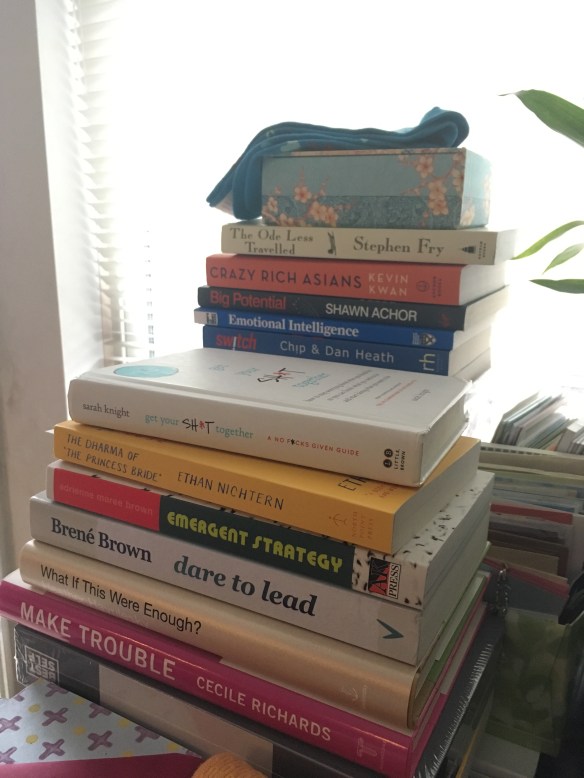
books 11-3-2018

NaBloPoMo 2018: What I’m Learning

Hi, I’m Cathy, and I’m addicted to my phone.

Last month I finally decided to do something about it, mostly so I could be more present to the kids.  It’s been a fascinating journey so far, and I’m proud to say I’ve already made progress.  First I banned Facebook after 6pm.  That went well until I traveled.  Then I took the Facebook app off of my phone.  The withdrawl continues to spike at times.  I also notice that I use other things to substitute—New York Times, email, Washington Post, email, WordPress Reader, email.  I notice an anxiety, a frustration, a kind of crazed, darting hankering– I crave that dopamine hit.

The awareness of it all, however, and the commitment to get disentangled from my screen, has cleared space for a recently dormant impulse to surface afresh:

READ!

* * *

At the conference last month I was turned on to the idea of complexity (or chaos) theory and how it relates to fixing physician burnout and turning our whole medical system around.  It was positively mind-blowing (for me—most others did not seem quite as lit).  The speaker was Anthony Suchman, my newest hero.  Some highlight ideas:

  • Every system is perfectly designed to get exactly the results it gets. Our current healthcare system evolved to this point precisely from serial and cumulative decisions made over years, even though the current state was never the intent.
  • We think of organizations as machines, with predictable, linear consequences of adjustments in one part or another. This is rarely how organizations (of people) actually work.  Rather, we can think of organizations as conversations, and let go our expectations of particular outcomes, the illusion of total control.  We can let things unfold and go where the outcomes lead us, all while holding to core values and goals.
  • Patterns are (re)created in each moment, and also self-organizing. So at the same time that a pattern (eg culture) seems inevitable and self-propagating, sometimes small, almost imperceptible perturbations can create new and dramatic cascades that lead to transformation (the butterfly effect).
  • Emergent Design thus embraces the approach of “finding answers we are willing to not know,” trusting that we will get where we need to go simply because we are paying attention (or that’s how I interpret it today).

This theory that everything within a system both results from and also contributes to the whole system (a fractal) validates an idea I have been advocating to my patients for years, and that I continue to personally relearn ad nauseam: It’s all connected.  The most concrete examples are Sleep, Exercise, Nutrition, Stress Management, and Relationships—I used to call them the 5 Realms of Health; now I call them the 5 Reciprocal Domains.  Each one is inextricably connected to every other one, and they all move in concert, with subtle or dramatic dynamics.

books 11-2-18

I browsed around my local bookstore a couple weeks ago and came across a colorful title on the shelf: Emergent Strategy by Adrienne Maree Brown.  So of course I snatched it up.  The blurb says:

Inspired by Octavia Butler’s explorations of our human relationship to change, Emergent Strategy is radical self-help, society-help, and planet-help designed to shape the futures we want to live.  Change is constant.  The world is in a continual state of flux.  It is a stream of ever-mutating, emergent patterns.  Rather than steel ourselves against such change, this book invites us to feel, map, assess, and learn from the swirling patterns around us in order to better understand and influence them as they happen.  This is a resolutely materialist “spirituality” based equally on science and science fiction, a visionary incantation to transform that which ultimately transforms us.

Holy cow, YAAAAS!!  I could not wait to read it!  So I bought it, along with Make Trouble by Cecile Richards, What If This Were Enough? By Heather Havrilesky, and The Dharma of “The Princess Bride” by Ethan Nichtern.  I had also ordered Leading Change in Healthcare, coauthored by Dr. Suchman and two others.  That copy arrived last week.

Suchman 1

I feel this as all part of a slow turn, getting off my phone and diving into books again.  I’m so excited.  I have done this before—buy a bunch of books and never read them.  They occupy whole shelves in my bedroom.  But I honestly feel a transformation coming on.  Yesterday I spent a couple hours reading, researching, and writing the blog post, then I turned off the computer and opened Brown’s book.  I read through the long introduction and resonated with sentences like, “Emergence is the way complex systems and patterns arise out of a multiplicity of relatively simple interactions.”  This is a quote from Complex Adaptive Leadership: Embracing Paradox and Uncertainty by Nick Obolensky (which I have also now ordered).  I also love (ha!), “Perhaps humans’ core function is love.  Love leads us to observe in a much deeper way than any other emotion.”  Also:

all that you touch

you change

all that you change

changes you

the only lasting truth

is change

god is change

That is a quote from Parable of the Sower by Octavia Butler.

Then before bed I opened Suchman et al’s book and found these words, also in the introduction:

Complexity theory here is enriched by the focus on relationships [Hallelujah!], rather than the more traditional reference to science.  “Relationship-Centered Care” is a way of thinking that brings love and all that is personal into a world, the world of healthcare, that is mostly interested in more control and more data-based, evidence-based practices.

The point is made throughout that administrators cannot bring real change into their healthcare institutions without going through change themselves.

(The book describes) the relationship-centered social dynamics that are at the heart of Lean and a major source of this method’s success.  Unfortunately, these social dynamics are overshadowed or even displaced by the analytic technique in some Lean implementations, compromising results.

Suchman 2

So I’m learning about new ways to think on change.   It’s changing how I approach trying to change my patterns, how I see my relationship to them, how I see all relationships.  Wow.

All of this to say, I feel a deeply personal, yet global and cosmic impulse for growth, for transformation—a shift into more mindful and intentional use of my time and energy, and how I manifest it outward.  Less distraction, more focus.  Less incidental information consumption, more integrated learning and coordinated application.  Less phone, more BOOKS.

What will be the outcome?  I have no idea, that’s what makes it so exciting and wonderful!  Onward!