Have you ever felt like you have no voice in your workplace, your community, or the world at large? When have you felt you do have a voice? What made the difference?
Two esteemed colleagues, Liz Lawrence and Eileen Barrett at the University of New Mexico, and I presented the above titled workshop at the International Conference on Physician Health on Friday. The objective was to give participants an opportunity to recognize and rally their strengths, claim their value and agency, and practice the words to advance an idea or project for improving physician health and well-being.
The idea for the workshop came from a conversation Eileen had with a young physician who felt he had no agency to improve his work situation, due to his junior status. This prompted her to ask, who has agency, and how do they get it? She concluded that agency is an active skill, not a passive state of being. Thus it can be learned/acquired, and everybody has/can have it. Furthermore, we apply it most effectively when we combine it with our strengths, in service of projects that are personally meaningful.
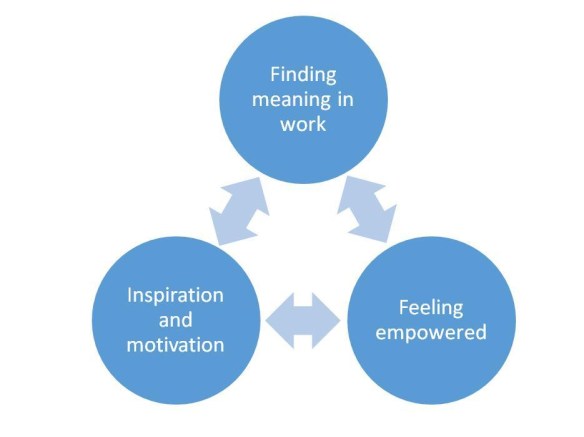
We presented the reciprocal triad of finding meaning in work, feeling empowered, and inspiration and motivation, as the foundation of agency and action.
Identifying Strengths
The first exercise had participants pair up and describe their strengths to each other.
What are your strengths? Imagine describing them to someone, out loud, in person. How does this feel? Our attendees reported feeling uncomfortable, not used to it. They also felt confident, connected, and encouraged speaking to someone they knew was listening supportively.
Defining the Project
Second, we asked participants to think for a few minutes about their own projects. It could be something they had been working on for a while, a new idea they recently came across, or something from a sample list we provided, related to Culture of Wellness or Efficiency of Practice. We asked:
- Is your idea “Big Enough to Matter, Small Enough to Win?” quoting Jonathan Kozol.
- Is it Specific, Measurable, Achievable, Relevant, and Time-bound (SMART)?
- How will your strengths apply?
- What else do you need? Who can help?
Partners met again to share and discuss each other’s ideas.
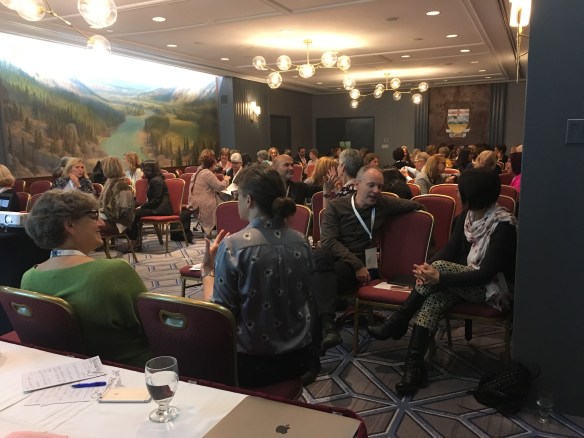
Afterward they reported elevated inspiration, excitement, and mutual support. Positive energy in the room rose palpably at this point, with lots of gesturing, smiling, and engagement.
Communication and Relationship
We didn’t call it an elevator pitch, but that’s basically what we asked attendees to attempt. In 90 seconds, each participant was to distill and express their idea into words that would convey its essence and enroll their partner in its goal. Having advanced to this segment of the workshop in less than twenty minutes, and now asking them to perform a pitch on the fly, I gave a pep talk (modified here to include some words I wish I had said):
“Now it’s time to PRACTICE. If we are to make progress in our projects, we must enroll other people. It’s all about relationships. Relationships kill us or save us, and they live and die by communication. A previous presenter said, ‘Language is the vehicle through which all interactions take place—both verbal and nonverbal.’
“You never know when or where you will meet your champion, or who it will be. The easier and better you can pull your idea out of your back pocket and present it cogently and impromptu, the higher your chances of success. Know your ask—be as clear as possible. Know your audience—what about your project is meaningful to them, what will they relate to? Make them the hero: Don’t come at them with demands. Come alongside them with open-ended questions; help them appreciate the power they have to help.
“You will have to be persistent. Practice will be key. Our keynote speaker, applying complexity theory to the work of physician well-being, invoked the image of a grain of sand dropping onto a pile. One grain may stick on impact and nothing happens to the pile. Another may cause a small section of sand to tumble just a little. Yet another grain can trigger the avalanche that alters the sand pile landscape entirely—and no one can predict which grain will be which. I posit that you are not a grain of sand. You hold an idea—a whole bag of sand—and each time you pitch it, you drop a grain (or a handful) on the pile. If one grain makes no immediate change, drop another one, and another, and another. This is the essence of the Growth Mindset—practice. Practice is Creation. Practice is Evolution. Practice is Progress. Your job now as speaker is to try with abandon. There is no such thing as a bad try. Pay attention to how it feels, where you get stuck, and where you shine. As the listener, your job is to make it safe for your partner to let go of fear and judgment, to lay it all out. Support, encourage, and critique with love. What moved you, what did you observe in words and body language that drew you in or put you off? What did you want more of?
“Make the most of this time. Dig in the bag and pull out a few grains to drop. Take advantage of your partner for feedback and support.”
The room was positively buzzing. And participants’ comments made our day (paraphrased here):
“Sticking with the same partner throughout was helpful; we could really connect each other’s strengths to our respective ideas and help each other develop them.”
“It was fascinating to see the energy change between talking informally about the idea and then having to present it as a pitch. She was so much smaller and hesitant the second time around.” (Partner): “The first time I was just talking to a colleague. The second time I pictured presenting to my board.” The experience was enlightening and curiosity-provoking.
“It’s different and easier talking to a supportive stranger, someone with whom you don’t already have relationship baggage.” How else, then, might we approach our stakeholders—how could we practice awareness of our assumptions and relationship dynamics, and perhaps modify them positively?
“Hearing someone else’s ideas informs my own. I like how he conveyed something, I saw how I could do the same; it gave me more insight.” Taking turns both presenting and listening engaged both people in mutual support and encouragement—both roles were helpful.
The Takeaways
Liz, Eileen and I have collaborated on physician wellness since 2015. We share meaning and mission around inspiring our colleagues to claim their value, recognize and stand both confidently and humbly in their power, and participate in a global movement of positive change. Our strengths and styles complement one another and the work flows naturally, synergistically. What a privilege and an honor it was to have this opportunity to present to and commune with our tribe members in physician health. May the processing and integration of all of our new learnings continue to sustain and connect us for the long road of work ahead. As Barack Obama says, “Change will not come if we wait for some other person or some other time. We are the ones we’ve been waiting for. We are the change we seek.”
Onward, my friends.