Curiosity, Humility, and Emotions

Temple of Aesculapius, Villa Borghese, Rome, Italy

Huh. It’s all a jumble tonight.

Another dense week of patient care and life in a chaotic geopolitical environment. *deep breath* All I can say is, thank God for my friends. Without fail, they hold me up every day. Our conversations lift me; our connections nourish me. The exchange of ideas, the positive reinforcement of kindness, generosity, and optimism–they make life worth living!

How often do you find yourself asking your friends and loved ones lately, “How are you?” Where do you put the emphasis? How are you? How are you? How are you? Context matters, right? Yesterday that remark, today this event, tomorrow that executive order, next week a reversal. This friend’s lab shutting down and that friend’s project halted because funding is suddenly gravely uncertain. Legal immigrants getting detained, POC history erased from public visibility (then reinstated and called a mistake). All kinds of emotions, all over the place, just under the surface if not fully emergent, effusing, and utterly hijacking.

I had an amazing call with Mande and Sharon tonight, my wonderful friends from Braver Angels. None of us actively lead Braver Angels workshops anymore, but we meet on FaceTime monthly to discuss and mutually support one another in living its principles. For ninety minutes we shared, questioned, reflected, admired, and wondered. By the end of the call my mind was so full of ideas for this post that I could barely wait to write. I quickly jotted it all down and now here I sit, befuddled at the scope of it all. Each idea could be its own post! I share the list of ideas below to document it for myself, and also to show how rich conversations can be if we approach them with a certain mindset.

Curiosity

If you haven’t already, I highly recommend reading Curious by Ian Leslie. I have consumed this book about three times and what struck me most the last time was the origin of curiosity: the desire to know more about something. Curiosity does not emerge from a vacuum; it originates from a germ of information or knowledge that we then wonder about–when we recognize a gap between what’s already known and not, and seek to fill it in.

Too often now, Blue and Red voters assume that they already know everything there is to know about the other side and everybody on it. I see and hear an utter dearth of curiosity on both sides, so many people speaking and writing in sweeping assumptions, narrow conclusions, and disparaging judgments all around. Honestly, how can you know everything there is to know about any person just by how they voted in one election? You may say you don’t need to know anything more; you feel justified judging them wholly and disparagingly just based on that one act. You are entitiled to this position, of course. I just think it’s one of the foundational mindsets that drives our most toxic divisions.

When was the last time you learned something about someone that surprised you, or that you simply did not previously know about them? When was the last time you wondered about someone and acted on that curiosity in a nonjudgmental, open, and connecting way? When did you last connect with someone meaningfully across difference, finding something in common that brought you closer as fellow humans? Imagine if these were all regular occurrences in your daily life–how wonderful would that be? I submit that this life is absolutely attainable–all we have to do is get just a little more curious than we are today, and express that curiosity openly and without prejudice.

Humility

When did you last honestly admit that you don’t know something? When someone offered new information or knowledge, how open were you to receiving it? How open are you in general to admitting what you don’t know, to entertaining new ideas, to holding space for your mind to be changed on any given topic, to acknowledging that you may be wrong? I will look harder this week now that I have posed the question, but I don’t notice a lot of humility in political discourse on either side. What do we not know? What assumptions do we make, and then draw incorrect and potentially harmful conclusions, based on ignorance and worse, the delusion of certainty? What would a more humble existence feel like?

Emotions

Friend Sharon is so wise. She practices attunement, emotional awareness, self-regulation, and effective communication. She queried her own reactions, responses, and needs in the chaos and determined that in order to connect across difference, we need to address our feelings. Not rocket science, and also profoundly uncomfortable and threatening for so many of us. Imagine gathering under the premise of politics, and conducting a discussion in which you don’t actually talk about policy, politicians, or political happenings. Rather, you talk about how it all makes you feel, how your values are involved, and what you believe. How would your expressions necessarily change in that kind of conversation? Leave your opinions, judgments, and arguments at the door, folks. Let’s talk and connect from the heart. Wow. Sign me up. Wanna join in?

Take a look at the idea list at the bottom of this post. What piques your curiosity? Leave a comment and I can write about it next week.

Meanwhile, here is my most current To Be Listened (to–TBL) book list and some resources that I found helpful or fascinating(ly frustrating) this week.

Wishing you all a week of curiosity, humility, and connecting emotion!

Possible, William Ury
Food For Thought, Alton Brown
Abundance, Ezra Klein and Derek Thompson
How to Change, Katy Milkman
The Certainty Trap, Ilana Redstone

Pete Buttigieg:
on DEI–watch here and here
his Substack
his book Trust–fast, easy, accessible, and important–a blueprint for healing our divisions, one interaction and relationship at a time.

A thoughtful and short piece from The Free Press: “I’m a Liberal at a ‘Conservative’ University. How Did I End Up Here?”

From The Guardian:
“The US has blocked Canadian access to a library straddling the Canada-US border, drawing criticism from a Quebec town where people have long enjoyed easy entry to the space.
“The Haskell Free Library and Opera House is located between Stanstead, Quebec, and Derby Line, Vermont. It was built deliberately to straddle the frontier between the two countries – a symbol of cooperation and friendship between Canada and the US.
The library’s entrance is on the Vermont side. Previously, Canadian visitors were able to enter using the sidewalk and entrance on the American side but were encouraged to bring documentation, according to the library’s website.
“Inside, a line of electrical tape demarcates the international boundary. About 60% of the building, including the books, is located in Canada. Upstairs, in the opera house, the audience sits in the US while the performers are in Canada.
“Under the new rules, Canadians will need to go through a formal border crossing before entering the library.”

Personal leadership
Known and unknown unknowns
Unknown to known is a huge step IF we are willing to take it
Openness
Relationship
DEI implementation methods, fairness, Buttigieg reel
Cis het white male allies
Historical romance as non-adversarial, powerful male-allied change agency
Lie in the bed we made of burn down the patriarchy, all men suck
Masculine and feminine energy in balance
What if we recorded our calls
How would we monitor and modify our words
Sharon’s workshop: feelings, values, and beliefs only. No judgments, no ad hominem, no politics. Connect across difference through shared humanity–harder than anyone anticipated
Vulnerability
Psychological safety
Woman doc bad exprience
Past adverse experiences that make us rigid, eg blood transfusion story
Stories we know nothing about that drive others’ thoughts feelings and behaviors
For International Women’s Day: From the Archive (Late Entry)

Hello from Rome, friends! Late to post this week as I traveled yesterday and could not get my act together to write this in advance–and it’s not even that much writing! Better late than never, though, right?

Saturday, March 8 was International Women’s Day. I saw so many messages on my social media feeds encouraging and uplifting women.

By far the most moving came from AJ, also known as @ajthisway on Instagram. AJ creates audio erotica on the Quinn app, among many other things, and will donate all of the proceeds from his audios this month to HeForShe, the United Nations Global Solidarity Movement for Gender Equality. Watch his reel explaining why this cause resonates with him and his fan community here.

It reminded me of a post I wrote referencing HeForShe, and when I looked back on the blog, it was almost ten years ago. Then I recalled other posts I have written about gender and allyship, and I thought this would be a great opportunity to gather a few in one place. I’ll list them here with some brief exerpts. I will continue to write about relationship in general, and maybe more on men and women in particular in the coming year. For now, please enjoy (or remember!) ideas that have appeared among the 680 posts on this blog to date.

How have your ideas, opinions, biases, words, and actions around gender and equity evolved in the last ten years? I have not spent time to really answer this question; maybe I’ll think about it this week on vacation, as I soak up Rome with Daughter. So much history, a fantastic city where our past, present, and future intersect! Onward, my friends!

He for She, We for Us, October 27, 2015
“As women, in our conscious minds, we know our worth and our contribution.  We know we have an equal right to our roles in civilization.  And, at this point in our collective human history, we feel the need to defend those roles, to fight for their visibility and validity.  More and more people now recognize that women need men to speak up for gender equality, that it’s not ‘just a women’s issue,’ but rather a human issue, and that all of us will live better, more wholly, when all of us are treated with equal respect and opportunity.  The UN’s He for She initiative embodies this ideal.
“We all matter, and we all have a unique role to play.  Nobody is more important than anyone else, and nobody can do it alone.
“We need to take turns leading and following. That is how a cooperative tribe works best.  It’s exhausting work, challenging social norms and moving a culture upward.  And we simply have to; it’s the right thing to do.”

Even the ‘Oppressor’ Deserves Safety and Support, July 6, 2020
“The more I think about it, the more I wish everybody had this kind of safety and support—this loving learning lab and community—to acquire scary new skills that, when practiced, benefit many more people than just us learners.
“I imagine this may be what participants in the White Men’s Caucus feel. Read all about it in Four Days to Change, which I started and finished in about three sittings… It provides a unique and profoundly important perspective on the true meaning of inclusion, that is, white men absolutely need to be included in leading and benefiting from systemic change for equity, not just passively doing the changing for others’ sake. During the Caucus retreat, white men are both challenged and supported to dig deep into their own privilege. Inescapable mirrors of truth and profound discomfort, and also of love and compassion, surround them for four days. They are expected to feel tremendous guilt and shame, both natural emotions that occur on the path of self-discovery and humility. But rather than weaponizing these feelings, facilitators love the attendees through them, shepherding them through the emotional (shit)storm to a place of self-compassion and forgiveness. This is where their outward humility, openness, and sincere advocacy for inclusion and diversity take root—because they experience it first hand from their teachers and peer learners. Leadership is hard enough, but leading initiatives in diversity, equity, and inclusion is a whole other dimension of complexity. How can we expect any leader, white male or otherwise (but white males especially), to do it well alone, without a core peer group willing to hold their feet to the fire with both love and conviction?”

White Male Allies, Please Do This, March 10, 2024
“So men: how are you helping?
“It’s more effective if you come alongside rather than come at. Berating, lecturing, or shaming fellow men to take a hard left from their stereotypes, implicit biases, and internalized misogyny hardly ever works. Rather, use your influence more quietly. Lead by example with your words and actions to the slow off-ramp of self-awareness, self-regulation and movement toward gender equality. Be gentle. Plant the seeds. Water, water, light, fertilize, water, light, water.. and eventually we can repot.
“Scale your influence by connecting with other exemplary leaders. Culture change occurs mostly from the top down, and CHCWMs [cis-het Christian white males] are the CEOs of American culture.”

The Complexity of Allyship, March 13, 2024
“Allyship carries cost. The first costs of thoughtful, intentional allyship are emotional and mental.
“The next costs are relational, and then reputational, financial, professional–myriad. The more visible we are, the greater the potential risks of taking a stand, staking a position. If we hold a designated or implicit leadership role in the community (and I would argue that we all/each lead in some way, know it, like it, want it or not), our choices and their potential consequences are that much more complex. For someone whose livelihood depends on maintaining relationships despite conflict, costs can be high in multiple ways. Choosing between one’s ethics and paying the bills never feels good, and we never know when someone may be in that situation. We must all decide for ourselves, in real time, the risks and costs we can bear. Not everyone stands in a position to decline work or dissent safely. Conscience and context often conflict. We each make our own decisions, and in the end, we must live with ourselves—our choices, our relationships, our regrets. Judging others for doing differently from us serves no useful purpose.”

Holding Allyship, November 17, 2024
–Hey, turns out I did a curation of my allyship posts recently! This post includes the posts above, and others:
“Google’s AI overview of the term:
Allyship is a social justice activism term that describes the actions taken by people in positions of privilege to support marginalized groups: 
Definition: Allyship is a lifelong process of building relationships with marginalized groups based on trust, consistency, and accountability. It’s an active practice of unlearning and re-evaluating one’s own privilege and working to operate in solidarity with marginalized groups. 

“I have written about allyship before, and I have another post drafting for later. Tonight I pull the existing catalogue together from 2016 to 2024, so I have it consolidated to reference hereafter. I imagine my own allyship posture and movements will evolve over time, as everything does. Looking back helps to frame where I came from and where I’ve been, and hopefully shows me where I still need to learn and improve.”

Self-Efficacy, Ethos Session 1

Ya kinda had to be there, my friends.

And it was all my friends who came to my first ever wellness presentation at Ethos today. For two easy and loving hours ten of us engaged in openness, curiosity, reflection, thought, and connection. After outlining the general themes and objectives of my past wellness presentations, General Manager Elena landed on ‘self-efficacy’ as the all-encompassing concept when we discussed our plans earlier this year. It felt immediately right. This was to be the first of four sessions throughout the year.

Self-efficacy: “an individual’s belief in their capacity to act in the ways necessary to reach specific goals.” (Bandura, 1977, 1986, 1997)

I have presented to academic surgeons on national stages and judges of the Federal Circuit Courts. Still, speaking to the Ethos community made me a little nervous. There would be fitness experts in the audience–what could I ‘teach’ them on the topic of exercise? This was a new and potentially very diverse group; one that did not necessarily know my credentials or professional expertise. My highest goal was for all of us to leave the session feeling inspired, empowered, connected, and thought-provoked. My intent was not to simply lecture or convey, rather to offer, invite, and receive in fluid exchange and mutual engagement. I had to give msyelf pep talks all week, calling forth my confidence in attuning, listening, asking good questions, reflecting, paraphrasing, as well as presenting.

What a real-time practice in self-efficacy, no? Walk the Talk, Chenger!

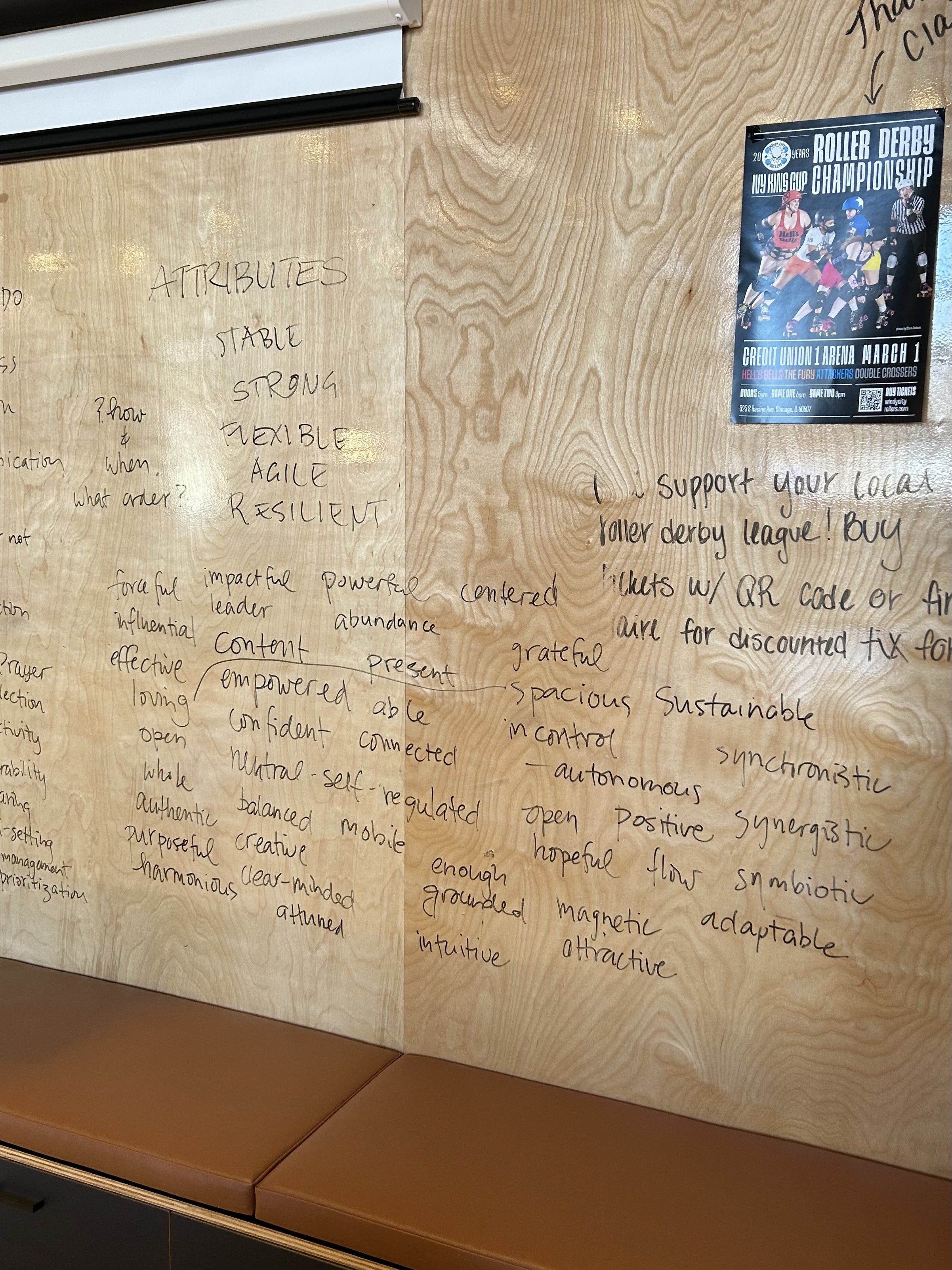
Dry erase before: “Of health and wellness: Domains, Practices, Attributes”

I planned today to introduce my ‘5-3-5’ framework of health: 5 domains, 3 core practices, and 5 atrributes. It’s a work in progress, which makes it a fun and high-potential foundation for discussion with any audience. After sharing our respective thoughts and experiences of self-efficacy, we explored how it applies in health and wellness.

“What are important domains of health?” I have written about ‘the five domains of health’–sleep, exercise, nutrition, stress management, and relationships–on patient action plans and this blog for many years. It’s relevant, reliable, and comprehensive for the purposes of an annual physical exam. But I wanted to learn from this audience how they see ‘domains of health’ in life as we live it. The brainstorm and discussion that ensued showed us all how layers of complexity and interconnected relationships at both individual and collective levels impact our experiences of both health and un-health.

Self-awareness, self-regulation, and effective communication: in my mind, these are the three core life practices that help us assess, adjust, and adapt to whatever life brings. The group’s suggestions of key health practices, we could argue, could all fit under one or more of the three. And it also emerged today that there may be a missing element of movement–that to be healthy we must not only attune inwardly, but act–we must both be and do–or not–there’s something here about intention and volition, about agency, I think. I invited. My friends offered. We noodled, played, exchanged, and documented. And now I have so much more to mush around with, to dig into and mine for treasures!

“When I am healthy, I feel…”

By now folks had caught on. I ask the open-ended question, record the responses, and when one of my own words comes up, I write it under the heading. Brother-in-law Kinnier compared the process to playing Family Feud and we all laughed. When I think of how I want us to feel in health–in body, mind, spirit, work, and relationship–these five words top my list today: Stable. Strong. Flexible. Agile. Resilient. The words my friends offered in this section represent sensations, emotions, and states of being, among other things. What words would you add? How besides words would you express/explain what it means to you to be healthy?

When I look at the ‘after’ state of the board (I did not take a picture of the whole due to glare, but I wish now that I had), I feel so gratified. I successfully offered my framework for health, developed organically and in collaboration with patients, colleagues, friends, and fellow life journeyers over decades of medical practice and living. We agreed at the end that next time we can include non-verbal expressions such as emojis, diagrams, symbols, and pictograms, to further deepen our exchange and discourse on these ideas.

*sigh*

The openness, curiosity, safety, warmth, connection, and love I felt today, friends. Ohmygoodness. I had to encourage myself in advance, reassure myself that I had what was needed to lead a discussion, to facilitate this opening, and invite and allow all of our wisdom to emerge and mingle. The energy in the Den vibrated today. It had a temperature, a depth. We all both contributed and benefited (I think), offered and received. The outcome felt elevated and synergistic–immensely greater than the sum of its individual parts.

This presentation series is part of my project to broaden my reach, to expand my contribution in health and wellness to more audiences, and to facilitate engagement, empowerment, and agency for individuals and organizations. Elena and I had orginally planned four quarterly sessions this year. Today’s session lasted thirty minutes longer than scheduled, and many of us wanted to keep the energy flowing, to continue the conversation sooner than three months from now, as we looked at the ‘after’ state of the board and saw so much possibility for future conversations!

YES. THIS. This is what I live for, my friends!

I write this summary so those who could not attend today might get a feel for what it was like. But I could only capture here a fraction of just my own experience. There is just something about a gathering, an intentional meeting when and where we choose to spend (give?) our time, energy, and resources together in service of lifting ourselves and one another.

There are simply not enough words to express my gratitude and appreciation for my friends who showed up today. Their unwavering presence and love made it safe for me to be BOOBS OUT, all me, all in, open and honest, curious and confident. We agreed today to all go home and let it sink in, to saturate in the connection, and see/feel what emerges that calls us to gather and commune around next time.

I. cannot. wait. Hope to see you there!