Barack Obama carries around charms in his pockets. People give him things when they meet him–little tokens, trinkets, you might say–offered with admiration and meaning, to feel connected. What would we expect a world leader to do with such bits and pieces? He keeps them in a bowl and every day picks a handful to tuck close, to remind him, he says, of why he does what he does. He writes about it in the memoir of his first term, A Promised Land, which I cannot recommend highly enough. What does it say about a man of such high status, who intentionally holds the well wishes of regular people on his person every day? I see it as profound humility and groundedness; I admire it and aspire to cultivate such qualities myself.
What talismans of love do you carry, visible and not?
My senior year of high school, after volleyball season ended, I started wearing one of my mom’s rings from her teen years. When it broke I replaced it with another gold band, another gift from a family member. When I started med school and had some money, I bought an intentional replacement, one with a bamboo motif, signifying my Chinese family roots. Now I also see it as a symbol of strength and flexibility, two practices I value highly, and which Ma exemplifies. I still wear my ‘one breath’ ring, and upgraded to a more solid yin-yang band. Like my wedding rings, these pieces stay on 24/7; if you find me down, you will still/already know some things about me.
When I travel, I wear a necklace with four pendants: Son’s and Daughter’s birthstones, and each of their passions. When Son left for college I got him a keychain admonishing, “Have Fun, Be Safe, Make Good Decisions, Call Your Mother.” He left it at home, but when I text him ‘HaFuBeSaMaGoDe’ he knows what I mean. It’s a shortcut. A reminder. A way to stay connected across time and distance.
Symbols. Representations. Expressions, signals. This is what matters to me, the talismans say. We feel seen when someone notices, acknowledges, and admires, reminded again of our choice to mark ourselves. The objects and signs communicate visually, tactilely, beyond what speech can convey. It’s almost visceral.
Comfort. Power. Hope. Agency. Meaningful objects remind us of our core values, direction, and purpose. We get to choose our symbols’ meaning. It may or may not matter whether/how others understand them; they are for ourselves and those with whom we bond over shared significance. We rub, clench, kiss, and hold them, often in the hardest, lowest times of our lives.
What if we try harder to notice and admire one another’s talismans? Get curious and ask the bearers to share their stories, and practice kind, reverent presence with it? How might that make things just a little better?
My dear friends, thank you for tolerating the continuous gushing about my romance immersion, 12 months now and still going strong! This post is about more than just the smut, I promise.
“Only my second MM romance. Captivating. So empathically and compassionately written, descriptions of the intrinsic experiences of mental illness, moral conflict, honest self-exploration and accountability open listeners’ minds and hearts to the depth of our fellow humans’ emotional, spiritual, and relational lives–with self as well as others. Sierra Simone‘s voluminous and passionate love of and attention to history shine so brightly, and her writing is both utterly sophisticated and completely relatable. Again, as in Sinner, social commentary is rendered gently, if clearly. This book could be read/heard and thoroughly enjoyed simply as sexy, contemporary romance. And with just a little more contemplation, its meaning and impact become so clearly and importantly much, much more. Jacob Morgan‘s and Sean Crisden‘s performances move and resonate. Morgan’s accents bring us to Belgium and France with vocal ease. The narrators’ expert acting proves that voice alone is enough to convey all we need to know and feel another’s experience.”
OK SO: Sierra Simone. O.M.G, a QUEEN of language and expression, holy cow! Of all the romance authors whose work I have now consumed (and there are so many more, I will not know them all in this lifetime), her voice stands out, rich and vibrant. “…utterly sophistocated and completely relatable”–maybe I aspire to be so, hence my zealous admiration–because while I cannot think of better words to decribe her work, I know she can.
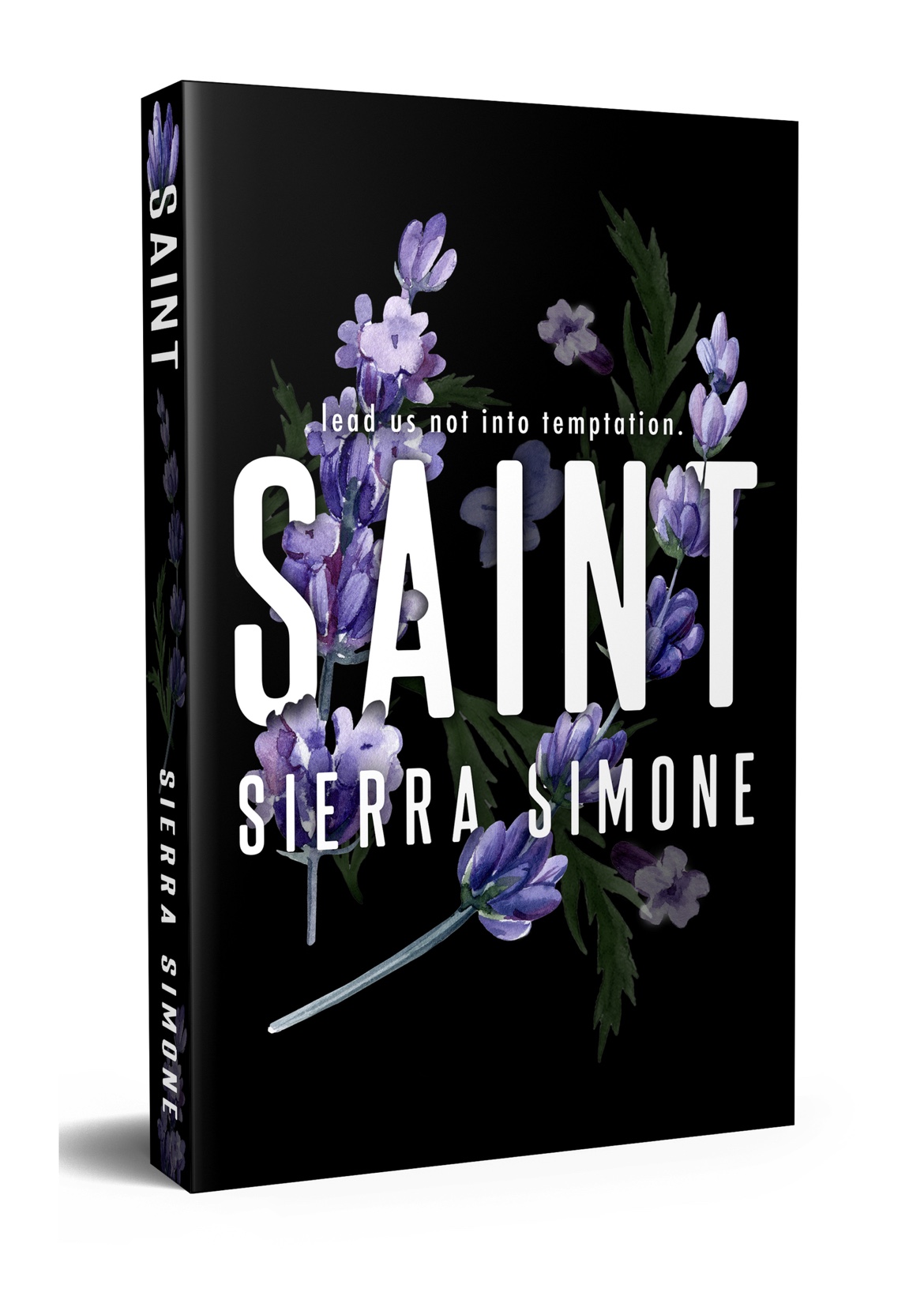
I have now listened to all three full length novels in the Priest Collection and I highly recommend them all. Jacob Morgan narrates with others, and his voice acting is simply superb, so honest and real. Inspired to listen by the Facebook Shaneiaks group live chat with Sierra and Shane East, once again I cannot thank this community enough for broadening my exposure, experience, and insights from fiction! Sierra is known for her explicitly erotic writing, and she describes in the chat how she came to commit, BOOBS OUT you might say, to writing spicy (‘ghost pepper’ level) romance for her own creative fulfillment. It so happens that doing this resonates deeply with readers and listeners everywhere–such a shining example of the far-reaching ripple benefits of open and audacious authenticity. I was moved to tears by Sinner and to deep thought by Saint, to the point of ordering the latter in print to annotate–only the second print romance I own so far.
The thoughts and feelings evoked by these stories almost escape verbalization. Journaling to untangle it all, I could only list the broad topics approached, addressed, probed, and articulated, individually and all intersecting: Racism. Religion. Spirituality. Grief. Blame. Conflict. Paradox. Love. Lust. Intimacy. Self-delusion. Fear. Shame. Communion. Self-love. Self-compassion. Honesty. Reconciliation. Peace. Commitment. Flexibility. AND. Reformation. Relationship, omg: Parental. Fraternal. Platonic. Romantic. Intimate. Carnal. Spiritual. Intellectual. Multidimensional. Eternal. It’s all an intense, existential jumble, yet conveyed wholly and elegantly in a couple hundred pages of writing, through only dialogue and narrative. Amazing.
The Catholic Church. Simone notes at the beginning of Priest: “I spent the majority of my life in the Catholic faith, and while I’m no longer Catholic, I still have the utmost affection and respect for the Catholic Church… That being said, this novel is about a Catholic priest falling in love. There is sex, more sex, and definitely some blasphemy. (The fun kind).” Her attitude toward the church is respectful, even reverent, as she clearly acknowledges its flaws and failures. Her criticism is loving, never disparaging or rude. How would our world be altered if more of us could take this approach to change and justice?
I think I liked Saint in particular because of the courageous and difficult journey Aiden takes toward integration–to know that he may carve a unique and unprecedented path to being wholly devoted to God without sacrificing any part of himself. I wanted so much for him to embrace that infinity loop of polarity navigation–self-acceptance and independence from dogma and wholehearted communal spiritual participation. Simone’s portayal of church leaders, always local and in personal relationship with the heroes, is so empathetic–they exemplify the ideal spiritual leaders and pastors–helping people through their personal conflicts and crises with love, compassion, humility, and non-judgment.
Characters on journeys to becoming their whole selves, loving each other in the process, helping each other self-actualize–is that what moves me? Isn’t that what heals? In the context of a social structure that has so much of its own paradox–such profound benefits of faith and community and also radically high risk for severe dysfunction, omg… Is there an institution other than religion, that harbors such gaping potential for both healing and harm?
Simone shows how to maintain a loving, open perspective, accepting both poles of the Church, by writing how three brothers in one family react to the same trauma (sister sexually assaulted by priest, later dying by suicide)… Her books do not generalize, dehumanize, demonize, or judge anyone or anything in broad strokes. She does not throw anyone or anything away, nor does she dismiss, excuse, minimize, or deflect. The novels don’t necessarily explore deeply–or I should say explicitly? They are not political or sociological commentary at their core. But through the characters’ struggles and stories, we get to consider myriad gray areas and dig, if we wish, patiently and lovingly, into deeper meaning, both collective and individual, shared and private. The characters’ relationships bridge diversity of race, gender, sexuality, and other aspects of humanity; their moments of epiphany, empathy, and connection emerge in gentle starkness, drawing readers/listeners into vicarious, second hand emotional education.
The ancillary characters all play important roles–obvious and blatant in message–necessarily. They remind me of my own role as physician: I get to observe you, my patient, and your life, as a third party. I am not in your life with you, for the most part. I get to stand and walk next to you when you come to me; I witness. I can know you, and you get to control (much of) that. I can only pry so much; you can choose to withhold. And I may still, if I pay attention, see you. Because our relationship is low-stakes and imbalanced (my role is only to survey and advise, much like the mentors, teachers, and pastors in these stories), I have the freedom to speak frankly, objectively, and lovingly… You may receive my advice more openly than from loved ones because of my credentials and the nature of our relationship. What a fascinating and meaningful privilege.
I wonder how people reject these stories–what do they object to, what are the emotions, triggers, rationalizations, and other factors? To me, these stories can be taken as lessons in honesty. Maybe that’s why I love them so much, because honesty is important to me, and barriers to honesty and self-relection can be formidable in the context of such strong, dogmatic social norms as in the Catholic Church, so heavily steeped in ritual, tradition, and institutionalization. Maybe I see these stories as exemplary works for culture change–fiction as vehicle for social movement–duh-HA! Does anyone expect that from romance? It’s unexpected and, I think, deliciously subversive. Such artful integration, BRAVA. More, please.
God bless Sierra Simone and authors everywhere and in all times, who make us think, feel, and connect, to be and do better.
Try as I might, I still have trouble approaching interactions with certain people feeling love first: Slow drivers. Fast drivers. Drivers who pass without signalling. Rude strangers. Abusive patients. People who repulse me and with whom I am bound in relationship of some kind. Loved ones on my hard days. Instead I feel annoyance and judgment–at them first, then at myself–and then guilt. *sigh*
Thankfully, it’s getting better. The intensity, duration and consequences of the negative emotions and interactions have all diminished over time, and sometimes I can actually avert them altogether. On a good day I ease up on the accelerator, leave more space between me and the car ahead, and utter no profanities–shocking. That’s usually after a good night’s sleep or a great workout, and it’s sunny outside. Somehow, driving has emerged as my barometer for this particular life skill, as if my average road rage quotient represents my overall life equanimity? How fascinating.
Maybe it’s because driving is such a mundane, steady state activity most of the time. How I show up in the car, on the road, is probably a pretty good indication of my real time state of mind. I’m essentially anonymous, and thus un-self-conscious, more ‘free’ to do as I am and as I feel, compared to at work or home where my actions have more tangible consequences on people I care about–that’s an interesting distinction. Because shouldn’t I care about everybody I meet? Don’t all of my fellow humans deserve the same baseline level of respect and dignity?
Why should I work to show up Love First (not a reference to the family intervention book and program) everywhere, with everyone? I think because it’s an easy idea to wrap my head and heart around. ‘Love’ encompasses so much, and the word itself resets me to be my best self. Love First immediately makes me more present, open, empathetic, curious, and most importantly, nonjudgmental. It hit me recently that when I don’t judge, I suffer a lot less. I can accept what’s happening, including how I feel about it, and approach my response more calmly. I am far more able to see multiple perspectives, allow for more than the most cynical explanations of others’ actions. Showing up Love First allows me to be my best self, and walk away from any interaction with the fewest regrets.
Love First allows my initial thoughts in the face of adversity to be open and honest questions, rather than ad hominem. I can de-escalate, defuse, and even disarm (figuratively) a situation or person far more easily in a loving state than in an adversarial one. It’s vulnerable, and not weak. Openness and love are my soft front–I present in possibility for understanding and connection. And I ground myself with confidence in my strong back–I know my boundaries and uphold them with firm conviction. When crossed, relationship either ends or requires renegotiation.
Here’s the best part: I’m able to show up more Love First to others now because I’m better at doing it for myself. When I blurt the driving expletive in the heat of the moment, I can simply say, “how fascinating”, make note of my mental/emotional/physical state, take a deep breath, and reset. I don’t have to judge my own recurring unwanted pattern. I can simply slow down, loosen my grip on the wheel, keep breathing, keep driving. Old habits take time to break, I’m making progress, and that’s what matters. It’s a win-win: compassion toward self translates to compassion toward others.
Next level: Consistent pre-emptive practice, mindshift in advance of interaction, groove Love First as the default rather than the correction. Mastery may take a lifetime, but I’m already well on my way to respectable proficiency. I’m okay with this. Onward.