November 6:  Caring For the Team Makes Me Better

IMG_2624

NaBloPoMo 2019

“How does he treat you?”

I don’t only ask this question of women whom I suspect of being abused at home.  I also ask my medical assistants.  Not about their domestic partners, but about our patients.

In my first practice, I sat/stood to the left of my medical assistant every day for six years.  It was a cozy (cramped) little counter space stacked with charts from end to end, with a couple of high-wheeley chairs.  Each chart stack had a laminated cover on top:  “For Cheng to Review/Sign,” “For Rose,” “Labs,” and “Messages.”  Charts journeyed from my left to my right/Rose’s left, to the bin under the counter to be filed.  It was incredibly efficient, actually.  I had a handwritten emoji system for indicating (dis)satisfaction with cholesterol and diabetes results.  Rose knew all of my patients and how to communicate sentiments and instructions clearly and lovingly.  She had been an MA since I was a kid; she knew what she was doing.  If a patient had a question on the phone, she could put them on hold and clarify with me, or I could just get on the phone and speak to the patient myself.  We were busy and happy, a well-oiled team-machine.

One day as I came up to my spot at the counter, I noticed an unusual sound next to me, like a distant, scratchy loudspeaker.  I turned and saw Rose holding the phone receiver about an inch from her ear.  The sound was my patient, yelling profanities at her so loudly I could hear his words from two feet away.  I can’t remember what the issue was, but he was obviously upset, and taking it out on her.  It surprised me because I had only known him to be sweet, respectful, and grateful.  Maybe he was just having a bad day?  I looked at Rose, who rolled her eyes and exhaled heavily.  I asked her to put him on hold so she could catch me up.  Apparently this had been going on longer than I knew, and she had not told me.  Had I not come upon it in real time, she may never have told me.  She would have simply tolerated it.

I picked up the call and declared myself.  He was the usual, respectful and calm patient I had always known.  I answered his medical questions.  Then I told him firmly that he did not have the right to treat anyone in my office the way he had just treated Rose.  I think there may have been some excuses and then an apology.  I made it clear that if he abused my team again, he would be discharged from the practice.  He agreed and apologized again.

That was my first opportunity to stand up for my team as an attending.  I will forever remember it.  I was a petite, young, Chinese woman doctor, speaking to a white man decades older than myself.  I stood up for my medical assistant, a woman of color and a couple decades older than me.  She had felt powerless to stand up for herself to his verbally vomitous abuse.  All I had to do was pick up the phone and say, “Mr. Soandso, this is Dr. Cheng.”  He never yelled at Rose or anyone in the office again, to my knowledge.  How could I have this much power, and why had nobody asked me to wield it in their defense before?  It was just accepted that patients could yell and scream at our staff, with no consequences?

IMG_2066

We recently discussed abusive patients during our regular doctors’ meeting at my current practice.  Immediately I thought, HELL NO.  The good news was that our team members feel safe reporting incidents to our managers and physicians.  My partners and I have all had to call patients to clarify our expectations of respect.  We understand that illness is stressful.  We understand that our healthcare system, especially at a large, bureaucratic institution, causes frustration, even rage.  However, none of that ever justifies or entitles a patient, or anyone, to belittle, dehumanize, or otherwise degrade another person, and especially not a team member who is doing their best to help–ever.  At this meeting, gratifyingly, we all voiced definitive confirmation that we fully support our team, and we will, without hesitation, educate and/or discharge any patient who violates our team’s right to a collegial and non-threatening work environment.

Even as I write this, I shake a little with rage and outrage at these patients’ behavior.  I can feel tightness and tension in my chest and abdomen, my breath quicker and shallower than its usual resting state.  I wonder if this triggers me because my mom is a nurse and I have seen how patients in the hospital abuse nurses.  I also know how women physicians are mistaken for nurses and thus ignored or dismissed, even by female patients.  I have known racism and sexism first hand.  But as a physician, I’m in a position to not have to tolerate it.  By virtue of two letters after my name, I have the power to protect my team, with authority.  And I work with other physicians who also recognize both this power and its attendant responsibility.

I hope our team feels protected, defended, and loved by us docs.  We may be the default work unit leaders, but they do the lion’s share of work that allows our practice to run as smoothly and successfully as it does.  They are who let me do my work as well as I do.  I depend on them every day.  So caring for them absolutely makes me better, makes us all better.


NaBloPoMo 2019:  What Makes Me Better

IMG_2639

My friends, it starts again woohoooooo!

National Blog Posting Month occurs every November, a 30 day daily blogging challenge apparently founded in 2006, inspired by National Novel Writing Month, or NaNoWriMo.  I think this will be my fourth attempt, and it gets easier and more fun every year!

This year’s theme originates from a sense of both gratitude and anticipation.  Increasingly I feel compelled to do more, contribute more, help more.  When I look around I am consistently humbled by those who go before me, on whose broad and strong shoulders I stand.  So I dedicate this month to all of you.

IMG_2646

November 1:  Role Play Makes Me Better.

I was converted to the Church of the Necessity of Role Play in 2003.  I had previously belonged to Tribe of Full-Socket Eye Roll at Role Play.  That year I had the privilege of attending a Stanford Faculty Development Program series.  It was a 7 week clinical teaching program for physicians.  Every week we practiced a specific teaching skill, on camera, then had to watch ourselves and critique our own and one another’s performance.  Even though each ‘encounter’ was only a few minutes, and we were all pretending, it felt real enough to translate into concrete behavior changes in real life—for all of us.

Since then I have always employed role play when teaching motivational interviewing (MI) to medical students.  At first I played the noncompliant or resistant patient, and had students take turns trying MI skils on me.  When I noticed myself feeling defensive and belittled in that role, I realized what the students were missing, and how it could enhance their empathy.  So I started having them take turns playing both patient and physician.  That was an epiphany for us all.  When I attended the Harvard Lifestyle Medicine Conference MI session in 2015, I experienced yet another layer of important experiential learning.  In dyads, we not only took turns playing patient and physician, but we practiced both directive and MI styles of counseling.  The contrast on both sides of each of those interactions solidified in both my cognitive and limbic brains why MI is a superior counseling method for behavior change.

This week at ICCH I innocently volunteered to play the physician in yet another role play.  Little did I know what I was in for.  I should have seen it coming, as the workshop title was “Teaching Medical Students How to Deal with Challenging Patient-Physician Encounters.”  I, unknowingly, stepped into a scenario of recurrent asthma exacerbation brought on by stress, due to domestic violence.  I felt anxious with a circle of international colleagues watching, and also confident that I could enter the play encounter the same as I aspire to enter a real one—present, open, grounded, kind, loving, and smart.  The physician teacher who played my patient stayed solidly in character and immediately drew me in with her slumped posture, dejected facial expression, and barely perceptible voice.  And she, like so many victims of violence, was not giving it up easily.

I had to conduct a medical interview as well as a psychological one, at times alternating between them.  I wanted to get at what I suspected (first generalized stress, and then clearly violence at home), but we had just met, and she really wanted to get out of the hospital.  Her fear was obvious; but she held its cause close to her chest, like the rest of her, until she could trust me.  I approached with general words at first, “Anything else going on lately?”  I kept my questioning as open ended as possible, and tried to leave space for her to answer.  Nothing.  Then I confessed my own inner dissonance:  “I feel like there’s something else…”  When that didn’t work, I continued with the general history.  No other chronic medical problems, no surgeries; allergies that can trigger her asthma, but no recent exposures.  You have 4 young kids, a full time job, a house to take care of.  Are you partnered?  Yes, married, to Bob.  Pause; a breath.  Then, “How does Bob treat you?”  Pause.  Why do you ask me that?  “I’m asking about abuse.”  And then it opened.  How did you know?  “I’ve been doing this a long time…  And someone close to me was abused.”  Do I look like her?  “You remind me of her.”

She was mortified that I would tell anyone.  How could I possibly help, then?  There were longer silences as I, frantic on the inside and slow breathing on the outside, racked my brain for solutions.  The harsh reality eventually settled on us both:  Neither of us could do much about her situation in that moment, her asthma attack was resolved, and the longer I kept her away from her family the worse I might make everything for her in the near term.  We agreed that I would look for ‘stress management’ resources, and I would give her my phone number.  And I would discharge her later that day, back to her violent husband, who had promised he would never hit her again.

It was so real.  I was almost able to forget about the audience.  I was personally invested in the health and well-being of this one person in front of me.  I imagined if she were a real patient.  Would I actually give her my phone number in this moment?  Absolutely I would.  We had to start somewhere, and I was the only person who knew, who could connect her to resources for help.

After it ended, I felt pretty drained.  We had both been tearful at times.  I also felt proud to have gotten through—both the exercise and to my patient.  I connected.  And even though I had no immediate solutions, I had established a relationship that had hope for helping a person who really needed it.

I have not encountered this scenario in real life in a while—that I know of.

I hope I’m not missing something, somewhere, for somebody who needs me.  Yikes.

Role play makes me better.  It reminds me to always beware my blind spots, to keep practicing, and to remember the deep humanity of every person I meet.

Tribe, Community, and Mission to Connect

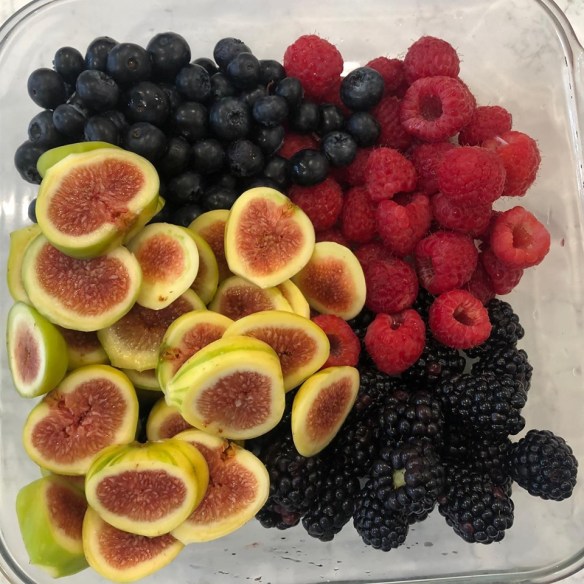
berries figs regina 9-2019

Fruit for Regina’s sweet galettes.  These are tiger figs, available at Trader Joe’s. 🙂

Friends, don’t you love those synthesis/cohesion moments when all of a sudden something important to you—a passion, a core value, a project—is validated from multiple angles?  That happened for me this weekend and I am positively giddy from it!

Tribe

My new group of medical students promises to be just as engaging and fun as every other I’ve had, yay!  They are only three rotations into their third year and already wise beyond their training.  This month we discussed tribalism.  They considered stereotypes, barriers to overcoming them, and how they might lead by example.  And they identified experiences in which such barriers are already breaking down.  “Finding your people” came up as both an aspirational as well as a potentially divisive ideal.  We discussed the benefits of ‘We’re Great!’ and the risks of ‘They Suck’ attitudes.  The conversation did not veer into political arenas, but it crossed my mind.  I tried to point out how the skills of professionalism we address in medical training apply well beyond the bedside and medical teams.  Our tribal memberships can save us and also keep us from living fully.  I’m so grateful to have these reminders on a regular basis.

Community

Some of you may notice I reference Ozan Varol increasingly this year (see coda below for why I think he’s so great).  I started following him in the winter after reading his post on why facts don’t change people’s minds.  This summer I joined his Inner Circle, a private forum of diverse and like-minded folks who subscribe to Ozan’s newsletter and wish to connect.  Yesterday Ozan generously hosted a conference call for three of us to get feedback on current projects.  At 2:00pm Central Daylight Time, I logged on from Chicago.  I met Ozan and his wife in Portland, OR.  J, a Canadian, called in from the Dominican Republic, where she has lived the past 24 years.  C, an organizational psychologist interested in humane-ness in the workplace, logged on from Germany.  And R, an education leader working on emotional intelligence workshops for schoolteachers, called in at 12:00am from India.  C, R, and I presented our projects and everybody gave generous, honest, and encouraging feedback to help us all do and be our best.  I could hardly contain my enthusiasm, gesticulating wildly and barely staying in the webcam frame sometimes.

I wrote to Ozan afterward:  “I’m still wrapping my brain around what you have done here–stimulated so many people to think more critically and also openly… Convened a community of us all and given us a forum to interact, at our own pace and in our own words, from around the world… and invited us to help one another, to contribute to lives that we would never otherwise touch…  What a privilege, a pleasure, and an absolutely ecstatic experience!!!”

Mission to Connect

I think it’s fair to say that part of Ozan’s mission is to connect people.  But not just for the sake of connection—to make us all more thoughtful, curious, and collaborative beings.  A man after my own heart!

Maybe my passion for such connection stems in part from my immigrant roots?  Today my daughter and I embarked on another food adventure at home:  Onigiri and chong you bing (but ours are much easier than the linked recipe!).  The former turned out to be less labor-intensive than I expected, so we made a bunch, both salmon and chicken versions.

onigiri chicken

Tonight’s teriyaki chicken onigiri selection

My Korean-American friend of 20 years, Regina, posted photos of her own culinary accomplishments today—savory and sweet galettes.  Mei and I may try those next!  Our ensuing text thread included my laments about the unhealthiness of onion pancakes (but oh, salt, fat, and starch—yummo!).  Her kind reply: “Making food together with your kids, carrying on food culture, bonding, it’s a win-win!!”  I knew I loved her for good reason.  And how lovely that we have stayed in touch all this time!  If not for that, I could never have recruited her to join my work team this year.  And holy cow, talk about a win-win!  Her kindness, generosity, curiosity, openness, and conscientiousness have elevated the team even higher than we could have dreamed—Thank you, Regina!  What a blessing our connection has been for so many.

My new German friend C is thinking of launching a blog to explore humane-ness and its effects and importance in the work environment.  She thinks maybe next year.  Yesterday Ozan and I both encouraged her to start now.  Asked whether I would follow, I said HELL YES.  Not only will writing about her topic develop her ideas and thesis faster; the interface with fellow readers and writers on a blog, the opportunity to join a community of thinkers, and the connection with folks from who knows where, doing who knows what amazing things, may very well yield untold treasures of relationship and development—as it has for me—so why wait?

Tonight my heart bursts with gratitude for membership in such thriving, complex, diverse and overlapping tribes.  I treasure the various communities that welcome me and give me a chance to contribute.  And my mission to make as many and meaningful connections as possible between all people stands validated and sustained once again.

Onward, my friends.  As Simon Sinek says, Together Is Better.


Ozan about

Why Ozan’s So Great:

  1. Humility.  So many bloggers and podcasters are so full of themselves.  It’s obnoxious.  They may have expertise and knowledge, maybe even wisdom.  But I cannot get past my aversion to their ego.  I have no such issue with Ozan. 🙂
  2. Goldilocks content.  The blogs are the perfect length!  Enough words to make his point eloquently, and not so many that I lose interest before the end.  He contacts subscribers at just the right frequency–weekly emails and biweekly podcasts.  And the newsletters are also the perfect blend of blog, quote, and other interesting material.  So many other authors inundate the inbox that I first ignore and then unsubscribe.  Ozan has really found the perfect touch.
  3. Resonance.  Though Ozan’s podcast topic is failure, what he really addresses is humanity in all of our complexity and fascinating ironies.  I LOVE that!  And he does it nonjudgmentally, always from the perspective of curiosity and learning.  I really respect that–the generosity of spirit and growth, exploratory mindset.
  4. Consistency and reliability.  Ozan is clearly disciplined and intentional when it comes to this work (and so I imagine he is also this way in life).  His podcast script has a reassuring cadence and authenticity to it.  When he says he’ll reply to all messages, he actually replies (that is what most impresses me about him–his responsiveness and how he makes me feel like I matter).  He says he will update us on something and then he does.  All in all a truly stand up and stand out guy among so many!