Less Phone, More BOOKS!

books 11-3-2018

NaBloPoMo 2018: What I’m Learning

Hi, I’m Cathy, and I’m addicted to my phone.

Last month I finally decided to do something about it, mostly so I could be more present to the kids.  It’s been a fascinating journey so far, and I’m proud to say I’ve already made progress.  First I banned Facebook after 6pm.  That went well until I traveled.  Then I took the Facebook app off of my phone.  The withdrawl continues to spike at times.  I also notice that I use other things to substitute—New York Times, email, Washington Post, email, WordPress Reader, email.  I notice an anxiety, a frustration, a kind of crazed, darting hankering– I crave that dopamine hit.

The awareness of it all, however, and the commitment to get disentangled from my screen, has cleared space for a recently dormant impulse to surface afresh:

READ!

* * *

At the conference last month I was turned on to the idea of complexity (or chaos) theory and how it relates to fixing physician burnout and turning our whole medical system around.  It was positively mind-blowing (for me—most others did not seem quite as lit).  The speaker was Anthony Suchman, my newest hero.  Some highlight ideas:

  • Every system is perfectly designed to get exactly the results it gets. Our current healthcare system evolved to this point precisely from serial and cumulative decisions made over years, even though the current state was never the intent.
  • We think of organizations as machines, with predictable, linear consequences of adjustments in one part or another. This is rarely how organizations (of people) actually work.  Rather, we can think of organizations as conversations, and let go our expectations of particular outcomes, the illusion of total control.  We can let things unfold and go where the outcomes lead us, all while holding to core values and goals.
  • Patterns are (re)created in each moment, and also self-organizing. So at the same time that a pattern (eg culture) seems inevitable and self-propagating, sometimes small, almost imperceptible perturbations can create new and dramatic cascades that lead to transformation (the butterfly effect).
  • Emergent Design thus embraces the approach of “finding answers we are willing to not know,” trusting that we will get where we need to go simply because we are paying attention (or that’s how I interpret it today).

This theory that everything within a system both results from and also contributes to the whole system (a fractal) validates an idea I have been advocating to my patients for years, and that I continue to personally relearn ad nauseam: It’s all connected.  The most concrete examples are Sleep, Exercise, Nutrition, Stress Management, and Relationships—I used to call them the 5 Realms of Health; now I call them the 5 Reciprocal Domains.  Each one is inextricably connected to every other one, and they all move in concert, with subtle or dramatic dynamics.

books 11-2-18

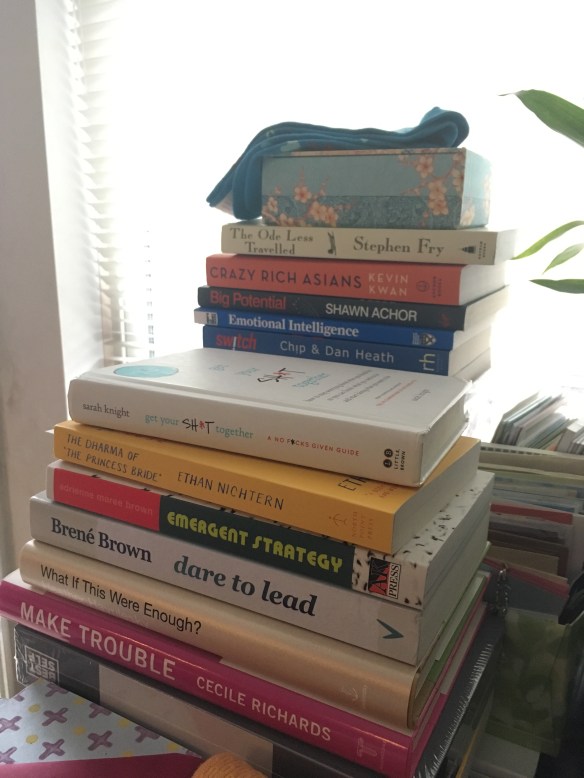
I browsed around my local bookstore a couple weeks ago and came across a colorful title on the shelf: Emergent Strategy by Adrienne Maree Brown.  So of course I snatched it up.  The blurb says:

Inspired by Octavia Butler’s explorations of our human relationship to change, Emergent Strategy is radical self-help, society-help, and planet-help designed to shape the futures we want to live.  Change is constant.  The world is in a continual state of flux.  It is a stream of ever-mutating, emergent patterns.  Rather than steel ourselves against such change, this book invites us to feel, map, assess, and learn from the swirling patterns around us in order to better understand and influence them as they happen.  This is a resolutely materialist “spirituality” based equally on science and science fiction, a visionary incantation to transform that which ultimately transforms us.

Holy cow, YAAAAS!!  I could not wait to read it!  So I bought it, along with Make Trouble by Cecile Richards, What If This Were Enough? By Heather Havrilesky, and The Dharma of “The Princess Bride” by Ethan Nichtern.  I had also ordered Leading Change in Healthcare, coauthored by Dr. Suchman and two others.  That copy arrived last week.

Suchman 1

I feel this as all part of a slow turn, getting off my phone and diving into books again.  I’m so excited.  I have done this before—buy a bunch of books and never read them.  They occupy whole shelves in my bedroom.  But I honestly feel a transformation coming on.  Yesterday I spent a couple hours reading, researching, and writing the blog post, then I turned off the computer and opened Brown’s book.  I read through the long introduction and resonated with sentences like, “Emergence is the way complex systems and patterns arise out of a multiplicity of relatively simple interactions.”  This is a quote from Complex Adaptive Leadership: Embracing Paradox and Uncertainty by Nick Obolensky (which I have also now ordered).  I also love (ha!), “Perhaps humans’ core function is love.  Love leads us to observe in a much deeper way than any other emotion.”  Also:

all that you touch

you change

all that you change

changes you

the only lasting truth

is change

god is change

That is a quote from Parable of the Sower by Octavia Butler.

Then before bed I opened Suchman et al’s book and found these words, also in the introduction:

Complexity theory here is enriched by the focus on relationships [Hallelujah!], rather than the more traditional reference to science.  “Relationship-Centered Care” is a way of thinking that brings love and all that is personal into a world, the world of healthcare, that is mostly interested in more control and more data-based, evidence-based practices.

The point is made throughout that administrators cannot bring real change into their healthcare institutions without going through change themselves.

(The book describes) the relationship-centered social dynamics that are at the heart of Lean and a major source of this method’s success.  Unfortunately, these social dynamics are overshadowed or even displaced by the analytic technique in some Lean implementations, compromising results.

Suchman 2

So I’m learning about new ways to think on change.   It’s changing how I approach trying to change my patterns, how I see my relationship to them, how I see all relationships.  Wow.

All of this to say, I feel a deeply personal, yet global and cosmic impulse for growth, for transformation—a shift into more mindful and intentional use of my time and energy, and how I manifest it outward.  Less distraction, more focus.  Less incidental information consumption, more integrated learning and coordinated application.  Less phone, more BOOKS.

What will be the outcome?  I have no idea, that’s what makes it so exciting and wonderful!  Onward!


How Not to Engage

DSC_0353

NaBloPoMo 2018: What I’m Learning

My friend Alex* posted about being a nurse and how she loves it despite having to always hold her pee, skip lunch, and get bled on, puked on, peed on, and yelled at, all while missing her family and taking care of yours.  One of her friends, we will call him Greg, commented that until nurses unionize and demand professional respect ‘just like physicians,’ nothing will change.

My impulsive (GRRR!) response:  “Trust me, physicians are struggling, too. I propose that we stand up for one another. Then we’d really be a strong force. And in the end it benefits us all–doctors, nurses, patients, the whole care team and, most importantly, patients. Also, I don’t know of any unions that physicians can join, but there are ones that nurses can: https://nurse.org/articles/pros-and-cons-nursing-unions/”  Okay, I know, saying, “Trust me,” is not a good way to get someone to trust or listen to you.  And my reply was defensive in its origin.  I sincerely believe what I wrote, though, that allied advocacy is an untapped force for good in medicine.  Physicians, patients, nurses, all healthcare professionals—why should we not actively support one another in all of our efforts to achieve a more cohesive, efficient, fair, and collaborative system, one that works better for all of us?  Why can we not embrace our connections and combine our voices to call for change?

Greg replied that basically he does not believe that physicians are “struggling,” and he does not see how we would stand up for one another.  After Alex described that I’m a physician “who will always help the nurses,” he wrote that doctors “can’t be in the business of supporting nurses.”  That we should “be in the business of supporting” ourselves, and “from all the research I’ve ever seen, they’ve continued to do a pretty good job of it.  Good for them.”  He expressed support for physicians’ right to advocate for ourselves.  In each reply, he continued to make his point that nurses should unionize.

I find this thread fascinating.  There are so many ways Greg and I could interpret each other’s replies.  When he talks about demanding respect ‘like physicians’ through unions, what benefits and outcomes does he imagine will follow?  When I say “struggling,” I wonder what he thinks I mean?  Actually he asks me, “How exactly are physicians struggling?”  He goes on to write, “Nurses are nurses and should be for nurses.”  All of his comments and the tone I inferred from them caused me to beg off of the thread.  Too bad, it might have been an interesting conversation—if we could have it in person.  Maybe we can later.

But it motivated me to look up some information to post here, in case anybody wonders ‘how physicians are struggling.’  The answer is burnout, depression, suicide, and leaving work that we love because it simply costs us too much—and I mean costs other than money.

Physician burnout is well described and referenced.

Doctors suffer from burnout in especially high numbers, according to the study, which was designed to offer a representative snapshot of doctors and the general U.S. working population. Nearly half of U.S. physicians – 49 percent – meet the definition for overall burnout, compared with 28 percent of other U.S. workers. More than 54 percent of doctors have at least one symptom of burnout, a more detailed analysis found.

Doctors also register more than one and a half times the general working public’s rates of emotional exhaustion and depersonalization. Working a median 50 hours per week, their satisfaction with work-life balance is far lower than that of others: 36 percent versus 61 percent.

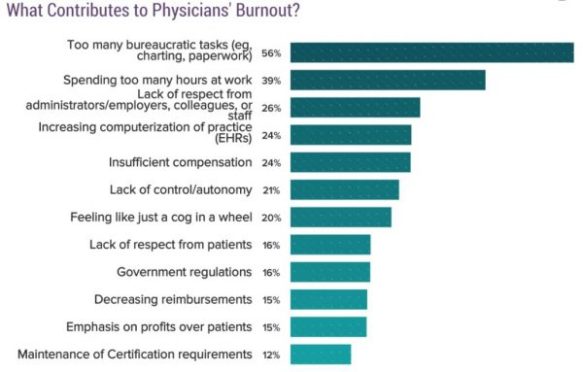
medscape burnout causes 2018

Medscape Survey 2018

There are myriad causes for physician burnout, and most of them lie in the system, not in our inherent lack of resilience or because of some intrinsic defect in our collective character.  The electronic health record has accelerated our dissatisfaction with work.  It does so by creating innumerable clicks to accomplish menial tasks, burdening us with data entry that detracts from actual medical decision making and patient care, and putting a physical barrier between us and our patients, further separating us in relationship.  Burned out and dissatisfied doctors are distracted, less empathetic, and aloof, and we may even make more mistakes.  And when we aren’t well, our patients aren’t well.

A 2015 Mayo Clinic study reported that roughly 40 percent of physicians suffer depression each year and almost 7 percent had considered suicide within the prior 12 months. It is estimated that 300 to 400 doctors take their lives every year.

The pain and suffering those statistics only hint at is bad enough. But they are compounded by findings that burnout corrodes the doctor-patient relationship, resulting in lower levels of patient satisfaction, job satisfaction and productivity, as well as higher levels of medical errors and disruptive behavior.

Burnout is also connected to the decision to switch jobs or leave medicine altogether — an ominous trend as the U.S. experiences a growing doctor shortage.


I have not addressed here the challenges that nurses face every day.  My mom is a nurse, and I have worked with nurses my whole career.  I see how they are treated by the system and by patients, and also by us physicians.  And yes, my extracurricular activities focus solely on advocating for physician health and well-being.  Maybe I should learn more about nurse burnout and job satisfaction, and figure out ways to advocate for my nursing friends and colleagues better.

Or maybe it’s too much to ask for groups to stick up for one another.  Maybe Greg is right, and it should be every tribe for itself, let others take care of their own.  Maybe it doesn’t do any good for people to know how and how much doctors “struggle.”  I don’t know.  But I have learned now not to instigate such debates on my friends’ pages on social media.

*Not her real name


Running Strong In Our Lane

photo 1

NaBloPoMo 2018:  What I’m Learning

So the NRA tweets, “Someone should tell self-important anti-gun doctors to stay in their lane. Half of the articles in Annals of Internal Medicine are pushing for gun control. Most upsetting, however, the medical community seems to have consulted NO ONE but themselves.”

Hmmm, self-important.  Yes, sometimes.  After four years of college, four years of medical school, up to seven years of residency and then another 3 years of fellowship to earn the privilege of operating on the spines, nerves, organs, and blood vessels of gunshot victims, to maybe give them a chance to stay alive much less walk and talk, I can tolerate a little (just a little) self-importance in my emergency medicine, neurosurgery, trauma surgery, critical care and other colleagues.  They are f*ing rock stars.

Anti-gun.  I have yet to meet any physician, or any person, really, who is wholly anti-gun.  We are pro-gun safety, anti-violence by guns.  We would like for toddlers to not kill their siblings and parents by accident.  We would like for domestic disputes to not escalate to someone shooting their family and then themselves in an impulsive fit of rage.  We would like for depressed and suicidal patients not to actually kill themselves, which is too much easier to do with a firearm than any other method.  We just want to stop being the only country where so many die every year from being shot by guns.

The American College of Physicians (ACP), the internal medicine professional society and my home for professional communion and development, and the largest medical specialty organization, has published an updated position paper on reducing firearm deaths in the US:

In 2015, 9 (the ACP) joined the American College of Surgeons, American College of Obstetricians and Gynecologists, American Public Health Association, American Psychiatric Association, American Academy of Family Physicians, American Academy of Pediatrics, American College of Emergency Physicians, and American Bar Association in a call to action to address gun violence as a public health threat, which was subsequently endorsed by 52 organizations that included clinician organizations, consumer organizations, organizations representing families of gun violence victims, research organizations, public health organizations, and other health advocacy organizations (2). Yet, firearm violence remains a problem—firearm-related mortality rates in the United States are still the highest among high-income countries (3).

Cited in their tweet, the NRA Institute for Legislative Action posted an article (no author identified) picking apart the ACP’s research citations and approach, stating, “This position paper leaves one wondering if the authors reviewed the evidence, or just found works that suited their needs. For all of the bluster about their own important role in the anti-gun movement and all of the misuse of research findings, the ACP makes one thing clear: they respect their own rights and opinions far more than they do those of law-abiding gun owners.”  *sigh*  As I have not read the primary literature on gun mortality and public health myself, I will not comment on that here.  I will just say that I wholeheartedly trust in the integrity of my colleagues and leaders at the ACP.  I’m proud of our advocacy for patients and, more recently, for physicians ourselves and our well-being.

My physician colleagues have posted a multitude of passionate responses on Twitter; you can read them here, here, and here.  And I just now saw this open letter to the NRA from the American Foundation for Firearm Injury Reduction in Medicine (AFFIRM) and signed it.  Below are highlights—please take a look.

I admit, I initially responded with profanity at seeing the NRA tweet.  My threshold for swearing is very low these days.  And I wanted to just post screenshots of the anti-NRA tweet storm and let them speak for me.  But that’s not me. I have yet to really decide how I want to design my public platform and conduct on issues like this.  For now, I can just say that tweets and articles like the NRA posted are disappointing.  I don’t want to follow that lead.

* * *

Dear National Rifle Association,

On Wednesday night (11/7/2018), in response to a position paper released by the American College of Physicians (ACP) Reducing Firearm Injuries and Death in the United States, your organization published the statement “Someone should tell self-important anti-gun doctors to stay in their lane.”

On that same day, the CDC published new data indicating that the death toll from gun violence in our nation continues to rise. As we read your demand for us doctors to stay in our lane, we awoke to learn of the 307th mass shooting in 2018 with another 12 innocent lives lost to an entirely preventable cause of death–gun violence.

Every medical professional practicing in the United States has seen enough gun violence firsthand to deeply understand the toll that this public health epidemic is taking on our children, families, and entire communities.

It is long past time for us to acknowledge the epidemic is real, devastating, and has root causes that can be addressed to assuage the damage. We must ALL come together to find meaningful solutions to this very American problem.

We, the undersigned – physicians, nurses, therapists, medical professionals, and other concerned community members – want to tell you that we are absolutely “in our lane” when we propose solutions to prevent death and disability from gun violence.

Our research efforts have been curtailed by your lobbying efforts to Congress. We ask that you join forces with us to find solutions. Help us in our non-partisan, physician-driven research efforts at AFFIRM Research.

We invite you to be part of the solution.

You dismissed the ACP’s position statement on preventing death and injury from gun violence by stating, “Most upsetting, however, the medical community seems to have consulted NO ONE but themselves.”

We extend our invitation for you to collaborate with us to find workable, effective strategies to diminish the death toll from suicide, homicide, domestic violence, and unintentional shootings for the thousands of Americans who will one day find themselves on the wrong side of a barrel of a gun.

We are not anti-gun. We are anti-bullet hole. Let’s work together.

Join us, or move over! This is our lane.