It Must Be True Because…

Spider web South Shore 8-23-14

NaBloPoMo 2018:  What I’m Learning

Funny how fear crops up sometimes.  It’s especially distressing when you fear your own ‘team.’  But we are here to learn and grow, so we step forward. My point in this post is to practice critical appraisal of research data before accepting or integrating it; especially if I am biased toward it.
BI fox news worse 2012

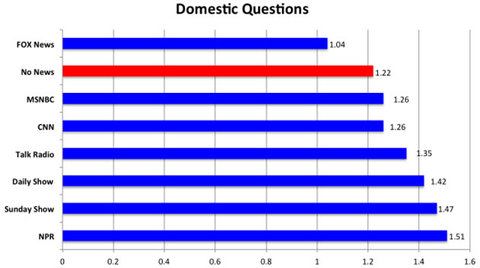
A fellow progressive Facebook group member posted this photo with a message of glee and encouraging everybody to disseminate.  I admit I also initially felt justified and righteous when I saw it.  But something kept me from sharing on my own page.  I should do this more often, perhaps—let something marinate for 24 hours before sharing, just to make sure it’s really something I want to engage with.  I ended up commenting that I think we should be careful about disseminating this kind of oversimplified graphic, as the data may not justify the claim.  I await the angry backlash.

After reading the article in Business Insider from whence the figure came, I had more questions than answers.  What are  Farleigh Dickinson University and Public Mind, anyway?  “Researchers asked 1,185 random nationwide respondents what news sources they had consumed in the past week and then asked them questions about events in the U.S. and abroad.”  What were the questions?  How were they chosen, and how do we know they represent broader knowledge of current events?  “With all else being equal, people who watched no news were expected to answer 1.28 [out of 5] correctly; those watching only Sunday morning shows figured at 1.52; those watching only ‘The Daily Show figured at 1.60; and those just listening to NPR were expected to correctly answer 1.97 [out of 4—why the ask one less for this?] international questions.”  Are these differences statistically significant?  And regardless, if the best we can do is answer less than 40% of domestic questions correctly, yikes.  How do we know this actually represents the population?  How does this data compare to similar research findings, maybe ones published in higher caliber, peer-reviewed journals?

The Business Insider article did link to the study report it referenced. I consider this to be a sign of responsible journalism—I look for it in the publications I read—access to the primary literature, so I can dissect and interpret ‘data’ for myself.  Turns out the study was a follow up in 2012 of an initial survey done in 2011 that reported similar findings.  The specific questions and statistical methods are included, as well as discussion of the results.  And while it’s not as rigorous as I am used to reading in peer-reviewed scientific journals, with sections for abstract, background, hypothesis, methods, results, discussion, and conclusion, I could follow the language and rationale of the authors, for the most part. I think they could have done a better job making a distinction between correlation and causation.  I also wished for a discussion addressing implications of the data and recommendations for further study.

Interestingly, I found a Forbes article entitled, “A Rigorous Scientific Look Into the ‘Fox News Effect.’”  I thought it was going to answer all of the questions I asked above.  It started out appropriately skeptical:

In 2012, a Fairleigh Dickinson University survey reported that Fox News viewers were less informed about current events than people who didn’t follow the news at all. The survey had asked current events questions like “Which party has the most seats in the House of Representatives?” and also asked what source of news people followed. The Fox viewers’ current events scores were in the basement. This finding was immediately trumpeted by the liberal media—by Fox, not so much—and has since become known as the Fox News effect. It conjures the image of Fox News as a black hole that sucks facts out of viewers’ heads.

I got excited when I read:

I have done similar surveys, both of current events and more general knowledge. In my research too, Fox News viewers scored the lowest of over 30 popular news sources (though Fox viewers did at least score better than those saying they didn’t follow the news). The chart’s horizontal black lines with tick marks indicate the margins of statistical error. Last Week Tonight with John Oliver, a news satire, had the best-informed viewers.

Turns out the rigor of this scientific look at the FDU data amounted to not much more than pointing out that correlation does not prove causation.  The author, William Poundstone, is a prolific non-fiction author and biographer of Carl Sagan, so I imagine he has formidable expertise parsing research data, though I don’t see any published research or surveys of his own.

In the end I’m satisfied, because I have done my homework on this topic.  I feel righteous again because, this time, I extricated myself from ‘liberal lemming’ (is that a thing? If not then I just coined it) mindset…  But it took some time.  And writing about it has cost me some psychic energy for organization and expression.

As I write this it occurs to me that it would be much more time efficient to just not believe anything I see or hear on any media platform—just be skeptical about everything and leave it at that.  Huh…  Nope.  That feels too much like willful blindness, which does not align with my core values.  It’s worth taking several minutes sometimes and disengagement, to verify the quality of what I take in on a daily basis.  I hereby commit to making this a regular practice.  I’ll let you know when I find anything really worthy of integration and dissemination.


The Hard Conversations

DSC_0694

NaBloPoMo 2018:  What I’m Learning

Life is about learning.  Learning requires acknowledging lack of skill, knowledge, understanding, or all three and more.  Boundaries, curiosity and non-judgment make it so much easier; too bad we tend to lose these natural traits (or they are trained out of us) early in life.  Then we have to relearn them as skills.  What happens when we reacquire boundaries, curiosity and non-judgment?  We get much better at having the hard conversations.  What makes conversations hard?  Not sure?  Just think of the conversations we avoid.  What are we actually avoiding?

I resist apologizing when I don’t want to admit that I misunderstood, that I made wrong assumptions that led to behaviors that hurt people, that I was not my best self.  I worry that people will think less of me and not trust me, not include me in the future.

I avoid giving negative feedback because I don’t know how the other person will take it.  Will they crumble in a heap of self-flagellating despair?  Will they lash out and attack me, verbally or physically, threatening my safety?  Will they disparage me to others, try to split our colleagues between us, sow discord and undermine our culture?  I worry that I will lose control of the situation.

We resist conversations about politics, religion, and issues like abortion because they can escalate in a nanosecond, filled with emotional tumult.  These are precisely the exchanges during which we blow past all of our boundaries for civility, language, tone of voice, and rhetoric.  We lose all interest in understanding what the other person thinks or, more importantly, how they feel.  We stop relating.  We judge everything out of their mouths as oppositional, ignorant, and unworthy.  We worry that we will lose our status, self-efficacy, agency, or our friends.

* * *

My friend Earnestine * has migraines.  Over the years she has worked out their patterns: timing, location, aura, duration, and triggers.  She hydrates, protects her sleep, and, most importantly, manages her stress with vigilance.  This way she generally avoids medications and keeps her symptoms under good control.  Recently she got caught in an unavoidably stressful situation with family.  A migraine hit her like a Mack truck out of nowhere.  She could barely walk, stumbling around, hanging onto walls and railings.  Her speech may have been slurred.  Thankfully she was able to escape to a friend’s house.  Her childhood friend, also a sufferer of headaches, offered her a handful of pills—her own prescription medications.  Earnestine struggled for the right words, and not just because her head was splitting.  If she refused, would she offend her friend, who has just rescued her from serious family chaos?  Would she trigger indignation, anger, resentment, rejection?  E found her personal values and boundaries tested, unexpectedly.  She felt ambivalent, as the core values of connection with a friend and right use of substances clashed.  She desperately desired relief from her pain, and she also needed to set an example for her boys, who were watching her response—what would she want them to do if one of their friends offered them ‘relief’?  Somehow through the fog, she found a way to acknowledge her friend’s generosity, and also explain that she was not comfortable taking someone else’s prescription medication.  She maintained her boundaries and stayed curious to monitor her friend’s and her boys’ responses.  Since that time, she continues to hold her friend in non-judgment, understanding that although she would not ever do the same, her friend’s intentions were loving.

I tell this story because I see it as a perfect example of boundaries, curiosity, and non-judgment in action:  Holding space for one’s own needs while attending to the needs of others and our relationship with them (both her friend and her sons).  Earnestine practices honoring her boundaries, which can, in some ways, be equated with her core values.  When they are challenged, she can stay in curiosity and explore the feelings that get triggered. She can withhold judgment on the feelings and simply experience them in the present moment, asking what they are trying to tell her.

This combination of boundaries, curiosity, and non-judgment, practiced regularly in small, everyday things, prepares us to face the harder situations and conversations with greater confidence.  We can trust ourselves, even if we don’t walk into any given situation knowing the right answer, to find it when we need it.  On the other side, these skills help us look back with fewer regrets, because we brought our best selves at the time.

I have learned to recognize opportunities to practice these skills, and now I resist apologizing, giving negative feedback, and talking about politics a lot less.  In fact, these are precisely the scenarios in which I can really test and hone my skills—sharpen them and improve my relational dexterity.  I almost look forward to them—sometimes.

It’s all a continuous journey, is it not?  Will we always face our fears with heroic courage and the perfect words and behaviors?  Hell. No.  AND, every day is a new chance to try.  What hard conversation might we come closer to doing better tomorrow?

*Not her real name

Decide in Advance

be the lighthouse

NaBloPoMo 2018:  What I’m Learning

It’s the first Sunday of November of an election year.  The political ads are ramping up.  Tension rises; the agitation is inescapable.  Some media would have you believe that one outcome or another is all but inevitable, the world will positively end if one side or the other wins.  I admit, I have felt my share of darkness and despondence at the words and actions of some (many), not just the last two years, but for a long while now.  It’s hard not to feel sucked into an inexorable downward spiral of animosity and rage.

Thankfully, I still hear voices of uplift, words that speak to the optimist and idealist in me.  Let me share some of those voices and words with you here.

* * *

My friend Donna Cameron, an expert on kindness, reminds us that we have a choice, not just on election day, but every day before and after, about how we conduct ourselves with one another:

We have to ask ourselves now, before we know the outcome of the election: Do we want a united country? Are we still capable of coming together to productively and positively address the complex issues that have divided us?

Civility and compassion are not weak. It takes strength to accept loss and move forward with resolve rather than bitterness. It takes strength not strike back when our buttons are pushed or our values are derided. It takes strength to recognize the pain someone else may be feeling and not belittle those feelings or dismiss their right to grieve.

Don’t look to the politicians or pundits to lose—or win—with grace. They’re going to be gloating in victory and blaming in defeat. It’s up to us to model what constructive behavior looks like and to demand it of our elected officials.

But what can we actually do?  How will we know when to act, and what to do in any given circumstance?  Isn’t it just too abstract to say, “practice empathy,” or “be compassionate?”  Maybe.  But if these are values for us, then we can translate them into actions and practice.  Empathy manifests as active listening, holding one’s tongue while hearing someone else’s story, resisting the urge to interrupt and tell our own story.  It means relating to their feelings and expressing understanding and solidarity.  “That sucks, I know that feeling, Me, Too.”  Empathic listening, validating words, and simply sitting with and holding space are good practices to start with.

The Southern Poverty Law Center offers 10 concrete steps to fight hate.  Examples include:

Repair acts of hate-fueled vandalism, as a neighborhood or a community.

Use whatever skills and means you have. Offer your print shop to make fliers. Share your musical talents at a rally. Give your employees the afternoon off to attend.

Report every incident.  Pressure your representatives.

Finally, look for role models.  If you have not read Ari Mahler’s personal account of caring for Robert Bowers in the ER, please click on the link now.  He is ‘the Jewish nurse.’  What would you have done in his place, called to the trauma bay to care for the man who may have just killed members of your family for their religion?

I’m sure he had no idea I was Jewish. Why thank a Jewish nurse, when 15 minutes beforehand, you’d shoot me in the head with no remorse? I didn’t say a word to him about my religion. I chose not to say anything to him the entire time. I wanted him to feel compassion. I chose to show him empathy. I felt that the best way to honor his victims was for a Jew to prove him wrong. Besides, if he finds out I’m Jewish, does it really matter? The better question is, what does it mean to you?

* * *

Sometimes I wonder if my posts are redundant.  I have decided to think of them as iterative.  Looking back, I found a couple of posts relevant to today, written in similar periods/mindsets of portent, reflection, and seeking.  Right before January 20, 2017, I shared words I had written to friends.

They represent my intentions for managing myself in the coming years, of reinforcing my core values and focusing on my highest aspirations.  As Simon Sinek posted once:  ‘Fight against something, we focus on what we hate.  Fight for something, we focus on what we love.’

Months later I connected with conservative friends in an attempt at mutual understanding. It was not as comforting as I had hoped; I did not really feel heard or understood.  And I learned a lot about managing expectations.

I admit that I felt a little defensive at times, as if anything I said about the origins of my distress would be met with, “You’re overreacting,” and “You’re worried about nothing, please…”  We later agreed that it is never helpful to invalidate someone’s emotional response to a stressor, regardless of whether or not we can relate.

Last week I had a new opportunity to hear a colleague’s conservative point of view on gender.  With practice, I have become so much more comfortable sitting back, listening for understanding, quieting my inner debater.  My urge to counter and convince did not escalate.  I heard earnestness, confusion, some fear, and mostly a desire to understand and integrate, to find balance and peace.  I was not asked for my opinion, and this time I was okay with it.  I hope we can engage again and again in the future.

Today, two days before we all head to the polls (if we have not already—please please vote), we can decide what kind of neighbor, colleague, friend, parent, child, coach, teammate, employee, boss, coworker, and American we want to be.

What if we choose to be the kindest, most empathetic and compassionate ones we have ever known?