
What happens for men when women speak Feminism?
I intend to ask this question to more men in my life from now on. What do you hear as Feminism? Where do you think it comes from? What do you think women are trying to accomplish by talking about equity and representation? What moves a man to ally with women in this movement? What keeps him from doing so? What are the risks, costs, and benefits for us all when he does and does not?
Women in Sports
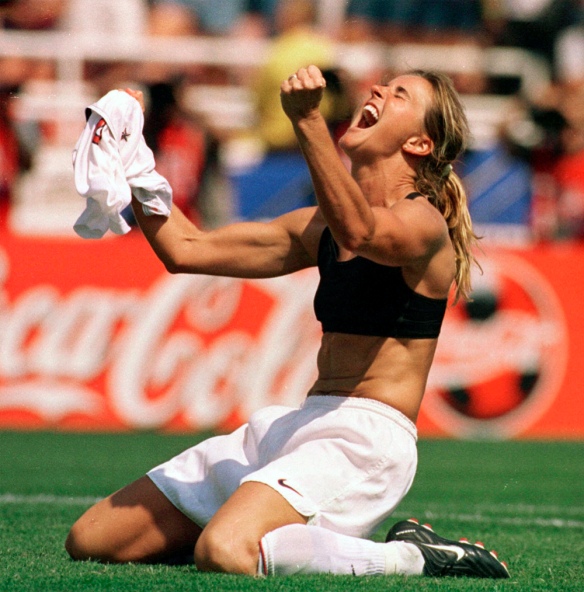
The US Women have just won their fourth World Cup Soccer title, kicking balls and ass, I like to say. What an accomplishment, and how far they’ve come since winning the first ever Women’s World Cup in 1991, the year I graduated high school. I don’t follow soccer, but as an American woman, this victory carries meaning for me. At halftime this morning I read about Brandi Chastain, the 1999 US World Cup champion midfielder who famously, spontaneously, took off her jersey in unadulterated celebration after firing the winning penalty kick in double overtime against China to win it all. The New York Times featured her story yesterday, commenting on the evolution of our perceptions and treatment of female athletes over these 20 years:
In that pivotal moment of arrival for women’s team sports in the United States and around the world, viewers saw Chastain removing her jersey and twirling it like a lariat, spinning around and falling to her knees, pumping her arms in exultant triumph. What resulted was perhaps the most iconic photograph ever taken of a female athlete, a depiction of pure spontaneous joy.
It was a moment of freedom and liberation, Marlene Bjornsrud, a longtime women’s coach and an influential sports executive, once told me. She called it a “casting off the burden of everything that kept us down and said, ‘You can’t do that because you are a woman.’ It was a moment that screamed, ‘Yes, I can.’”
Title IX was signed into law by President Nixon in 1972, one year before I was born. So I took it for granted that girls could play sports just like boys in school—not every sport, but most. I also took for granted the inherent assumptions about women in athletics—that we cannot be as fast, as strong, or as competitive as men. I have so much more appreciation now for icons like Billy Jean King, Martina Navratilova, and Pat Summitt. I think about the WNBA, and women coaching in the NBA, NHL, and NFL, and I marvel at how far we have come. Take a look at this timeline of women’s sports in the US to get a fuller perspective. I know many will say we have a long way yet to go. But today, let us joyfully celebrate all that we have accomplished already. Wahoo!! [fist bump and dancing woman emojis]
Journal of Bone and Joint Surgery, January 2012
Women at Work
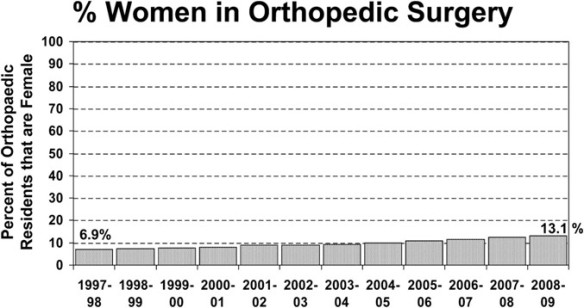
I’m thinking about the culture of orthopaedic surgery. In the twenty years since I graduated from medical school, I see more and more women in this field (as well as other surgical specialties), which makes me proud. While women comprise only 5% of practicing orthopaedic surgeons, 15% of American orthopaedic residents are now women, which is roughly double the percentage in 1999. But what’s it like to be a woman in orthopaedics? How do these women present, perhaps differently, at work compared to in their personal lives? Is it truly safe for them to be themselves as surgeons? The American Orthopaedic Association held their annual meeting recently. My orthopod friend returned from the conference and commented that the rare women leaders in his field seem ‘fierce’ and ‘tough’—but in a good way? It struck him to wonder if they are just like that in general, or do they have to be that way to navigate their male-dominated specialty. He wondered how they would be seen if they displayed sensitivity and emotion, “because a man can be seen as sensitive and kind” and not only does it cost him nothing, his social status is likely to be elevated because of it. My friend was not sure this is the case for his female colleagues, and he seemed both empathetic and powerless at the idea. Looks like gender parity may take a bit longer in medicine than in sports.
At work in general, women’s status varies considerably. But research points to common issues such a 22% pay gap and too few women in leadership (5% of US corporate CEOs), though these are improving. One need not look far for abundant evidence that having more women on the corporate team improves earnings and morale. Much is also written on strategies for improving gender equity at work. Two of my favorites are exit interviews and work-life balance initiatives for all employees, not just women. But as I wrote last week, it’s not just about including women as participants in the workforce. It’s about truly appreciating the diversity of experience, biology, and contribution that women bring to any group they serve.

Women and Men
There is no way I can do justice to this topic in the remainder of this post. So let me just share some ideas and resources I will continue to explore in the months and years to come.
I asked at the beginning what happens for men when women speak Feminism. A corollary question is what happens for all of us when we hear the words ‘toxic masculinity’? My guess is men get defensive and women get aggressive. Personally I love the phrase because it’s so incisively descriptive. But it can also be a flashpoint phrase, one that immediately incites conflict and emotional hijack. Let me be clear: toxic masculinity does not imply that men and manhood are toxic by nature. Quite the contrary, the phrase refers to a culture of expectations of men that is just as toxic for men as it is for women. Male surgeons may well benefit from being sensitive and kind, but not too much so, lest they be seen as weak. This is a vast oversimplification, by the way; the history and complexity of toxic masculinity are explored articulately here.
Readers of this blog know how much I love Brené Brown. Her explanations of how shame (where toxic masculinity is born) manifests and organizes around gender—and why it is toxic for both men and women–are the most poignant and real. Read her first hand comments to Ms. magazine here, and a stay-at-home dad writer’s interpretation of them here. If you seek a nonjudgmental, objective, and real-life exploration of the complex dynamics between men and women, read The Gifts of Imperfection and Daring Greatly. Sister (she’s not old enough to be Aunt) Brené’s books are the most accessible form of evidence-based, all-around relationship advice I have ever read, and I’m so grateful for her. From the Ms. Interview:
What role do you think vulnerability played in the #MeToo movement?
Know what I love about the #MeToo movement?—and, me too—I thought until I was 25 or 30, that sexual harassment was just the price of entry. The greatest casualty of trauma is the ability to be vulnerable. So this #MeToo movement is re-defining and re-claiming vulnerability, and putting vulnerability in the context it belongs in, which is power and courage.
What gives you hope?
The thing that scares me about the world today is the same thing that gives me hope. I believe we’re witnessing white male power over. It’s making its last stand right now. And it’s scary because last stands are dangerous, and people get very backed into a corner. I think this is the last stand, and that we’re going to see a shift, mercifully, from white male power to inclusive power with it too. And I think from that paradigm, we can do anything, change anything, and be anything.
And it’s not just women who can claim agency against misogyny and sexism. Men who identify as feminists serve as allies for gender equity and respect. But men can also help themselves and each other break free from the restraints of machismo and chauvinism. Movements like The Good Men Project and Evryman give men a forum for honest, vulnerable emotional expression and connection. Just like women surgeons and corporate executives, all men need inclusive spaces where they can feel true belonging, where they are free to be all of themselves—hard emotions and all—for all our sakes.
Men I admire in this space include Nate Green, Ozan Varol, and David Brooks.
* * * * *
To lift my spirits here at the end of this long post, I’m listening to a song on repeat: Woman, Amen by Dierks Bentley. It’s such a shining anthem of a man’s unabashed love and appreciation for his partner. I can also imagine modifying the lyrics and hearing Faith Hill singing about her man Tim McGraw.
Thanks for reading to the end, friends.
Our relationships kill us or save us, and we really need to be better at taking care of each other, locally and globally. We, men and women alike, are all in this together, inextricably, in sickness and in health, forever.
Only Love can save us. Let’s get on it.



 Healing Through Connection