We Are Tested

9-2018

What a shit week.  I wonder, how are you doing, my friends?  Because I look around and it really seems like I’m not the only one feeling it.  A friend’s young, healthy sister-in-law was diagnosed with metastatic lung cancer and possibly also lymphoma.  Another friend’s cousin died from a drug overdose after recently completing rehab and getting back to her young family.  Patients are sick with mysterious and disconcerting illnesses.  Pipe bombs were sent to a slew of Democratic leaders and supporters.  And today a man commits yet another deadly, hate-driven shooting.  Seriously, WTAF?  And I honestly think we have yet to hit rock bottom.  I don’t see any of it turning around anytime soon.

I have barely made it through—so much psychic energy required to simply move from one task to the next, taking care of many (and not so much some others).  This past year, actually, sometimes I’m barely holding it together.  First the knee injury, then taking on a new big role at work.  Then surgery/rehab, and another personal crisis that derailed all of my health habits for spring and summer.  As I go around the country talking about personal resilience and culture of wellness, I wonder, am I being a hypocrite?  Am I really walking my talk?  Because if I’m not, I had better just sit down and shut up.

I wrote to a friend today, “I hope you are able to take care of yourself and recharge.  The energy in the world is so tumultuous and agitated.  It’s no help to blame and lament (well maybe lamenting can be a bit cathartic—for a while).  I guess this is a time to exercise our best skills—sharpen them against the harsh and jagged surfaces of challenge and trial.  I feel like all year my professed self-care practices have been called out and called forth—TESTED.  And I’m still here…  Still doing some good every day (I think), alongside the mistakes, the sub-par moments, the not-my-best words, actions, and thoughts…  But hey, who’s perfect?  Nobody.  And are we all here doing the best we can?  I agree with Brené Brown’s husband Steve, the pediatrician: It helps me live better when I choose to believe that we are—all visible evidence to the contrary.” (Here is another article that describes well the benefits of this mindset.)

CO fall 2018

Similar to last week, as I consider this idea, I am met with readings and conversations that deepen the exploration.  Friend and author Donna Cameron published an op-ed today in which she, in her typically kind and gentle style, encourages us all to be our best and see the best in others—on November 7, a day full of potential for vehement loathing and gloating celebration.  In her wisdom, Donna urges us to think ahead and decide in advance how we will choose to think, speak, and act.  How can we be our best on that day, to ourselves and to one another, no matter what the circumstances?

Recently I have had conversations with trusted friends, my coach, and my therapist, focused on my own most cavernous arenas of personal self-loathing and shame.  How lucky that I have such generous, loving, wise, candid, and brave people holding me up.  With their help, I can move past shame, take a step back, and recognize that I simply have some dysfunctional patterns, just like everybody else.  I slide into these deep grooves when I’m stressed, exhausted, and distracted—they are the default. They are part of me, and also subject to change—to intentional modification, gradual evolution.  These days I meditate often on the distinction between perfection and healthy striving, and I’m also reminded daily of the benefits of cultivating a growth mindset.  These days, instead of berating myself for falling into the same deep hole in my sidewalk, I can hold it more lightly, laugh, and exclaim, “How Fascinating!” climb out (often with a little help from my friends), and walk—ever onward.

IMG_0218

Today as I walked outside, slowly (I’m so tired), I noticed the leaves again.  I think autumn is my favorite season.  It reminds me of the wholeness and beauty of transitions.  They are inevitable.  They are temporary (or constant?).  They are unpredictable, at times prolonged, at other times sudden and acute.  They can feel at once painful, joyous, terrifying, shocking, enlightening, overwhelming, confusing, awe-inspiring (or simply inspiring).  It occurs to me that the best way through them involves practicing some combination of mindfulness, self-compassion, empathy, generosity, deep breathing, sleep, connection, self-awareness, magnanimity, and of course love.  The only way out is through, and if we do it well, we can grow a little at a time in the process.
IMG_0223

Who knows what shit will be flung our way and hit the fan next week?  How will we cope?  I know I will be leaning on my tribe and looking to make our ties ever stronger and thicker.  Thank you for being here to share the journey.

Who’s On Your Pit Crew?


Who helps you succeed?

Who checks in with you regularly and gives you feedback on your performance?

Who rushes to your side when you need help?

Who can tell not only when you have a lugnut loose but also how to help you tighten it again?

Who is on your pit crew?

I can’t remember the first time I started using this analogy.  I do recall, of course, it came about in a patient encounter.  For a long time now I have consistently asked patients about their emotional support networks, their connections.  As I get older, I feel increasingly aware of and grateful for all the people at every phase of life who have helped me learn, improve, succeed, and become.  Nobody succeeds alone—really, all but a rare few of us can even survive alone.

My friend Jeremy Topin, a critical care physician, husband, and dad, writes a heartfelt and honest blog about life as all these things—because he is at once all of them and more—there is no way to truly separate one role from another in life.  His recent post on depression among physicians reminded me of the pit crew idea.  Medical culture does not encourage pit crews for its workers.  It’s evolving, painfully slowly, and I hope to have a hand in that evolution.  But for now, far too many physicians and other caregivers suffer burnout, depression, anxiety, and other work-related heaviness in silence, and it can cost us our lives.

Thankfully, many of us have intact and well-functioning pit crews.  46% of physician respondents to the most recent Medscape survey reported talking to friends and family as a coping mechanism, second only to exercise, and right above sleep.  I count my trainer, my therapist, my life coach, and my Counsel of Wisdom, my closest friends, as my core crew.  I have become more and more open about having a therapist and a coach—ya gotta walk the talk if you’re going to be credible about your work.

Full disclosure, I am not a car racing fan.  Pretty much all I know about pit crews is from Disney’s “Cars” and admiring Lightning McQueens’ motley one.  But that’s how it happens, right?  We acquire and accumulate relationships and connections along the winding way in life.  Who knows when or where it might happen?  I met mine in school, in the exam room, at meetings, and I was introduced by mutual acquaintances.

As I consider further, though, having a pit crew is only part of the success story.  Research shows us time and again that serving on someone else’s pit crew fulfills a profound human need, also.  I suggest works by Adam Grant and Kelly McGonigal if you wish to read more about this.  But maybe you don’t need to read or hear the research evidence to understand this concept?  How does helping others help you?  On whose pit crew do you serve?  To whose Lightning McQueen are you Mater or Luigi?

If your pit crew is sparse, people who study and do this work recommend finding something meaningful or someone you love to serve.  It could be something simple and non-committal, like serving at a soup kitchen or collecting winter coats for shelters.  It could be reading or playing piano at a senior center.  Or it could be mentoring a junior colleague over many months or years.

Imagine a music teacher who accompanies her cello student at recitals.  She plays piano, fingers and hands moving lightly and nimbly over the keys as her protégé plays her heart out during each performance.  I went to my son’s school this afternoon for a music concert, where this pit crew idea struck me again.  I don’t know if the accompanists were the performers’ teachers, but that’s how I saw them, as they were all clearly middle aged adults playing alongside teenagers—surely they had some wisdom to impart in this relationship?  It occurred to me that ‘accompanist’ may not fully accredit these adults’ roles in the kids’ lives.  The music they contributed not only supported the students’ performances.  These adults integrated their music making with the primary performers’, lifting it beyond where it could go alone.  They contributed their own advanced skills and supportive presence to help these young people succeed.  It was a team effort.  And that’s the point, I think.

How widely could we apply this pit crew metaphor?  How does it resonate with you today?  How else is your life like a racecar driver’s?  What’s exhilarating about it?  How is it faster and more intense than other drivers’?  Is that okay with you?  How much longer can you sustain this work, and what do you need to maintain the joy and reward?

Lastly, what did you think of this post?  It’s much more stream of consciousness and impromptu than I’m used to.  I’m trying to get more efficient with my time—three hours per post finishing at 2am on a weeknight is no longer an option.  Your feedback is welcome!

One more weekly post and then the 30 day marathon that is NaBloPoMo, my friends!  Woo hoooooo, ONWARD!

From Meaning to Mission:  Finding Your Voice and Speaking Up for Change

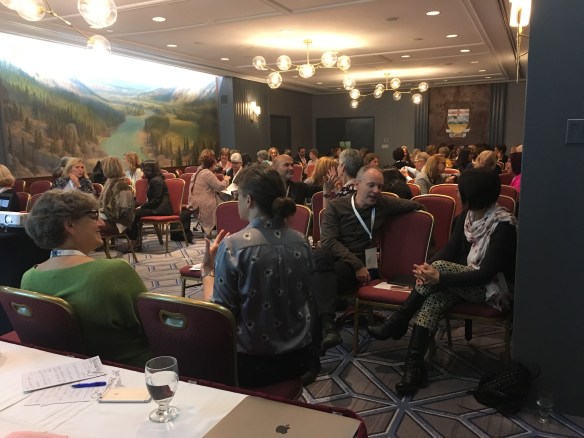
Fairmont workshop room

Have you ever felt like you have no voice in your workplace, your community, or the world at large?  When have you felt you do have a voice?  What made the difference?

Two esteemed colleagues, Liz Lawrence and Eileen Barrett at the University of New Mexico, and I presented the above titled workshop at the International Conference on Physician Health on Friday.  The objective was to give participants an opportunity to recognize and rally their strengths, claim their value and agency, and practice the words to advance an idea or project for improving physician health and well-being.

The idea for the workshop came from a conversation Eileen had with a young physician who felt he had no agency to improve his work situation, due to his junior status.  This prompted her to ask, who has agency, and how do they get it?  She concluded that agency is an active skill, not a passive state of being.  Thus it can be learned/acquired, and everybody has/can have it.  Furthermore, we apply it most effectively when we combine it with our strengths, in service of projects that are personally meaningful.

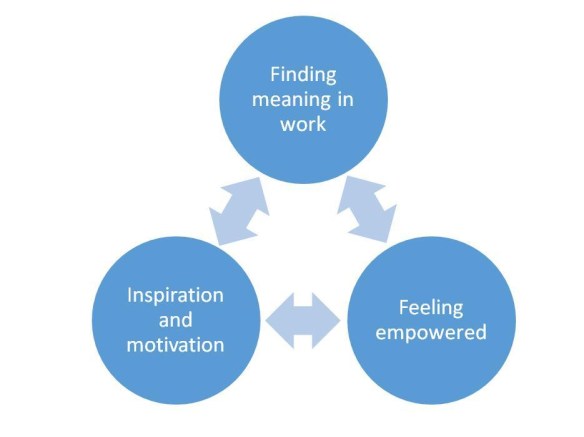
We presented the reciprocal triad of finding meaning in work, feeling empowered, and inspiration and motivation, as the foundation of agency and action.

EB triad

Identifying Strengths

The first exercise had participants pair up and describe their strengths to each other.

What are your strengths?  Imagine describing them to someone, out loud, in person.  How does this feel?  Our attendees reported feeling uncomfortable, not used to it.  They also felt confident, connected, and encouraged speaking to someone they knew was listening supportively.

Defining the Project

Second, we asked participants to think for a few minutes about their own projects.  It could be something they had been working on for a while, a new idea they recently came across, or something from a sample list we provided, related to Culture of Wellness or Efficiency of Practice.  We asked:

  • Is your idea “Big Enough to Matter, Small Enough to Win?” quoting Jonathan Kozol.
  • Is it Specific, Measurable, Achievable, Relevant, and Time-bound (SMART)?
  • How will your strengths apply?
  • What else do you need? Who can help?

Partners met again to share and discuss each other’s ideas.

Afterward they reported elevated inspiration, excitement, and mutual support.  Positive energy in the room rose palpably at this point, with lots of gesturing, smiling, and engagement.

ICPH 2018 workshop

Communication and Relationship

We didn’t call it an elevator pitch, but that’s basically what we asked attendees to attempt.  In 90 seconds, each participant was to distill and express their idea into words that would convey its essence and enroll their partner in its goal.  Having advanced to this segment of the workshop in less than twenty minutes, and now asking them to perform a pitch on the fly, I gave a pep talk (modified here to include some words I wish I had said):

“Now it’s time to PRACTICE.  If we are to make progress in our projects, we must enroll other people.  It’s all about relationships.  Relationships kill us or save us, and they live and die by communication.  A previous presenter said, ‘Language is the vehicle through which all interactions take place—both verbal and nonverbal.’

“You never know when or where you will meet your champion, or who it will be.  The easier and better you can pull your idea out of your back pocket and present it cogently and impromptu, the higher your chances of success.  Know your ask—be as clear as possible.  Know your audience—what about your project is meaningful to them, what will they relate to?  Make them the hero:  Don’t come at them with demands.  Come alongside them with open-ended questions; help them appreciate the power they have to help.

“You will have to be persistent.  Practice will be key.  Our keynote speaker, applying complexity theory to the work of physician well-being, invoked the image of a grain of sand dropping onto a pile.  One grain may stick on impact and nothing happens to the pile.  Another may cause a small section of sand to tumble just a little.  Yet another grain can trigger the avalanche that alters the sand pile landscape entirely—and no one can predict which grain will be which.  I posit that you are not a grain of sand.  You hold an idea—a whole bag of sand—and each time you pitch it, you drop a grain (or a handful) on the pile.  If one grain makes no immediate change, drop another one, and another, and another.  This is the essence of the Growth Mindset—practice.  Practice is Creation.  Practice is Evolution.  Practice is Progress.  Your job now as speaker is to try with abandon.  There is no such thing as a bad try.  Pay attention to how it feels, where you get stuck, and where you shine.  As the listener, your job is to make it safe for your partner to let go of fear and judgment, to lay it all out.  Support, encourage, and critique with love.  What moved you, what did you observe in words and body language that drew you in or put you off?  What did you want more of?

“Make the most of this time.  Dig in the bag and pull out a few grains to drop.  Take advantage of your partner for feedback and support.”

The room was positively buzzing.  And participants’ comments made our day (paraphrased here):

“Sticking with the same partner throughout was helpful; we could really connect each other’s strengths to our respective ideas and help each other develop them.”

“It was fascinating to see the energy change between talking informally about the idea and then having to present it as a pitch.  She was so much smaller and hesitant the second time around.”  (Partner):  “The first time I was just talking to a colleague.  The second time I pictured presenting to my board.”  The experience was enlightening and curiosity-provoking.

“It’s different and easier talking to a supportive stranger, someone with whom you don’t already have relationship baggage.”  How else, then, might we approach our stakeholders—how could we practice awareness of our assumptions and relationship dynamics, and perhaps modify them positively?

“Hearing someone else’s ideas informs my own.  I like how he conveyed something, I saw how I could do the same; it gave me more insight.”  Taking turns both presenting and listening engaged both people in mutual support and encouragement—both roles were helpful.

The Takeaways

Liz, Eileen and I have collaborated on physician wellness since 2015.  We share meaning and mission around inspiring our colleagues to claim their value, recognize and stand both confidently and humbly in their power, and participate in a global movement of positive change.  Our strengths and styles complement one another and the work flows naturally, synergistically.  What a privilege and an honor it was to have this opportunity to present to and commune with our tribe members in physician health.  May the processing and integration of all of our new learnings continue to sustain and connect us for the long road of work ahead.  As Barack Obama says, “Change will not come if we wait for some other person or some other time. We are the ones we’ve been waiting for. We are the change we seek.”

Onward, my friends.

EB LL CC ICPH 2018