Mobility is Confidence

DSC_0492

It is Day 11 of NaBloPoMo 2017: Field Notes from a Life in Medicine, Day 10 of Bum Knee Cathy.

So far, so good!  This third time through NBPM is definitely easier and less stressful than before.  It’s not my best writing, but it’s not bad.  I’m spending less time thinking and writing, and having ‘way more fun.  Can’t say that much for BKC, though.  I’ve never had an injury like this and I’m not quite sure what to expect.  The good news is, swelling is decreasing and I limp a little less every day.

I had not gone 7 days without exercise in almost three years, and it was starting to feel a little too comfortable.  It also did not help that we had a bag of Kit Kats left over from Halloween—bad planning.  So on day 8 I decided to see what I could do in the gym.  Turns out, I still need to avoid activities that require me to plant my feet or fully extend the knees.  But there is still a lot I can do, and today I found a full suite of moves, some modified, that were enough to break a sweat, woo hooooo!!  Even though I wrote that I was good about losing my training discipline, I was still worried.

Today, however, I have my confidence back.  Earlier this week I reconciled with the possibility of not playing volleyball anymore, but I have not given up on my intention to get back on the court.  And if that’s not possible, then I can try the other things on my list: martial arts, kickboxing, tennis, and who knows what else?  Still so many possibilities!

The day before I hurt myself I passed a lady on the way to work.  She was older, obese, walking with a limp and a cane.  I came up behind her, slowed down, and passed her when space opened up on the sidewalk.  I suddenly appreciated my unencumbered gait.  How ironic.  My parents are almost 70 years old and they just returned from a month-long tour of China and Taiwan.  He golfs and she still precepts nursing students in the hospital.  Neither of them has ever had a prolonged period of immobility, even after major surgery.  They still move through life confident in what their bodies can do, looking forward to their next trip.  I know many orthopaedic surgeons.  With them I have shared patients who got their lives back after joint replacement surgery—able to walk, golf, and even ski again—without pain, and with confidence.

Tonight I appreciate that much more what my parents have achieved and what my colleagues do.  I appreciate my body that much more, and what is required to maintain it.  I appreciate the importance of conversations with my own patients, when we talk about establishing habits in middle age that will allow us all to be strong and healthy in old age.

How much do we take our mobility for granted?  For myself, not as much today as I did 12 days ago.

Conscience and Ego?

DSC_0503

NaBloPoMo 2017: Field Notes from a Life in Medicine

I’m so grateful for my many friends who make a daily practice of examining and reflecting on feelings, behavior, and meaning.  We see each other often and trade stories of enlightening, demoralizing, enraging, moving, curious, inspiring, dismaying, confusing, validating, and human experiences.  Tonight one of them texted me about a conversation with a fellow cosmic journeyer: “Wise Friend told me that when he’s really wrong is when he’s the most defensive and I thought about it and it’s true for me, too.”

It didn’t take me long to relate viscerally to this message.  I tried reading The Dark Side of the Light Chasers by Debbie Ford some years ago.  It’s all about facing our specific areas of self-loathing and overcoming them with I don’t know what.  Because while I usually take pride in my ability to explore my insides and be with the ugly, I could not make it through that book.  When I got to the comprehensive self-loathing-identification exercise, I had to stop, and my subconscious gnarled such that I picked a fight with the husband that lasted two weeks.  I like to think that I have evolved since then, that my inner life is slightly less gnarly these days. I now choose to work through my self-loathing one small piece at a time, in small doses with my therapist, on and off.

I texted back tonight from my gut, “I think it’s true for all of us, most defensive when most wrong.  Our consciences know better than our egos.”  It was one of those unguarded moments that allows for a new (for me) expression for an old concept.  And now I have a new idea to consider: how do conscience and ego interact, and what are the products of their collaboration and/or competition?  More importantly, how does the interaction (entanglement?) show up in our relationships?  Marriage, parenting, friendship, physician-patient?  How can we manage these relationships optimally through exploring this mental/emotional interplay?  Maybe I’m overthinking…  If it’s mostly true that our consciences know better than our egos, then maybe I can just continue practicing awareness of Ego’s tendency to bully Conscience, and training Conscience to peacefully and firmly Resist.


Hopey, Changey Hero Making

IVY Litt 11-8-17

NaBloPoMo 2017: Field Notes from a Life in Medicine, Day 8

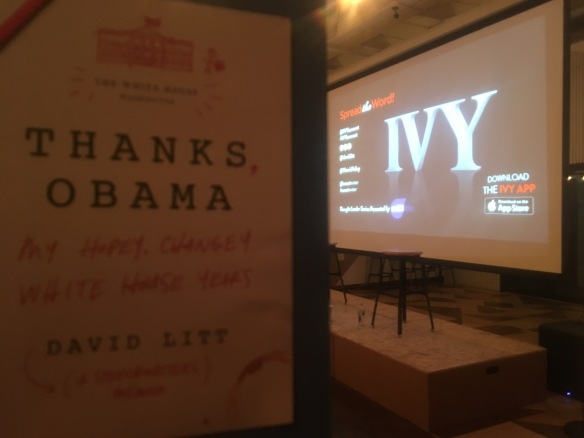
Funny how I just wrote last night about connecting new dots to old dots.  It just happened again tonight!  A couple of weeks ago I responded to an online ad for an IVY Ideas Night with David Litt, author of Thanks Obama: My Hopey, Changey White House Years, entitled, “How to Inspire, Persuade, and Entertain.”  Litt was a senior speechwriter for President Obama, so I thought I could learn new tips for presentations, and feel a little closer to the president whom I miss so much.

I’ve done public speaking since eighth grade, when our speech teacher first taught us abdominal breathing and I discovered the thrill of holding the attention of a room full of people with only my words.  I work at an academic medical center and I hold zero publications, but my CV documents over 10 years of professional presentations to various audiences.  I thought I was pretty good at this speaking thing.

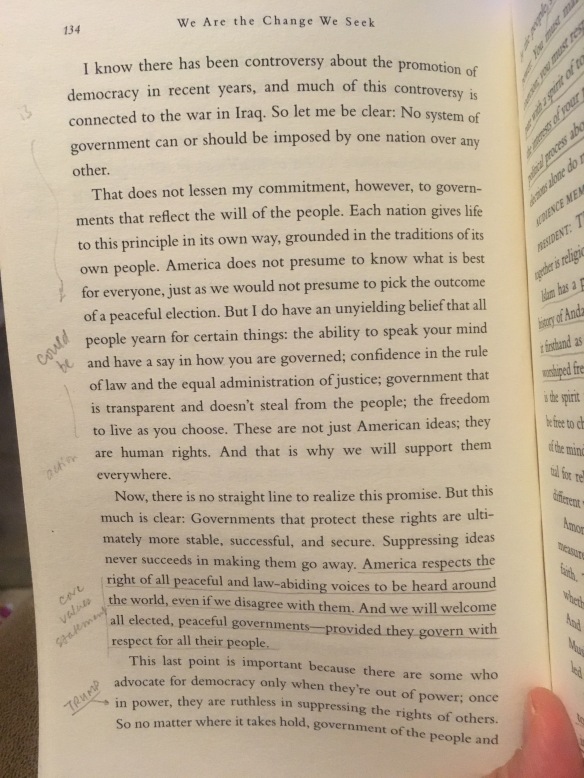
Three years ago I came across this TED talk by Nancy Duarte, whose ‘secret structure’ of great presentations I have used since I subsequently read her book, Resonate.  Essentially, she recommends that we invite audiences on adventure stories, create active tension between what is and what could be, and most importantly, make the audience the hero.  I have done this better and worse since then, but I always recognize the framework when I see it.  Those familiar with this blog know that I am also a fan of Simon Sinek, whose central message is that we perform at our best when we are crystal clear about our Why.  “People don’t buy what you do, they buy Why you do it,” he says.  Barack Obama employs both authors’ principles with eloquence and finesse, which I noticed reading We Are The Change We Seek, a collection of his speeches as president.  The best speeches delivered in this construction create audiences who are inspired, motivated, and empowered to hail a meaningful call to action.

Obama is could be core values

That’s basically what David Litt conveyed tonight.  When asked what advice he was given that served him best, he said, “Imagine someone in your audience will tell their friend tomorrow about your talk.  What is the one thing you want them to say about it?”  What is the Why of your talk?  Even though he no longer writes speeches for the most powerful person in the world, he expressed a desire to continue inspiring, empowering, and promoting personal agency in all whom his work touches. Make each and every audience member their own hero.

It turns out, however, that this approach applies to much more than public speaking.  On my 50 hour, 500 mile, aspen-pursuing weekend in Colorado last month, I described to my dear friend my favorite moments at work.  At the end of a patient’s day-long physical, after I have spent 90 minutes listening to their stories of weight gain and loss, work transitions and complex family dynamics, and reviewing their biometrics and blood test results, I meet with them for an additional 30 minutes to debrief.  This is when I present an integrated action plan compiled by the nutritionist, exercise physiologist, and myself.  It is a bulleted summary of our conversations throughout the day, centered on the patient’s core values and self-determined short and long term health goals, and crafted with their full participation.  I get to reflect back to my patients all that I see them doing well, and shine light on areas for potential improvement.  It’s an opportunity to explore the possible—to Aim High, Aim Higher, as the United States Air Force exhorts.  I often present the plan with phrases like, “Strong work!” “You’ got this,” and “Can’t wait to see what the coming year brings!”  My friend turned to me as we wound through autumn gold in the Rocky Mountains, a bit tearfully, and said, “You make them the hero of their own story.”  Yeah, I do, I thought, and I got a little teary, too.

Words are powerful.  They are our primary tool for relating to each other, for making another person feel seen, heard, understood, accepted, and loved.  You don’t have to be a public speaker or a presidential speechwriter to make a positive difference with your words.  At work, in your family, with your friends, with people on the street and in the elevator—what is the one thing you want someone to remember from their encounter with you?