How Do We Get Better?

IMG_4328

It is Week 5 of sheltering in place for many of us.  How are you feeling?  What emotions occur most often?  To where and on whom are they directed?  How do you see the future, and what does that feel like?

Who do we want to be on the other side if this crisis?

For all our sakes, I hope we can be more patient, kind, empathic, open-minded, thoughtful, intentional, and connected.  The COVID-19 pandemic shows us what ultimate paradox really means—trauma and grief on a scale not seen in generations, as well as an opportunity for unprecedented growth, both as individuals and as a society.

I think about the risks and possibilities as both a clinician and citizen.  The experiences overlap, as do the strategies to mitigate suffering.  I am so grateful that physician burnout and well-being has already been addressed in so many institutions, and at so many levels, before this crisis hit.  Programs like physician peer support and Balint Groups show us that our leadership cares for our well-being, or at least recognizes the need for organizational support of it.  Employee Assistance Programs and the like are much more visible now, and hopefully barriers to access are also down.  Everywhere I see offers for formal organizational support and ‘wellness.’

But what will really make the difference in the end?  How will we really grow into our best selves through this, the greatest global challenge of most of our lives so far?

I think it will be in our small, day to day, apparently mundane interactions.

Too often we underestimate the impact of our milieu on our attitudes, thoughts, words, and actions—how we are impacted by our environment, and how we impact it in return.

A wise friend observed two groups of people responding to COVID-19.  One sees the pandemic in terms of ‘what’s happening to me.’  The other experiences it as ‘what’s happening to all of us.’  This is a falsely dichotomous oversimplification, obviously.  But it may be instructive to notice one day this week, if we were to categorize our own thinking/feeling/speaking/acting with regard to COVID, where would we land more of the time?

I’m reminded of the stages of tribal culture described by David Logan and colleagues in their book, Tribal Leadership, and presented eloquently in his TED talk.  I have discussed this idea in previous posts.
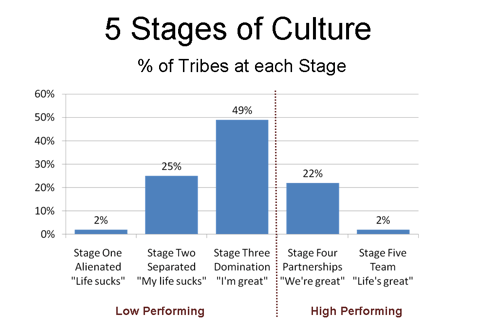
The visual above encapsulates Logan et al’s theory of tribal culture.  Their work aims to advance groups from lower to higher levels of culture and performance.  In this framework, the currency of cultural economy is language.  Each tribe member’s dominant cultural stage mindset emanates in their words, and is represented/encapsulated in each stage’s mantra above.

Those who experience COVID-19 as ‘what’s happening to me’ likely live in the lower three stages most of the time—self-absorbed, competing, uninterested in personal or societal connection and growth.  Those able to see how ‘this is happening to us all’ have made the shift toward an Outward Mindset, seeing their node selves as inextricable members of a larger, interconnected system.  For a system to function well, grow, and sustain itself best through crisis after crisis, it must achieve a collective “We’re great” or “Life is Great” mindset.

Whom do you know on your team, among your friends, or in your family, who lives these words (most of the time)?  How do you feel when you’re around them?  What do you hear them saying right now? What energy do they exude?  When I meet people like this in my life, I feel calm, soothed.  They remind me to be humble, and to remember what I can do to help, both myself and others.  I feel connected in their presence; I recall my strengths and potential for contribution, and I’m motivated to act accordingly.  They give me hope.

So what do I hear them saying, what language do they speak that elevates our communal culture?

First, they avoid ad hominem.  They refrain not just from political rhetoric and attacks; they don’t make generalizations about groups based on race, gender, geography, social class, etc.  They also withhold judgment—they entertain various stories about people’s motivation, circumstances, and values, rather than jumping to oversimplified conclusions based on their own biases.

Second, they empathize.  They strive to relate to each person they’re with, as well ‘the others’.  And if they can’t do that, they validate the others’ feelings.  “That’s so hard,” can be the most soothing words a person can hear when they’re struggling and suffering. And “Well, we don’t know what they’re living,” reminds me to be humble.

Third, they offer hope.  But it’s not false hope or superficial, Pollyannish positivity.  They honestly believe in and see the light at the end of the tunnel, and they point to it for our benefit.  They do this by asking, “What do you need?”  “How can I help?” and saying simply, “I’m here.”

When I come across people like this, I want to be around them more.  I want to emulate them.  I point out their words and actions to others, and show the positive movement they inspire in me and others.  Stage 4 and 5 tribal leaders lead by example.  And make no mistake, they are everywhere.  They often don’t have a title or any designated authority.  But the team/organization/family is always better for their presence.

If you have people like this on your team, consider:  how can you be more like them?  What do they inspire in you?  If you are this person, how can you bring people along in this mindset?  This is how we get better through our current crisis:  We find the leaders who speak the language of We, Together, Growth, and Hope.  We find and follow those who set the example, and we strive to set it ourselves.  We take advantage of the programs and support systems around us.  We get help, get better, and then turn around and help others.

Yes, there is much trauma and grief.  There is also boundless love and connection.  We find the latter easily when we look, and it sustains us.  We can absorb that energy, join that movement, and make a difference in every encounter with our fellow humans.  We can absolutely be better.


What Emerges from Crisis:  Connection, Learning, and Contribution

IMG_2126

“What observations/discoveries/learnings have you noticed in these weeks?”

In phone calls, emails, and snail mail to friends, I find myself asking this question repeatedly.  This exercise yields two wins:  1) I’m connecting to my people all across the country; 2) I get to answer for myself, and new insights emerge each time.

How are you connecting with your people in these weeks of physical separation?

What have you had to reframe, create, and experiment with to make life work in our sudden new reality?  How does it feel?  What are you learning?

* * * * * *

 Inconvenient Emotions

Very early in the pandemic, when I realized my clinical volume would drop to practically nothing, I started to feel something akin to survivor’s guilt.  I still feel it—I am not on the front lines; I myself am not in harm’s way, as so many of my colleagues are.  I feel relief for not having to be there (yet).  Then I feel guilty for feeling relieved.  So I try to make myself useful, giving Zoom presentations on wellness to colleagues and firesides on Instagram for the public.  Life has settled into something of a routine.  I do video calls, helping with operations management and team organization from an armchair (standing desk).  Turns out I enjoy working from home!  And I feel guilty for enjoying anything about this time of unprecedented global disruption.  Hello, mental and emotional whiplash, my inescapable human companion.  Thankfully, self-compassion practice keeps me sane.

* * * * * *

Acceptance with Agency

“The first step to changing your circumstances is to accept them.”  Wut?  I have grappled for years to understand this concept; today I think I finally got it (thank you, Donna!).

Today I choose to define acceptance as a state of possibility, rather than of resignation or victimhood.  Sometimes it helps to describe something by pointing to its opposite:  What happens when we refuse to accept what is?  Often we cling to what we think should beWhat should be is a narrow set of unmet expectations that keeps us anchored to the past, or at least to an unreality that simply does not exist.

What happens when we finally accept what is?  We are liberated to ask some important questions:  How do I feel about what is?  What are the best and worst potential outcomes from here?  What do I want to be different?  How can I effect that change?  What is my work here?

Accepting what is brings us over the threshold from the narrowness of what should be to the wide possibility of what could be, where our agency is what we make of it.

* * * * * *

Optimism + Cynicism = Peace

Some days I get so excited, reveling in human ingenuity and resilience!  Look at the transitions we all made, practically on a dime, moving healthcare and education online, organizing COVID testing and creating treatment protocols, constructing hospital wards in convention centers, initiating clinical trials, and sharing experience and data internationally at breakneck speed!  All this learning and application, holy cow, how could we not be smarter, more connected, and better after all of this?

By being human, that’s how.  Despite our great capacity for survival and adaptation, we are creatures of habit and products of our environments and relationships.  We revert more easily than we convert.  On cynical days I think, “Nothing will change.  We will stay the same stupid species we have become, just a couple hundred thousand deaths closer to our own stupid, eventual extinction.  And we will deserve it.”

Here’s the fascinating thing, though:  I vacillate in this false dichotomy lightly, even though the emotions on both sides can get intense.  We humans are such a complex enigma, capable of profound love and selflessness, and also unfathomable hatred and destruction.  That’s simply what is—we are all of these things, intricately complicated in our nature.  Each one of us possesses an infinite set of potential vectors for connection and/or destruction.  But I still get to choose what to do with my time, energy, and resources in this lifetime.  It’s my call.  So I’m okay; I’ got this.

* * * * * *

Co-Creation:  The New Normal

The last two years I have had the privilege to work with colleagues around our vision, mission, and values.  I have studied various work cultures, observed and interviewed associates and teammates.  LOH taught me the language and framework to synthesize my own, evolving style of relational leadership.  During this downtime—this unearned vacation—I have time and space to consider a bigger picture.  What about our culture best manifests our mission and values?  How did this facilitate our successes in reorganization and mobilization?  What held us back?  What needs to happen (change?) in order for us to emerge from this crisis in learning and growth, rather than in fear and trauma?  These questions apply professionally, personally, and societally.

My strengths lie in relationship and connection.   Throughout this long journey to flatten the curve (and it will be months), I can contribute my insight, observations, and talents at synthesis, creativity and vision, to make our new normal as mindful, intentional, collaborative, and functional as possible.  I can paint a vivid picture of where we could go.  I can embrace dissenting voices and find alignment in apparently divergent interests.  I can help us be better.  This is the contribution I can make.

What will your contribution be?

10-22-19-2

The Best Thing That Could Happen

IMG_3222

What do you think is the best thing that could happen out of the COVID-19 pandemic?

I think it’s Connection.

How ironic, as the current best solution to mitigating illness and death is physical (not really social) separation.

Connection won’t come easily, though.  Today I felt all kinds of yuck:  Conflicted.  Unsettled.  Angry, Cynical, Fearful, Guilty, Annoyed, Confined, Enraged.  Not exactly connecting emotions.  The people going about their usual routines, disregarding distancing guidelines, and claiming it as their right to ‘live free’ agitate me the most.  When they get sick, and after they have infected numerous others, some gravely, my colleagues and I will care for them the same as for those who followed the guidelines and acted unselfishly for the greater good.  We will put ourselves in harm’s way, and more of us will pay with our lives for their false freedom.  Because when your ‘right’ to ‘live free’ puts others’ lives at risk, that is not freedom.  That is negligence.

That said, I’ve not lost all hope.  Through Facebook, Zoom, email and snail mail, I am now better connected with some folks than before, and I’m grateful.  They have helped me consider and envision the best possible New Normal on the other side of COVID-19.  I share my wish list below, as well as links to my favorite articles from the past week.

Also, join me this Wednesday, April 8, at 6pm Chicago time for an Instagram live chat.  Owners Tim and Victoria at Ethos Training Systems will host a fireside-style session on COVID-19.  You can join by finding me, chenger91, or Ethos, at the time above.  Please know that I do this public event as a friend of Ethos, and not as a representative of my employer or any medical professional society.  I claim no expertise in infectious disease or epidemiology; I’m just one doctor doing my best to share relevant information and practical advice.

IMG_3635

To Create Our Best Post-COVID Future, Let Us:

Continue to connect earnestly with people near and far.

Advance toward universal healthcare in some form, and shore up our social safety nets.

Reclaim our collective mindset—temper extreme individualism with more altruism and empathy.

Slow down—maintain more flexible work schedules, better childcare options.  Generate less pollution, decrease unnecessary production and consumption.

Live more mindfully and in the present:  Enjoy the good more and dwell less on the bad.  Increase both awareness and appreciation of all that is well in life.

Hold rigorous science and medicine far above opinion and ideology.

Practice Learning, Flexibility, Agility, and Resilience, in all domains, large and small, individually and as a collective.

Recognize our shared humanity, maintain that recognition, and act consistently from that recognition—bake it into our cultural norms henceforth.

IMG_3595

Pieces that helped me the past week:

An excellent review of the evolution of and rationale for universal masking:  https://www.vox.com/2020/3/31/21198132/coronavirus-covid-face-masks-n95-respirator-ppe-shortage?fbclid=IwAR237JXMUy94AcI_4uigdP3ZZUfoNd1c_4tyRDi-A8u2BYm7YZmSJ0f3ii8

A summary of current knowledge of SARS-CoV-2 and COVID-19, written accessibly and with practical recommendations, by my teacher and colleague, Dr. Alex Lickerman:  https://imaginemd.net/blog/coronavirus-april-2020-part-5/?fbclid=IwAR20m7QfOSUlZlAZuTaytKDaw210j_wWuqd6xgGBeTbIHAEfZeASfDnYTac

Dr. Lickerman doing a similar review as a guest on a podcast, also excellent: https://www.larryweeks.com/ep-36-coronavirus-qa-with-dr-alex-lickerman-m-d/?fbclid=IwAR077iOtNkCGcyjJdjVWZWKW6RWgtNhVgdN7cYvrnd2bQcbaStrRvTjdqAE

From Maria Shriver’s Sunday PaperBut today is Palm Sunday, and Easter Sunday is a week away. This week is the beginning of Holy Week, a time of spiritual renewal and rebirth. So, I’m taking that as a sign that we aren’t meant to go back to what was. We are meant to go forward both individually and collectively. Each of us will come out of this time a different person, a changed human being. How could we not?
What a double tragedy it would be if we went back to the way we were. To a time when we didn’t care for our planet. To a time when we were so mean to one another. To a time when we were so divided in every way. To a time when we didn’t know our neighbors. To a time when so many only cared about themselves and saw others as the “other.”

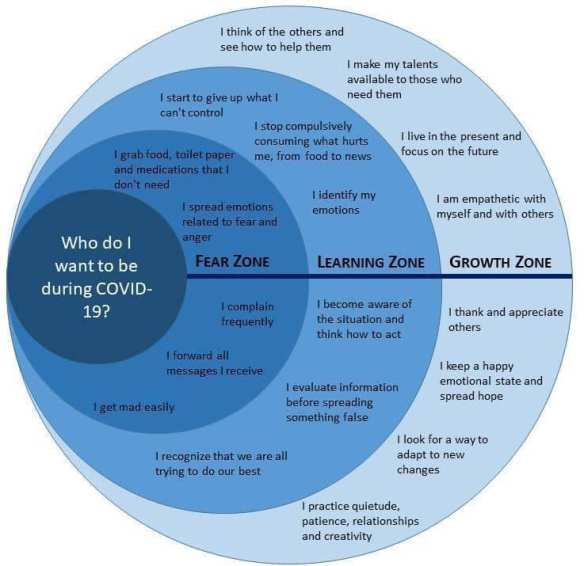
A diagram shared on social media of our human responses to the crisis (I don’t know who created it—if you do, please give credit in the comments and tell them thank you).  I think it’s normal that we should find ourselves doing things in each of the nested circles every day.  We can exercise compassion for ourselves and others at the same time:

covid nested circles

Finally, a poem, also from Maria Shriver’s Sunday Paper, shared by her niece, who died with her 8 year-old son the very same day:

covid after poem maria shriver niece maeve

Things will likely feel worse for at least a few weeks before they feel better, my friends.  Hold tight to those you love and who love you.  Count your blessings.  Take perspective.  Consider deeply our inextricable and undeniable interconnectedness.  Be kind.