Agency and Emergence

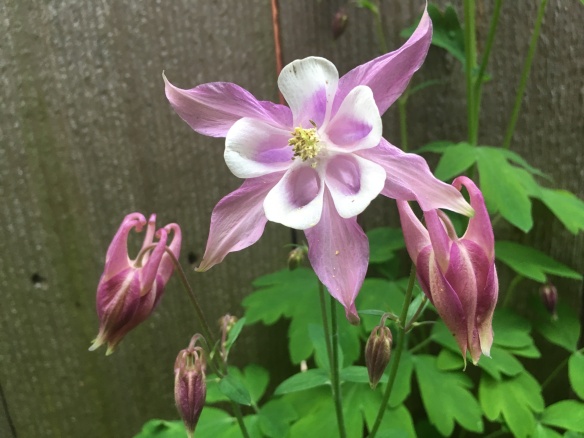
IMG_1568

When do you push forward, and when do you step back?

How do you decide, or is it decided for you?

How does this reciprocal rhythm oscillate and dance in your life?

*****

Modern western culture tells individuals and organizations alike: Grow! Move! Push! –Or die!  Competition and scarcity dominate the collective psyche, if not consciously then subconsciously, no question.  Even on vacation we are pressured to do something socially noteworthy, lest we have nothing to report upon return.  There is a palpable, frenetic, explicit and implicit drive—to keep driving.  I’m not complaining, necessarily.  Growth, innovation, evolution, improvement, advancement, development—I pursue these with as much fervor as anyone.  It has served me well!  My whole life the hard work (and a lot of luck) has paid off in spades, in school, work, and now leadership in multiple realms.  I have accomplished as much as I could have imagined at this age, and I’m just getting started!  How exciting and rewarding, living a life of audacious acceleration, of claiming agency, of “Yes, AND!”
IMG_1547

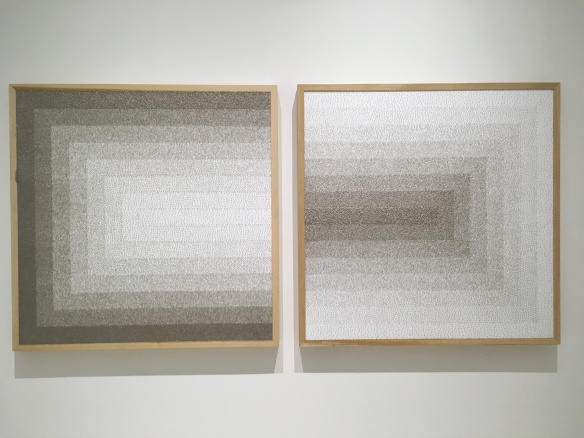
Tara Donovan, Chicago IL July 2019

Yet, lately I feel another energy emerging.  It came on unexpectedly, and I welcome it like my oldest friend.

I only realized it as I wrote about ‘Aunt Rachel,’ Dr. Rachel Remen, last month.  “I am called to slow down, to be still, more than I have been (have allowed?), for a very long time,” I wrote, quite spontaneously.  Those words forelighted a month of ‘settling and recharging… awareness and fulfillment,’ as I wrote to my friend, when I realized what was happening.  This meta-awareness always fills me with awe and gratitude, as if the cosmos lets me in on a secret, conspiring to prepare me for what lies ahead. Remen’s My Grandfather’s Blessings reminds me of the importance of human connection at the deepest level.  Big Magic by Elizabeth Gilbert makes me confident and brave to create, to make things to share, like this blog or a new oral presentation.  The Art of Possibility helps me dig deep, in a different way every time I reread it, for fundamental relational skills when I need them the most.

The week I wrote about Aunt Rachel, Maria Popova’s post on friendship as rendered by Kahlil Gibran crossed my email inbox.  The Prophet was one of my favorite books in high school.  I found it moving, inspiring, and reassuring, like a lovingly personal counselor, in those emotionally tumultuous adolescent times.  Popova’s post brought that comfort back, similar to how Remen’s book did in recent weeks.  I felt compelled to follow her sequential links to writings by Seneca, CS Lewis, David Whyte, and John O’Donohue, all on friendship.  She quotes Seneca, the stoic: “Ponder for a long time whether you shall admit a given person to your friendship; but when you have decided to admit him, welcome him with all your heart and soul. Speak as boldly with him as with yourself…”  Something within me was deeply moved, activated to seek more.

IMG_1545

Tara Donovan, Chicago, IL, July 2019

How fascinating, what is with this fresh call on my attention?  I’m not sure, but I trust it fully, and have embraced it.  I found To Bless the Space Between Us by John O’Donohue, a book of the most eloquent blessings, and Consolations: The Solace, Nourishment, and Underlying Meaning of Everyday Words by David Whyte.  Both books quench my thirst for beautiful language that articulates the deep longing for meaning and connection, with myself as well as with others.  They call to me.

Between caring for patients, leading work teams, proposing new projects, LOH training, speaking engagements, wife-ing, parenting and friending, life could hardly be more challenging or fulfilling (I should also call my parents more often!).  I see every meeting, every letter, every message as a chance to show up all in, fully present, at my best.  To be my Best Self in all realms, I push myself to learn, practice, and excel, to exercise my agency in service of relationships and connection.  So sometimes the universe approaches me lovingly, jogging alongside, inviting me to slow down.  Take a break, he says, enjoy the view.  Soak it in.  Relish how far you’ve come, what you’ve built thus far.  Breathe deep, stretch out.  Rest a while.  What do you see, she asks, how does it feel? What have you learned, they say, what can you synthesize and integrate, before you march on with resolve and conviction once again, in the direction of your biggest dreams?

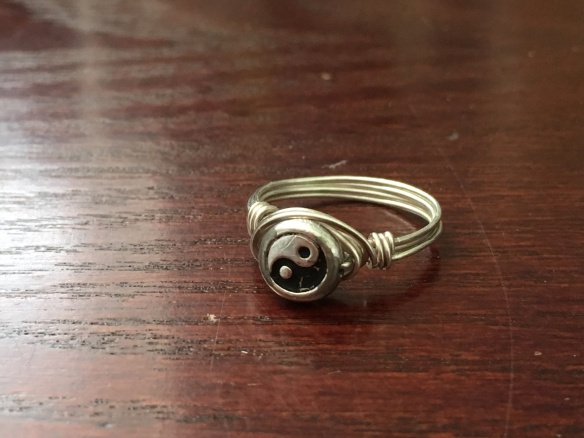
The word pairs below emerged, with a little nudging, over the past week.  I see them not as dichotomies, not at all in conflict.  Rather, they are each separate and inextricable sides of the same multifaceted polyhedron of life, necessary counterbalances for a healthy, fulfilling, and meaningful existence.  I started wearing my Yin-Yang ring in January.  It is meant to remind me that opposites are more often complementary than oppositional.  Our society values agency over emergence.  We endorse doing ahead of holding.  But practicing emergence is by no means passive, weak, or unproductive.  It is active, enthusiastic participation in the dance of life, the reciprocal movement of ebb and flow.  Childbirth and heartbeat are quintessential examples of the balance of Agency and Emergence, giving and receiving, contracting and relaxing.

What other word pairs would you add?

I commit to fully inhabiting, savoring this deliberate time and open space, however long it lasts.  Energy will shift again, as it always does.  I have the next self-improvement books and task lists in queue.  I’ll get on the blocks again, ready for the starting gun, soon enough.  But for now, I breathe deeply and look around in appreciation and learning.


   Agency                           Emergence

Control                             Relation

        Action                          Observation

Power                        Capacity

Acceleration                          Momentum

      Focus                         Zoom Out

Contraction                       Relaxation

Tightening                      Stretching

Exhale (blow)                     Inhale (smell)

  Intention                        Possibility

  Strength                        Elasticity

Telling                        Asking

             Make this happen                         What’s trying to happen?

            Tap the system                       Watch it spin a while

               Grip                        Hold loosely

Drive                      Ride

Take up space                          Hold space

Yang                     Yin

  Heartbeat

  Childbirth

The exhibit where I took the art photos:  https://smartmuseum.uchicago.edu/exhibitions/tara-donovan-fieldwork/

Our 5 Fundamental Needs

561512_4331884049855_1855935252_n


To Feel:


Seen

Look what I can do

This is how I can contribute

See me achieve


Heard

Hear my concerns

Take me into account


Understood

Validate me

Normalize my feelings

Say you can relate


Accepted

Tell me I belong


Loved

Participate in the Messy with me

Commit to sticking with me through the hard shit

Let me be my whole self with you

Be your whole self with me


Children by parents

Patients by doctors

Students by teachers

Workers by managers

The led by their leaders

Spouses

Friends


What if?


The Status of Women, 1999-2019

IMG_1282

What happens for men when women speak Feminism?

I intend to ask this question to more men in my life from now on.  What do you hear as Feminism?  Where do you think it comes from?  What do you think women are trying to accomplish by talking about equity and representation?  What moves a man to ally with women in this movement?  What keeps him from doing so?  What are the risks, costs, and benefits for us all when he does and does not?

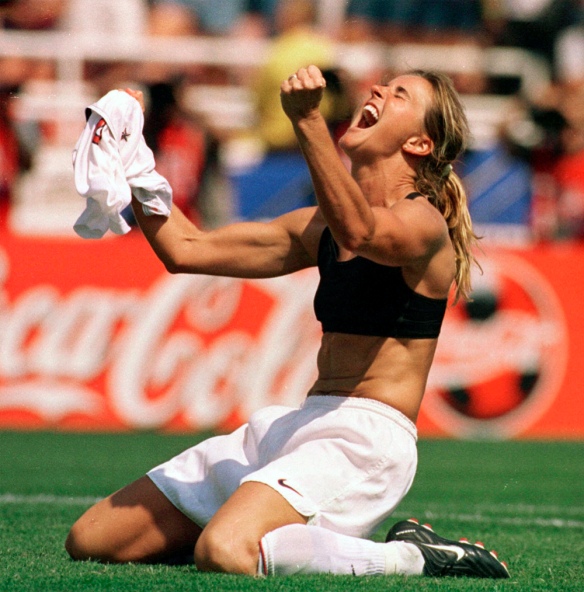
AP QUICK HITS THE 99ERS S SOC FILE USA CA

Women in Sports

The US Women have just won their fourth World Cup Soccer title, kicking balls and ass, I like to say.  What an accomplishment, and how far they’ve come since winning the first ever Women’s World Cup in 1991, the year I graduated high school.  I don’t follow soccer, but as an American woman, this victory carries meaning for me.  At halftime this morning I read about Brandi Chastain, the 1999 US World Cup champion midfielder who famously, spontaneously, took off her jersey in unadulterated celebration after firing the winning penalty kick in double overtime against China to win it all.  The New York Times featured her story yesterday, commenting on the evolution of our perceptions and treatment of female athletes over these 20 years:

In that pivotal moment of arrival for women’s team sports in the United States and around the world, viewers saw Chastain removing her jersey and twirling it like a lariat, spinning around and falling to her knees, pumping her arms in exultant triumph. What resulted was perhaps the most iconic photograph ever taken of a female athlete, a depiction of pure spontaneous joy.

It was a moment of freedom and liberation, Marlene Bjornsrud, a longtime women’s coach and an influential sports executive, once told me. She called it a “casting off the burden of everything that kept us down and said, ‘You can’t do that because you are a woman.’ It was a moment that screamed, ‘Yes, I can.’”

Title IX was signed into law by President Nixon in 1972, one year before I was born.  So I took it for granted that girls could play sports just like boys in school—not every sport, but most.  I also took for granted the inherent assumptions about women in athletics—that we cannot be as fast, as strong, or as competitive as men.  I have so much more appreciation now for icons like Billy Jean King, Martina Navratilova, and Pat Summitt. I think about the WNBA, and women coaching in the NBA, NHL, and NFL, and I marvel at how far we have come.  Take a look at this timeline of women’s sports in the US to get a fuller perspective.  I know many will say we have a long way yet to go.  But today, let us joyfully celebrate all that we have accomplished already.  Wahoo!! [fist bump and dancing woman emojis]


Ortho women residents 1999-2013 jbjs jan 2012

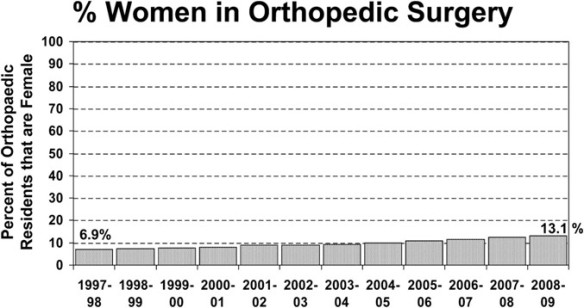
Journal of Bone and Joint Surgery, January 2012

Women at Work

I’m thinking about the culture of orthopaedic surgery.  In the twenty years since I graduated from medical school, I see more and more women in this field (as well as other surgical specialties), which makes me proud.  While women comprise only 5% of practicing orthopaedic surgeons, 15% of American orthopaedic residents are now women, which is roughly double the percentage in 1999.  But what’s it like to be a woman in orthopaedics?  How do these women present, perhaps differently, at work compared to in their personal lives?  Is it truly safe for them to be themselves as surgeons?  The American Orthopaedic Association held their annual meeting recently.  My orthopod friend returned from the conference and commented that the rare women leaders in his field seem ‘fierce’ and ‘tough’—but in a good way?  It struck him to wonder if they are just like that in general, or do they have to be that way to navigate their male-dominated specialty.  He wondered how they would be seen if they displayed sensitivity and emotion, “because a man can be seen as sensitive and kind” and not only does it cost him nothing, his social status is likely to be elevated because of it.  My friend was not sure this is the case for his female colleagues, and he seemed both empathetic and powerless at the idea.  Looks like gender parity may take a bit longer in medicine than in sports.

At work in general, women’s status varies considerably.  But research points to common issues such a 22% pay gap and too few women in leadership (5% of US corporate CEOs), though these are improving.  One need not look far for abundant evidence that having more women on the corporate team improves earnings and morale.  Much is also written on strategies for improving gender equity at work.  Two of my favorites are exit interviews and work-life balance initiatives for all employees, not just women.  But as I wrote last week, it’s not just about including women as participants in the workforce.  It’s about truly appreciating the diversity of experience, biology, and contribution that women bring to any group they serve.


561204_3707569082371_72213499_n

Women and Men

There is no way I can do justice to this topic in the remainder of this post.  So let me just share some ideas and resources I will continue to explore in the months and years to come.

I asked at the beginning what happens for men when women speak Feminism.  A corollary question is what happens for all of us when we hear the words ‘toxic masculinity’?  My guess is men get defensive and women get aggressive.  Personally I love the phrase because it’s so incisively descriptive.  But it can also be a flashpoint phrase, one that immediately incites conflict and emotional hijack.  Let me be clear: toxic masculinity does not imply that men and manhood are toxic by nature.  Quite the contrary, the phrase refers to a culture of expectations of men that is just as toxic for men as it is for women.  Male surgeons may well benefit from being sensitive and kind, but not too much so, lest they be seen as weak.  This is a vast oversimplification, by the way; the history and complexity of toxic masculinity are explored articulately here.

Readers of this blog know how much I love Brené Brown.  Her explanations of how shame (where toxic masculinity is born) manifests and organizes around gender—and why it is toxic for both men and women–are the most poignant and real.  Read her first hand comments to Ms. magazine here, and a stay-at-home dad writer’s interpretation of them here.  If you seek a nonjudgmental, objective, and real-life exploration of the complex dynamics between men and women, read The Gifts of Imperfection and Daring Greatly.  Sister (she’s not old enough to be Aunt) Brené’s books are the most accessible form of evidence-based, all-around relationship advice I have ever read, and I’m so grateful for her.  From the Ms. Interview:

What role do you think vulnerability played in the #MeToo movement?

Know what I love about the #MeToo movement?—and, me too—I thought until I was 25 or 30, that sexual harassment was just the price of entry.  The greatest casualty of trauma is the ability to be vulnerable. So this #MeToo movement is re-defining and re-claiming vulnerability, and putting vulnerability in the context it belongs in, which is power and courage. 

 What gives you hope?

The thing that scares me about the world today is the same thing that gives me hope. I believe we’re witnessing white male power over. It’s making its last stand right now. And it’s scary because last stands are dangerous, and people get very backed into a corner. I think this is the last stand, and that we’re going to see a shift, mercifully, from white male power to inclusive power with it too. And I think from that paradigm, we can do anything, change anything, and be anything. 

And it’s not just women who can claim agency against misogyny and sexism.  Men who identify as feminists serve as allies for gender equity and respect.  But men can also help themselves and each other break free from the restraints of machismo and chauvinism.  Movements like The Good Men Project and Evryman give men a forum for honest, vulnerable emotional expression and connection.  Just like women surgeons and corporate executives, all men need inclusive spaces where they can feel true belonging, where they are free to be all of themselves—hard emotions and all—for all our sakes.

Men I admire in this space include Nate Green, Ozan Varol, and David Brooks.

* * * * *

To lift my spirits here at the end of this long post, I’m listening to a song on repeat: Woman, Amen by Dierks Bentley.  It’s such a shining anthem of a man’s unabashed love and appreciation for his partner.  I can also imagine modifying the lyrics and hearing Faith Hill singing about her man Tim McGraw.

Thanks for reading to the end, friends.

Our relationships kill us or save us, and we really need to be better at taking care of each other, locally and globally.  We, men and women alike, are all in this together, inextricably, in sickness and in health, forever.

Only Love can save us.  Let’s get on it.