Decide in Advance

be the lighthouse

NaBloPoMo 2018:  What I’m Learning

It’s the first Sunday of November of an election year.  The political ads are ramping up.  Tension rises; the agitation is inescapable.  Some media would have you believe that one outcome or another is all but inevitable, the world will positively end if one side or the other wins.  I admit, I have felt my share of darkness and despondence at the words and actions of some (many), not just the last two years, but for a long while now.  It’s hard not to feel sucked into an inexorable downward spiral of animosity and rage.

Thankfully, I still hear voices of uplift, words that speak to the optimist and idealist in me.  Let me share some of those voices and words with you here.

* * *

My friend Donna Cameron, an expert on kindness, reminds us that we have a choice, not just on election day, but every day before and after, about how we conduct ourselves with one another:

We have to ask ourselves now, before we know the outcome of the election: Do we want a united country? Are we still capable of coming together to productively and positively address the complex issues that have divided us?

Civility and compassion are not weak. It takes strength to accept loss and move forward with resolve rather than bitterness. It takes strength not strike back when our buttons are pushed or our values are derided. It takes strength to recognize the pain someone else may be feeling and not belittle those feelings or dismiss their right to grieve.

Don’t look to the politicians or pundits to lose—or win—with grace. They’re going to be gloating in victory and blaming in defeat. It’s up to us to model what constructive behavior looks like and to demand it of our elected officials.

But what can we actually do?  How will we know when to act, and what to do in any given circumstance?  Isn’t it just too abstract to say, “practice empathy,” or “be compassionate?”  Maybe.  But if these are values for us, then we can translate them into actions and practice.  Empathy manifests as active listening, holding one’s tongue while hearing someone else’s story, resisting the urge to interrupt and tell our own story.  It means relating to their feelings and expressing understanding and solidarity.  “That sucks, I know that feeling, Me, Too.”  Empathic listening, validating words, and simply sitting with and holding space are good practices to start with.
The Southern Poverty Law Center offers 10 concrete steps to fight hate.  Examples include:

Repair acts of hate-fueled vandalism, as a neighborhood or a community.

Use whatever skills and means you have. Offer your print shop to make fliers. Share your musical talents at a rally. Give your employees the afternoon off to attend.

Report every incident.  Pressure your representatives.

Finally, look for role models.  If you have not read Ari Mahler’s personal account of caring for Robert Bowers in the ER, please click on the link now.  He is ‘the Jewish nurse.’  What would you have done in his place, called to the trauma bay to care for the man who may have just killed members of your family for their religion?

I’m sure he had no idea I was Jewish. Why thank a Jewish nurse, when 15 minutes beforehand, you’d shoot me in the head with no remorse? I didn’t say a word to him about my religion. I chose not to say anything to him the entire time. I wanted him to feel compassion. I chose to show him empathy. I felt that the best way to honor his victims was for a Jew to prove him wrong. Besides, if he finds out I’m Jewish, does it really matter? The better question is, what does it mean to you?

* * *

Sometimes I wonder if my posts are redundant.  I have decided to think of them as iterative.  Looking back, I found a couple of posts relevant to today, written in similar periods/mindsets of portent, reflection, and seeking.  Right before January 20, 2017, I shared words I had written to friends.

They represent my intentions for managing myself in the coming years, of reinforcing my core values and focusing on my highest aspirations.  As Simon Sinek posted once:  ‘Fight against something, we focus on what we hate.  Fight for something, we focus on what we love.’

Months later I connected with conservative friends in an attempt at mutual understanding. It was not as comforting as I had hoped; I did not really feel heard or understood.  And I learned a lot about managing expectations.

I admit that I felt a little defensive at times, as if anything I said about the origins of my distress would be met with, “You’re overreacting,” and “You’re worried about nothing, please…”  We later agreed that it is never helpful to invalidate someone’s emotional response to a stressor, regardless of whether or not we can relate.

Last week I had a new opportunity to hear a colleague’s conservative point of view on gender.  With practice, I have become so much more comfortable sitting back, listening for understanding, quieting my inner debater.  My urge to counter and convince did not escalate.  I heard earnestness, confusion, some fear, and mostly a desire to understand and integrate, to find balance and peace.  I was not asked for my opinion, and this time I was okay with it.  I hope we can engage again and again in the future.

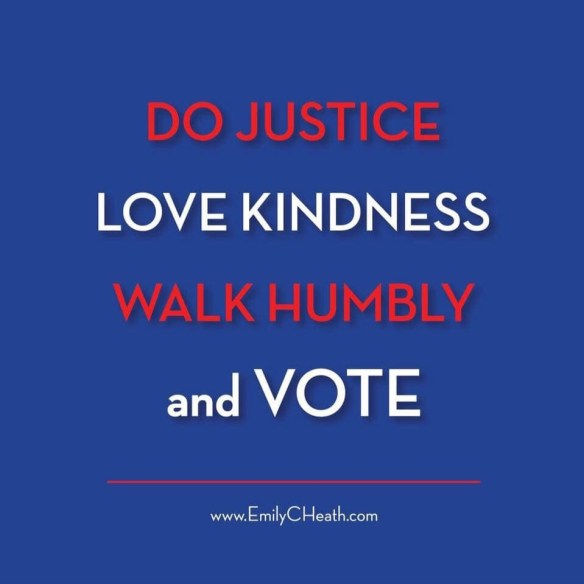
Today, two days before we all head to the polls (if we have not already—please please vote), we can decide what kind of neighbor, colleague, friend, parent, child, coach, teammate, employee, boss, coworker, and American we want to be.

What if we choose to be the kindest, most empathetic and compassionate ones we have ever known?

Walk a Mile

DSC_0440

NaBloPoMo 2018:  What I’m Learning

These last 5 years, I have had the privilege of caring for designated leaders of all kinds—business leaders who also lead their families, their faith communities, their professional societies, and myriad other entities. I have studied and presented on the intersection of health and leadership, the reciprocal relationships between self-care and care of others.  Each day I ask probing questions of my patients’ habits of thought and action, and they answer with honesty and candor.  It’s particularly fulfilling when I hear, “Huh, that’s a good question, I’ve never thought of that before.”  In those moments, I feel I bring value beyond interpreting blood pressure and cholesterol results.

I’ve been interested in leadership for a long time, and had opportunities to lead in various small ways through the years.  In January 2018, I was given a more visible title and designation than I had ever had—YIKES.  I was surprised and unsuspecting, though not totally unprepared.  And, like parenting, nothing can quite prepare you fully for the experience.  I spoke to a leader in my organization about a year ago, who expressed loneliness in his position.  I admit that I half dismissed the idea, thinking there should just be a way to balance collegial, friendly, and leader-led relationships.  I think I was about a week into my new role when I fully, viscerally, understood his perspective and humbly admitted my own loneliness.  I felt guilty and a little ashamed for my reflexive disregard for his confession of vulnerability—because even if I did not fully dismiss his experience, I did judge it.  And that speaks more to my own fear of loneliness and isolation than it says anything about him.

Thankfully, I did not wallow in guilt or shame for long.  “How fascinating,” I thought.  Being judgmental like that is not consistent with my core values.  These ten months have been a practice in navigating and managing that loneliness—cultivating relationships in new ways to maintain connection while simultaneously practicing the required discretion in information sharing.  Often I have felt profound humility (and now more embarrassment than shame) at how I thought I knew so much about effective leadership, mostly from the point of view of being led, and only sometimes as a leader myself.

DSC_0645

This fall Brené Brown saved me from further self-flagellation over my lack of skills and understanding of what it takes to be a good leader.  The thing I admire most about her is how she walks the talk of vulnerability and courage.  She shares her mistakes, missteps, and learnings so openly, and anyone who reads her books or sees her presentations gets to profit from it all.  I will always remember where I was, because I laughed out loud in sheer relief, when I heard her read from her latest book, Dare to Lead:

Over the past five years, I’ve transitioned from research professor to research professor and founder and CEO.  The first hard and humbling lesson?  Regardless of the complexity of the concepts, studying leadership is way easier than leading.

When I think about my personal experiences with leading over the past few years, the only endeavors that have required the same level of self-awareness and equally high-level ‘comms plans’ are being married for twenty-four years and parenting.  And that’s saying something.  I completely underestimated the pull on my emotional bandwidth, the sheer determination it takes to stay calm under pressure, and the weight of continuous problem solving and decision making.  Oh, yeah—and the sleepless nights.

I thought, well, if Brené Brown still had stuff to learn after assuming a new leadership role, then I’m doing okay!  I am both freed from self-imposed, unrealistic expectations of perfection, and also still responsible for continuing to practice self-awareness, humility, and honesty.

I have learned to look harder at the cynical stories I tell about my leaders, and seek to understand better the divergent and competing interests they must balance every day.  I can withhold judgment of their motivations until I have more information, and if I’m not entitled to all the information, I can decide how much I trust my leaders to act in my best interests, or at least in the best interests of the organization.  I can hold myself accountable to my own standards of honesty, candor, and integrity.  I can ask and challenge, inquire and resist (or accommodate), all with curiosity and respect, and making the most generous possible assumptions of others.

How lucky am I to have this remarkable learning opportunity?  To practice the skills I have observed, admired, and studied in others for so long, to own them.  I have walked a mile in these new shoes.  I have a few shallow blisters for the journey so far.  But the shoes are the right size, and the leather is softening.  I’m still feeling fit.  The path will wind and climb, and that’s okay.  I don’t walk alone; I have mentors and role models walking ahead and by my side.  So bring it!  We’ got this.

We Are Tested

9-2018

What a shit week.  I wonder, how are you doing, my friends?  Because I look around and it really seems like I’m not the only one feeling it.  A friend’s young, healthy sister-in-law was diagnosed with metastatic lung cancer and possibly also lymphoma.  Another friend’s cousin died from a drug overdose after recently completing rehab and getting back to her young family.  Patients are sick with mysterious and disconcerting illnesses.  Pipe bombs were sent to a slew of Democratic leaders and supporters.  And today a man commits yet another deadly, hate-driven shooting.  Seriously, WTAF?  And I honestly think we have yet to hit rock bottom.  I don’t see any of it turning around anytime soon.

I have barely made it through—so much psychic energy required to simply move from one task to the next, taking care of many (and not so much some others).  This past year, actually, sometimes I’m barely holding it together.  First the knee injury, then taking on a new big role at work.  Then surgery/rehab, and another personal crisis that derailed all of my health habits for spring and summer.  As I go around the country talking about personal resilience and culture of wellness, I wonder, am I being a hypocrite?  Am I really walking my talk?  Because if I’m not, I had better just sit down and shut up.

I wrote to a friend today, “I hope you are able to take care of yourself and recharge.  The energy in the world is so tumultuous and agitated.  It’s no help to blame and lament (well maybe lamenting can be a bit cathartic—for a while).  I guess this is a time to exercise our best skills—sharpen them against the harsh and jagged surfaces of challenge and trial.  I feel like all year my professed self-care practices have been called out and called forth—TESTED.  And I’m still here…  Still doing some good every day (I think), alongside the mistakes, the sub-par moments, the not-my-best words, actions, and thoughts…  But hey, who’s perfect?  Nobody.  And are we all here doing the best we can?  I agree with Brené Brown’s husband Steve, the pediatrician: It helps me live better when I choose to believe that we are—all visible evidence to the contrary.” (Here is another article that describes well the benefits of this mindset.)

CO fall 2018

Similar to last week, as I consider this idea, I am met with readings and conversations that deepen the exploration.  Friend and author Donna Cameron published an op-ed today in which she, in her typically kind and gentle style, encourages us all to be our best and see the best in others—on November 7, a day full of potential for vehement loathing and gloating celebration.  In her wisdom, Donna urges us to think ahead and decide in advance how we will choose to think, speak, and act.  How can we be our best on that day, to ourselves and to one another, no matter what the circumstances?

Recently I have had conversations with trusted friends, my coach, and my therapist, focused on my own most cavernous arenas of personal self-loathing and shame.  How lucky that I have such generous, loving, wise, candid, and brave people holding me up.  With their help, I can move past shame, take a step back, and recognize that I simply have some dysfunctional patterns, just like everybody else.  I slide into these deep grooves when I’m stressed, exhausted, and distracted—they are the default. They are part of me, and also subject to change—to intentional modification, gradual evolution.  These days I meditate often on the distinction between perfection and healthy striving, and I’m also reminded daily of the benefits of cultivating a growth mindset.  These days, instead of berating myself for falling into the same deep hole in my sidewalk, I can hold it more lightly, laugh, and exclaim, “How Fascinating!” climb out (often with a little help from my friends), and walk—ever onward.

IMG_0218

Today as I walked outside, slowly (I’m so tired), I noticed the leaves again.  I think autumn is my favorite season.  It reminds me of the wholeness and beauty of transitions.  They are inevitable.  They are temporary (or constant?).  They are unpredictable, at times prolonged, at other times sudden and acute.  They can feel at once painful, joyous, terrifying, shocking, enlightening, overwhelming, confusing, awe-inspiring (or simply inspiring).  It occurs to me that the best way through them involves practicing some combination of mindfulness, self-compassion, empathy, generosity, deep breathing, sleep, connection, self-awareness, magnanimity, and of course love.  The only way out is through, and if we do it well, we can grow a little at a time in the process.

IMG_0223

Who knows what shit will be flung our way and hit the fan next week?  How will we cope?  I know I will be leaning on my tribe and looking to make our ties ever stronger and thicker.  Thank you for being here to share the journey.