
#AtoZChallenge: Xerophyte People

Webster’s Ninth New Collegiate Dictionary

Xerophyte: a plant structurally adapted for life and growth with a limited water supply esp. by means of mechanisms that limit transpiration or that provide for the storage of water.
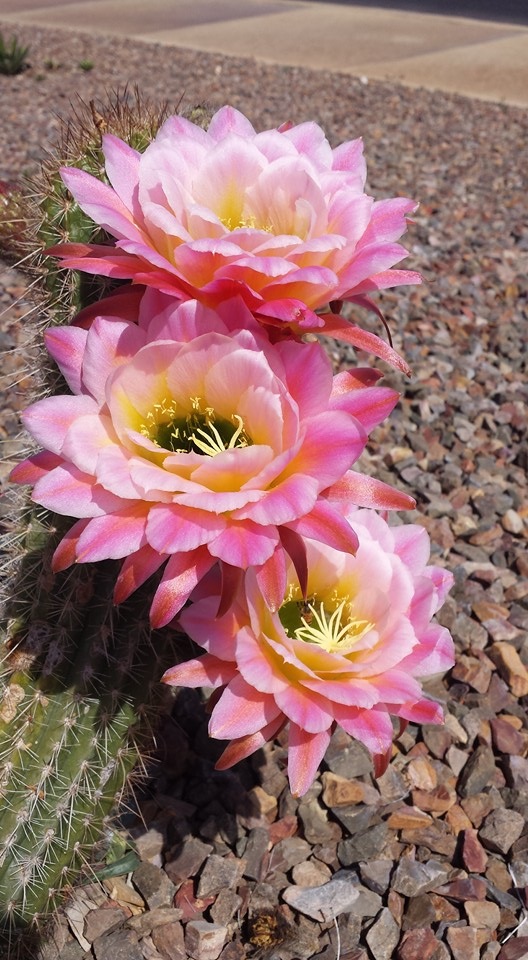
AC cactus 2016

Photo courtesy of Cyndie Abbott, Green Valley, Arizona, 2016


Water is essential for growth and survival—of plants and animals alike. So how is it that some plants can not only survive, but thrive and even reproduce, with so little water?  On top of that, they also provide beauty, habitation, and even sustenance for others.  Their short-lived flowers splash color onto monochromatic landscapes.  Regional animals are adapted to live nestled among some xerophytes’ barbs.  Survival programs tell us to seek these plants as a source of essential hydration when stranded in the dessert.

Humans share many of these tough flora’s adaptive qualities. We evolved as omnivores, able to eat most things that grow in nature.  Our big forebrains allowed us to cultivate plants to eat.  We learned to capture, then herd, animals for our own use.  We have come so far as to alter and control our environments, in order to live in places where nature may never have intended.

But the more interesting parallel between xerophyte plants and Xerophyte People is resilience.  If we consider metaphorical water for human life, many things come to mind: joy, security, connection, purpose, meaning, love.  Think of all the people who live with little or none of these things.  Think of those who once had these things, and then had them forcibly taken away, often indefinitely—by war, abuse, illness, death.  In medicine, we witness this kind of suffering regularly.  Our hearts break alongside those of our patients and their families.  But it’s not always forever.  In primary care, where I have the privilege of knowing patients over long periods, I have also celebrated remarkable reversals.  New relationships, revelations, births, treatment innovations—you never know what will happen to turn the tide.

So what keeps us hanging on? Like plants, maybe we figure out ways to prevent further loss—limit transpiration.  Thick skin and prickly spines keep us protected.  Only the very persistent or the specially equipped can penetrate our defenses.  But more important, we have adapted to store what we need.  Even if we cannot readily identify or articulate it, something keeps us going.  Maybe it’s hope, remembrance, or some core value or aspiration we have yet to realize—some inner pilot light that never goes out.  Some might call it the human spirit.  Whatever it is, I stand in reverence of its mystery, its utterly saving presence.

To all the Xerophyte People in our world, I say as Glennon Doyle Melton does:  Carry On, Warriors.
IMG_1680.JPG

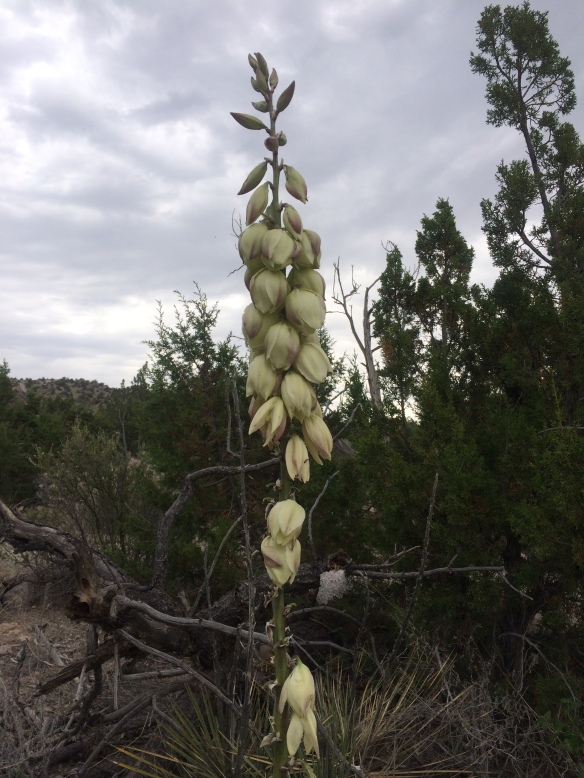
Tent Rocks National Monument, New Mexico, June 2015

#AtoZChallenge: Every Day A Revolution

Brad Paisley is one of my favorite celebrities. I like him as a person because he likes to have fun and he doesn’t take himself too seriously.  I like his songs because they tell fun stories and also address social issues like racism, sexism, and domestic violence.  I also admire how he uses language and double entendres.  His song “Welcome to the Future” describes how the world has changed over the decades.  From having to go to an arcade to play Pac-Man to having it on his phone; from fighting the Japanese in World War II to collaborating with companies in Tokyo.  He also references the civil rights movement.  One of the lines sings, “He-e-e-y, every day’s a revolution.”

Every day the earth makes one turn on its axis; things keep moving as they always have. It can feel pretty mundane, or utterly reassuring.  On the other hand, every day there may be another kind of revolution, defined by Webster’s Ninth New Collegiate Dictionary as “activity or movement designed to effect fundamental changes in the socioeconomic situation.”  I love this dual meaning of the word, as well as the word itself—it rolls off the tongue, strong and steady.  Revolution requires an axis, a center.  A globe rotates steadily, stable in particular dimensions.  On the other hand, social (or personal) revolution requires destabilization, transition, and transformation.

Newton’s law of inertia states that an object at rest tends to stay at rest, unless acted upon by an unbalanced, external force. Inertia relates to the status quo, the way things are and have always been.  An external force does not appear out of nowhere; it must have a source.  When it meets the stationary object, potential energy is converted to kinetic energy—it generates movement.  Once set in motion, the object tends to stay in motion, and voila, progress.  Similarly, chemical reactions require a threshold activation energy to proceed.  Molecular force mounts almost imperceptibly until that threshold is reached, and then the reaction ensues spontaneously, sometimes spectacularly.

Progress can be at once incremental and radical. Considering women’s suffrage, civil rights, and gay marriage, for example, history shows us long arcs of people laboring tirelessly for causes over generations, leading finally to pivotal and critical policy changes.  In the first two cases, expansive movements of inclusion have allowed all of us to benefit from the talent, participation, and contributions of formerly excluded and oppressed groups.  Like the turning of an incandescent light bulb, gently, patiently, and consistently in one direction, the steady work of activists eventually leads to sudden and intense illumination.  Darkness becomes light, cold spaces are warmed.

This is the kind of Revolution I seek.


#AtoZChallenge: Questioning A to Z

I love asking questions, the more open-ended the better!

So let’s have a little compounded alphabet fun:


Question your Asssumptions.  Allow for Alternate realities to the ones you Assume.

Question your Biases.  Broaden your perspective.

Question your Conclusions.  What other stories could you tell to suffer less in your Circumstances?

Question Dogma.  Whom does it benefit?

Question Everything—just to make sure you get it.

Question your Fear.  Understand its utility, then put it in its place and move on.

EGilbert letter to fear

From Elizabeth Gilbert’s Facebook page, March 11, 2016; an exerpt from her brilliant book, _Big Magic: Creative Living Beyond Fear_

Question Generalizations.  Apply them to individuals with Great caution.

Question Hubris.  Where Hides it in you, and how does it Hinder your enlightenment?

Question Ideas.  Flesh them out, stoke them, cultivate them.

Question Jealousy.  What does it do for you?  How does it make you behave?

Question Knowledge.  What do we really “Know?”  Beware the arrogance of believing we can Know all.

Question Love.  Reassess, revitalize, rekindle, relinquish.  Probe it, because it evolves.

Question the Majority.  Have they really got it right?  Stand with the Minority when necessary, and Question them, too.

Question Nature.  Explore.  Dig.  Observe.  Learn.  Exalt!

Question Opacity.  What’s being hidden or withheld?  Why?

Question Perfection.  Is it really attainable, and what does it cost you to strive for it? Consider Perseverance as a healthier alternative Pursuit.

Question Quality.  What’s it worth to you?  What are you willing to settle for?

Question Resistance.  Have patience, get curious.  Before attempting to persuade, try to understand.

Question the Sages in your life.  Ask them to tell their stories.  There is always something to learn.

Question Time.  There is no substitute and it is finite.  Are you spending it wisely?

Question the Universe.  What has it to teach us?  In its vastness, what do we contribute?

Question Violence.  Where lies its inciting pain?  Can it be healed?  How can we prevent it?

Question Wealth.  Do you have it where it matters?

Question Xenophobia.  Always.

Question Yesterday.  What moved you? Surprised you? Taught you?

Question the Zeitgeist.  What does it tell us about our life and times?  Do we  need to change course?


What, how, when, why, and whom do you Question?