I have thought actively about this question for weeks now, if not many years.
It’s easy to see doctors, nurses, teachers, and childcare workers as Helpers–we do it for a living. Do you consider yourself a member of a Helping profession? Why and why not? Here is my premise: We are all Helpers.
I just spent two days at Readers Take Denver, my first ever book event (it’s all about romance, surprise!). I skipped my annual national professional society meeting, in the city where Son goes to school, to attend this giant convention where I would meet some of my favorite voice actors and fellow Shane East fanatics. It. Was. Glorious.
I decided to get the whole experience, so I registered to volunteer for parts of the event. I was assigned to help Susie Tate for an afternoon, taking pictures with readers and moving books. I knew of her but have not read or listened to any of her work. Turns out she’s a doctor in the UK! We hung out between signings, and when anyone approached the table I got so excited to help a fellow woman physician writer connect with her readers! What a privilege. Looking back on our conversations, it stands out to me that Susie’s work as both physician and romance author helps people immensely. She may see 50 patients a day in her general practice clinic, and when someone is sick she knows how to navigate the system to get them admitted while also caring for everybody else on her schedule. It’s heroic. She draws on her medical knowledge and experience in writing novels with complex characters, living relationships of struggle and redemption. Readers and listeners relate to her stories and gush about how much her books mean to them. Susie Tate and all of her romance author peers are Helpers, no question.
Let’s also consider the amazing, talented, generous, and gifted romance narrators, shall we? I have now met Shane, as well as Jason Clarke, Sofia Lette, Kit Swann, Angelina Rocca, Gary Furlong, Henry Kramer, Sean Crisden, Lessa Lamb, Chris Brinkley, Aaron Shedlock, and Teri Schnaubelt. Not only do they bring these empathic stories to life in our ears, but they are, themselves, some of the most kind, compassionate, present, thoughtful, and attuned people I have met. It makes sense, right? They engage with stories every day, putting themselves in a diversity of characters’ shoes, minds, and hearts, all in service of helping us relate more deeply and meaningfully to our shared humanity. Wow. Helpers. God bless ’em all.
En route to Denver, I texted my Ethos friends (who are all basically 20 years my junior):
The Ethos Breakfast Club showed up! Encouragement, reflection, validation, humor, and love flowed forth more than I could have imagined, and I felt immediately buoyed. I was able to present at the convention not just to Shane, but to everybody I met, all me and all in, feeling humbly confident, grounded, and attuned. If you are a friend, you are a Helper! In times of struggle, pain, defeat, and fear, who but our friends lift us up? In times of joy, accomplishment, celebration, and connection, who but our friends ampify the light most brightly? I say often, “The only way out is through; the best way through is together.” It is a truth I hold sacred; none of us does anything without help from others.
And it was on me to ask for the help I needed, no? Helping oneself, in this case knowing when, where, and on whom to call, is a life skill, as important as any other. Individualistic Western culture promotes a delusion of self-made-ness that harms us. With help from one another, we can learn to balance independence with interdependence and live richer, more stable, and more fulfilling lives. We simply cannot overestimate how much human connection helps and heals.
Know it, like it, want it or not, we are all in relationship. All humans, everything in nature, the cosmos. Therefore, anytime you do something that makes anything better for anyone else, you Help us all. Stocking grocery store shelves. Driving a city bus. Growing food. Performing standup comedy. Listening. Parenting. Taking care of yourself. Imagine if we defined any given job or activity as Helping? How would this change our perspective about its role in society? How would we show up differently to the work in this new context? ‘Helping,’ as a concept, feels very different from ‘providing a service.’ The former is personal; the latter is transactional. Helping is connecting, person to person, recognizing and honoring shared humanity.
Identify as a Helper.
How could everything be better if we all practiced this, even a little bit?
Oh friends. So much is going on. How are you this week?
When I posted about white male allies last weekend, it was not just because of International Women’s Day. For the past couple of weeks, the romance audio community has roiled in allegations and discovery of unethical and predatory behavior by one individual, a male narrator and producer, against women–authors, narrators, and fans alike. My new friends and people I respect and admire have been triggered, shocked, saddened and enraged, as well as attacked and dismissed for their experiences. It’s all so discouraging, so human. The allegations are numerous and consistent. Some of the person’s defenders are aggressive and do not refrain from ad hominem attacks against those who have spoken out. Comments on all sides have escalated and people are suffering.
This post is not about parsing allegations or judging a perpetrator. It’s an exploration of the complexities of effective allyship. It’s a lot more complicated than my post last week makes out, though the central values and tenets are simple and fundamental.
Messaging with a friend a few days into the controversy, I asked, “Wondering how any male narrators would be willing/able to step up as more visible, direct allies? This is always such a big ask… I would never want them to put their own careers or personal lives in jeopardy from any backlash or get entangled in unproductive arguing… I guess it’s a question we can all ask ourselves—how we can make the most effective positive difference in our own way, given our own circumstances… how much we are willing to risk, etc…”
So, what are the questions to ask when we consider upstanding and allying?
How does this affect me directly? Indirectly? How do I feel about it? What do I think about it (because these are different)? How does this affect people I care about, whom I respect and admire? How does this affect all of our relationships, professional, personal, financial, and other? What do I not know? What do I need and not need to know, to act? What can I do? What can I do? What can I do? What am I willing to do? What would I be trying to accomplish? Do I have the bandwidth/reserve/resources? What is my role here? What will it cost me? What will I be risking? What is the worst-case scenario if I act or don’t, and how likely is it to occur? What would that be like, could I handle it? What are the consequences for others if I act or not; could I cause unintended harm?
What core values of mine, of the community, are violated here? How can I best uphold and live into those values in this context?
What other questions do I need to ask?
Not all the questions above can be answered quickly or completely. Emotional overload can lead to knee-jerk reactions and do more harm than good, increasing the likelihood of regret and damaged relationships in an already fraught situation. The way forward is often unclear at first. So we must slow down, think things through. In the interim, silence may come across as indifference. Anything said or done, or not, may be criticized; no response is 100% ‘safe.’ Each of us handles stress and conflict differently. We must remember not to judge one another about how we engage–there are many ways to upstand, each partially ‘right’, and also likely incomplete.
Allyship carries cost. The first costs of thoughtful, intentional allyship are emotional and mental.
The next costs are relational, and then reputational, financial, professional–myriad. The more visible we are, the greater the potential risks of taking a stand, staking a position. If we hold a designated or implicit leadership role in the community (and I would argue that we all/each lead in some way, know it, like it, want it or not), our choices and their potential consequences are that much more complex. For someone whose livelihood depends on maintaining relationships despite conflict, costs can be high in multiple ways. Choosing between one’s ethics and paying the bills never feels good, and we never know when someone may be in that situation. We must all decide for ourselves, in real time, the risks and costs we can bear. Not everyone stands in a position to decline work or dissent safely. Conscience and context often conflict. We each make our own decisions, and in the end, we must live with ourselves—our choices, our relationships, our regrets. Judging others for doing differently from us serves no useful purpose.
Some have asked, “Do I have a right to speak here? Is it my place to say anything?” What if the problem doesn’t involve or affect me directly? What if I’m just butting in? I wonder if this is the question that distinguishes an upstander from a bystander?
The list of questions above, considered thoughtfully and with core values in front, can guide us to the words and actions that feel most honest, authentic, grounded, and appropriate. In my mind it all comes back to relationship. As an ally my job, my role, and my ultimate objective is to uplift and uphold my loved ones in distress. Allyship, to me, means showing up with openness, empathy, compassion, kindness, and respect. It means validating someone’s emotions and experience, regardless of my opinions about the situation. It does not mean prosecuting without evidence or attacking on someone’s behalf. In the short term, real allies breathe, hold space, and stand in solidarity. There is a closeness, an intimate proximity that includes eye contact, erect posture, and a deep, resonant presence. I’m here for you. I see you. I’m in this with you. Even if we are not physically together, true allyship can be felt this way across great distances. In the long term, allies work for systems changes that benefit us all. If we start here, tapping into our capacity for deep Agape love, then the words and actions are more likely to come from a place of real connection. As fellow humans, I think we do have this right, and it is our place. We are called to care for one another.
You are not alone. I see you. I stand with you. We are stronger together.
Costs of allyship are real. When we bear them together, the more of us upstanding in concert, we each pay a little less. We all benefit. Allyship is leadership with presence, openness, groundedness, kindness, and love. It shows up as integrity, accountability, and respect.
Practice giving grace. We are all humans, here doing our best. We all fail. Forgiveness and accountability are not mutually exclusive.
I know this post is already long, so I appreciate that you’re still reading. There is more! I write to clarify and document my own thoughts and opinions, to record my own process, so I may look back and see what progress I might make. If any of it resonates with you, dear reader, then that gratifies me.
Compassionate Accountability
I believe the people who have spoken out. I believe they were manipulated, taken advantage of, and harmed. I do not believe, however, that the person they accuse is evil, or in any way deserves to be threatened, dehumanized, attacked, or harmed himself, in any way. He is human, just like the rest of us. One of my core assumptions about humanity is that we are all here doing our best. So how is it that some people’s best is so hurtful to others? How are humans so loving and so scary, so constructive and destructive at the same time? It’s too big a question to answer; we can only live it, as Rilke says.
As some have pointed out in the past week, ‘hurt people hurt people’. I believe this, as it often explains so much. As a fundamental perspective, this default stance in the face of harmful human behavior holds our minds open to empathy, compassion, and forgiveness, which are what heal us, perpetrators and victims alike. We are all the amalgamation of our past experiences and those of our families of origin, traumas included, over generations. We all have our triggers and reaction patterns, established early and evolved over a lifetime. Severely dysfunctional behavior patterns root deeply, and the inner work required to modify or moderate them is arduous. I can hardly imagine how anyone could do it alone—heal and overcome, learn to lead with love and vulnerability—this is not do-it-yourself stuff, my friends. And yet one of the first things we do to hurt people who hurt people is isolate them. We judge, shame, dehumanize, and ostracize them, among other things. How could that possibly help stop them from hurting more, both themselves and others?
This is not to say that aggressors should not be held accountable for their actions and harms. Accusations and evidence must be aggregated and assessed objectively, thoughtfully, and in context. “Innocent until proven guilty” is another useful premise from which to proceed. Easier said than done, though, no? How many allegations does it take for accusers to be believed, for any of us to act on their behalf, to upstand, defend, and advocate? And what actions do we take?
Once again, I go back to the list of questions above. I need to be still, sit quietly, and settle into my own inner knowing. After tending to the affected, how do we address the alleged perpetrator? Separation and protection of victims from additional potential harm comes to mind first. But here is where we must beware of that fundamentally high-risk divergence—encircling victims in love and compassion, and basically throwing away alleged offenders—ejecting them from the tribe, irrevocably, physically and socially. The latter, while immediately gratifying, is counterproductive in the long run. In the end, some felons forfeit their right to live freely among us. Even then, however, their right to be treated humanely and with dignity is still innate and should be held intact.
Imagine confronting the accused calmly, kindly, and compassionately, and also firmly, calling forth their better nature to own their actions and the consequences thereof. Picture having fortitude and magnanimity, enough inner peace ourselves, to stoically withstand their defensive backlash, however vehement, grounded in solidarity and allyship not only with their victims, but with the part of themselves that also hurts. When I think about this, about the magnitude and depth of pain on all sides, the immensity of it all feels almost intolerable. No wonder we short circuit to ad hominem and violence. The overwhelming distress and anguish of holding others’ pain as well as our own, of being with all the darkness, wading into the depths—this is a cave of emotional and mental stress that few of us are experienced or trained to navigate. And yet, I think it is where we must go, a journey we must take, to get past the oversimplified, binary, save the victim/punish the villain dichotomy. I know some who have the skills, who embody this ethos of messy shared humanity, and who can teach and lead us, by example more than anything.
Hurt people hurt people. How can we help one another hurt less?
What does true allyship really mean, and how can we each and all achieve it? For me it is both acute and chronic, simple and so complex: It is about universal love. In each new situation when people are hurting, I can take it slowly, ODOMOBaaT–one day, one moment, one breath at a time–to determine how my allyship manifests best, appropriate for context and aligned with my values.
This narrator/producer controversy feels like an earthquake in the romance community. Or maybe a typhoon? Some felt the tremors, saw the cloud formations long before anybody else. Now it has hit, everything is shaken, and lives are altered. Here in the immediate aftershocks, we must take care of the wounded. First responders have mobilized, and some can only yet self-protect. We all must take care of ourselves first. Next, we sift through the rubble. Everyone is affected, though differently; our losses are unique as well as shared: relationships, valued possessions, assumptions of safety, trust, and connection. Emotions spiral, opinions fly, conflict escalates. The more deeply we can breathe, the more slowly we can speak and act, the better we will all be in the long run. With time, clearer, less loaded assessments may occur. Systems, guidelines, recourse can be revised for better transparency, accountability, and equity. Here we risk overcorrection, a hyperreactive response, all well-intentioned, and also counterproductive. Crises will inevitably recur, and the cycles persist. Alas, that is how we humans do. How wildly imperfect and eternally exhausting.
How else can we go but slowly, one step at a time, and together?
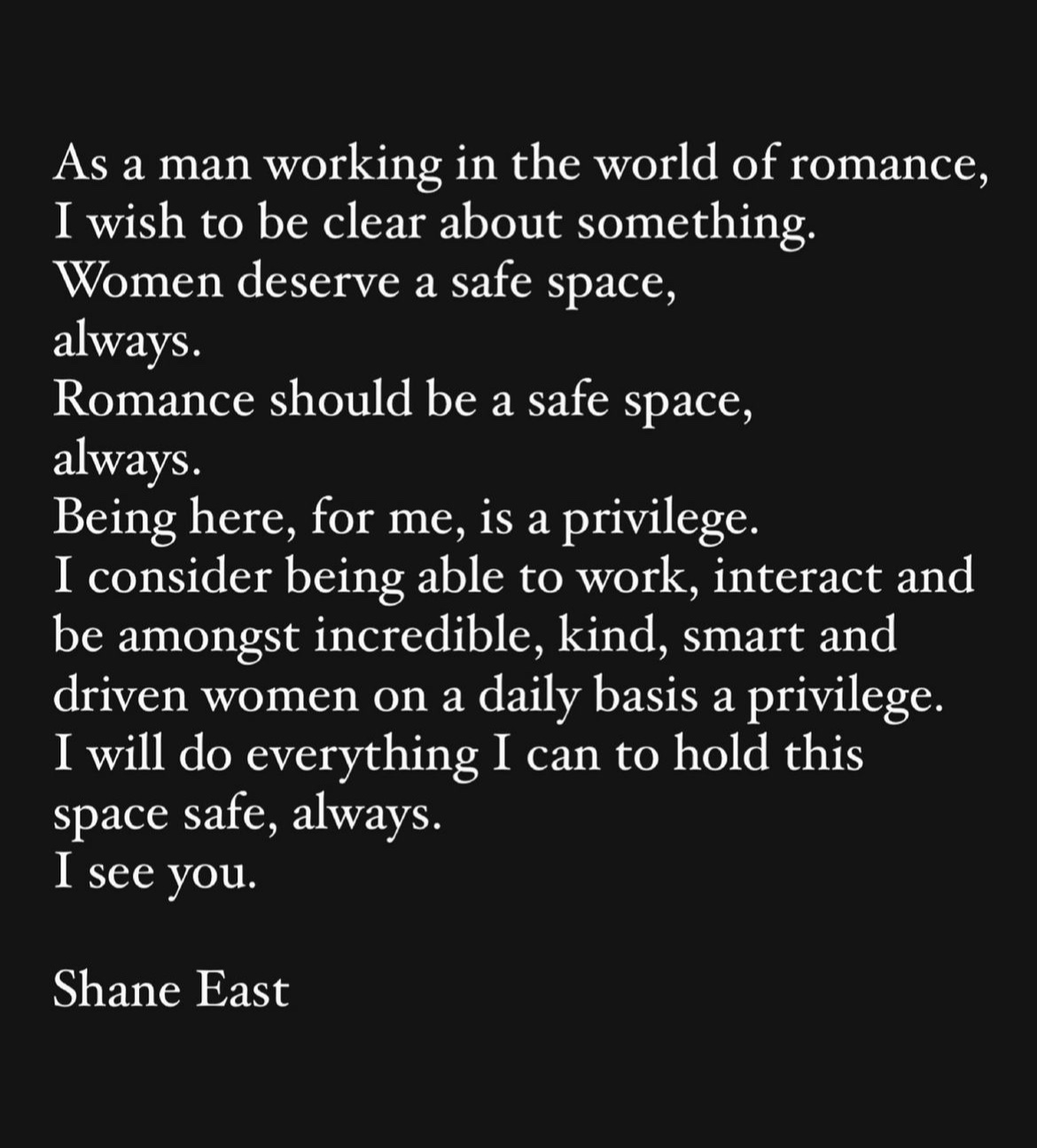
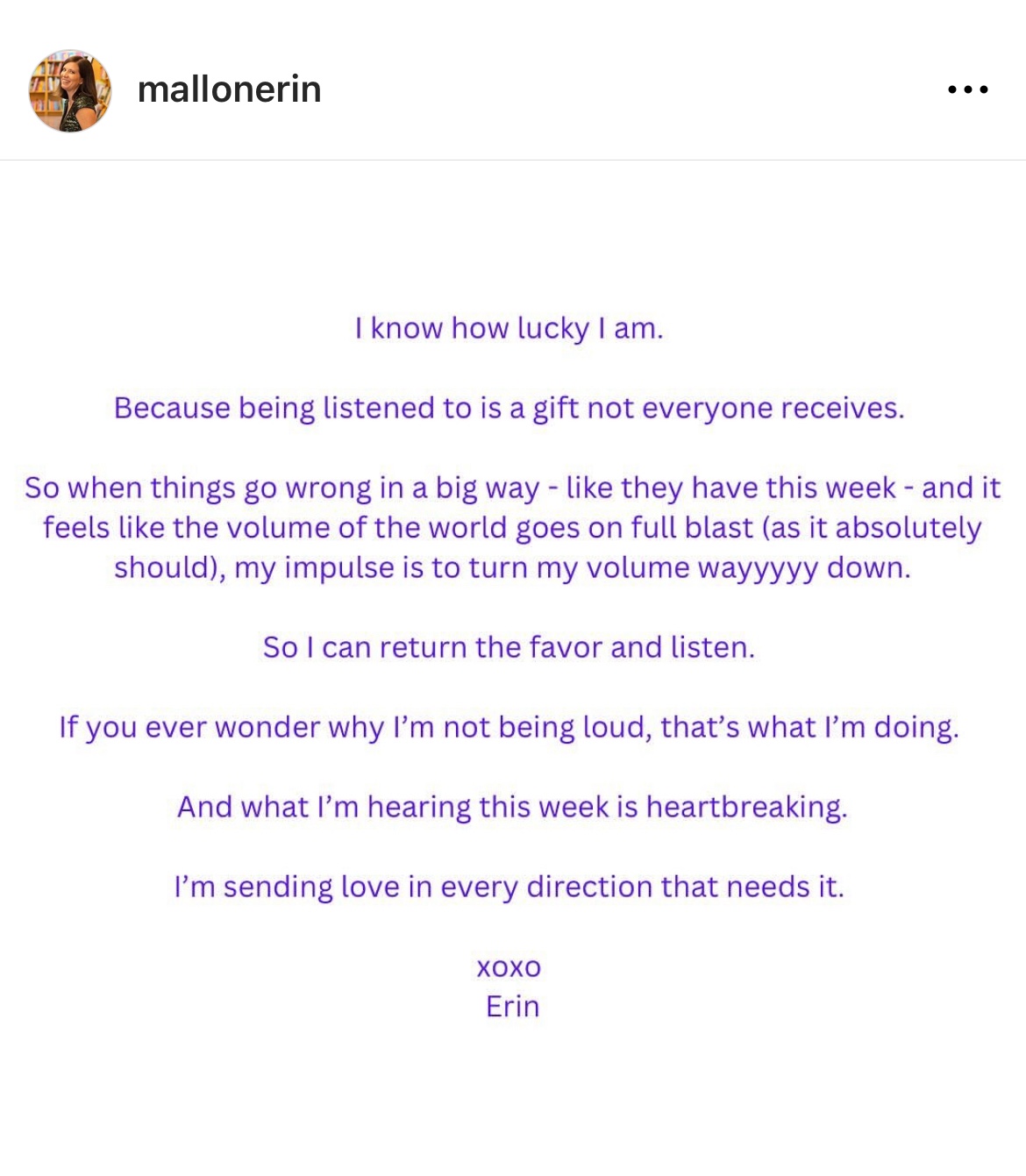
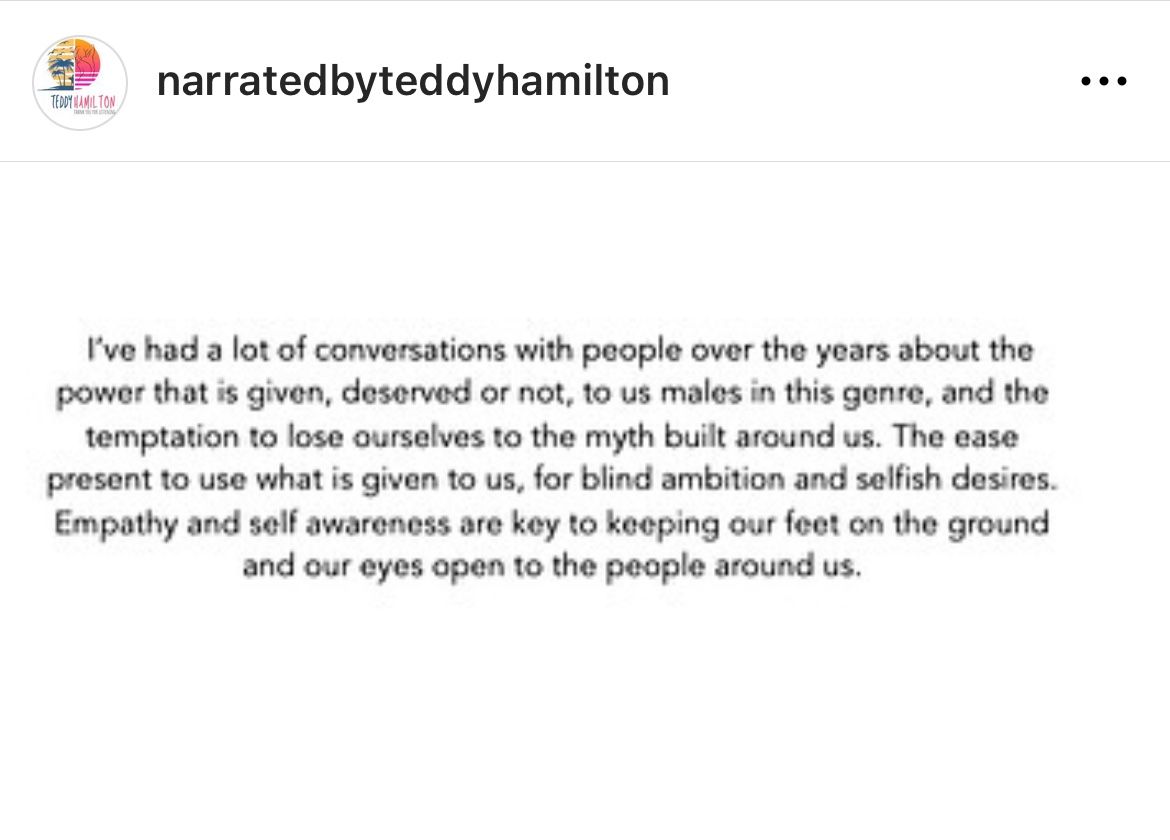
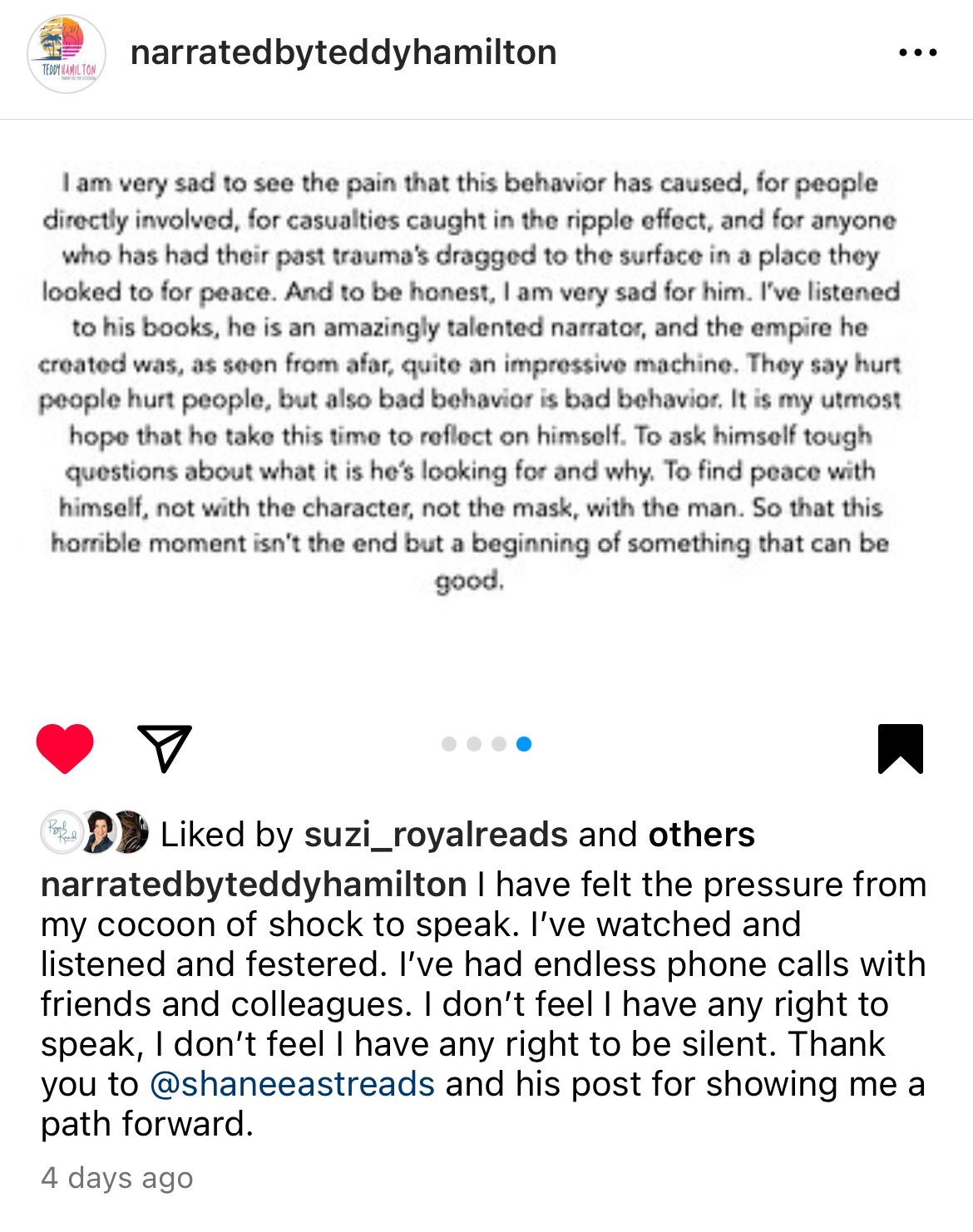
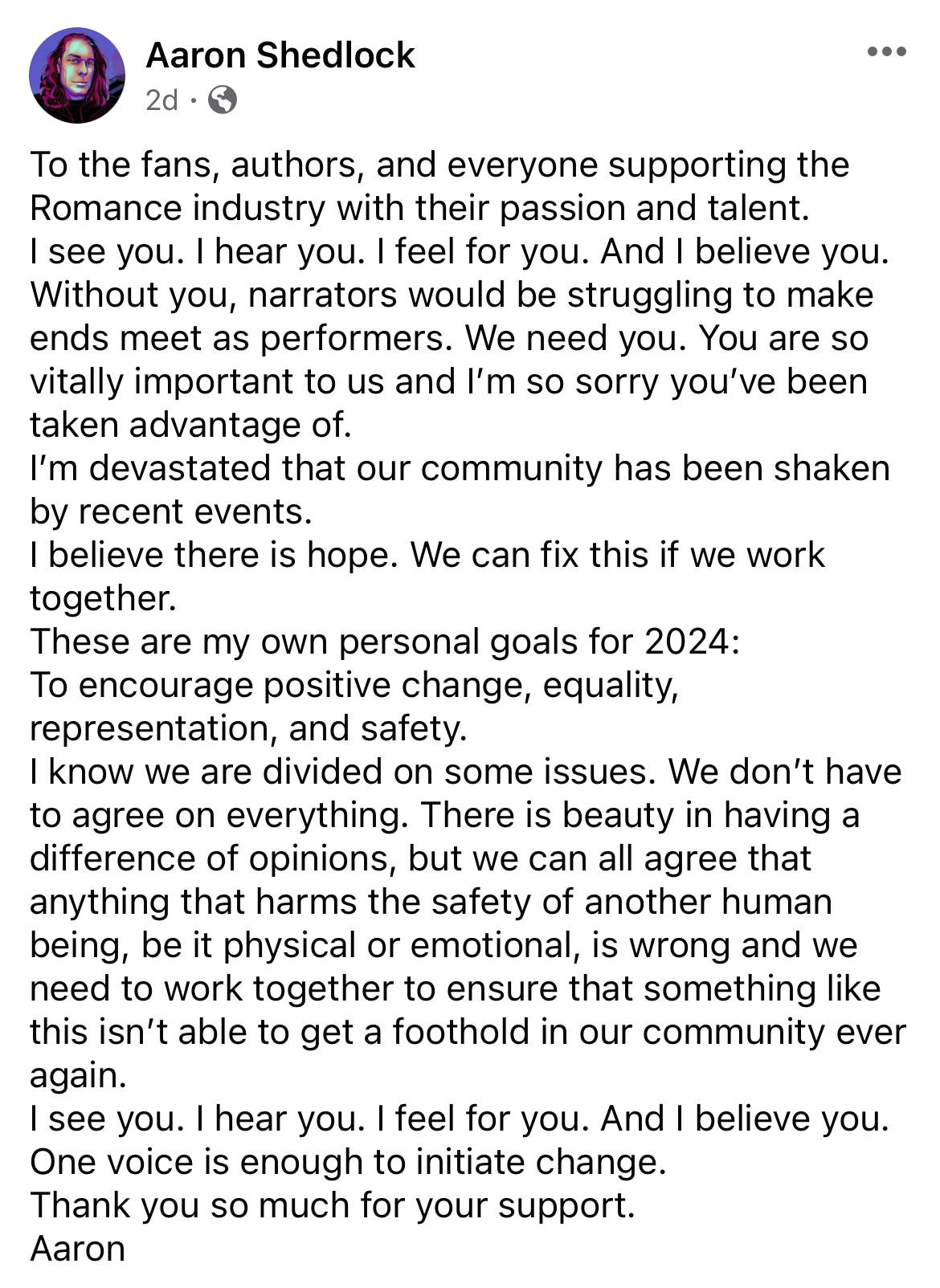
I have included below some ally statements that I admire. Please help me hold the romance audio community in peace and light. And wherever you are, whatever you’re doing, whomever you’re with, I wish you what you need to stand up on behalf of those you can help.
Watch Andi Arndt’s full video here; listen to her describe so adeptly the responsibility of artists who use psuedonyms.
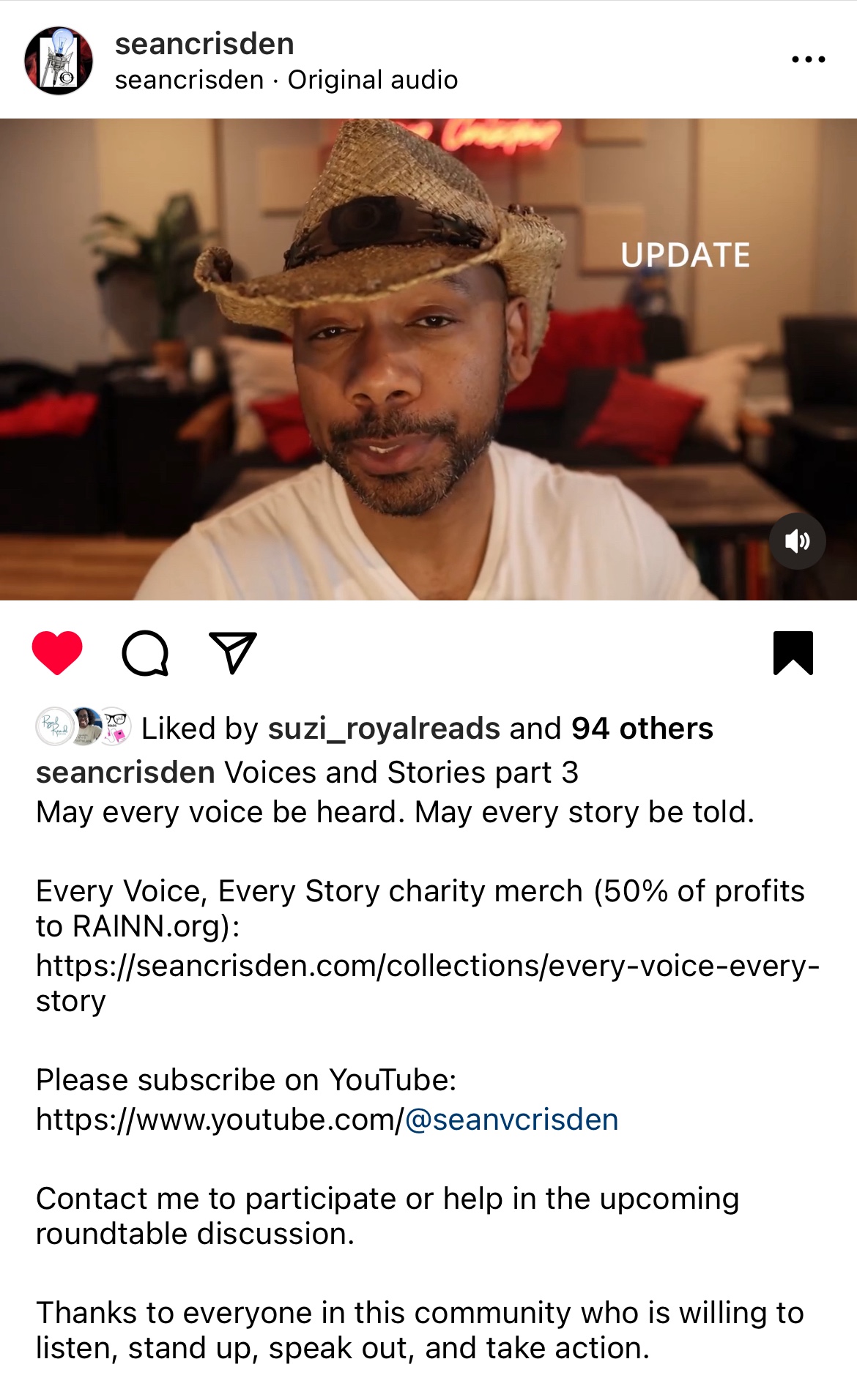
Watch Sean Crisden’s Instagram video here; subscribe to his YouTube channel here. He is preparing a round table discussion, which he specifically states is meant to include a divergence of perspectives. I will try to participate in that.
Watch this heartfelt video by author Cheri Champagne, describing how she is affected by the narrator/producer’s actions, as well as by the backlash against him and his company. The ripples reach far and wide. Thankfully, the community is rallying and hopefully all affected can come through with the least possible damage and trauma.
My dear friends, thank you for tolerating the continuous gushing about my romance immersion, 12 months now and still going strong! This post is about more than just the smut, I promise.
“Only my second MM romance. Captivating. So empathically and compassionately written, descriptions of the intrinsic experiences of mental illness, moral conflict, honest self-exploration and accountability open listeners’ minds and hearts to the depth of our fellow humans’ emotional, spiritual, and relational lives–with self as well as others. Sierra Simone‘s voluminous and passionate love of and attention to history shine so brightly, and her writing is both utterly sophisticated and completely relatable. Again, as in Sinner, social commentary is rendered gently, if clearly. This book could be read/heard and thoroughly enjoyed simply as sexy, contemporary romance. And with just a little more contemplation, its meaning and impact become so clearly and importantly much, much more. Jacob Morgan‘s and Sean Crisden‘s performances move and resonate. Morgan’s accents bring us to Belgium and France with vocal ease. The narrators’ expert acting proves that voice alone is enough to convey all we need to know and feel another’s experience.”
OK SO: Sierra Simone. O.M.G, a QUEEN of language and expression, holy cow! Of all the romance authors whose work I have now consumed (and there are so many more, I will not know them all in this lifetime), her voice stands out, rich and vibrant. “…utterly sophistocated and completely relatable”–maybe I aspire to be so, hence my zealous admiration–because while I cannot think of better words to decribe her work, I know she can.
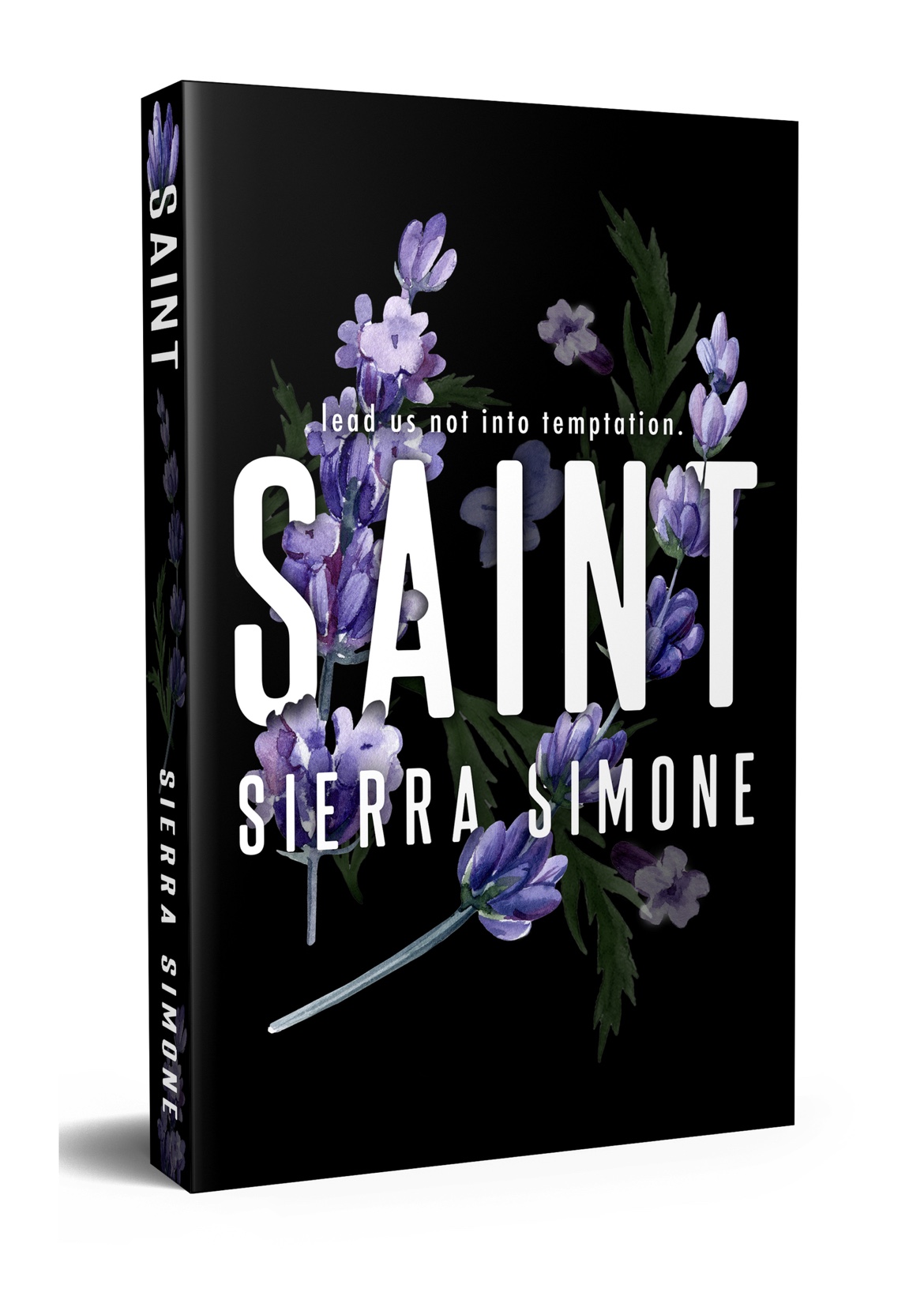
I have now listened to all three full length novels in the Priest Collection and I highly recommend them all. Jacob Morgan narrates with others, and his voice acting is simply superb, so honest and real. Inspired to listen by the Facebook Shaneiaks group live chat with Sierra and Shane East, once again I cannot thank this community enough for broadening my exposure, experience, and insights from fiction! Sierra is known for her explicitly erotic writing, and she describes in the chat how she came to commit, BOOBS OUT you might say, to writing spicy (‘ghost pepper’ level) romance for her own creative fulfillment. It so happens that doing this resonates deeply with readers and listeners everywhere–such a shining example of the far-reaching ripple benefits of open and audacious authenticity. I was moved to tears by Sinner and to deep thought by Saint, to the point of ordering the latter in print to annotate–only the second print romance I own so far.
The thoughts and feelings evoked by these stories almost escape verbalization. Journaling to untangle it all, I could only list the broad topics approached, addressed, probed, and articulated, individually and all intersecting: Racism. Religion. Spirituality. Grief. Blame. Conflict. Paradox. Love. Lust. Intimacy. Self-delusion. Fear. Shame. Communion. Self-love. Self-compassion. Honesty. Reconciliation. Peace. Commitment. Flexibility. AND. Reformation. Relationship, omg: Parental. Fraternal. Platonic. Romantic. Intimate. Carnal. Spiritual. Intellectual. Multidimensional. Eternal. It’s all an intense, existential jumble, yet conveyed wholly and elegantly in a couple hundred pages of writing, through only dialogue and narrative. Amazing.
The Catholic Church. Simone notes at the beginning of Priest: “I spent the majority of my life in the Catholic faith, and while I’m no longer Catholic, I still have the utmost affection and respect for the Catholic Church… That being said, this novel is about a Catholic priest falling in love. There is sex, more sex, and definitely some blasphemy. (The fun kind).” Her attitude toward the church is respectful, even reverent, as she clearly acknowledges its flaws and failures. Her criticism is loving, never disparaging or rude. How would our world be altered if more of us could take this approach to change and justice?
I think I liked Saint in particular because of the courageous and difficult journey Aiden takes toward integration–to know that he may carve a unique and unprecedented path to being wholly devoted to God without sacrificing any part of himself. I wanted so much for him to embrace that infinity loop of polarity navigation–self-acceptance and independence from dogma and wholehearted communal spiritual participation. Simone’s portayal of church leaders, always local and in personal relationship with the heroes, is so empathetic–they exemplify the ideal spiritual leaders and pastors–helping people through their personal conflicts and crises with love, compassion, humility, and non-judgment.
Characters on journeys to becoming their whole selves, loving each other in the process, helping each other self-actualize–is that what moves me? Isn’t that what heals? In the context of a social structure that has so much of its own paradox–such profound benefits of faith and community and also radically high risk for severe dysfunction, omg… Is there an institution other than religion, that harbors such gaping potential for both healing and harm?
Simone shows how to maintain a loving, open perspective, accepting both poles of the Church, by writing how three brothers in one family react to the same trauma (sister sexually assaulted by priest, later dying by suicide)… Her books do not generalize, dehumanize, demonize, or judge anyone or anything in broad strokes. She does not throw anyone or anything away, nor does she dismiss, excuse, minimize, or deflect. The novels don’t necessarily explore deeply–or I should say explicitly? They are not political or sociological commentary at their core. But through the characters’ struggles and stories, we get to consider myriad gray areas and dig, if we wish, patiently and lovingly, into deeper meaning, both collective and individual, shared and private. The characters’ relationships bridge diversity of race, gender, sexuality, and other aspects of humanity; their moments of epiphany, empathy, and connection emerge in gentle starkness, drawing readers/listeners into vicarious, second hand emotional education.
The ancillary characters all play important roles–obvious and blatant in message–necessarily. They remind me of my own role as physician: I get to observe you, my patient, and your life, as a third party. I am not in your life with you, for the most part. I get to stand and walk next to you when you come to me; I witness. I can know you, and you get to control (much of) that. I can only pry so much; you can choose to withhold. And I may still, if I pay attention, see you. Because our relationship is low-stakes and imbalanced (my role is only to survey and advise, much like the mentors, teachers, and pastors in these stories), I have the freedom to speak frankly, objectively, and lovingly… You may receive my advice more openly than from loved ones because of my credentials and the nature of our relationship. What a fascinating and meaningful privilege.
I wonder how people reject these stories–what do they object to, what are the emotions, triggers, rationalizations, and other factors? To me, these stories can be taken as lessons in honesty. Maybe that’s why I love them so much, because honesty is important to me, and barriers to honesty and self-relection can be formidable in the context of such strong, dogmatic social norms as in the Catholic Church, so heavily steeped in ritual, tradition, and institutionalization. Maybe I see these stories as exemplary works for culture change–fiction as vehicle for social movement–duh-HA! Does anyone expect that from romance? It’s unexpected and, I think, deliciously subversive. Such artful integration, BRAVA. More, please.
God bless Sierra Simone and authors everywhere and in all times, who make us think, feel, and connect, to be and do better.









 Healing Through Connection