Practicing the Art of Possibility Since 2009

It’s been 15 years since I attended the second ever Harvard Coaching Conference, where I met Ben Zander and The Art of Possibility changed my life. I reference the book’s concepts and practices regularly on this blog, and have given four copies to friends in the last five months–a spate that catches my attention. With the most recent gift, I was moved to listen again, prepared for yet a deeper, more incisive experience, even after having read and listened countless times already. HA!–this just occurs to me–It may be the very practices from the book that underlie this latest re-exploration. Openness, humility, honesty, creativity, authenticity, and connection–I valued these highly even before 2009, and AofP has reinforced them all repeatedly.

Describing the book to a new friend recently, I focused on the authors’ distinction between our Calculating Self, the one engaged in social norms of measurement, competition, and conventional success, and our Central Self, the honest, inner, relational soul that understands and seeks connection and collaboration that brings deep meaning, joy, and peace. I remember flipping through my print copy sometime last year and thinking wow, I have really internalized these teachings! I pull on the catch phrases often–Give the A, Be a Contribution, Rule #6, The Way Things Are, Be the Board–and the practices they point to guide me daily through circumstances and interactions that would have perturbed me much more a decade ago than they do today. The more I thought about it and spoke to Friend, however, the more I wondered what new and more I’d get out of yet another listen–ready for advanced, deeper practice–because though the slope of the curve may have shallowed, I am definitely still learning; I have Possibility yet to harness!

I feel proud of the work I’ve done to lead with my Central Self. It started before the Harvard conference when I connected with Christine, my life coach, in 2005. At that time coaching was seen as froo-froo fringe activity, as evidenced by the groan and eye roll from my colleague when I mentioned it. So I continued silently after that, learning techniques of open, honest questioning, mind-body query, and honoring peoples’ stories, the unique meaning we each make out of any situation, regardless of how or whether it makes sense to anyone else. I have honed high self-awareness and -regulation of my own stories, appreciating both their partial validity and heavy biases, ready (almost) always to have them challenged, corrected, and nuanced. Showing up from my Central Self, recognizing and lovingly inviting forth others’ Central Selves, has yielded such color, texture, meaning, learning, and connection in my life, that it increasingly defies verbal description. Meeting Lessa Lamb at Readers Take Denver last weekend and feeling this instant resonance, I tried articulating it anyway, and it came out as, “Exponentially Synergistic Cosmic ROCKET FUEL,” which is pretty close!

Now halfway through The Art of Possibility again, the humbling has struck. I am indeed proficient at these skills in multiple domains. I have incorporated the principles seamlessly into patient action plans and public presentations for at least the past ten years, each year more organically and easily. Still, in my most complex and difficult relationships, I have far yet to go. Old narratives and deeply grooved relational patterns stemming from childhood–oh how they persist wih force! Thankfully, I also follow Tara Brach and Kristin Neff, and as my self-compassion grows, so too does my capacity for deeper honesty, acceptance, and advanced inner Possibility work. I vibrate at a high relational frequency, and The Art of Possibility has resonated deeply from the moment I heard the authors speak. The teachings amplify my innate signals of deep human connection, and help me show up increasingly All In, All Me, with courage and conviction, including to the work of the slaying and dissecting my own demons.

–*sigh*–

Part of me regrets not being further along on this self-development journey. I’m already 50 years old, worked with Christine since age 32, and others before her. Even with the turbo boost from The Zanders at age 36 and Simon Sinek, Brene Brown, Adam Grant, and others since, I still swirl at times in patterns of fixation, reactivity, and agitation. The episodes are definitely less frequent, intense, damaging, and prolonged, though, so that’s a win, and I feel my inner peace proficiency accelerating lately.

So, to the practices I return:

The Way Things Are: Be with it all, whatever it is, including how I feel about it. I am competent, maybe even expert, and not yet a master. Learn, practice, train, ad infinitum. Mastery may or may not come; the nature of the work is to persist. I can be at peace with this, with all of it, the way it is, while I work to make it all better.

Give the A: As I do for others, I can give myself grace and compassion for showing up every day to do my best. I see my potential and that of others. I help myself by getting help from others, so that I can help others, all of us together on the journey.

Being a Contribution: Every day, with any and every interaction, I can bring my best self, show up to lift up. It doesn’t have to be big or flashy. Presence, eye contact, listening, reflecting, connecting. People can feel well when they meet me. I can help, and lead by example in this way.

Telling the We Story: This one makes me shiver with Possibility. It’s about seeing us all, every single one of us, as inextricably connected–we all matter to one another and to everything in nature–a complex, adaptive system of systems, the butterfly effect in motion and action. When I remember the We story, rather than feeling overwhelmed, I feel calm, empowered, and purposeful, because just by being a better me, I make the world better.

I hope my friends get as much out of this book as I have, over the last 15 years and for many years to come. The wisdom and application are infinite, as we humans muddle and struggle through our own counterproductive behaviors and conventions. The practices in The Art of Possibility give me the validation, confidence, hope, and conviction to keep sharing, speaking, and loving, every chance I get, even (especially) when it’s hard.

Wishing us all a present, open, kind, and loving week. May we connect meaningfully with our fellow humans, and may that connection both anchor and uplift us all.

Accountability

What does accountability mean to you? How do you hold it, for yourself and others?

OWN. YOUR. SHIT. No more, no less. The more I think of it, the more I also include fairness and nonjudgment in this concept. At its core, accountability is objective, dispassionate. Ironic, then, that its consistent practice plays a central role in building and maintaining trust, that profound, subjective emotion that can move mountains when strong, and yet can be destroyed in a single breath.

We are almost halfway through the month, friends! Listing my own life practices every day feels like a whole lot of repetitive navel gazing–does it resonate at all? Or are you getting supremely bored? I’m loving it personally, as new insights emerge almost as soon as I sit down each evening, and I see so many nascent and intertwined ideas to develop and expand in the book. Do the societal assessments and admonishments feel pedantic? Redundant and preachy? Oh well, I’m working stuff out here–thanks for joining the ride, and feel free to get off and get back on later, it won’t be like this forever! Okay onward:

How do I already do accountability well?
–I take responsibility. After an initial WTF, ‘you suck’ moment in interpersonal conflict, I am quick to self-assess, ask myself the asshole question, apologize if needed, and make repairs. For operational snags at work I trouble shoot with the team and our collaborative root cause analyses are efficient and effective.
–I invite others to own their stuff, gently. Holding someone accountable is not the same as blaming, shaming, or guilt tripping. The objective is not to make someone ‘feel bad’, but rather to acknowledge and address mistakes and course correct going forward.
–I’m able to separate facts from interpretation, most of the time. Even in the most emotionally charged situations, I’m able to reason through and eventually get to reconciliation.

How could I do better?
–It’s hard to put my finger on it…sometimes I’m in such a rush to take responsibility that I get anxious, almost like it’s a race to blame myself before others can do it–is it virtue signaling? I really do believe, in my thinking brain, what I wrote above. True accountability is not about blame. But my feeling brain may still harbor some false unworthiness that I need to work out?
–I think I can do better at upholding accountability around me. It can be a delicate balance of relationship, task, emotional regulation, and other factors… Sometimes it’s not appropriate to do it in real time, rather people (I) need to cool down, find the loving posture, attitude, and words. This risks missing the opportunity. So I can balance commitment with timing?

How does society do accountability well?

Wheels of Justice. They turn, at least sometimes, if slowly, imperfectly, and incompletely. There are tenacious and resilient people all around working to make visible and accountable that which others would sweep under any rug. Their relentless persistence and infinite mindset truly boggle me, and I bow in admiration.

How could we do better?

Transparency. Political campaign funding. Corporate finance and taxes. Pharmaceutical research. Medical billing. Legal loopholes. We can’t hold anyone accountable if we don’t know who’s doing what. Sunlight is the best disinfectant, as they say–it’s at least a partial truth.

Cull the bureaucracy, grow the manpower. So many systems remind me of the Weasleys’ Burrow, a house built of lopsided additions, ricketty stairs, and hoarded artifacts from divergent historical worlds. FDA drug approval and post market safety monitoring, civil and criminal litigation, employee hiring, promotion, and retention–so much red tape and not enough people who understand and can navigate it–people who do good go overworked and unrecognized and those who do harm fly blithely under the radar, all for far longer than serves us. Like individual people, our organizations and institutions need agility, responsiveness, and adaptiveness to operate optimally in the accelerating complexity of our world. Easier said than done, I know.

What else? How does accountability show up effectively in your life? Where do you really need more? I will revisit this; stay tuned.

On Malice, Validation, and the Butterfly Effect

A mash-up quote; still helpful.
Image from https://www.facebook.com/BlessedAreTheWeird/posts/i-like-this-whoever-wrote-itupdate-appears-to-be-a-translation-of-text-from-the-/947443432078922/
Likely sources: https://merrimackvalleyhavurah.wordpress.com/2018/06/23/fake-news-fake-quotes/

Friends, here is my latest confluence of ideas for making a more lovingly connected world, from three articles I have read this month:

Malice

Readers of this blog may know that I’m a big fan of David French. He writes columns for The Atlantic and The Dispatch, and serves the latter as senior editor. He is politically conservative and one of my intellectual role models. Last weekend he posted an article, “A Blow Against the Malice Theory of American Politics,” which I highly recommend. Some highlights:

“Negative polarization (or negative partisanship), as I’ve written many times, is the term for politics that is fundamentally motivated by animosity for the other side more than affection to your own party’s leaders or ideas. 

“Under the malice theory, the key to electoral victory is unlocking that anger. That means highlighting everything wrong with your opponents. That means hyping their alleged mortal threat to the Republic. Because of pre-existing animosity, your message will fall on fertile soil.

“In this context, it’s easy to see how kindness and graciousness are seen as weakness, or at least as a lack of conviction.”

Basically, if we think of our political opponents as a ‘them’, an other, we make them an abstraction. If we paint them with broad brushes in various shades of ‘evil,’ then we make ourselves fundamentally susceptible to tyrants who manupilate that fear and hatred for their own purposes. We follow blindly out of emotional hijack, deluding ourselves that we are being totally rational. The ultimate tool of such tyrants is dehumanization, making ‘the other’ a thing rather than a person, something we could not possibly relate to or care for.

Validation

One potent antidote to dehumanization and malice politics is emotional validation. I found this article while writing Monday’s post on how to be less shitty to one another. If you read any of the essays from this post, read this one! More highlights:

“Emotional validation is the process of learning about, understanding, and expressing acceptance of another person’s emotional experience. Emotional validation is distinguished from emotional invalidation, when a person’s emotional experiences are rejected, ignored, or judged.

“Validating an emotion doesn’t mean that you agree with the other person or that you think their emotional response is warranted. Rather, you demonstrate that you understand what they are feeling without trying to talk them out of or shame them for it.”

When we talk about people on the ‘other’ side of politics from us, what do we say? Do we speak in generalizations? Do we assume nefarious motives, declaring that they are just bad people? Maybe we say we ‘can’t imagine,’ ‘don’t understand’ how anyone would vote the way they do? What assumptions do we make about how they live their lives and how it must be completely different from us? Validation requires us to put down these generalizations and see each other as individuals, humans, people with whom we are in relationship (and we are all in relationship)–to move in closer, as Brene Brown asks us to do. It’s a practice in empathy and ultimately, a neutralizer of negative partisanship.

Why should we validate one another’s emotions? Because it helps us connect, especially across difference. When we feel validated, we let our guard down. When we feel seen, we de-escalate. Then we are more likely and able to engage in discussions, even disagreements, with more openness and curiosity, respect and collaboration. But someone has to take the first step on the path to de-escalation, to lead by example and invitation.

The Butterfly Effect

In my Quirky Nerd post, I mentioned this idea at the end, in passing. I like to include links to interesting ideas, and found the essay on Farnam Street by Shane Parrish and/or his team. Parrish hosts The Knowledge Project, one of my favorite podcasts. Ever since learning about the self-organizing nature of culture, I have felt validated (ha!) and increasingly confident to point out how the impact of any given node in any system both impacts and is impacted by that system–because everything is connected! I define myself as a node, and I am a member of multiple systems at once (we all are). Some systems are nested (family, neighborhood, city, state, nation); some overlap (Chinese-Americans, physicians, working moms). Looking from the most complex and simultaneous perspective, we can then see how the state or movement of any one node may have direct and indirect ripple effects that propagate and eventuate in dramatic multi-systemic change.

Or, it may not. It’s a paradox–anything you and I do can have transformative effects or no effect at all. I wrote about this as the Optimistic Nihilist. From Farnam Street: ” John Gribbin writes in his cult-classic work Deep Simplicity, ‘some systems … are very sensitive to their starting conditions, so that a tiny difference in the initial ‘push’ you give them causes a big difference in where they end up, and there is feedback, so that what a system does affects its own behavior.’

“We like to think we can predict the future and exercise a degree of control over powerful systems such as the weather and the economy. Yet the butterfly effect shows that we cannot. The systems around us are chaotic and entropic, prone to sudden change. For some kinds of systems, we can try to create favorable starting conditions and be mindful of the kinds of catalysts that might act on those conditions – but that’s as far as our power extends. If we think that we can identify every catalyst and control or predict outcomes, we are only setting ourselves up for a fall.”

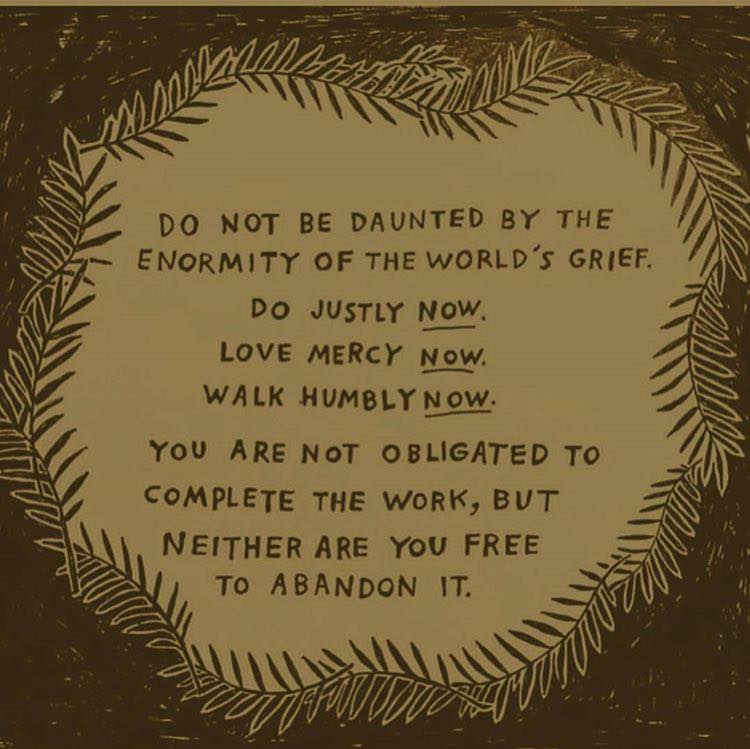
My point here is that when I start to feel too small to make a difference, I just remember my role as node. I may not see the waves that my attitude, words, actions and relationships create in the world. But I believe wholeheartedly that I can and do make a difference–a big one, potentially. I just don’t know exactly which day, which conversation, which post, which relationship will incite the shifts I agitate to make–toward mutual understanding, accpetance, cooperation, and connection. Thus, anything and everything I do matters, so I keep it up. I commit to playing the infinite game of human connection, and my just cause is to de-escalate, defuse, and disarm us, in service of interpersonal peace. But anything I do could not matter at all, so I don’t have to burden myself with perfection and exhaustive hamster wheeling.

It’s a perfectly joyous paradox.

Thanks for reading to the end of this long one, folks. Past the halfway mark of 30 days, woohoooooo! I’m still having a lot of fun, hope you are, too!

Peace out, my peeps—ODOMOBaaT.

https://www.facebook.com/soulsistersmemorial/photos/a.1462513750611588/2068742843322006